Healthy Car Battery Voltage: What Your Readings Mean
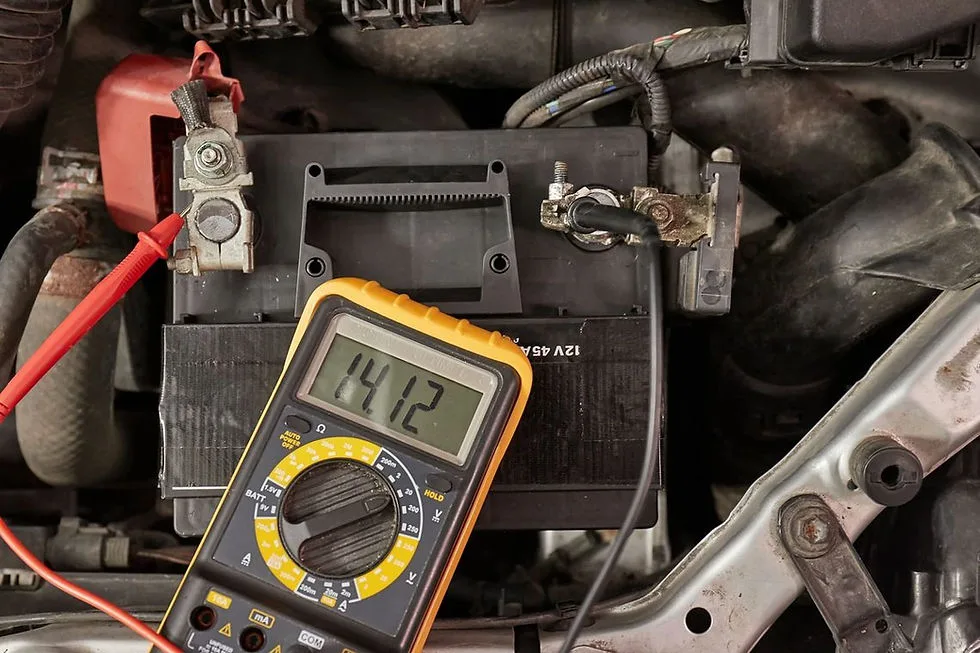
Pop the hood, touch two multimeter probes to the terminals, and you'll get a number. The tricky part is knowing whether that number means your battery is healthy or quietly dying. A healthy car battery voltage sits between 12.6 and 12.8 volts at rest, but that single figure only tells part of the story.
The same battery can read four different "correct" values depending on when and how you measure it.
Per SAE J537 testing standards, a battery isn't judged on resting voltage alone. It also has to hold above roughly 9.6 volts while cranking the engine. In our research, that under-load reading catches far more dying batteries than the resting number ever does.
Here's the quick answer first, then the full picture.
Quick Answer
A healthy car battery voltage is 12.6 to 12.8 volts at rest. That reading applies with the engine off after sitting overnight. With the engine running, expect 13.7 to 14.7 volts.
During cranking, voltage should stay above 9.6 volts. Anything at 12.0 volts or below means the battery needs charging.
Why There's No Single "Healthy" Number (It Depends When You Measure)
If someone tells you "12.6 volts is healthy" and stops there, they've given you a half-answer. A car battery lives in three different electrical states, and each one has its own healthy range. Measure at the wrong moment and a failing battery can look perfect, or a perfect battery can look dead.
Think of it as three separate tests that answer three separate questions:
- Resting voltage (engine off, car rested): How charged is the battery right now?
- Cranking voltage (during engine start): Can the battery still deliver real power under load?
- Running voltage (engine on): Is the alternator recharging the battery properly?
That's the if/then logic this whole article follows. If the resting number is low, you check whether the battery needs a charge or the alternator isn't doing its job. If the resting number looks fine but the car cranks slowly, you test under load.
Each reading rules something in or out.
The reason a 12-volt battery reads 12.6 when healthy comes down to chemistry. Inside the case sit six lead-acid cells wired in series, and each cell produces about 2.1 volts when fully charged. You can see how those plates and cells fit together in our breakdown of what sits under the caps.
Six times 2.1 gives you 12.6, which is why the nominal 12-volt label undersells a healthy battery slightly.
One more wrinkle. Battery chemistry matters too. As of 2026, a growing share of cars on the road run AGM or EFB batteries for stop-start systems, and their healthy resting numbers sit a touch higher than old-school flooded batteries.
We'll cover those separately further down.
Car Battery Voltage Chart: Resting Voltage vs. State of Charge
Resting voltage maps directly to state of charge, which is the percentage of usable energy left in the battery. The relationship is tight enough that Battery Council International publishes reference tables built on it. Here's the standard chart for a flooded 12V lead-acid battery at roughly 70°F (21°C), measured after a proper rest period.
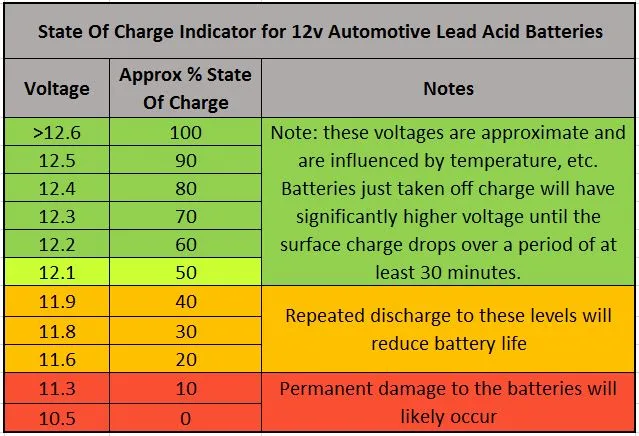
| Resting Voltage | State of Charge | What It Means |
|---|---|---|
| 12.6V or higher | 100% | Healthy and fully charged |
| 12.4V | ~75% | Usable, but charge it soon |
| 12.2V | ~50% | Undercharged, sulfation risk begins |
| 12.0V | ~25% | Heavily discharged, charge immediately |
| 11.9V or lower | Discharged | May not start the car |
| ~10.5V | 0% or dead cell | Likely one failed cell |
Two things jump out from this chart. First, the entire working range spans less than one volt. The gap between "perfect" and "won't start" is tiny, which is why a multimeter reading to two decimal places beats one that shows only one.
Second, 12.4 volts is the trap. It sounds close to 12.6, so most people shrug it off. It actually means a quarter of your capacity is gone.
A battery living at 12.4 volts or below starts growing sulfate crystals on its plates. That process, called sulfation, permanently eats capacity over weeks and months.
The 10.5-volt figure deserves a special mention. If your battery keeps settling around 10.5 volts no matter how long you charge it, one of the six cells has almost certainly died. Each cell contributes 2.1 volts, and 12.6 minus 2.1 lands you right at 10.5.
No charger fixes a dead cell. That battery is done.
Cold skews these numbers slightly downward and heat skews them up. The U.S. Department of Energy notes that lead-acid chemistry slows significantly in cold conditions, which is part of why winter mornings expose weak batteries first.
Temperature effects get their own section below.
Before You Test: The Rest Period and Surface Charge Problem
The single most common voltage-testing mistake happens before the probes ever touch the terminals. If you measure right after driving, you're not reading the battery's true state of charge. You're reading surface charge, a temporary voltage boost sitting on the plates after the alternator has been feeding them.
Surface charge can push a tired battery up to 12.8 or even 13.2 volts. It looks fantastic. Then it bleeds off over a few hours and the same battery settles at 12.2.
If you tested during that inflated window, you'd have called a failing battery healthy.
Here's the if/then for timing your test:
- If the car has sat overnight (or at least 4 to 12 hours with everything off), test away. Your reading is trustworthy.
- If you just drove or charged the battery, burn off the surface charge first. Turn the headlights on for about two minutes, switch them off, wait ten minutes, then test.
- If you only have a minute, test anyway but treat a high reading with suspicion. A low reading after driving is meaningful. A high one might not be.
That asymmetry is worth remembering. Surface charge only lies in one direction. A battery that reads 12.1 volts right after a drive is genuinely in trouble, because it should be reading artificially high at that moment.
A battery that reads 12.7 right after a drive has proven nothing yet.
Also check the basics before blaming the battery. Corroded or loose terminals can drop voltage at the connection point and mimic a weak battery. Give both clamps a wiggle.
If they move by hand, clean and tighten them, then retest.
How to Check Your Battery Voltage With a Multimeter
You need one tool, and it costs about $10 to $25. Any digital multimeter with a DC voltage mode will do this job accurately. You don't need a professional-grade meter for battery checks, though if you're new to meters entirely, our walkthrough for first-time meter owners covers the basics in more depth.
Setting Up the Multimeter Correctly
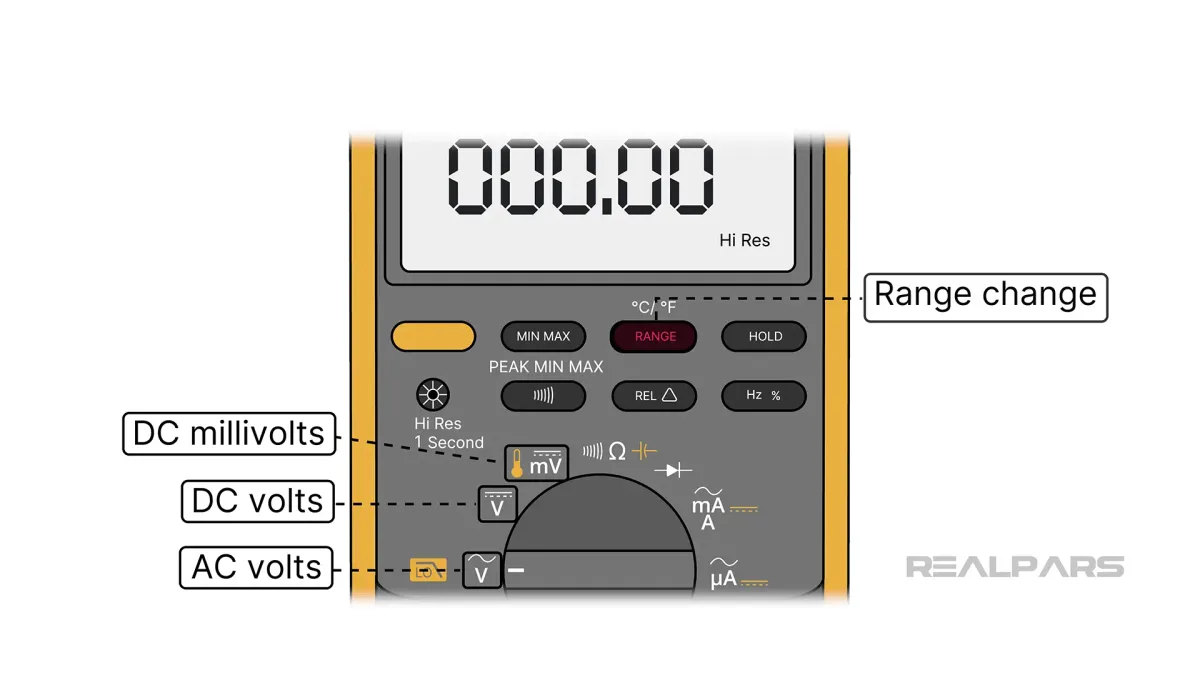
Turn the dial to DC volts. On most meters that's marked with a V and a straight line, sometimes with dashes under it. If yours says DCV, that label works the same way, and we've explained what that dial position does if the markings confuse you.
Do not use the AC setting (V with a wavy line). Car batteries are DC only.
If your meter has manual ranges, pick 20V. That range covers everything a 12V system can show, from a dead battery to an overcharging alternator. Auto-ranging meters figure this out on their own.
Check your lead placement:
- Red lead in the port marked VΩ (voltage and resistance)
- Black lead in the COM port
- Never in the 10A port for a voltage test
If the symbols on your dial look like hieroglyphics, our guide to decoding the dial markings sorts them all out.
Where to Put the Probes
Touch the red probe to the positive (+) terminal and the black probe to the negative (−) terminal. Press firmly onto clean metal, not onto corrosion or plastic covers. The reading appears in a second or two.
Three quick tips for a trustworthy number:
- Probe the battery posts themselves, not the cable clamps. This bypasses any corrosion hiding between clamp and post.
- If you see a negative number like −12.6, your probes are swapped. The magnitude is still correct. Just flip them.
- Take the reading twice, a few seconds apart. They should match within a hundredth or two.
Write the number down. Seriously. You'll compare it against the cranking and running readings next, and the pattern across all three numbers is what delivers the verdict.
If the display itself is throwing you off, here's how to make sense of the readout before you move on.
Reading #1: Resting Voltage and What Your Number Means
Your resting reading sorts the battery into one of four zones. Each zone has its own next step, so find your number below and follow the branch that matches.
12.6V or Higher: Healthy and Fully Charged
A rested reading of 12.6 to 12.8 volts means the battery is fully charged. That's the green zone for a flooded battery. Nothing to fix here.
One caveat before you celebrate. A full charge is not the same as full health. An old battery with shrunken capacity can still charge to 12.6 volts, then collapse the moment the starter demands 150 amps.
If your car cranks slowly despite a good resting number, skip ahead to the cranking test. That's where weak-but-charged batteries get exposed.
12.4V: The Sneaky "Looks Fine" Zone
At 12.4 volts you've got roughly 75% charge, and that missing quarter matters more than it sounds. The car will still start fine, so nothing feels wrong. Meanwhile sulfation is quietly hardening on the plates.
The if/then is simple. If you read 12.4, put the battery on a charger within a day or two, then investigate why it wasn't full. Short trips, a weak alternator, or a small parasitic drain are the usual suspects.
A healthy charging system should not leave a battery at 75% overnight.
12.0 to 12.2V: Discharged and at Risk of Sulfation
This range means half your charge or more is gone, and the battery is actively degrading while it sits there. Charge it now, not this weekend. Every day spent below 12.4 volts makes more of the capacity loss permanent.
After a full charge, let it rest overnight and retest. If it holds 12.6, the battery survived and your job shifts to finding the drain. If it settles back into the low 12s with nothing connected, the battery itself is losing its grip.
Below 11.9V: Deeply Discharged or a Dead Cell
Under 11.9 volts the battery is functionally empty, and under about 10.8 it probably won't turn the starter at all. A reading parked stubbornly near 10.5 volts after charging points to a dead cell, which no charger can revive.
Deep discharge is survivable once, maybe twice, for a standard starting battery. These batteries are built with thin plates for burst power, not deep cycling. Each full drain steals a chunk of lifespan, and our lifespan expectations guide explains why a deeply drained battery rarely returns to full strength.
Reading #2: Cranking Voltage, the Test That Actually Catches Dying Batteries
Cranking voltage should stay above 9.6 volts while the starter spins, measured at around 70°F. That threshold comes from SAE International testing standards, and it's the single most revealing number in this entire process. Resting voltage measures charge.
Cranking voltage measures strength.
Here's how to capture it. Set your multimeter to DC volts and connect it across the battery posts. If your meter has a MIN/MAX function, activate it.
Have a helper start the engine while you watch the display. The lowest number during the crank is your result.
Interpret it with this branch logic:
- Above 9.6V and the car starts crisply: the battery delivers power under load. Healthy.
- 9.6V to 10.5V with slow cranking: borderline. Charge fully and retest. If it repeats, the battery is fading.
- Below 9.6V: the battery cannot back up its resting voltage with real current. Plan a replacement.
- Drops toward 6V or lower: severely weak battery or a high-resistance connection. Check terminals first, then condemn the battery.
This test works because cranking demands enormous current, often 100 to 200 amps for a typical engine. Delivering that burst is exactly what the cold cranking amps rating promises on the label. A sulfated or aging battery can't move that much current, so its voltage caves under the load even when its resting number looked respectable.
Cold weather tightens the margin. A battery that dips to 9.8 volts on a mild afternoon may plunge below 9.6 on a freezing morning. If your borderline reading happens in summer, treat it as a fall warning, not a pass.
Reading #3: Running Voltage, Testing the Alternator Instead of the Battery
With the engine running, a reading between 13.7 and 14.7 volts means the charging system is healthy. Notice what changed. You're no longer testing the battery at all.
The alternator now controls the voltage you see at the terminals.
Take this reading twice. First at idle with accessories off. Then at about 2,000 rpm with the headlights, blower fan, and rear defroster all on.
A healthy system holds the voltage inside the window in both conditions, though it may dip briefly when loads first switch on.
13.7 to 14.7V: The Charging System Is Doing Its Job
Anything in this window means the alternator and voltage regulator are replenishing the battery correctly. Some vehicles with smart charging systems will wander within this range on purpose, dropping output when the battery is full. A reading of 13.6 at idle on a modern car with a fully charged battery is usually fine.
Under 13.2V or Over 15V: When the Alternator Is the Real Problem
Below about 13.2 volts while running, the alternator isn't keeping up, and the battery is slowly starving. This is how good batteries get wrongly condemned. The battery tests weak because it never receives a full charge, so it gets replaced, and the new one dies six months later from the same starving alternator.
Above 15 volts is the opposite failure. A stuck voltage regulator is overcharging, which overheats the battery, boils electrolyte in flooded designs, and can damage sensitive electronics. Both conditions send you to the alternator, not the battery aisle.
Quick reference for the running test:
| Running Voltage | Verdict | Next Step |
|---|---|---|
| 13.7 to 14.7V | Charging normally | Nothing needed |
| 13.2 to 13.6V | Marginal | Retest at 2,000 rpm with loads on |
| Below 13.2V | Undercharging | Test alternator and belt |
| Above 15V | Overcharging | Replace regulator or alternator soon |
AGM, EFB, and Stop-Start Batteries: Why Their Healthy Numbers Run Higher
If your car has automatic stop-start, your healthy resting range shifts upward to roughly 12.8 to 13.0 volts. That's because AGM construction holds its electrolyte in fiberglass mats pressed against the plates, which changes the chemistry's resting behavior slightly. We've covered how that mat design works in detail if you want the full picture.

Judge an AGM by flooded-battery numbers and you'll misread it. An AGM resting at 12.5 volts sounds nearly full on the standard chart. By AGM standards it's closer to 75% and due for a charge.
Shift every threshold up about 0.2 volts and the earlier chart still works.
EFB batteries split the difference. They're an upgraded flooded design built for entry-level stop-start systems, and they rest close to standard flooded numbers, maybe a hair higher. Our explainer on this enhanced flooded design covers where they fit.
Check your battery label: AGM and EFB are printed clearly on modern units.
Two extra rules for these batteries:
- Charging voltage is stricter. Most AGM manufacturers cap charging around 14.6 to 14.8 volts. A charger without an AGM mode can quietly cook one.
- Replacement must match. Stop-start cars expect the battery type they shipped with. Swapping an AGM for a cheaper flooded unit leads to early failure, and many cars also need the new battery registered to the body computer. Our rundown of the main chemistry options helps you match correctly.
Low Voltage? Your Decision Path: Recharge, Load Test, or Replace
A low reading is a symptom, not a verdict. The decision tree below turns your numbers into an action, and it saves people from buying batteries they don't need.
When a Recharge-and-Retest Is Worth Trying
If the battery is under four years old and simply read low, always charge before condemning it. Use a smart charger, bring it to full, then let it rest overnight and retest. A battery that holds 12.6 volts after resting, and then passes the cranking test, was just discharged.
Something drained it, and that's your real problem to chase.
If it charges "full" but settles at 12.4 or lower by morning with nothing connected, it can no longer hold charge. That's internal failure, and no amount of recharging changes the outcome.
When to Get a Free Load Test at the Parts Store
If your readings are borderline or contradictory, get a professional test before spending money. Most major auto parts stores in the US run free conductance tests, the handheld kind that measures internal resistance and estimates capacity in seconds. It catches weak batteries that still post decent voltage.
Bring the battery fully charged if you can. Conductance testers are less accurate on deeply discharged batteries and may report "charge and retest" instead of a verdict.
When the Battery Is Done, No Matter What the Voltage Says
Some situations end in replacement regardless of a pretty resting number. If any of these apply, stop testing and start shopping:
- A cell reading near 10.5 volts after a full charge
- A swollen, cracked, or leaking case
- Repeated deep discharges within a few months
- Age past five years with any slow-cranking symptoms
- Failing the cranking test twice with clean, tight terminals
When you do replace it, match the group size, chemistry, and rating your vehicle calls for. Getting the right physical fit matters as much as the voltage specs.
What Drains a Healthy Battery: Parasitic Draw, Short Trips, and Sitting Idle
If your battery keeps testing low but passes every health check, something is draining it or undercharging it. Three culprits cover almost every case.
Parasitic draw is current leaking out while the car sleeps. Every modern car pulls a little to keep modules and memory alive, but the healthy target is under about 50 milliamps once everything powers down. Dash cams, aftermarket alarms, stuck glovebox lights, and faulty modules can pull ten times that.
At 500 milliamps, a healthy battery can drop below starting voltage in under a week.
Short trips starve the battery instead of draining it. Starting the engine costs a real chunk of charge, and a five-minute drive doesn't pay it back. String together weeks of school runs and errands and the resting voltage slides from 12.6 to 12.4 to 12.2 without a single fault anywhere.
Sitting idle combines both problems. A parked car loses charge to parasitic draw plus natural self-discharge. In our research, a typical modern vehicle left untouched drops meaningfully within three to four weeks.
If a car sits longer than that, a smart maintainer (a regulated float charger) holds the battery at full without overcharging.
The if/then: if your battery tests healthy after charging but reads low again within days, measure parasitic draw. If it only sags over weeks of short-trip driving, take a 30-minute highway drive weekly or use a maintainer.
Temperature Matters: Cold Mornings, Hot Climates, and Your Readings
Temperature bends every number in this article. The reference readings assume roughly 70°F, and real driveways rarely cooperate.
Cold slows the chemical reaction inside the battery. At freezing, a battery delivers noticeably less current, and at 0°F it can lose 30 to 50% of its available cranking power. Meanwhile the engine needs more power to turn, since its oil has thickened.
That squeeze from both sides is why weak batteries die on the first truly cold morning, not in September when they started fading.
Cold also nudges resting voltage down slightly. A healthy battery might read 12.5 on a freezing morning and be perfectly fine. Don't condemn a battery on a cold reading alone.
Bring it to room temperature or judge it by the cranking test instead.
Heat is the quieter killer. High underhood temperatures speed up grid corrosion and water loss inside the battery, which is why batteries in Phoenix or Las Vegas often fail in three years while the same model lasts five or six in Minnesota. Worse, hot-climate failures tend to arrive suddenly, with little slow-cranking warning.
Our expected-lifespan-by-climate breakdown shows how sharp that regional gap gets.
Practical rules by season:
- Fall: test before the first freeze. A borderline September battery is a December no-start.
- Summer in hot climates: test at each oil change once the battery passes age three.
- Winter reading low? Retest warm before buying anything.
Mistakes That Lead to Replacing a Perfectly Good Battery
Plenty of healthy batteries get scrapped over avoidable testing errors. These are the ones that cost people real money.
- Testing right after a drive. Surface charge inflates the number, and a jump-started car shows alternator voltage, not battery health. Rest first.
- Blaming the battery for an alternator problem. If running voltage sits below 13.2, the battery is a victim. Replace it without fixing the alternator and the new one dies the same slow death.
- Ignoring the terminals. Corrosion between post and clamp can mimic a dead battery entirely. Clean both mating surfaces before trusting any reading.
- Reading a discharged battery as a dead battery. A battery at 11.8 volts might be ruined, or it might just need a charge after a dome light stayed on. Charge and retest before condemning it.
- Using the wrong meter mode. AC volts, resistance mode, or a mis-set range gives nonsense numbers. Confirm you're on DC volts before probing.
- Judging an AGM by flooded numbers. A 12.5-volt AGM is due for charging, not "basically full."
- Trusting one reading. A single number is a snapshot. The resting, cranking, and running trio together is the diagnosis.
The pattern behind most of these is the same. Voltage tells you the battery's state at one moment, and the mistake is treating that moment as the whole story.
Safety Basics Before You Touch the Terminals
A voltage test is low-risk, but the battery itself deserves respect. Lead-acid batteries vent hydrogen gas while charging, and hydrogen ignites from a single spark. Keep flames, cigarettes, and spark sources away, and never lean your face directly over the battery while testing or jumping.
The electrolyte inside is diluted sulfuric acid. Wear eye protection if you're cleaning corrosion or handling the battery, and wash immediately if any white or greenish crust touches skin. That fuzzy buildup on terminals is corrosive too, not just ugly.
A few non-negotiables:
- Disconnect negative first, reconnect negative last. This prevents a short if your wrench touches the body while on the positive terminal.
- Never lay metal tools across the battery. A wrench bridging both posts becomes an instant arc welder.
- Remove metal jewelry before working near the terminals.
- Jump-start in the right order. Positive to positive first, then the final negative clamp goes to bare engine metal on the dead car, not the battery post.
- Recycle old batteries. US retailers accept them, and most states build a refundable core charge into every purchase.
The 12-volt system won't shock you through dry skin. The real hazards are current, acid, and gas, not voltage.
Frequently Asked Questions
Is 12.4 volts OK for a car battery?
It's acceptable but not healthy long-term. At 12.4 volts the battery holds about 75% charge, and sulfation starts building below that level. The car will start fine, but you should charge the battery soon and figure out why it isn't reaching a full 12.6 volts.
What voltage is too low for a car battery?
Below 11.9 volts at rest, the battery is effectively discharged and may not start the car. Under cranking load, anything below 9.6 volts signals a failing battery. A battery stuck near 10.5 volts after a full charge almost always has a dead cell and needs replacement.
Why does my battery read 12.6 volts but the car won't start?
Voltage without current delivery means the battery can't perform under load, or the problem lies elsewhere. Run the cranking test to check for voltage collapse. Also inspect terminal corrosion, the starter, and ground connections.
A resting reading only proves charge level, never cranking strength.
What should battery voltage be with the engine running?
Between 13.7 and 14.7 volts at the battery terminals. That range shows the alternator charging properly. Below 13.2 volts points to an undercharging alternator or slipping belt.
Above 15 volts means the regulator is overcharging, which damages the battery and electronics. Both need prompt attention.
How many volts does it take to start a car?
Most cars need the battery above roughly 11.8 volts at rest to crank reliably, and voltage must stay above about 9.6 volts during the crank itself. Cold weather raises the bar, since the engine turns harder and the battery delivers less current at low temperatures.
Do AGM batteries have a different healthy voltage?
Yes. A fully charged AGM rests around 12.8 to 13.0 volts, roughly 0.2 volts higher than flooded batteries. Judge an AGM by flooded numbers and you'll overestimate its charge.
AGM charging is also stricter, topping out near 14.8 volts on most manufacturer specs.
Your 5-Minute Battery Verdict: The Full Decision Flow
Here's the whole process, condensed into one pass you can run in a driveway.
- Rest the car overnight, or burn off surface charge with two minutes of headlights.
- Read resting voltage. 12.6V or higher, continue. 12.0 to 12.5V, charge fully and retest. Below 11.9V, charge, then load test.
- Run the cranking test. Stays above 9.6V, the battery is strong. Dips below, replace it.
- Check running voltage. 13.7 to 14.7V, the alternator is fine. Outside that window, fix the charging system before blaming the battery.
- Still unsure? Get a free conductance test at a parts store with the battery fully charged.
Three numbers, five minutes, one clear verdict. That's the difference between guessing at the parts counter and knowing exactly what your battery needs.

Similar Posts