Alternator Output Voltage: What’s Normal & Healthy
Alternator trouble usually shows up as a dim dash light, a slow crank, or a battery that keeps going flat. So knowing what should alternator output voltage be is one of the fastest ways to catch a charging problem before it strands you. The right number lives in a narrow band, and reading it takes about two minutes with a cheap meter.
Here's the short version. A healthy charging system on a running engine sits at roughly 13.8 to 14.4 volts, per common OEM charging specs as of 2026. Anything far below or above that hints at a fault worth chasing.
Let's start with the quick answer, then unpack why the "right" voltage shifts with temperature, load, and the type of alternator under your hood.

What Should Alternator Output Voltage Be? The Quick Answer
Alternator output voltage should read about 13.8 to 14.4 volts with the engine running. Measure it right at the battery terminals with a multimeter. A resting battery, engine off, sits near 12.6 volts.
Below 13.0 volts running usually means undercharging. Above 15.0 volts sustained points to overcharging or a bad regulator.
Why There's No Single "Correct" Voltage Number
The honest answer is that "correct" moves around. Your voltage regulator doesn't aim for one fixed figure. It targets a set point that shifts with battery temperature, engine load, and how charged the battery already is.
Think of it like a thermostat for electricity. On a cold morning, the regulator pushes higher voltage to force charge into a sluggish battery. Once everything warms up and the battery fills, it eases back.
That's normal behavior, not a fault.

Three things swing the reading the most:
- Battery temperature: colder means higher target voltage, hotter means lower.
- State of charge: a nearly full battery gets a gentler charge than a drained one.
- Electrical load: headlights, blower fan, and rear defrost all pull the number around.
So if two people test the same car an hour apart and get 14.5 and 13.7 volts, both can be fine. What matters is whether the reading fits the conditions. That's the whole reason a flat "it should be 14 volts" answer trips people up.
The Healthy Voltage Ranges (Engine Off, Idle, and Under Load)
The clearest way to judge your charging system is to read it in three states. Each one tells you something different. Together they paint the full picture.
Resting Battery Voltage With the Engine Off
A healthy 12V battery at rest reads about 12.6 volts. Let the car sit for an hour first, since a fresh drive leaves a "surface charge" that reads high. State-of-charge references from the trade group Battery Council International line up closely with this scale.
| State of charge | Resting voltage (engine off) |
|---|---|
| 100% | 12.6 to 12.8 V |
| 75% | ~12.4 V |
| 50% | ~12.2 V |
| 25% | ~12.0 V |
| Discharged | 11.9 V or below |
If your resting number sits low, charge the battery before you blame the alternator. A weak battery skews every test that follows. When a full charge still won't hold, that points at a battery losing its grip, not the charging system.
Charging Voltage at Idle and Cruising
Start the engine and the number should jump to roughly 13.8 to 14.4 volts. At idle it may sit at the lower end, especially with the AC and lights on. Bring the revs up to around 1,500 to 2,000 RPM and it should hold steady or climb slightly.
If the voltage barely rises above resting, the alternator isn't pulling its weight. And if you've wondered whether a running engine actually tops off the battery, the answer depends on this reading holding above 13.8 volts.
What Changes on Cold Mornings vs. a Hot Engine Bay
Cold weather pushes the regulator harder. On a freezing morning, seeing 14.6 to 14.8 volts for the first few minutes is normal. The system is working to wake a cold, stiff battery.
A hot engine bay does the opposite. Once things heat up and the battery is full, the voltage can settle toward 13.5 volts. That drop isn't a failure.
It's temperature compensation doing its job. This same cold behavior is one reason engines drag or refuse to fire in freezing weather when the battery is already tired.
Smart Charging Alternators: Why 12.5V to 15V Can Be Normal
Here's where a lot of DIY diagnoses go sideways. Many cars built in the last 15 years use a smart charging system, where the ECU controls the alternator instead of a simple fixed regulator. On these, the voltage swings on purpose.
You might see 12.5 volts one minute and 15.0 volts the next. That's by design. The computer eases off charging when it can, to cut drag on the engine and save fuel.
Then it ramps up when the battery needs it or when you lift off the throttle.
So if your reading bounces around, don't panic. On a smart-charging car, a swinging number is healthy. A dead-flat 14.2 volts that never moves can actually be the odd one out.
A few signs you're dealing with a smart alternator:
- Voltage that drifts between roughly 12.5 and 15.0 volts as you drive.
- A brief voltage dip right after a cold start, then a rise.
- A stop-start system, or an AGM/EFB battery from the factory.
To read these properly, watch the trend over a few minutes rather than one snapshot. Better yet, check live data through an OBD-II scanner, which shows the target the ECU is actually asking for.
How to Read Your Charging Voltage With a Multimeter
Testing charging voltage is a two-minute job, and a basic digital multimeter is all you need. You don't need a shop or a scan tool for the core reading. If you want the full walkthrough, our guide on checking the alternator with a handheld meter covers every step.
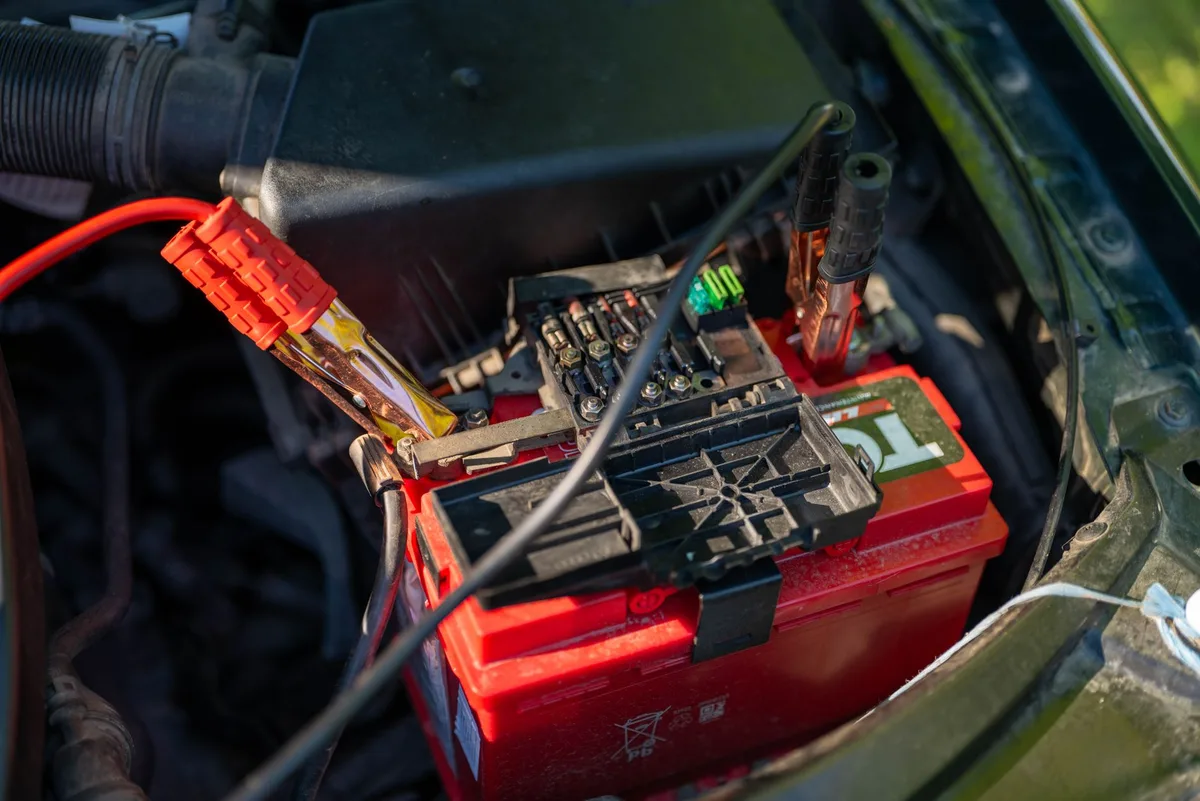
Set your meter to DC volts, on the 20V range if it isn't auto-ranging. Then follow the sequence below.
Where to Put the Probes: Battery Terminals vs. the B+ Post
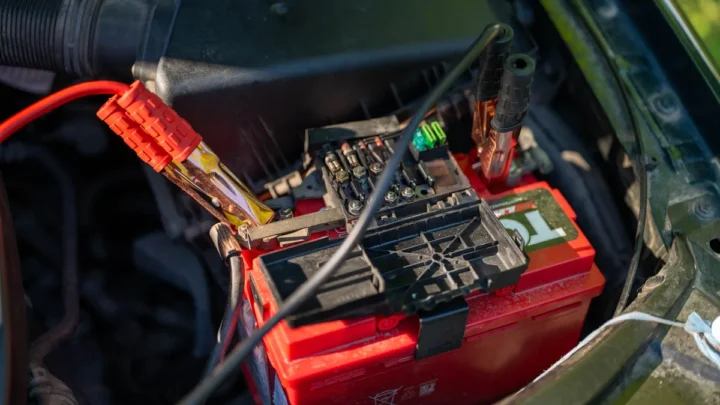
Touch the red probe to the battery positive post and the black probe to the negative post. This gives you the voltage the battery actually sees, which is what keeps your car charged.
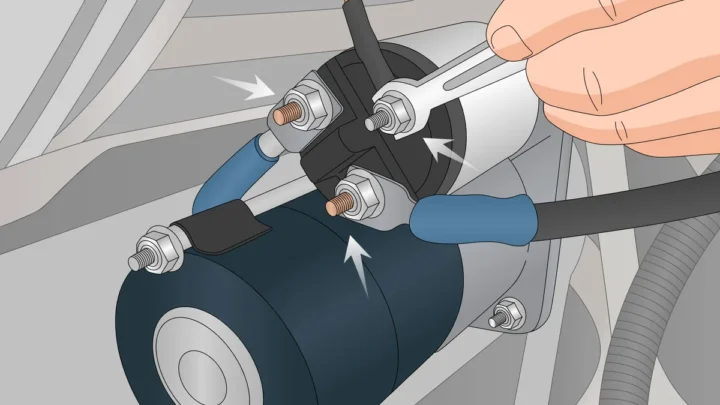
For a second reading, move the red probe to the alternator's B+ output post, the thick cable stud on the back. Compare the two. A gap larger than about 0.5 volts between the alternator and the battery points to voltage drop in the cable or a bad connection, not a weak alternator.
Testing With No Load, Then With Everything On
Run the test in two stages so you can see how the system holds up:
- Engine running, everything off. Note the no-load voltage (expect ~13.8 to 14.4 V).
- Switch on the headlights, high-beam, blower fan, and rear defrost.
- Read again. A small dip is fine. The number should still hold above 13.0 volts.
If the voltage collapses under load, the alternator can't keep up with demand. If it climbs past 15.0 volts, suspect the regulator. A car battery is safe to probe, and you won't hurt a decent meter testing it as long as you're on the DC volts setting.
Reading the Results: Undercharging, Normal, or Overcharging
Once you have your numbers, sorting them is simple. Your running voltage falls into one of three buckets. Each points you toward a different fix.
Signs of Undercharging (Below 13V Running)
If the engine's running and you're seeing under 13.0 volts, the battery isn't getting fed. Watch for dim headlights, a slow crank, and a battery warning light on the dash. Electronics may act glitchy or reset.
Common culprits include a worn alternator, a slipping or glazed serpentine belt, or a failing voltage regulator. A corroded ground strap can do it too. And if the charging light glows but the battery still goes flat, the wiring between the two often takes the blame.
Signs of Overcharging (Above 15V Sustained)
Sustained voltage above 15.0 volts is the dangerous one. Overcharging cooks the battery. You may notice a rotten-egg smell, a swollen case, or the battery running hot after a drive.
The usual cause is a failed voltage regulator stuck at full output. Left alone, it boils off electrolyte and shortens battery life fast. Kill the overcharge before it destroys a good battery.
That smell in particular is a red flag worth tracking down quickly.
The Voltage Drop Test That Catches Hidden Charging Faults
A voltage drop test finds the faults a simple voltage reading misses. Your alternator can push a perfect 14.2 volts and the battery still starves, all because of resistance in the cables or connections. This test measures that lost voltage directly.
Here's the fast version, done with the engine running and some load on:
- Positive side: red probe on the alternator B+ post, black probe on the battery positive. You want under 0.3 volts.
- Ground side: red probe on the battery negative, black probe on the alternator case. Again, under 0.3 volts.
Anything above roughly 0.5 volts means trouble. That's a corroded terminal, a loose stud, or a tired cable eating your charge. Clean the connection or replace the cable, then retest.
A poor engine-to-body ground is a frequent hidden offender, and a meter can pinpoint a bad ground in minutes.
AC Ripple: The Failing-Diode Check Most People Skip
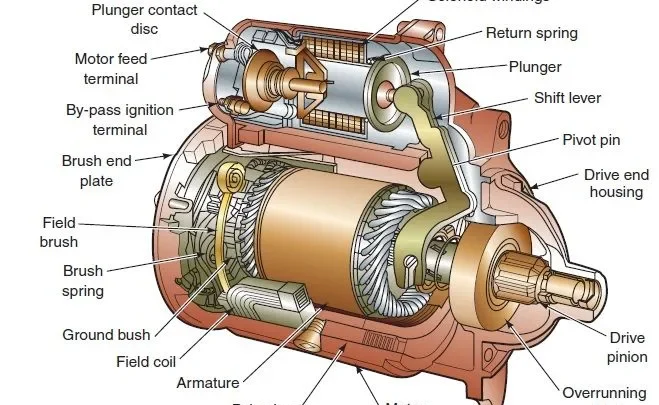
AC ripple tells you if the alternator's diodes are dying, and most people never test for it. An alternator makes AC internally, then a diode rectifier bridge converts it to DC. When a diode fails, raw AC leaks through and rides on top of your DC voltage.
Testing it is quick. Switch your multimeter to AC volts, engine running. Probe the battery terminals like a normal voltage check.
You want to see under 0.05 volts AC, or 50 millivolts. Anything higher, say 0.1 volts or more, points to one or more bad diodes. Bad diodes cause flickering lights, odd electrical gremlins, and slow charging even when DC voltage looks fine.
It's a cheap check that saves you from swapping the wrong part.
Battery Problem or Alternator Problem? How to Tell Them Apart
The classic question: is it the battery or the alternator? Your voltage readings answer it faster than guesswork. Run this simple logic.
| Test | Battery fault | Alternator fault |
|---|---|---|
| Rest voltage (engine off) | Low, under 12.4 V | Normal, ~12.6 V |
| Voltage after full charge | Won't hold, drops fast | Holds fine |
| Running voltage | Normal 13.8 to 14.4 V | Low or wild |
| Crank behavior | Slow, then fine once running | Fine at first, dies later |
If the car starts strong but slowly dies as you drive, the alternator isn't charging. If it struggles to crank after sitting overnight but drives fine, suspect the battery. A new battery that keeps dying overnight often points to a parasitic drain instead of either part.
Hunting that down with a meter is its own quick drain-tracing job.
Common Mistakes That Lead to a Wrong Diagnosis
Most bad diagnoses come from a handful of avoidable slip-ups. Get past these and your readings will actually mean something.
- Testing on a surface charge: a battery reads high right after driving. Let it rest before judging rest voltage.
- Ignoring smart charging: a swinging 12.5 to 15.0 volts is normal on modern cars, not a fault.
- Reading only at idle: check at 1,500 RPM and under load, not just idle with everything off.
- Trusting a weak battery: a half-dead battery skews every charging test. Charge it first.
- Wrong meter setting: DC volts for charging, AC volts for ripple. Mixing them up gives nonsense.
One more trap: blaming the alternator when the real fault is a loose ground or a corroded terminal. That's exactly what the voltage drop test catches. Slow down, test in order, and you'll land on the right part the first time.
Safety Steps Before You Test Anything Near the Battery
A car battery is safe to probe, but it deserves respect. It stores serious current and vents hydrogen gas, which is flammable. A stray spark near the top is the last thing you want.
Keep these habits every time:
- No sparks or flames near the battery, and no smoking.
- Wear eye protection. Battery acid blinds.
- Never let a wrench or probe bridge the B+ post to ground.
- Don't disconnect the battery while the engine runs. The voltage spike can fry electronics.
If you're charging rather than testing, ventilation matters just as much. Our notes on charging a battery inside safely cover the airflow basics worth following.

Similar Posts