How to Test a Car Battery With a Multimeter
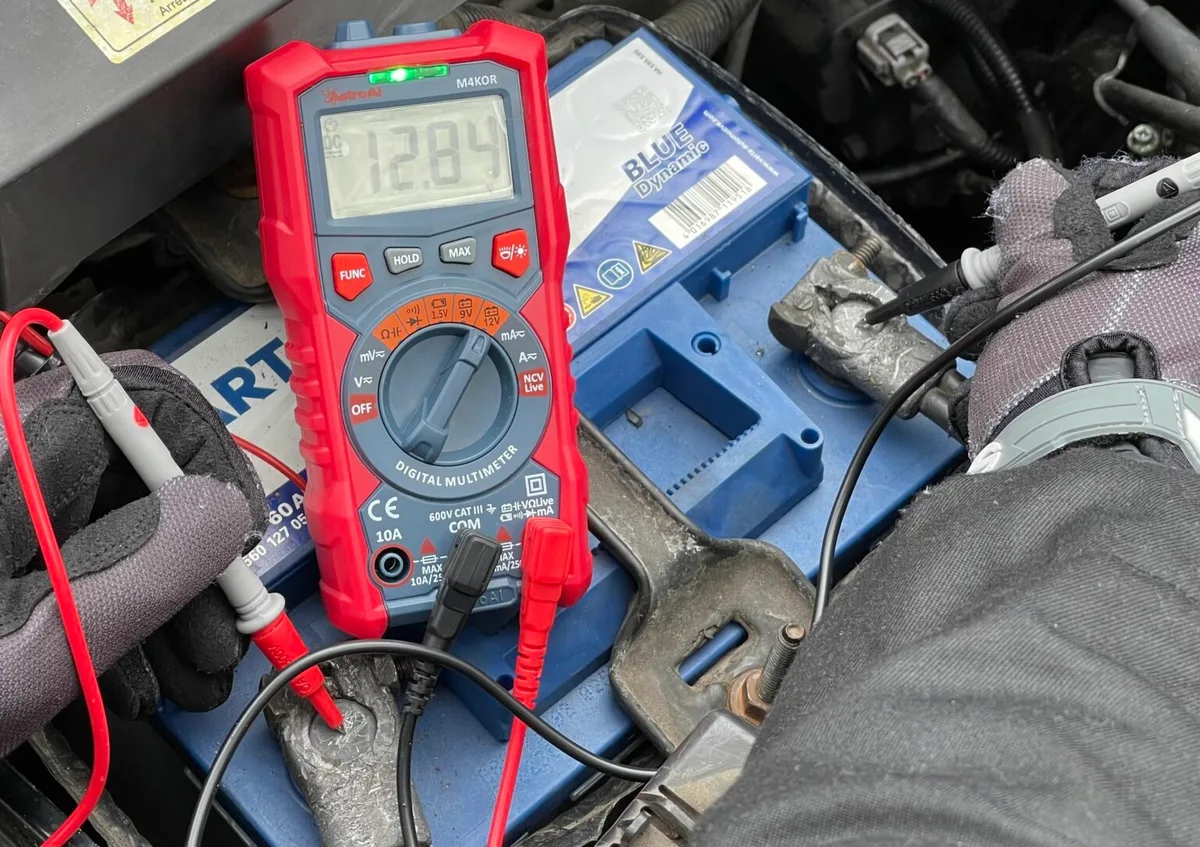
Your car cranks slower than it used to, or maybe it just clicked at you this morning. A multimeter car battery test tells you in about five minutes whether the battery is the problem, or whether something else is draining it. No shop visit, no guessing, no buying a battery you didn't need.
The whole test hinges on a few known numbers. A healthy 12V battery reads 12.6 volts or higher at rest, and the charging system should push 13.7 to 14.7 volts with the engine running. Per SAE J537 battery testing standards, voltage under specific conditions is the fastest window into battery health.
Here's why this cheap little tool is worth trusting.
Why a $20 Multimeter Beats Guessing When Your Car Won't Start
A no-start has three usual suspects: the battery, the alternator, or something drawing power overnight. They all produce the same symptom, a car that won't turn over. Replacing parts until it starts is the expensive way to find out which one it was.
A basic digital multimeter costs $15 to $30 as of 2026. A replacement battery runs $120 to $280, with AGM units at the top of that range. Spend five minutes with the meter and you'll know which repair you actually need before spending a dime.
The workflow is simple if/then logic. If resting voltage is low, you charge and re-test. If cranking voltage collapses, the battery is weak.
If running voltage is low, the alternator is the problem, not the battery. Each reading points you down a different branch, and we'll walk every one of them.
One more advantage: the skill transfers. The same test works on motorcycle, lawn tractor, boat, and RV batteries. Learn it once and you'll use it for years.
The Quick Answer: What Your Battery Voltage Should Read
A multimeter car battery test checks voltage at the battery posts. Set the meter to DC volts. A healthy battery reads 12.6 volts or higher at rest.
It should stay above 9.6 volts while cranking. With the engine running, expect 13.7 to 14.7 volts.
Those three numbers cover the three core tests. Resting voltage shows state of charge. Cranking voltage shows whether the battery can perform under load.
Running voltage shows whether the alternator is recharging it. If you want the deeper story on why the "12V" label actually means 12.6, we've broken down the real voltage range in a separate guide.
What a Multimeter Can (and Can't) Tell You About Your Battery
A multimeter measures voltage, which tells you state of charge: how full the battery is right now. That's genuinely useful. It catches discharged batteries, dead cells, undercharging alternators, and parasitic drains.
What it can't measure directly is state of health: how much capacity the battery has left. A worn-out battery can sit at a perfect 12.6 volts with no load, then collapse the moment the starter asks for 150+ amps. That's why the cranking test in Step 2 matters so much.
Voltage alone is only half the diagnosis.
A multimeter also can't verify cold cranking amps. If you're wondering what that rating means for winter starts, here's what that spec measures in plain terms. Testing actual CCA takes a conductance tester or a carbon-pile load tester, the kind auto parts stores use for free.
The Battery Council International publishes the group size and rating standards those testers reference.
Here's the honest framing:
- Multimeter catches: low charge, dead cells, alternator faults, overnight drains
- Multimeter misses: exact remaining capacity, true CCA output, early internal corrosion
- The fix: run the cranking test, and escalate to a load test when readings look fine but symptoms persist
Knowing how the plates and acid inside actually make power, which we cover in our plain-English explainer, makes these limits easier to understand. Voltage reflects chemistry, not mechanical wear.
Setting Up Your Multimeter for a Battery Test
Setup takes under a minute, and getting it right is the difference between a useful reading and a misleading one. Park the car, switch off the ignition, and turn off headlights, interior lights, and accessories. Pop the hood and find the battery posts.
Check the terminals before you measure anything. Corrosion, that white or blue-green crust, ruins probe contact and skews readings. Scrub it off with a wire brush and a baking soda paste, then dry the posts.
Which Setting to Use (DC Volts, 20V Range)
Turn the dial to DC voltage, marked V with a straight line and dashes above it. If the label confuses you, our short explainer on the DCV dial position clears it up. Car batteries are DC.
The AC setting will give you nonsense numbers.
On a manual-ranging meter, pick the 20V range. It's the smallest range above 12.6, which gives you two decimal places of resolution. You need that precision because 12.4 and 12.6 volts mean different things.
An auto-ranging meter picks the range itself, and we've explained how that feature works if you're unsure which type you own.
Plug the black lead into the COM port. Plug the red lead into the port marked V (not the 10A port, that one's for current testing later). If any dial icon looks unfamiliar, this rundown of common meter markings decodes them all.
Where the Probes Go
Touch the red probe to the positive post, marked + and usually capped in red. Touch the black probe to the negative post. Press firmly against clean metal.
The display settles in a second or two. If you see a negative number like -12.62, you've reversed the probes. Nothing is damaged.
Swap them and read again.
Step 1: The Resting Voltage Test
This is the baseline test, and it answers one question: how charged is the battery right now? The car must be off, and ideally it should have sat for a while. If you just drove, the reading will lie to you, which brings us to the most skipped step in this whole process.
Kill the Surface Charge First
A battery fresh off the alternator carries a surface charge that inflates the reading by 0.2 to 0.3 volts. A tired battery can fake a healthy 12.7 volts this way. You have two options to burn it off.
- Fast way: turn the headlights on for 30 to 60 seconds, turn them off, wait two minutes, then test
- Patient way: let the car sit for at least an hour after driving, overnight is even better
Skip this and every number in the chart below shifts on you. It's the single most common reason people misdiagnose a battery.
Car Battery Voltage Chart: What Your Reading Means
With the surface charge gone, probe the posts and match your reading to the chart. These values assume a standard flooded battery at roughly room temperature.
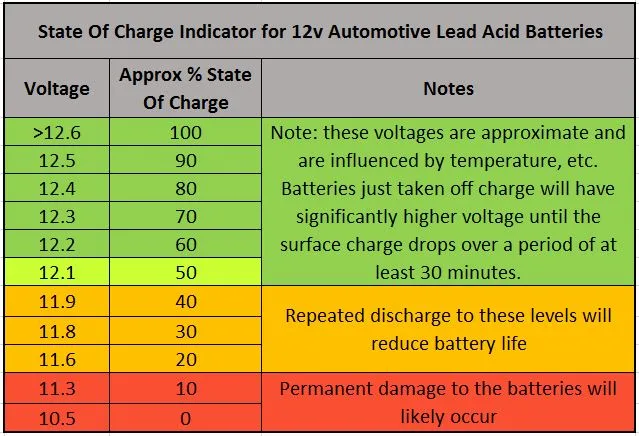
| Resting Voltage | State of Charge | What It Means |
|---|---|---|
| 12.6V or higher | 100% | Healthy and fully charged |
| 12.4V | ~75% | Usable, but charge it soon |
| 12.2V | ~50% | Undercharged, charge and re-test |
| 12.0V | ~25% | Deeply discharged, sulfation risk |
| 11.9V or lower | Discharged | Recharge fully, then re-test |
| Below 10.5V | Failed | Almost certainly a dead cell |
Now apply the branch logic. If you read 12.6V or higher, state of charge is fine, so move to the cranking test in Step 2. If you read 12.2 to 12.5V, recharge with a proper battery charger and re-test after it rests.
If it won't hold 12.4V+ after a full charge, the battery is failing.
Below 12.0V, charge it overnight and re-test before judging anything. A battery that sat unused for weeks may recover fully. Below 10.5V at rest, one of the six cells has died, and no charger brings that back.
AGM batteries run slightly higher across the board, around 12.8 to 12.9V when full, and we'll cover those differences in their own section.
Step 2: The Cranking Voltage Test
This test answers the question the resting test can't: can the battery deliver power under load? The starter motor pulls a huge burst of current, and a weak battery shows its age here first. If your battery passed Step 1 but the car still cranks slowly, this is where you'll find the truth.
The pass/fail line is 9.6 volts. Watch the meter while the engine cranks. If voltage stays above 9.6V (at roughly 70°F), the battery is holding up under load.
If it dips below 9.6V, the battery is weak, even if it read a beautiful 12.6V at rest.
Keep probes on the posts exactly as before. Have a helper crank the engine for a few seconds while you watch the display. Don't crank longer than 10 to 15 seconds at a stretch, and let the starter rest a minute between attempts.
Interpret the branches like this:
- Stays above 9.6V: battery passes under load, move to Step 3
- Drops to 9.0V or so: marginal, expect trouble on the next cold morning
- Falls below 8.5V: high internal resistance or a dying cell, plan on replacement
- Collapses below 7V: the battery is done, no charger fixes this
How to Run It Without a Helper
Use the Min/Max button if your meter has one. Press it before cranking, then start the car yourself. The meter records the lowest voltage it saw during the crank, and you read it afterward at your leisure.
No Min/Max function? Wedge the meter somewhere visible through the windshield, like on the cowl near the wipers, with probes clipped to the posts. Alligator clip leads make this much easier than hand-held probes.
Watch the display as you turn the key.
Step 3: The Charging System Test (Is It the Alternator?)
This test tells you whether the alternator is recharging the battery or slowly starving it. A perfect battery dies in a day or two if the charging system isn't doing its job. Plenty of "bad batteries" replaced every year were actually victims of a failing alternator.
Start the engine and let it idle. Put the probes back on the battery posts, same polarity as before. You're looking for 13.7 to 14.7 volts.
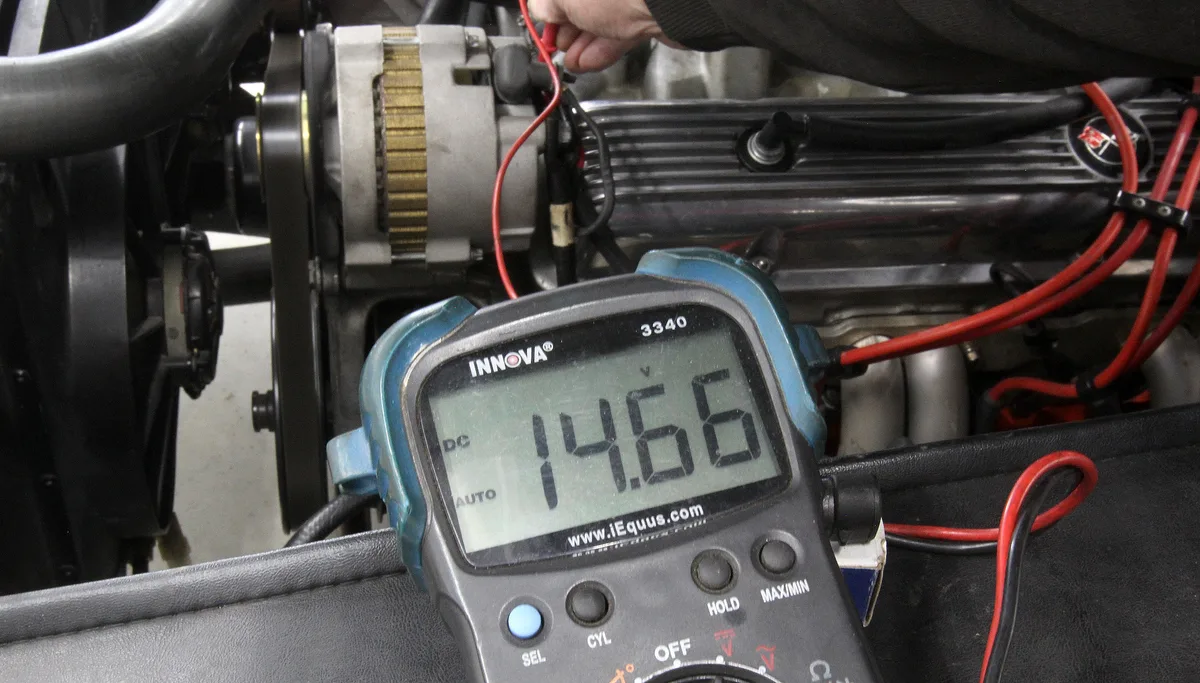
Now load the system. Turn on the headlights, rear defroster, and blower fan, then have someone hold the engine at about 2,000 RPM. Voltage should stay in that same 13.7 to 14.7V band.
A healthy alternator handles the load without breaking a sweat.
| Engine-Running Voltage | Diagnosis |
|---|---|
| 13.7V to 14.7V | Charging system healthy |
| 13.2V to 13.7V | Weak but charging, watch it |
| Below 13.2V | Undercharging, suspect alternator or belt |
| Above 15.0V | Overcharging, bad voltage regulator |
If voltage barely rises above the resting reading, the alternator isn't charging. Check the belt tension and the alternator connections before condemning the alternator itself. A loose belt or corroded cable causes identical symptoms for a fraction of the cost.
Overcharging is the sneaky one. Above 15 volts, the regulator is cooking the battery, boiling off electrolyte and warping plates. That shortens battery life fast, so fix it promptly.
One warning: never disconnect a battery cable while the engine runs to "test" the alternator. That old trick sends a voltage spike through modern electronics and can fry modules worth far more than an alternator.
Step 4: The Parasitic Draw Test (When Your Battery Dies Overnight)
If the battery tests healthy and the alternator charges properly, but the car still won't start after sitting, something is drinking power while the car sleeps. That's a parasitic draw. Common culprits include a glovebox light that never shuts off, an aftermarket stereo, a stuck relay, or a module that won't go to sleep.
The healthy benchmark is under 50 milliamps (0.05 amps) for most vehicles. Some modern cars with lots of modules run up to about 85 mA. Anything in the hundreds of milliamps will flatten a battery in days.
This test uses the meter differently. You'll measure current, not voltage, which means the meter goes in series with the circuit:
- Make sure everything is off and the key is out of the ignition.
- Move the red lead to the 10A input, and set the dial to DC amps. Our breakdown of that high-current input explains why this port matters here.
- Disconnect the negative battery cable.
- Connect the red probe to the cable end and the black probe to the negative post. The meter now bridges the gap, and all current flows through it.
- Wait 30 to 60 minutes. Modern cars need time for every module to go to sleep before the reading means anything.
- Read the draw. Under 50 mA is normal.
Two cautions here. Don't open a door, turn the key, or trigger anything while the meter is in line. The current spike can pop the meter's internal fuse, and we've covered why that fuse blows and how to replace it.
And never crank the engine with the meter connected this way.
If the draw is high, pull fuses one at a time while watching the meter. When the number drops, you've found the guilty circuit. From there it's a matter of tracing what's on that fuse.
The Decision Tree: What to Do Based on Your Readings
You've now got up to four numbers: resting voltage, cranking voltage, charging voltage, and parasitic draw. Here's how they combine into a verdict. Find your situation below and follow the branch.
12.6V or Higher, But Still Having Problems?
A good resting number with bad symptoms means the problem is under load or elsewhere. If cranking voltage dropped below 9.6V, the battery has hidden internal wear, so replace it. If cranking passed too, shift your attention to the charging test and the parasitic draw test.
If all four tests pass and the car still acts up, the battery isn't your problem. Suspect the starter motor, a bad ground strap, or corroded cable connections. A voltage drop test on the cables is the next diagnostic step.
12.2V to 12.5V: Charge It, Then Re-Test
This battery is partly discharged, not necessarily bad. Put it on a proper battery charger overnight, let it rest an hour off the charger, then re-test. If it now holds 12.6V and passes the cranking test, it was just low, so figure out why.
Short trips are a classic cause. City driving never gives the alternator time to fully top off the battery. If the car sits for weeks at a time, a battery maintainer solves the problem for around $30.
If it won't climb above 12.4V after a full charge, the battery has lost capacity. Budget for a replacement soon.
Below 12.0V: Charge or Replace?
Charge first, judge second. A deeply discharged battery can't be fairly tested until it's full. Charge it overnight, rest it, and re-test the resting voltage.
If it recovers to 12.6V and holds it for a couple of days, the battery survived. Deep discharges leave scars, though. Sulfation hardens on the plates each time a battery sits low, and every episode trims capacity.
A battery that's been flattened two or three times rarely lasts another winter, a pattern consistent with typical service life expectations.
If it recovers but sags back below 12.4V within 24 hours with nothing connected, it's self-discharging internally. Replace it.
Below 10.5V: Almost Certainly a Dead Cell
A 12V battery is six 2.1V cells in series, so losing one cell drops the maximum to about 10.5V. No charger resurrects a dead cell. If your battery rests at 10.5V or lower after a full overnight charge, the diagnosis is over.
Replace the battery.
One quick check before buying: confirm the correct physical size for your vehicle. Our guide to matching the right fit for your car saves a return trip.
AGM and Start-Stop Batteries: Different Numbers to Watch
AGM batteries run slightly higher voltages than flooded batteries, and judging one by the standard chart will mislead you. A fully charged AGM rests at 12.8 to 12.9 volts. At 12.5V, an AGM is only around 75% charged, a number that would look nearly full on a flooded battery.
If you're not sure what makes these different, our explainer on glass-mat construction covers the design.
Start-stop vehicles almost always carry an AGM or an enhanced flooded battery. These get worked far harder than a conventional battery, restarting the engine dozens of times per drive. The EFB variant sits between standard flooded and AGM in both price and durability, and we've detailed how that middle option works separately.
Testing procedure stays identical: same DC volts setting, same probe placement, same cranking threshold of 9.6V. Only the resting interpretation shifts:
| Resting Voltage | Flooded Battery | AGM Battery |
|---|---|---|
| Fully charged | 12.6V+ | 12.8V to 12.9V |
| ~75% | 12.4V | 12.5V to 12.6V |
| ~50% | 12.2V | 12.3V |
| Recharge now | Below 12.2V | Below 12.4V |
Two extra cautions for start-stop cars. Replacement batteries often need registration with the car's computer, so the charging strategy matches the new battery. And always replace AGM with AGM.
Downgrading to a cheaper flooded battery in a start-stop car kills the new battery within a year or two.
Cold Weather Changes Your Readings, Here's How to Adjust
Cold skews every number downward, so a winter test needs adjusted expectations. Battery voltage drops roughly 0.01V for every degree Fahrenheit below room temperature. A healthy battery reading 12.6V in the garage might show 12.4V at 20°F, and that's normal.
Capacity takes a bigger hit than voltage. At 32°F a battery delivers about 65% of its rated power. At 0°F that falls to 40% or so, right when the engine needs more cranking effort because the oil is thick.
Adjust the cranking threshold too. The 9.6V pass line assumes roughly 70°F. In freezing weather, a drop to 9.4V during cranking can still be acceptable.
Below about 9.1V in the cold, treat the battery as suspect.
Practical takeaway: test in October, not January. A battery that's marginal in fall will fail on the first single-digit morning. Northern drivers should treat a 12.4V fall reading as a nudge to charge or replace before winter locks in.
Mistakes That Give You a False Reading
Most "bad" multimeter results trace back to test technique, not the battery. Run down this list before trusting a strange number.
- Skipping the surface charge step. The most common error by far. It inflates readings 0.2 to 0.3V and hides a weak battery.
- Testing with the meter on AC volts. You'll see zero or gibberish. The dial must point to DC.
- Wrong range on a manual meter. The 200V range shows 12 with no decimals. You need 20V for the precision that matters.
- Dirty or corroded posts. Crust between probe and lead post can shave off tenths of a volt. Clean first, test second.
- Probing the clamps instead of the posts. A corroded clamp connection reads lower than the battery's true voltage. Touch the lead posts themselves.
- Testing with doors open and lights on. Interior lights pull current and drag the reading down slightly. Close everything up.
- Judging an AGM by flooded numbers. As covered above, 12.5V means different things on different chemistries.
- Reading the draw test too early. A car tested five minutes after locking shows modules still awake and a scary-high milliamp number. Wait the full 30 to 60 minutes.
One more subtle trap: weak meter batteries. A dying 9V cell inside the multimeter causes drifting, unstable readings. If numbers wander for no reason, swap the meter's battery before blaming the car's.
When the Multimeter Isn't Enough: Load Testing and Conductance Testers
A multimeter can pass a battery that's about to fail, and that's its honest limit. Voltage confirms charge, and the cranking test approximates load behavior. Neither directly measures remaining capacity or true CCA output.
Escalate when the story doesn't add up. If resting and cranking numbers look fine but you're still getting slow starts, or the battery is past year three of its life, get a proper load test. Our data on typical service timelines shows most flooded batteries fade between years three and five, sooner in hot climates.
Three tools sit above the multimeter:
| Tool | What It Measures | Best For |
|---|---|---|
| Carbon-pile load tester | Voltage under a real 100+ amp load | Definitive pass/fail verdict |
| Conductance tester | Internal resistance, estimated CCA | Quick health check, no discharge |
| Hydrometer | Electrolyte specific gravity per cell | Flooded batteries with removable caps |
Here's the good news: you probably don't need to buy any of them. Major US parts chains test batteries free, using conductance testers that print an estimated CCA against the rated spec. If you're comparing that printout to the sticker, understanding marine and warm-weather cranking ratings helps you read it correctly.
The smart workflow uses both layers. Multimeter at home to narrow the diagnosis, free load test to confirm before spending $150+. If the conductance test shows measured CCA below about 70% of rated, replace the battery even if voltage looks fine.
Safety Basics Before You Touch the Terminals
The 12 volts itself can't shock you, but a car battery still deserves respect. It stores enough current to weld metal, and it vents flammable hydrogen gas while charging. OSHA guidance on battery handling flags both hazards for good reason.
Follow these rules every time:
- Take off rings, watches, and metal bracelets. A ring bridging a terminal to ground can glow red hot in seconds.
- Never let the probes or any tool touch both posts at once. The spark is instant.
- Keep flames, cigarettes, and spark sources away, especially right after charging.
- Wear safety glasses around flooded batteries. The electrolyte is sulfuric acid.
- Limit cranking to 10 to 15 seconds per attempt to protect the starter.
- When removing cables, disconnect negative first and reconnect it last.
- Wash your hands afterward. Battery cases and terminals carry lead residue.
If a battery case is cracked, bulging, or leaking, stop testing. Replace it, and take the old one to a retailer for recycling. Most states require it, and stores credit the core charge back to you.
Frequently Asked Questions
What setting should a multimeter be on to test a car battery?
Set the dial to DC voltage, shown as a V with a solid line over dashes. On a manual-ranging meter, choose the 20V range for two-decimal precision. Plug black into COM and red into the V port.
Never use the AC setting for battery work.
Is 12.4 volts enough for a car battery?
A 12.4V resting reading means roughly 75% charged. The car will usually start fine, but the battery is undercharged. Charge it fully and re-test.
If it won't hold above 12.4V after charging, capacity is fading and replacement time is close.
Can a car battery read 12.6 volts and still be bad?
Yes. Resting voltage shows charge level, not health. A battery with high internal resistance can read 12.6V unloaded and collapse below 9.6V while cranking.
That's why the cranking test matters, and why a load test is the final word.
How do I know if it's the battery or the alternator?
Test both. If resting voltage is 12.6V and cranking stays above 9.6V, the battery is fine. Then check voltage with the engine running.
Below 13.2V means the alternator isn't charging. In the normal 13.7 to 14.7V band, look at parasitic draw instead.
What voltage means a car battery needs replacing?
Below 10.5V at rest after a full overnight charge means a dead cell, so replace it. Also replace a battery that drops below 9.6V during cranking at normal temperatures, or one that can't hold 12.4V for a day after charging.
How often should I test my car battery with a multimeter?
Twice a year works for most drivers, once before summer heat and once before winter. Add a test any time you notice slow cranking, dim lights at idle, or after the car sits unused for several weeks. The test takes five minutes.
Your Final Verdict: Charge, Replace, or Look Elsewhere
Every reading you've taken funnels into one of three outcomes. Match your results to the row below and you have your answer.
| Your Readings | Verdict |
|---|---|
| Rests 12.6V+, cranks above 9.6V, charges 13.7 to 14.7V | Battery and alternator are fine, look elsewhere |
| Rests 12.2 to 12.5V, recovers after charging | Charge it, then find out why it was low |
| Won't hold 12.4V after a full charge | Replace the battery |
| Cranking drops below 9.6V | Replace, even if resting voltage looks good |
| Rests below 10.5V after charging | Dead cell, replace immediately |
| Battery passes but draw exceeds 50 to 85 mA | Fix the parasitic drain, keep the battery |
| Running voltage below 13.2V or above 15V | Repair the charging system, not the battery |
If the verdict is replace, buy the same chemistry your car came with, confirm the group size, and check the date code so you're not starting with a battery that sat on a shelf for a year. If the verdict is charge, a maintainer prevents a repeat, especially for cars that sit.
And if everything passes, trust the numbers. The starter, cables, and grounds cause plenty of no-starts that get blamed on healthy batteries. Your meter just saved you from paying to find that out the hard way.
Keep the multimeter in the glovebox. Five minutes twice a year, and a dead battery will never ambush you on a cold morning again.

Similar Posts