CA vs MCA on a Battery: What They Really Mean
If you've stared at a battery label and wondered what is CA and MCA on a battery, you're not alone. Both ratings measure the same thing: how much starting power the battery pushes out in the cold. The confusion usually comes from mixing them up with CCA, which is a different test.
Here's the short version. CA stands for Cranking Amps and MCA stands for Marine Cranking Amps. Both are tested at 32°F (0°C) under the SAE J537 standard, so they read the same number.
As of 2026, that's still how battery makers label them. Let's break down what each one really tells you.
Quick Answer
CA (Cranking Amps) and MCA (Marine Cranking Amps) are the same rating. Both measure the amps a battery delivers for 30 seconds at 32°F (0°C) while staying above 7.2 volts. MCA is just the marine label for CA.
Neither equals CCA, which is tested colder at 0°F (−18°C) and reads lower.
What CA and MCA Actually Mean on a Battery
CA means Cranking Amps. It's the number of amps a fully charged battery can supply for 30 seconds at 32°F (0°C) without dropping below 7.2 volts.
MCA means Marine Cranking Amps. It uses the exact same test at the exact same temperature. The only difference is the label.
Marine and powersports batteries carry the "MCA" tag, while car batteries often say "CA."
So when you see CA on one battery and MCA on another, you're looking at identical measurements. A battery rated 800 CA and a battery rated 800 MCA crank the same. That's the single most useful thing to understand here.
Why does this matter? A strong cranking number means faster, more reliable starts. A weak one can leave you turning the key to nothing, especially in the cold.
If you've dealt with sluggish starts, our guide on why cranking pulls the voltage down explains what's happening under the hood.
How Cranking Amps Are Tested (32°F, 30 Seconds, 7.2 Volts)
Cranking ratings aren't guesses. They come from a controlled bench test defined by SAE International. Here's how the CA and MCA test works.
- The battery is fully charged first.
- It's brought to 32°F (0°C), the freezing point of water.
- It discharges at a set current for 30 seconds.
- Throughout those 30 seconds, terminal voltage must stay at or above 7.2 volts.
The highest current the battery holds under those rules becomes its CA or MCA rating. You can read the full method on the SAE International standards site.
The 7.2-volt cutoff isn't random. A 12-volt lead-acid battery has six cells. Each cell must hold at least 1.2 volts to reliably spin a starter.
Six cells times 1.2 volts equals 7.2 volts. Drop below that, and the engine may not turn over.
Plate surface area drives these numbers. More and thinner plates give more cranking power, which is why starting batteries are built differently from deep-cycle ones. To confirm a battery's real health, a quick multimeter check beats trusting the label alone.
CA vs MCA vs CCA: Why the Temperature Changes Everything
The real confusion isn't CA versus MCA. It's CA/MCA versus CCA. The gap comes down to one thing: test temperature.
Colder tests produce lower numbers, because batteries are weaker in the cold.
Why CCA Reads Lower Than CA and MCA
CCA stands for Cold Cranking Amps. It runs the same 30-second, 7.2-volt test, but at 0°F (−18°C) instead of 32°F. That's 32 degrees colder.
Cold thickens the electrolyte and slows the chemical reaction inside the battery. So the same battery delivers fewer amps at 0°F than at 32°F. That's why the CCA number is always lower than the CA or MCA number on the identical battery.
Think of it this way. CA and MCA flatter the battery with a milder test. CCA judges it on a harsh winter morning.
Neither is wrong. They just measure at different temperatures.
Where HCA Fits In
HCA means Hot Cranking Amps. It's tested at 80°F (26.7°C), warmer than all the others. Because heat helps the reaction, HCA gives the highest number of the three.
You'll rarely see HCA on modern labels. But if you do, remember it's the most generous rating. Cold-weather buyers should ignore it and look at CCA instead.
If you drive where winters bite, our notes on how the cold drags battery performance down are worth a read.
Side-by-Side Comparison of CA, MCA, CCA, and HCA
Here's how the four cranking ratings stack up. Same test method, different temperatures, different numbers.
| Rating | Full name | Test temperature | Reads | Common use |
|---|---|---|---|---|
| CA | Cranking Amps | 32°F (0°C) | Higher | Cars, general auto |
| MCA | Marine Cranking Amps | 32°F (0°C) | Same as CA | Boats, powersports |
| CCA | Cold Cranking Amps | 0°F (−18°C) | Lower | Cold-climate vehicles |
| HCA | Hot Cranking Amps | 80°F (26.7°C) | Highest | Rare, warm-weather specs |
A few takeaways:
- CA and MCA are interchangeable. Same temperature, same result.
- CCA is the strictest common rating. Use it for winter starting.
- HCA looks impressive but tells you the least about a tough start.
- Always compare batteries using the same rating type.
Mixing rating types is the classic buying mistake. An 800 MCA battery is not stronger than a 650 CCA battery. They're measured on different scales.
Convert first, then compare.
How to Convert CA and MCA to CCA (and Back)
Converting is simple once you know the rough factor. CCA runs about 0.75 to 0.80 of the CA or MCA number. So to estimate CCA, multiply the CA/MCA figure by roughly 0.8.
Going the other way, multiply CCA by about 1.25 to land near the CA/MCA value. These are close approximations, not exact conversions. Every battery chemistry behaves a little differently.
Here's a quick reference:
| You have | To get | Multiply by |
|---|---|---|
| MCA or CA | CCA | 0.80 |
| CCA | MCA or CA | 1.25 |
A worked example makes it click. Say a marine battery lists 1000 MCA. Multiply by 0.8 and you get roughly 800 CCA.
Now you can fairly compare it against a car battery rated in CCA.
Flip it around for a car battery rated 600 CCA. Multiply by 1.25 to get about 750 CA. Always convert both batteries to the same scale before deciding which is stronger.
Which Rating Actually Matters for Your Situation
The right rating depends on where and how you start your engine. Cold starts lean on CCA. Milder starts are fine judged by CA or MCA.
Here's how it breaks down by user.

Cold-Climate Drivers
If you park outside through freezing winters, CCA is your number. A 0°F test reflects the brutal mornings when starting is hardest. Meeting or beating your vehicle's factory CCA spec keeps you off the tow-truck list.
Cold also masks a weak battery until it fails. A pack that cranks fine in summer can die the first hard frost. Our breakdown of what winter does to your readings explains why the margin shrinks fast.
Boaters and Powersports Users
For boats, jet skis, and ATVs, MCA is the rating you'll see, and it's the right one. Marine engines rarely start in sub-freezing conditions, so the 32°F test fits real use. Match the MCA your engine maker specifies and you're set.
Marine batteries also face vibration and deeper draws than car batteries. Look for a dual-purpose or dedicated starting model rated for your motor. Don't assume a high MCA covers cold-weather duty.
It doesn't.
Warm and Temperate Conditions
In mild climates, CA and MCA describe your starting power just fine. Freezing starts are rare, so the 32°F rating is realistic. You won't gain much by chasing an oversized CCA number here.
Still, match the manufacturer's minimum spec whatever your climate. Undersizing strains the starter and shortens battery life. When in doubt, buy to the factory figure.
Reading Your Battery Label Without Getting Fooled
Battery labels pack several numbers, and marketing loves the biggest one. Look for the letters, not just the digits. "CA," "MCA," "CCA," and "HCA" tell you which test produced the amps.
Here's what to check on the label:
- The cranking rating type (CA, MCA, CCA, or HCA).
- The actual amp value next to it.
- Reserve Capacity in minutes, if listed.
- The BCI group size for fitment.
A common trick is printing a large CA or MCA figure while burying the CCA. A battery might shout "1000 MCA" but only deliver around 800 CCA. If your engine needs 850 CCA, that battery falls short despite the flashy number.
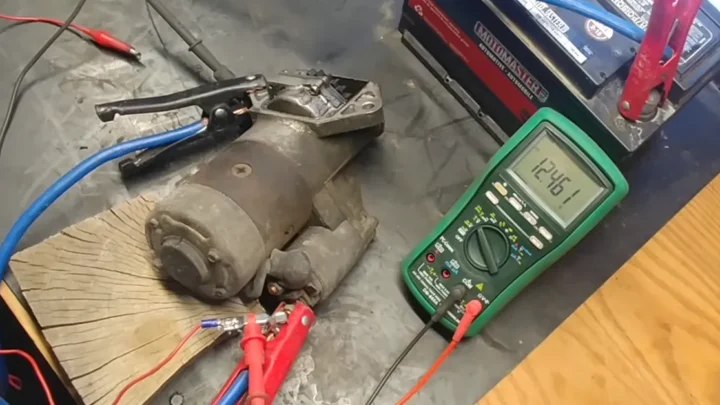
When the label shows only one rating, convert it before comparing. And to verify the battery is holding charge at all, a simple voltage check helps. A reading like 12.4 volts sits mid-range, while lower numbers signal trouble.
Common Mistakes When Comparing Cranking Ratings
Most cranking-rating errors come from comparing apples to oranges. Here are the mistakes we see most in aggregate buyer feedback.
- Comparing MCA against CCA directly. They're different temperatures. Convert first.
- Assuming higher MCA means better cold starting. It doesn't. CCA rules the cold.
- Ignoring the factory CCA spec in the owner's manual. That number is the floor.
- Buying purely on the biggest printed figure. Check which test it came from.
- Trusting a rating on an old or discharged battery. Ratings assume full charge and good health.
That last point trips people up. A battery only hits its rated cranking amps when fully charged and healthy. An aging pack can read a fine voltage yet fail to crank.
If your car shows 12 volts but won't turn over, weak cranking output is often the culprit. Voltage and cranking amps are related, but they aren't the same measurement.
Cranking Amps vs Reserve Capacity vs Amp-Hours
Cranking ratings measure starting power. Reserve Capacity and Amp-hours measure how long a battery runs, not how hard it cranks. Mixing these up leads to the wrong battery for the job.

Similar Posts