How to Charge a Car Battery With Another Car
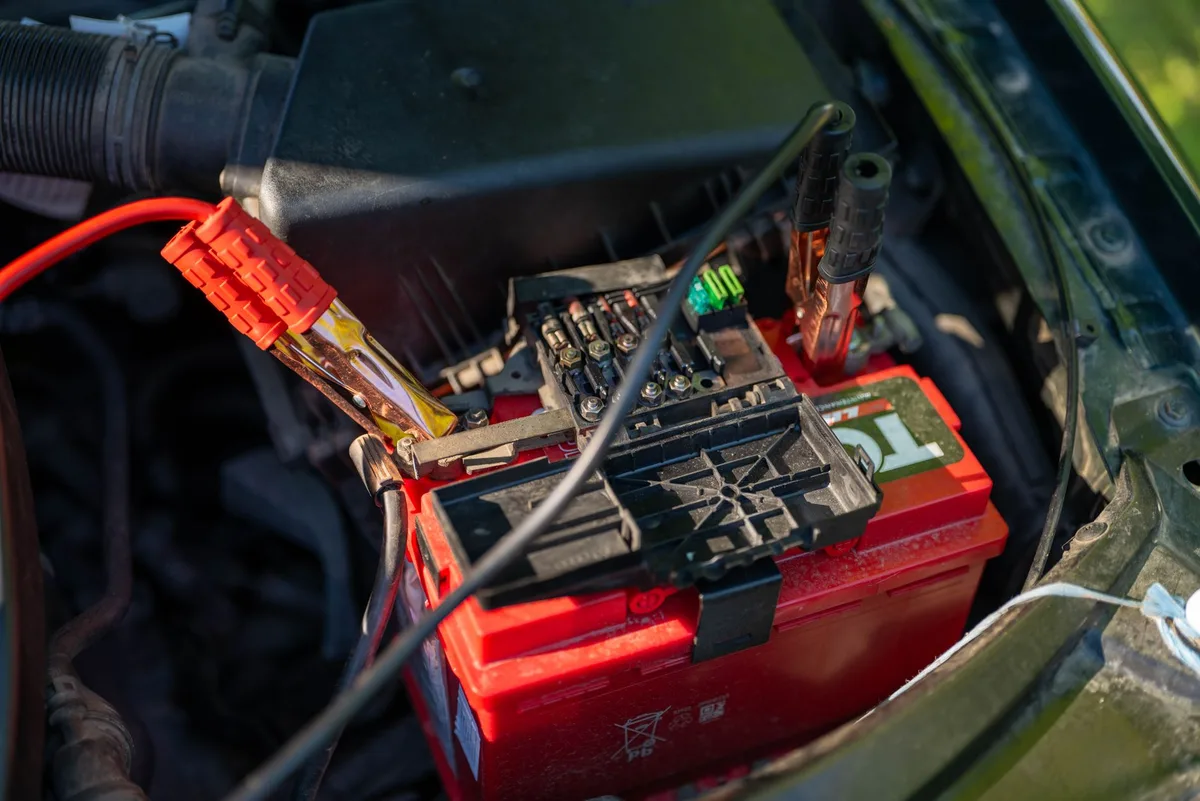
Charging a dead car battery from another car is one of the most useful skills a driver can have, and knowing how to charge a car battery with another car can save you a tow bill and a wrecked afternoon. The catch is that the order you connect the cables actually matters. Do it right and your engine fires up in minutes.
Do it wrong and you risk sparks, a fried computer, or a ruined battery.
Here's the honest truth most quick guides skip. A standard 12-volt lead-acid battery vents small amounts of hydrogen gas, which is flammable, so a careless spark near the terminals is a real hazard. As of 2026, the safe method is settled and simple once you know it.
Let's start with why that connection sequence is such a big deal.
Quick Answer
Park a working car close to the dead one. Turn both engines off. Connect red clamps to the positive terminals of both batteries.
Connect one black clamp to the good battery's negative post. Clamp the last black lead to bare metal on the dead car, not its battery. Start the donor car, wait a few minutes, then start the dead car.
Why Getting the Jump-Start Order Right Actually Matters
The connection order isn't fussy tradition. It's about controlling where the one unavoidable spark happens.
When you attach that final clamp, a tiny spark jumps as current flows. You want that spark far away from the battery, because the battery is where hydrogen gas collects. That's the whole reason the last connection goes to bare metal on the engine, not the battery post.
Reverse polarity is the other big risk. If you swap red and black, you send current backwards through both cars. That can blow fuses, damage the alternator, and scramble sensitive electronics in seconds.
Modern cars are packed with control modules, and they don't forgive a wiring mistake.
Get the sequence right and jump-starting is genuinely safe. If you'd like the full walkthrough on its own, our guide to doing it with cables safely covers every step in detail.
Dead Battery or Something Else? How to Tell Before You Grab the Cables
A jump only fixes a dead battery. It won't fix a bad starter or an empty fuel tank. So confirm the battery is actually the problem first.
Here's what a flat battery usually looks like:
- The engine cranks slowly or not at all.
- You hear a rapid clicking when you turn the key.
- Dashboard lights are dim or flicker.
- The interior light barely glows or stays dark.
- Nothing happens at all, no lights, no crank.
If the headlights are bright and strong but the engine still won't crank, the battery probably isn't your issue. That points more toward a starter or a wiring fault. A car that reads good voltage but won't crank is a classic example of a non-battery problem.
Cold weather muddies the picture too. Low temperatures cut a battery's cranking power, so a weak battery that's fine in summer can quit in January. If your no-start only happens on freezing mornings, the reasons behind cold-weather starting trouble are worth a quick read.
One more check before anything else. If you spot damage, walk away from the jump.
What Happens When You Jump One Car From Another
Jumping a car isn't really "charging" the dead battery the way a wall charger does. It's borrowing enough power to start the engine.
Once the dead car's engine runs, its own alternator takes over. The alternator is the belt-driven generator that produces electricity while the engine turns. It powers the car and slowly refills the battery as you drive.
That's why a jump is fast but shallow. You get a few seconds of borrowed cranking power, not a topped-up battery. The real recharge happens over the next 20 to 30 minutes of driving.
It also explains a frustrating scenario. If your car starts on a jump but dies again the moment you shut it off, the battery may not be holding charge, or your charging system could be failing. When the alternator seems fine but the battery still drains, the fault usually lies elsewhere.
For safe handling of lead-acid batteries and the hydrogen risk, the guidance from OSHA is the authoritative reference.
What You Need: Jumper Cables, a Donor Car, and a Quick Safety Check
You need three things: a set of jumper cables, a running vehicle, and thirty seconds of prep. Let's break each one down.
Picking the Right Jumper Cables
Not all cables are equal. Thin, cheap ones struggle to carry enough current, especially in the cold.
Cable thickness is measured in gauge, and a lower number means a thicker wire. Here's a simple guide.
| Cable gauge | Best for | Notes |
|---|---|---|
| 4 to 6 AWG | Most cars and small SUVs | Good all-round choice |
| 1 to 2 AWG | Trucks, vans, large engines | Handles high current |
| 8 to 10 AWG | Very small cars only | Can struggle in cold weather |
Look for solid copper clamps and cables at least 10 to 12 feet long. Longer cables let you reach when cars can't park nose to nose.
The Quick Safety Check
Run through this before you connect anything:
- Both cars in park or neutral, parking brakes set.
- Both ignitions off, keys out.
- Remove rings, watches, and dangling metal.
- Inspect the dead battery for cracks, leaks, or swelling.
Never jump a battery that's frozen, cracked, or bulging. A swollen or bloated battery can rupture, and a leaking one exposes you to acid. If you smell rotten eggs, that sulfur odor signals a battery venting gas, so stop and deal with that first.
How to Charge a Car Battery With Another Car, Step by Step
Follow this order exactly. Red to dead, red to donor, black to donor, black to ground.
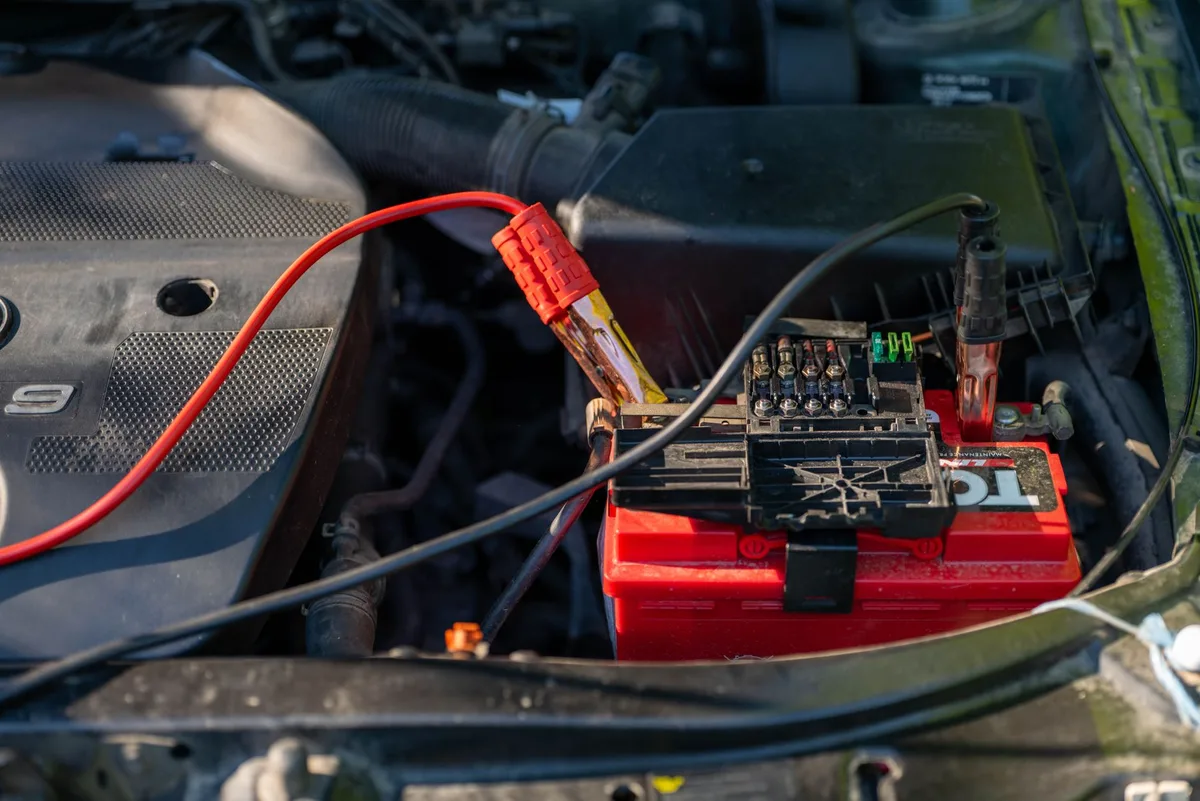
- Position the working car close to the dead one, engines off. The cars must not touch.
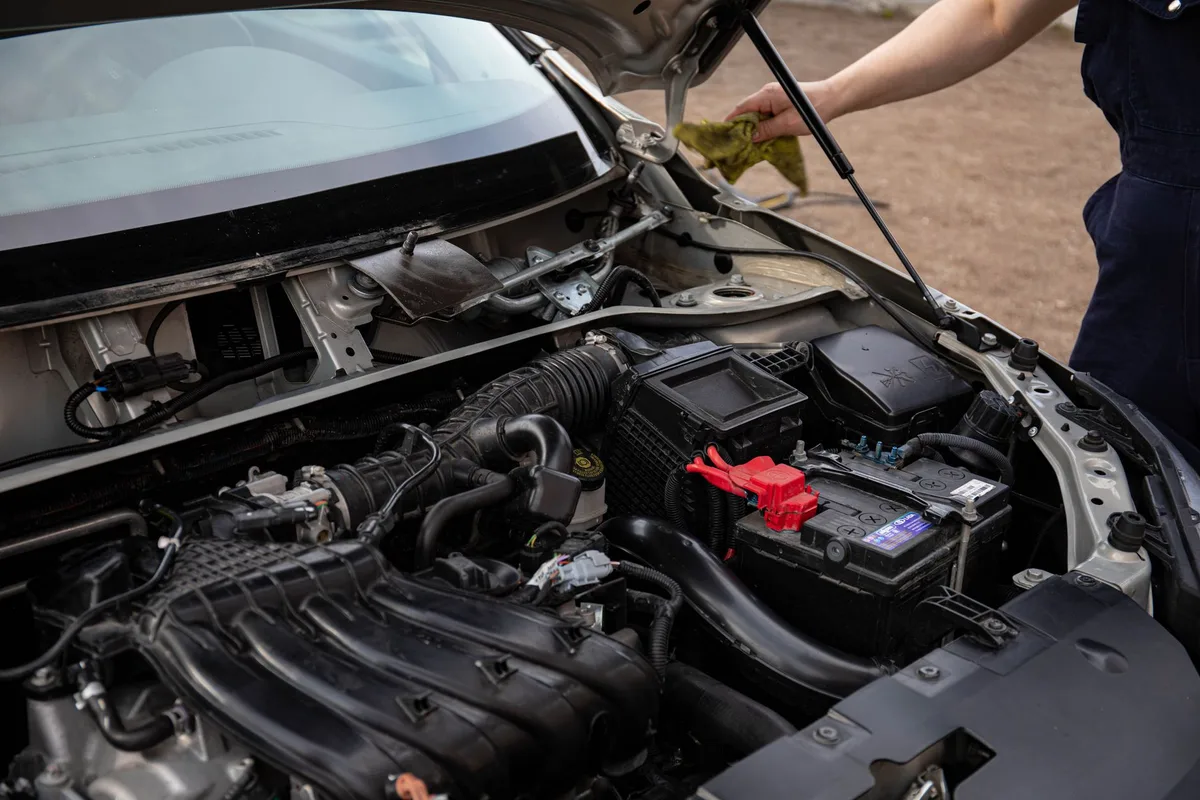
- Clamp one red lead to the positive (+) terminal of the dead battery.
- Clamp the other red lead to the positive (+) terminal of the good battery.
- Clamp one black lead to the negative (, ) terminal of the good battery.
- Clamp the final black lead to a bare metal bolt or bracket on the dead car's engine, away from the battery.
- Start the donor car and let it idle for two to five minutes.
- Try starting the dead car. If it cranks slowly, wait a bit longer and try again.
Once it fires up, don't shut it off. Remove the cables in the reverse order you connected them: last black clamp first, then the other black, then both reds.
Then drive. A steady 20 to 30 minute run lets the alternator put real charge back into the battery. A quick trip around the block won't cut it.
Why the Final Black Clamp Goes to Bare Metal, Not the Battery
That last black clamp goes to bare metal because it moves the spark away from the battery. The moment you complete the circuit, a small spark jumps. Near the battery, that spark can ignite vented hydrogen.
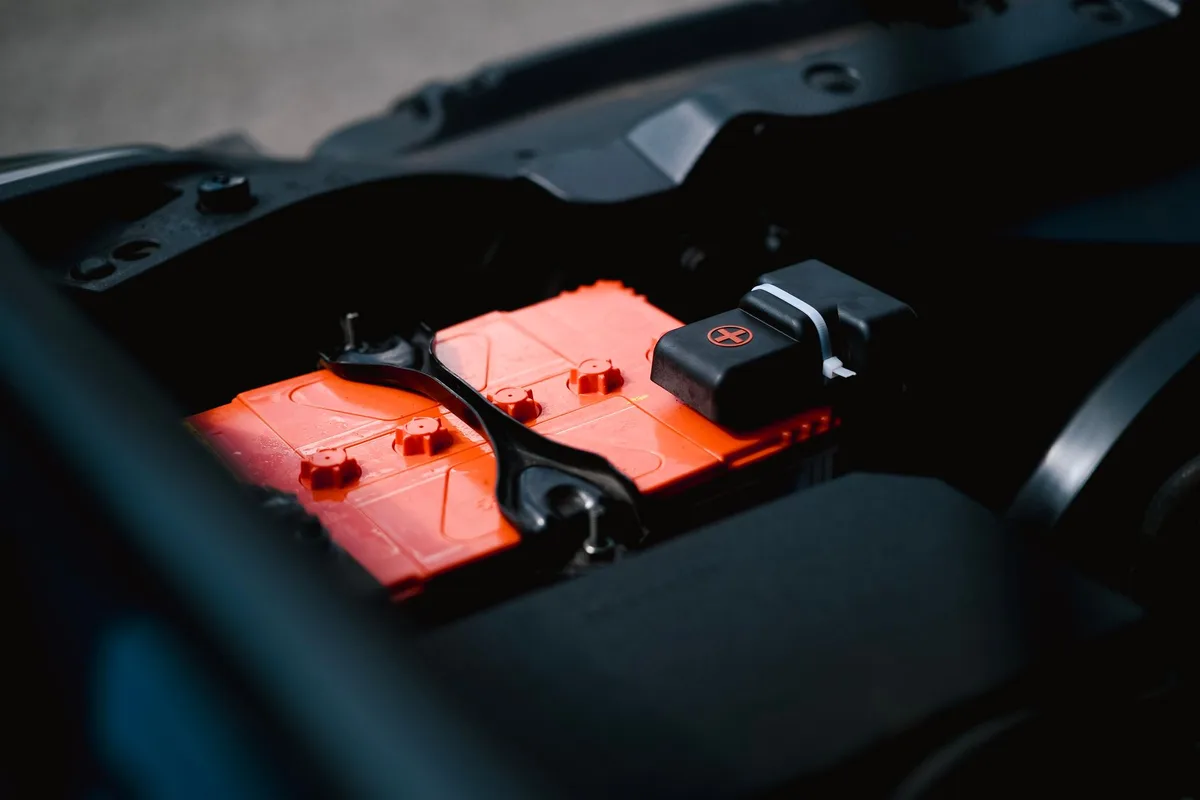
A good ground point is any clean, unpainted metal bolt or bracket on the engine. A shock tower bolt or an engine lifting hook works well. Avoid moving parts like belts, pulleys, and the fan.
Clamping to the dead battery's negative post seems easier, but it puts the spark right at the gas source. It also matters that the ground is solid. A weak connection here mimics a bad ground fault and can stop the jump from working at all.
Hydrogen Gas, Acid, and Sparks: The Safety Rules You Can't Skip
Lead-acid batteries are safe in normal use, but a jump-start pushes them harder. Two hazards stand out: flammable hydrogen gas and corrosive sulfuric acid.
Keep these rules front of mind:
- No smoking, flames, or sparks near either battery.
- Wear eye protection if you have it handy.
- Never let the two clamp ends touch while cables are live.
- Don't lean over the battery when you make the final connection.
If a battery is hot, hissing, or crusted with white or green deposit around the posts, be extra careful. Heavy corrosion or a battery leaking acid means it's damaged. Acid on your skin needs flushing with water right away.
Ventilation helps too. Jumping in an open driveway is safer than a closed garage. Fresh air keeps hydrogen from building up around the terminals.
When You Should NOT Jump a Car
Skip the jump entirely if the battery is frozen, cracked, swollen, or leaking. Forcing current through a damaged battery can cause it to burst. When in doubt, call for roadside help instead.
Hybrids and electric vehicles need special care. Their high-voltage packs are never jumped directly. Many hybrids do have a small 12-volt battery you can boost, but the jump points are often located away from it.
Check the owner's manual first, because some makers require a specific procedure.
Here's a quick decision guide:
| Situation | Safe to jump? | What to do |
|---|---|---|
| Standard 12V battery, just drained | Yes | Follow the steps above |
| Frozen, cracked, or swollen battery | No | Replace it, don't jump |
| Hybrid 12V auxiliary battery | Usually | Use the manual's jump points |
| EV high-voltage system | Never directly | Call the maker's service line |
| 24V truck system | Only with 24V donor | Match the voltage |
Never mix voltages. Hooking a 12-volt car to a 24-volt system sends the wrong voltage into sensitive electronics. That's an expensive mistake.
Mistakes That Fry Electronics or Damage Your Battery
The costliest jump-start errors come from rushing. A few seconds of care saves hundreds in repairs.
Watch out for these:
- Reversed clamps. Red on negative sends current backward and can blow the alternator and control modules.
- Clamps touching each other while connected to a live battery. That's a direct short.
- Revving the donor engine hard. A gentle idle is plenty. High RPM spikes voltage.
- Yanking cables off in the wrong order. Remove the engine-ground clamp first.
- Jumping a battery with a dead cell. It may never take the charge.
If your electronics act strange after a jump, like warning lights or a no-crank, a mistake may have blown a fuse. A car that shows good voltage yet won't crank sometimes points to exactly this. Testing tools help, but you can damage a meter on a car battery if you use the wrong setting, so double-check before probing.
Car Still Won't Start After a Jump? Here's What's Really Going On
If the engine won't crank even with good cables, the battery may not be the only problem. Work through the likely causes in order.
First, check your connections. Loose or corroded clamps are the number one reason a jump fails. Wiggle each clamp and scrape off any crust for solid metal-to-metal contact.
Next, give it more time. A deeply drained battery sometimes needs five to ten minutes of the donor car idling before it has enough juice to crank.
If it still won't go, the fault may be deeper:
- A dead cell means the battery is finished. A battery that won't hold a charge needs replacing.
- A bad starter clicks but won't turn the engine.
- A parasitic drain keeps flattening a good battery. Learning to track down a hidden current draw usually finds the culprit.
If the car starts but dies right after you disconnect, suspect the charging system. When the alternator charges but the battery still dies, driving won't refill it, and you'll be stranded again soon.
Jumper Cables vs. Portable Jump Packs vs. Battery Chargers
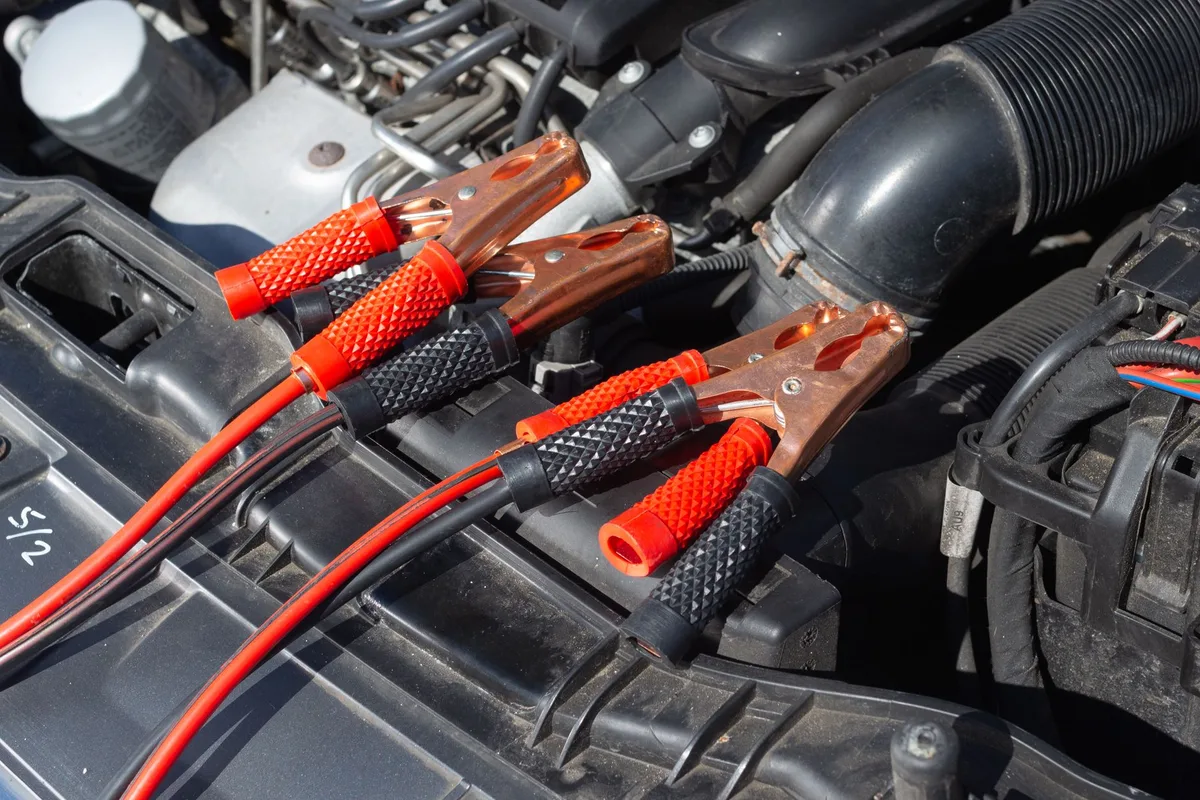
Each tool solves a different problem. Cables need a second car. A portable jump pack works alone.
A battery charger refills a battery slowly at home.
| Tool | Best for | Speed | Needs a donor car? |
|---|---|---|---|
| Jumper cables | Roadside starts with help nearby | Minutes | Yes |
| Lithium jump pack | Solo drivers, no second car | Minutes | No |
| Battery charger | Home charging, weak batteries | Hours | No |
A portable lithium jump starter is the smart backup to keep in your trunk. Most units start a 4-cylinder engine on their own and double as a phone charger. They hold charge for months, so check yours a few times a year.
A plug-in charger or trickle maintainer is different. It won't rescue you on the road, but it fully recharges a healthy battery and keeps a parked car topped up.
After the Jump: Recharging With the Alternator and Testing the Battery
Once running, the alternator does the recharging, but it needs time. Drive steadily for 20 to 30 minutes so the battery can recover a real charge. Short hops around town won't finish the job.
Highway driving works best. Steady engine speed keeps the alternator output consistent. Avoid piling on the heater, headlights, and rear defrost all at once while it recharges.
After the drive, test the battery to see if it held. Let the car sit, then check resting voltage. Our guide on checking a battery once it's charged walks through the reading.
Knowing how long to let it rest first makes that number accurate.
How Long to Drive, What Voltage to Expect, and Other Numbers That Matter
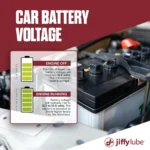
A healthy battery reads 12.6 to 12.7 volts at rest with the engine off. With the engine running, you should see 13.7 to 14.7 volts as the alternator charges. Numbers below that point to a weak charging system.
Here are the figures worth remembering:
| Reading | Healthy value | What it means |
|---|---|---|
| Resting voltage | 12.6 to 12.7V | Fully charged |
| Below 12.4V | Partial charge | Needs recharging |
| Below 12.0V | Deeply discharged | Battery is struggling |
| Engine running | 13.7 to 14.7V | Alternator working |
If your running voltage sits low, the alternator output may be weak. A quick test tells you whether the battery or the charging system is at fault. For the full picture of what normal voltage looks like, the resting number is your baseline.
When to Stop Jumping and Replace the Battery or Call for Help
If you're jumping the same car more than once or twice a week, the battery is telling you it's done. Repeated jumps are a patch, not a fix. A tired battery only gets worse.
Replace the battery when you notice these signs:
- It needs a jump every few days.
- Voltage drops fast after charging.
- The case looks swollen or smells sour.
- The battery is more than four or five years old.
Knowing the warning signs of a failing battery saves you from being stranded. If a fresh battery keeps dying overnight, the problem isn't the battery at all. That points to a drain or charging fault worth chasing down.
Call for professional help if you see acid, smell burning, or suspect wiring damage. Some risks aren't worth a DIY attempt.
Frequently Asked Questions
How long should I let the donor car run before starting mine?
Let the working car idle two to five minutes before you try to start the dead one. For a deeply drained battery, give it five to ten minutes. This lets enough charge flow across the cables to crank the engine.
Can I charge a completely dead battery from another car?
Yes, in most cases, as long as the battery isn't damaged. A completely flat but healthy battery usually takes a few extra minutes of the donor car idling. If it won't take any charge at all, the battery likely has a dead cell and needs replacing.
Do both cars need to be running during a jump-start?
No. Start the donor car, but keep the dead car off until you're ready to crank it. Running the donor engine feeds power through the cables.
Once the dead car starts, disconnect and let it keep running.
How long should I drive after a jump-start?
Drive at least 20 to 30 minutes, ideally at steady highway speed. That gives the alternator enough time to put real charge back into the battery. A short trip around the block won't recharge it, and the car may not restart later.
Is it safe to jump-start in the rain?
Yes, jump-starting in the rain is generally safe because 12 volts is low and won't shock you through water. Keep the clamps dry and away from each other. Just avoid working near standing water, and dry your hands before handling the terminals.
Why does my car die again right after a jump?
If the engine quits once you disconnect, the alternator likely isn't charging. The battery had just enough borrowed power to start but nothing kept it running. Have the charging system tested before driving far, or you'll be stranded again.
Similar Posts