Skip to content

Car Battery Voltage: What’s Normal and What’s Not

·18 min read·by
what voltage should a car battery be

If your car cranked slowly this morning, you're probably wondering what voltage should a car battery be before it counts as healthy. The short answer is 12.6 volts or higher with the engine off, after the car has been sitting. But that single number hides a lot, because the "right" voltage changes depending on whether the engine is off, running, or cranking.

Per SAE J537 testing standards, a fully charged 12V lead-acid battery reads about 12.6 to 12.8 volts at rest. Anything at 12.0 volts is nearly discharged, even though it sounds close to fine. The gap between healthy and dying is smaller than most drivers realize, so let's start with the numbers that matter.

what voltage should a car battery be

Quick Answer

A healthy car battery should read 12.6 volts or more at rest. That means engine off and the car sitting for a few hours. With the engine running, expect 13.7 to 14.7 volts.

During cranking, voltage should stay above 9.6 volts. Readings below 12.4 volts at rest mean the battery needs charging.

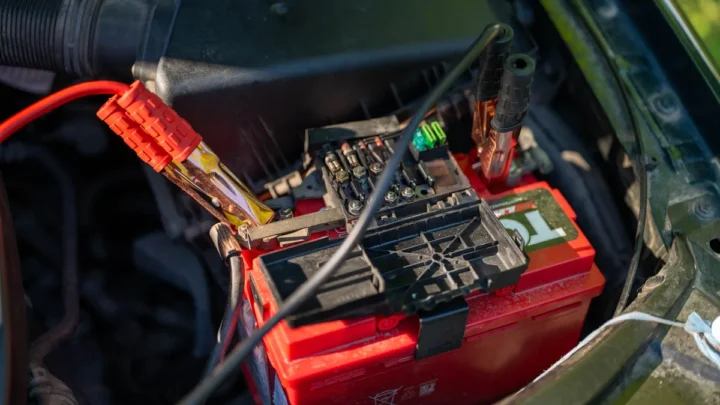
What Voltage Should Car Battery Be?!via Mechanic Mindset

Why One Number Can't Tell You If Your Battery Is Healthy

A car battery is really six 2.1-volt cells wired in series. That's why "12-volt battery" is a slight misnomer, and why a true full charge lands at 12.6 volts or a touch above. If you want the deeper story on how those cells make power, we've covered the chemistry behind it in a separate guide.

Here's the catch. Voltage tells you the battery's state of charge, not its state of health. A worn-out battery can show a beautiful 12.6 volts at rest and still collapse the moment the starter asks for 150 amps.

Think of it like checking a fuel gauge. A full tank tells you nothing about whether the engine runs well. That's why real diagnosis uses an if/then approach across three conditions:

  • Engine off: tests the battery's charge level.
  • Engine running: tests the alternator and charging system.
  • During cranking: tests the battery's ability to deliver current under load.

If all three readings land in range, the system is healthy. If any one falls out of range, the pattern tells you exactly where the problem lives. The rest of this guide walks through each branch.

One more wrinkle before the chart. As of 2026, plenty of cars on the road run AGM or EFB batteries instead of traditional flooded lead-acid. Their target voltages sit slightly higher, and we'll flag those differences as we go.

Car Battery Voltage Chart: What Each Reading Actually Means

Resting voltage maps to state of charge in a surprisingly tight band. The whole usable range between full and empty spans less than one volt. That's why a reading of 12.2 volts, which sounds harmless, actually means your battery is half dead.
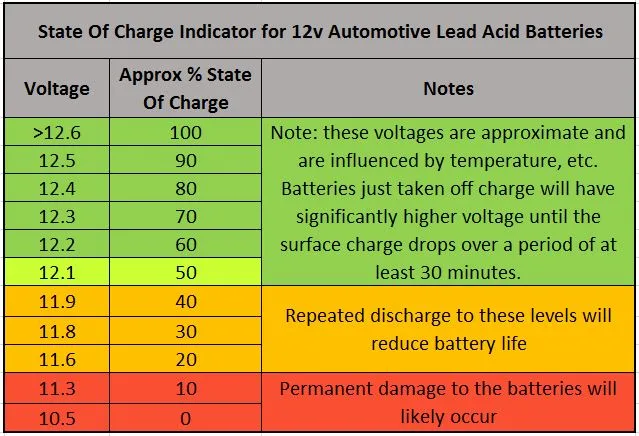
car battery voltage chart

Resting Voltage and State of Charge

Use this chart after the car has sat for at least four hours, ideally overnight. These figures apply to a standard flooded lead-acid battery at roughly 70°F (21°C).

Resting VoltageState of ChargeWhat It Means
12.6V or higher100%Healthy and fully charged
12.4V~75%Usable, but recharge soon
12.2V~50%Undercharged, sulfation risk
12.0V~25%Nearly discharged, charge now
Below 11.9V0 to 10%Deeply discharged, may not recover
~10.5VDead cellOne cell has failed, replace the battery

Two readings on that chart deserve extra attention. First, 12.4 volts is the action threshold. If your battery sits below 12.4 volts for weeks, lead sulfate crystals harden on the plates.

That process, called sulfation, permanently steals capacity.

Second, 10.5 volts is the dead-cell signature. Each cell contributes about 2.1 volts, so a battery stuck near 10.5 volts has lost one entire cell. No charger fixes that.

It's replacement time.

Notice how small the steps are. The difference between "fully charged" and "half discharged" is only 0.4 volts. A cheap analog gauge can't resolve that, which is why a digital multimeter is the right tool for this job.

AGM vs Flooded: Slightly Different Targets

AGM batteries run slightly higher voltages across the board. A fully charged AGM typically rests at 12.8 to 13.0 volts, thanks to its lower internal resistance and tighter plate construction. EFB batteries, common in start-stop cars, behave closer to standard flooded numbers but tolerate deeper cycling.

Manufacturer specifications from brands like VARTA and Odyssey confirm these small offsets. So if your AGM reads 12.6 volts, don't celebrate. For that chemistry, 12.6 volts means roughly 90% charged, not full.

The practical rule: know your battery type before you judge the number. A label check takes ten seconds, and the various chemistries on the market each have their own sweet spot.

How to Test Your Battery Voltage With a Multimeter

Testing takes about two minutes once the battery is properly rested. The multimeter itself can cost as little as $10 to $40, and even budget units read DC voltage accurately enough for this job.

Getting Rid of Surface Charge First

If you test right after driving, you'll get a lie. Charging leaves a temporary "surface charge" on the plates that can push readings to 13.0 volts or more on a mediocre battery. It fools more DIYers than any other single mistake.

You have two options:

  • Best method: let the car sit for at least four hours, ideally overnight. Then test before starting it.
  • Quick method: turn the headlights on for 30 to 60 seconds, switch them off, wait two minutes, then test.

The quick method burns off the surface charge so the reading reflects the true resting voltage. Either way, never trust a voltage reading taken minutes after the engine shuts off.

Setting Up the Multimeter and Taking the Reading

Here's the full sequence:

  1. Set the dial to DC voltage, shown as V with a straight line, on the 20V range if your meter isn't auto-ranging.
  2. Plug the black lead into COM and the red lead into the VΩ jack.
  3. Touch the red probe to the positive (+) terminal and the black probe to the negative (-) terminal.
  4. Read the display. A steady number appears within a second.
  5. Compare it against the chart above.

testing car battery with multimeter

If the DC voltage setting confuses you, that V-with-a-line marking is covered in our piece on the DCV dial position. And if the whole dial looks like hieroglyphics, there's a full rundown of every marking on the dial that's worth five minutes.

A few practical tips. Press the probes firmly into clean metal on the posts, not onto corrosion. If you see a negative number, your probes are swapped.

Nothing breaks, just reverse them. If you get a wildly low reading like 8 volts on a car that starts fine, check the terminals for crust before condemning the battery.

First time holding a meter? Our walkthrough on taking your first measurement covers the basics without the jargon.

Engine Off, Engine Running, Cranking: The Three Readings That Diagnose Everything

One reading gives you a clue. Three readings give you a diagnosis. This is the core workflow, and it separates a $20 fix from a $200 mistake.

Engine Off: Testing the Battery Itself

This is the resting test you just performed. It answers one question: how much charge is the battery holding right now?

If the reading is 12.6 volts or higher, the battery is charged. If it's lower, the battery is either partly discharged or losing capacity. But here's the branching logic: a low resting reading doesn't tell you why.

The battery could be worn out, the alternator could be undercharging it, or something could be draining it overnight. The next two readings sort that out.

Engine Running: Testing the Alternator

Start the engine and probe the terminals again. You should now see 13.7 to 14.7 volts. That's the alternator feeding the battery through the voltage regulator.

The if/then breakdown:

  • 13.7 to 14.7V: charging system is healthy.
  • Below 13.2V: the alternator is undercharging. The battery will slowly drain even while you drive.
  • Above 15V: the regulator has failed. Overcharging boils electrolyte and cooks the battery.

Per the U.S. Department of Energy, lead-acid charging is temperature-sensitive, which is why modern regulators adjust output with heat and cold. A running reading of 14.9 volts on a freezing morning can be normal.

The same reading in July desert heat leans toward a regulator problem.

During Cranking: Testing Under Real Load

This is the reading most drivers skip, and it's the most revealing. Have a helper crank the engine while you watch the meter. Voltage will dip, and that dip is the whole story.

A healthy battery stays at or above 9.6 volts during cranking at around 70°F. That threshold comes straight from industry load-test standards. A battery that sags to 8 volts while cranking is failing, even if it showed a perfect 12.6 volts at rest.

Why does this matter so much? Cranking is the only moment the battery works hard. The starter pulls 100 to 200 amps for a couple of seconds.

A sulfated or aging battery can hold voltage with no load but can't deliver amps on demand. That amp-delivery ability is exactly what cold cranking ratings measure, and it fades years before resting voltage does.

If your battery passes the resting test but fails the cranking test, trust the cranking test. That's the branch that predicts next week's no-start.

What Your Reading Tells You to Do Next

The number on your meter is a fork in the road. Each range points to a different action, so find your reading below and follow that branch.

12.6V or Higher: You're Good

No action needed on the charge front. If the car also cranks strongly, close the hood and drive.

One caveat. If the battery is past four years old, run the cranking test anyway. Age catches up with lead-acid chemistry even when the resting number looks perfect, and typical service life runs shorter than most owners expect.

12.2 to 12.5V: Recharge Before You Judge

Don't condemn the battery yet. This range usually means a partly drained but recoverable battery. Put it on a smart charger overnight, then retest after it rests a few hours off the charger.

If it comes back to 12.6 volts and holds there for a couple of days, you're fine. If it drifts back down within 48 hours, the battery is self-discharging too fast. That points to internal wear, and replacement is on the horizon.

Short-trip driving lives in this range too. Ten-minute commutes never let the alternator finish the job, so the battery slowly starves. A monthly top-up with a maintainer solves it.

12.0 to 12.2V: Something's Draining or Undercharging

At this level, the battery is around half charged or less, and there's a reason. Three suspects, in order of likelihood:

  • Parasitic draw: a glovebox light, aftermarket stereo, or faulty module pulling current overnight.
  • Undercharging alternator: check the engine-running voltage. Below 13.2 volts confirms it.
  • A battery losing capacity: it charges up but can't hold it.

If the engine-running reading is healthy and nothing obvious is draining it, charge the battery fully and watch it over a week. A healthy battery loses only a few percent of charge per month sitting idle. Losing half a volt in days means the battery itself is the problem.

Below 12V: Recharge, Retest, and Prepare to Replace

A reading under 12 volts means deep discharge, and deep discharge damages standard car batteries. Every deep cycle sheds a little active material off the plates. Charge it with a proper smart charger, not just a drive around the block, then retest.

Here's the honest math. A flooded battery that's been below 11.9 volts more than once or twice rarely returns to full capacity. It may pass a voltage test after charging yet fail the first cold morning.

If yours has hit this range repeatedly, start shopping and check what fits your vehicle before you're stranded.

Stuck Around 10.5V: The Dead Cell Signature

No rescue exists here. When one of the six cells shorts internally, the battery tops out around 10.5 volts no matter how long it charges. A charger may even flash an error code and refuse to start.

Confirm it by charging for several hours and retesting. Still pinned near 10.5? That's five working cells doing the job of six.

Replace the battery, and match the group size your tray requires so the new one fits properly.

Battery Problem or Alternator Problem? How to Tell Them Apart

The two-minute answer: test at rest, then test running. The battery test and the alternator test are different tests, and mixing them up is how good alternators get replaced for no reason.

alternator charging voltage

Use this pattern table:

Resting VoltageRunning VoltageDiagnosis
12.6V13.7 to 14.7VBoth healthy
Low (12.0 to 12.4V)13.7 to 14.7VBattery or parasitic draw, alternator fine
12.6VBelow 13.2VAlternator undercharging
LowBelow 13.2VAlternator failing, battery starving
AnyAbove 15VVoltage regulator failed, overcharging

A few real-world tells sharpen the picture. Dimming headlights at idle that brighten when you rev point to the alternator. A car that starts fine after driving but won't start after sitting overnight points to the battery or a parasitic draw.

The jump-start test helps too. If a jump gets you going and the car then runs all day, the battery likely failed to hold charge. If the car dies again while driving, the alternator isn't feeding the system.

Don't overlook the cheap fix either. Corroded terminals or a loose ground strap can mimic both failures by choking current flow. Clean the posts with a wire brush before you spend money on parts.

And never disconnect a battery cable with the engine running to "test the alternator." That old trick can spike voltage and fry modern ECUs.

How Temperature Changes the Numbers

Cold shifts every threshold in this article. Battery chemistry is just a controlled chemical reaction, and cold slows chemical reactions down.

At 0°F (-18°C), a battery delivers roughly 30 to 50% less cranking power than at room temperature. Meanwhile the engine demands more, because cold oil is thicker to spin. That squeeze from both ends is why batteries die on the first freezing morning, not in September.

The specific adjustments to know:

  • Resting voltage reads slightly lower in the cold. A reading of 12.5 volts on a frozen morning can still be a full battery.
  • Cranking minimum drops with temperature. The 9.6-volt floor applies at 70°F. At freezing, a dip to 9.1 volts can still be acceptable.
  • Charging voltage runs higher in cold weather by design. Seeing 14.8 or 14.9 volts on a winter morning is normal regulator behavior.

Heat is the quieter killer. High under-hood temperatures speed up grid corrosion and water loss inside the battery. That's why batteries in Phoenix or inland Australia often fail in three years while the same model lasts five in a mild climate.

Our lifespan-by-climate breakdown shows just how wide that gap runs.

The takeaway for testing: note the temperature when you measure. A borderline reading in extreme cold deserves a retest in a warm garage before you spend money.

Test Your Car Battery With a Multimetervia Lowe’s Home Improvement

Mistakes That Ruin Your Reading (and Your Diagnosis)

Most bad diagnoses trace back to a handful of testing errors. Every one of these is avoidable.

  • Testing right after driving. Surface charge inflates the number by 0.3 to 0.6 volts. Always rest the battery or burn the charge off with headlights first.
  • Calling 12.0 volts "basically fine." It's a 25% charge. This single misread kills more batteries through sulfation than any other.
  • Probing corroded terminals. Crust between probe and post drops the reading. Scrape to clean metal.
  • Using the wrong meter setting. AC volts or the wrong range gives garbage numbers. If your display shows odd symbols or zeros, our guide to making sense of the display sorts it fast.
  • Judging an AGM by flooded numbers. An AGM at 12.6 volts isn't full. Know your chemistry first.
  • Skipping the retest after charging. One reading is a snapshot. The trend over days is the diagnosis.
  • Trusting the dashboard voltmeter. Factory gauges are damped and vague. Use a real meter at the posts.

One more subtle trap: testing at the jump posts under the hood instead of the battery itself. Some cars bury the battery in the trunk or fender, and remote posts can read slightly different through long cables. When accuracy matters, measure at the actual terminals.

When Voltage Looks Fine but the Battery Is Still Dying

Yes, a battery can pass the voltage test and still be nearly dead. Resting voltage measures charge, not capacity, and capacity is what fades with age.

Picture a water tank slowly filling with sand. The water level (voltage) still reads full, but the tank holds less and less actual water (amp-hours). An old battery charges to 12.6 volts quickly precisely because there's less healthy plate material left to fill.

The warning signs that voltage won't show you:

  • Cranking sounds slightly slower than it used to, especially on cold mornings.
  • The battery drains flat from small loads, like leaving a dome light on for an hour.
  • A jump-start is needed after the car sits for a long weekend.
  • The battery is past year four, regardless of how it tests.

This is where load testing earns its keep. A carbon pile tester pulls half the battery's rated cold cranking amps for 15 seconds while watching voltage. Shops also use conductance testers, like the Midtronics units, that measure internal resistance in seconds.

Most parts stores run either test free.

Reserve capacity fades the same invisible way. That's the minutes a battery can run essential electronics if the alternator quits, and that buffer rating shrinks with age just like cranking power does.

The practical rule: use your multimeter for charge-state decisions and trend-watching. Once a battery passes its fourth birthday, add a yearly professional load test. Voltage tells you today's charge.

Load tells you next winter's odds.

Keeping Your Battery in the Healthy Voltage Range

Batteries rarely die overnight. They drift downward for months first, and a little routine attention keeps them above the danger line.

The habits that matter most:

  • Drive long enough to recharge. A cold start costs charge that a ten-minute trip can't repay. Mix in a 30-minute drive weekly, or use a maintainer.
  • Put stored vehicles on a smart maintainer. A parked car self-discharges a few percent per month, and modern cars add constant module drain on top. A CTEK, NOCO, or Battery Tender unit holds the battery at a proper float voltage indefinitely.
  • Check voltage monthly in extreme climates. Sixty seconds with a meter catches drift before it becomes sulfation.
  • Keep terminals clean and tight. Corrosion resists charging current just like it resists cranking current.

Match the charger to the chemistry. AGM and start-stop EFB batteries want specific charge profiles, and most smart chargers have a dedicated mode for them. Charging an AGM on an old-school unregulated charger can overheat it.

If your car sits for weeks at a time, the maintainer is the single best money you'll spend. A $40 device routinely doubles battery life compared to letting the battery cycle between full and half-dead in a driveway.

Safety Basics Before You Touch the Terminals

A voltage test is low-risk, but the battery itself isn't a toy. Two hazards deserve respect: hydrogen gas and sulfuric acid.

Charging batteries vent hydrogen, which ignites easily in enclosed spaces. Keep sparks, cigarettes, and open flames away, and connect charger clamps before plugging the charger in. The electrolyte inside is dilute sulfuric acid, so wear eye protection when charging or load testing, and wash off any contact immediately.

The short list:

  • Remove metal jewelry before working near the terminals. A wrench or ring bridging the posts becomes a welding rod.
  • Connect red to positive first, black to negative last. Reverse the order when removing.
  • Never lean directly over a battery while it's under charge or load.
  • Don't charge a cracked, bulging, or frozen battery. Replace it.

When a battery does reach the end, don't bin it. Lead-acid batteries are among the most recycled products in existence, and retailers take old units back against the core charge. The [U.S.

Environmental Protection Agency](https://www.epa.gov) outlines proper handling, and virtually every parts store handles the recycling for you.

Frequently Asked Questions

Is 12.4 volts OK for a car battery?

It's acceptable but not ideal. A resting reading of 12.4 volts means roughly 75% charge. The car will start fine, but sitting below full charge invites sulfation over time.

Charge it fully with a smart charger soon, then retest to confirm it holds 12.6 volts.

What voltage is too low to start a car?

Most cars struggle below about 11.8 to 12.0 volts resting, though it varies with temperature and engine size. The truer test is cranking voltage. If the battery sags under 9.6 volts while the starter spins, starting becomes unreliable regardless of the resting number.

What should car battery voltage be with the engine running?

Between 13.7 and 14.7 volts at the terminals. That range shows the alternator charging properly through the voltage regulator. Below 13.2 volts means undercharging.

Above 15 volts means the regulator has failed and is overcharging, which cooks the battery. Cold weather pushes normal readings toward the top of the range.

Why does my battery read 12.6 volts but the car won't start?

Voltage shows charge, not cranking strength. An aged or sulfated battery can hold 12.6 volts with no load yet collapse when the starter demands 150 amps. Run a cranking test or get a free load test at a parts store.

Also check for corroded terminals and a healthy ground connection.

How many volts should a car battery lose overnight?

Almost none. A healthy battery drops maybe 0.01 to 0.02 volts overnight. Losing a tenth of a volt or more every night points to a parasitic draw or a battery that can't hold charge.

Charge it fully, disconnect the negative cable overnight, and retest to separate the two causes.

Do AGM batteries have different voltage numbers?

Yes, slightly higher across the board. A fully charged AGM rests at about 12.8 to 13.0 volts instead of 12.6. The sealed glass-mat design lowers internal resistance, which lifts every threshold a bit.

Judge an AGM by AGM numbers, or a 90% charge will look "full."

Your Voltage Decision Guide at a Glance

Everything above collapses into one workflow. Rest the battery, take three readings, and follow the branch that matches.

ReadingConditionYour Move
12.6V+RestingHealthy. Retest seasonally
12.4 to 12.5VRestingCharge soon, confirm it holds
12.0 to 12.3VRestingCharge now, hunt for a draw or alternator issue
Below 12.0VRestingCharge, retest, plan replacement
~10.5VRestingDead cell. Replace
13.7 to 14.7VRunningCharging system healthy
Below 13.2VRunningAlternator or belt problem
Above 15VRunningFailed regulator. Fix before it kills the battery
9.6V+CrankingBattery delivers under load
Below 9.6VCrankingFailing battery, even if resting looks fine

Three habits make the numbers work for you. Test at the same conditions each time, rested and at the posts. Treat 12.4 volts as your action line, not 12.0.

And once the battery passes four years old, back up your multimeter checks with a yearly load test.

A meter, two minutes, and this chart will catch nearly every battery failure before it strands you. That's a better deal than any tow truck offers.

Ryan Carter is the founder of AutoVerse Authority. A self-taught gearhead from just outside Kansas City, he's spent 15 years buying, fixing, and living with cars — and now shares honest, hands-on advice so everyday drivers can save money and skip the dealership traps.

Share.

Similar Posts

What Should Alternator Voltage Be…Car Battery Reads 12V but Won&#82…How to Set a Multimeter to 20V DC…How Long to Drive After a Jump St…How to Test Parasitic Draw With a…Why Your Battery Voltage Drops Wh…Multimeter Setting for Car Batter…How to Test a Car Battery Without…How to Test a Car Battery With a …How to Use Back Probe Pins on a M…
Share