12V Battery Voltage Chart: What Your Readings Mean
If you've ever put a meter on a battery and stared at "12.38" with no idea what it meant, you're in the right place. A 12v battery voltage chart translates that number into something useful: how full the battery actually is. The catch is that one chart doesn't fit every battery, and reading it at the wrong moment gives you a number that lies.
Here's why precision matters: the entire working range of a lead-acid battery spans barely one volt. Per Battery Council International specifications, 12.6v means full while 12.0v means nearly empty, so a 0.2v misread can be the difference between "fine" and "failing". Let's start with the fast answer, then get into the charts themselves.
Quick Answer
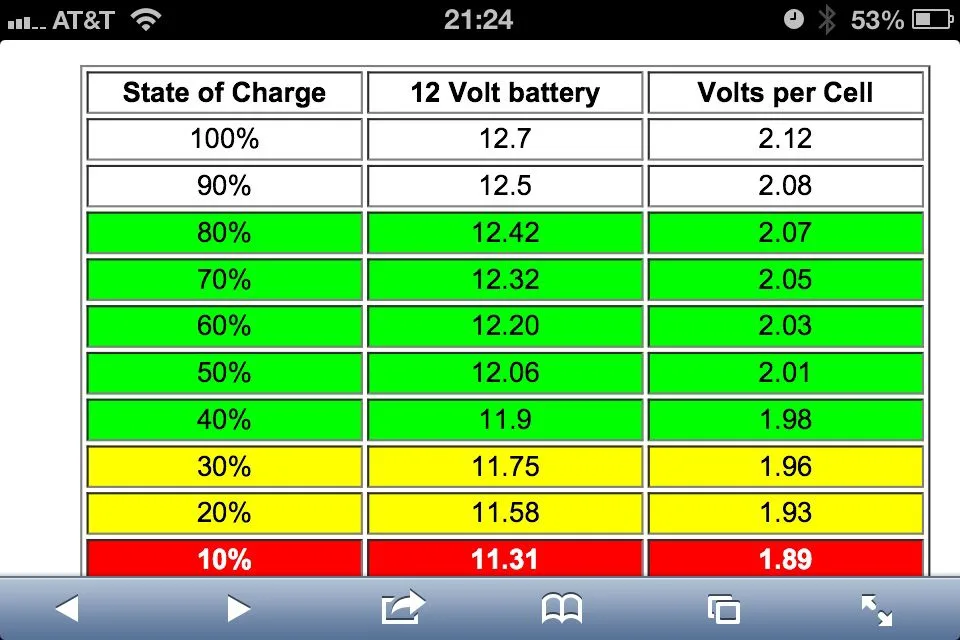
A 12v battery voltage chart links resting voltage to state of charge. A full lead-acid battery rests at 12.6 to 12.7 volts. A reading of 12.2 volts means roughly 60 percent charge.
Below 12.0 volts, the battery is close to empty. AGM batteries read slightly higher, around 12.8 volts when full. LiFePO4 batteries rest higher still, near 13.3 to 13.6 volts.
Here's the condensed version for the three common chemistries, measured at rest:
| State of Charge | Flooded Lead-Acid | AGM | LiFePO4 |
|---|---|---|---|
| 100% | 12.6 to 12.7v | 12.8 to 13.0v | 13.3 to 13.6v |
| 75% | 12.4v | 12.6v | 13.2v |
| 50% | 12.06 to 12.2v | 12.1 to 12.3v | 13.1v |
| 25% | 11.9v | 12.0v | 13.0v |
| 0% (flat) | 11.8v or less | 11.8v or less | 12.0v or less |
Those numbers only hold if the battery has been resting with no charger and no load. We'll cover why in a moment.
Why One Voltage Chart Can't Cover Every 12v Battery
The chart you need depends on what's inside the case. Every "12v" battery is really a stack of cells wired in series, and the chemistry of those cells sets the voltage range. A lead-acid battery uses six cells at about 2.1v each.
A LiFePO4 battery uses four lithium cells at 3.2v each. Same label on the outside, different math on the inside.
That's why a lithium battery resting at 12.8v is nearly empty while an AGM at 12.8v is completely full. Apply the wrong chart and you'll either panic over a healthy battery or slowly kill one you thought was fine. If you're not sure which chemistry you own, sorting out the main battery chemistries takes two minutes and saves a lot of confusion.
The second variable is what the battery is doing when you measure it. There are three completely different readings:
- Resting voltage: no charging, no load, ideally after 4+ hours of sitting. This is the only reading the charts are built for.
- Voltage under load: always reads lower because current is flowing. Sag is normal here.
- Charging voltage: reads 13.2 to 14.7v depending on charge stage. This tells you about the charger, not the battery.
So the workflow is simple if/then logic. If the battery has rested for hours, use the chart for your chemistry. If it's under load or freshly charged, the chart doesn't apply yet.
Get those two conditions right and voltage becomes a genuinely reliable diagnostic tool.
12v Lead-Acid Battery Voltage Chart (Flooded and Standard Deep-Cycle)
This is the chart most people are looking for. It covers flooded (wet cell) batteries, which as of 2026 still power the majority of cars, trucks, boats, and budget RV setups. It also works for standard deep-cycle flooded batteries in golf carts and trolling motors.
| Resting Voltage | State of Charge | What It Means |
|---|---|---|
| 12.70v+ | 100% | Fully charged and healthy |
| 12.50v | 90% | Strong, no action needed |
| 12.42v | 80% | Normal working range |
| 12.32v | 70% | Fine for daily use |
| 12.20v | 60% | Recharge soon |
| 12.06v | 50% | The deep-cycle floor. Recharge now |
| 11.90v | 40% | Actively wearing the battery |
| 11.75v | 30% | Sulfation risk zone |
| 11.58v | 20% | Serious discharge |
| 11.31v | 10% | Nearly dead |
| 10.50v | 0% | Fully discharged, damage likely |
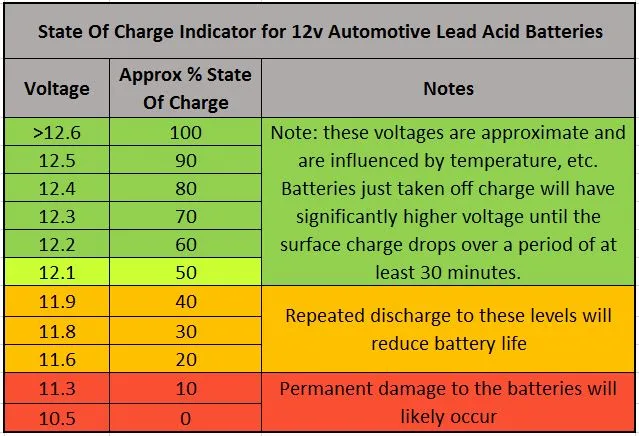
Two numbers on this chart matter more than the rest. The first is 12.6v, the baseline for a full battery. If your battery never reaches it even after a full overnight charge, capacity is fading.
Our breakdown of what a full battery should read covers the healthy range in more detail.
The second is 12.06v, the 50 percent mark. Manufacturer cycle-life data is blunt about this. A flooded deep-cycle battery drained to 50 percent repeatedly can deliver 1,000+ cycles.
Drain it to empty each time and you might get 200. Staying above that line can double or triple the battery's life.
One warning for starting batteries: this chart measures charge, not cranking strength. A worn battery can rest at 12.6v and still collapse the moment the starter kicks in. That's a capacity problem, which is what cold cranking ratings measure, and we'll cover how to catch it in the load-testing section.
AGM and Gel Battery Voltage Chart: The Numbers Shift Slightly Higher
AGM and gel batteries are still lead-acid at heart, but their sealed construction changes the numbers a little. The electrolyte is held in glass mats or a silica gel instead of sloshing freely, and the tighter internal design produces slightly higher resting voltages. If you want the full picture of how glass mat construction works, we've broken it down separately.
| Resting Voltage | AGM State of Charge | Gel State of Charge |
|---|---|---|
| 12.8 to 13.0v | 100% | 100% (12.85v+) |
| 12.6v | 75% | 80% |
| 12.3v | 50% | 55% |
| 12.0v | 25% | 30% |
| 11.8v | 0% | 5% |
The practical takeaway: an AGM reading 12.6v is not full. It's sitting around 75 percent. Judge it against the flooded chart and you'll chronically undercharge it, which slowly sulfates the plates and shortens its life.
Aggregate warranty-claim data from AGM makers points to chronic undercharging as a leading cause of early failure.
A few AGM and gel specifics worth knowing:
- Lower self-discharge: AGM loses roughly 1 to 3 percent charge per month at rest, so a stored battery holds its voltage longer than flooded.
- Charging limits matter: gel batteries especially dislike voltages above about 14.2v. Always match your charger to the chemistry.
- No equalization: the equalization charge used on flooded batteries will damage sealed types.
If your vehicle has stop-start but the battery isn't AGM, it's likely an enhanced flooded design, which reads much like the standard flooded chart. When in doubt, check the label before choosing a chart.
LiFePO4 (Lithium) Battery Voltage Chart: Why the Curve Is Almost Flat
Lithium iron phosphate changes the rules. A LiFePO4 battery holds a nearly constant voltage across most of its capacity, which is great for your gear and terrible for voltage-based guessing. Research from the US Department of Energy consistently shows LiFePO4's flat discharge plateau is one of its defining traits.
| Resting Voltage | State of Charge |
|---|---|
| 13.6v+ | 100% |
| 13.4v | 90% |
| 13.3v | 80% |
| 13.2v | 60 to 70% |
| 13.1v | 40 to 50% |
| 13.0v | 30% |
| 12.9v | 20% |
| 12.5v | 10% |
| 12.0v or less | Empty (BMS cutoff near) |
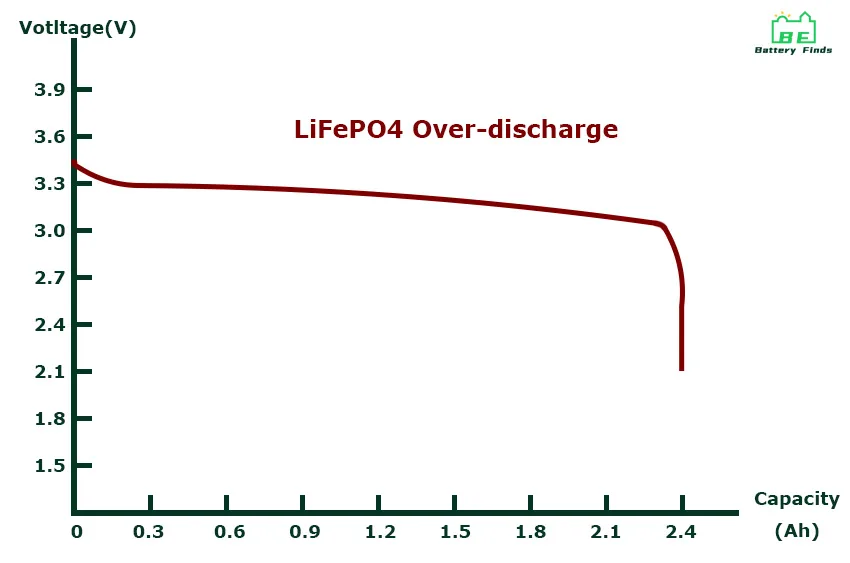
Look at the middle of that table. Between roughly 30 and 80 percent charge, the voltage barely moves a tenth of a volt. That's the flat plateau.
A multimeter accurate to ±0.1v simply can't tell you whether a lithium battery in that zone is one-third full or three-quarters full.
The edges of the curve are steep, though. Above 13.4v you're near full, and once the reading drops through 12.9v the battery is falling fast toward empty. So the if/then logic for lithium looks like this:
- If it reads 13.3v or higher: you're comfortably charged.
- If it reads 13.0 to 13.2v: somewhere in the middle. Voltage alone can't pin it down.
- If it reads 12.9v or lower: charge soon. The drop from here is fast.
Two more lithium quirks. First, the built-in battery management system (BMS) disconnects the cells at a low-voltage cutoff, so a lithium battery reading 0v on your meter's DC setting may just be a tripped BMS, not a dead battery. Second, because of that flat curve, serious lithium setups track state of charge with a shunt monitor that counts amp-hours instead of guessing from voltage.
We'll get to those tools shortly.
Resting, Under Load, or Charging: Which Reading Are You Actually Looking At?
Every misdiagnosed battery we've researched traces back to the same mistake: applying the resting chart to a battery that wasn't resting. The same battery can read 12.4v, 11.8v, and 14.2v within the same hour depending on what it's doing. All three readings are "correct".
Only one of them tells you the state of charge.
Resting Voltage (The Only Reading the Charts Are Built For)
Resting voltage, also called open circuit voltage, is measured with everything disconnected and the battery sitting idle. No charger, no load, no engine running. Every chart in this article assumes this condition.
The reason is chemical, not electrical. Right after charging or discharging, the electrolyte near the plates hasn't equalized with the rest of the fluid. The voltage you read reflects that local imbalance, not the true charge.
Give it time and the reading settles to a number the chart can actually interpret.
Voltage Under Load: Why It Reads Lower and What Sag Tells You
Under load, voltage always drops, and that's normal. Current flowing through the battery's internal resistance eats some voltage before it ever reaches your meter. A healthy flooded battery at 12.6v resting might show 12.2v running a fridge, then bounce right back.
The useful signal is how far it sags. If a battery drops from 12.6v to below 11.5v under a modest load, internal resistance is climbing and the battery is aging. During engine cranking, a healthy 12v starting battery should stay at or above 9.6v.
Dip below that on a warm day and the battery is on its way out, no matter what it reads at rest.
Charging Voltage: Bulk, Absorption, and Float Numbers Explained
A battery on charge reads the charger's output, not its own state. Modern smart chargers move through three stages, and each has its own voltage signature:
| Charge Stage | Typical Voltage (12v lead-acid) | What's Happening |
|---|---|---|
| Bulk | 14.4 to 14.7v | Maximum current, battery filling fast |
| Absorption | 14.2 to 14.6v held steady | Topping off the last 20 percent |
| Float | 13.2 to 13.8v | Maintenance trickle, battery full |
This is also how you check an alternator. With the engine running, healthy charging shows 13.8 to 14.4v at the terminals. If you see 12.6v with the engine on, the alternator isn't charging at all.
If you're fuzzy on how the charging system feeds the battery, our explainer on how the whole system works fills in that picture.
How to Test Your Battery Voltage the Right Way
The test itself takes thirty seconds. The setup around it is what separates a useful reading from a misleading one. Here's the full workflow.
What You Need: Multimeter Settings and Accuracy
Any digital multimeter in the $20 to $50 range is accurate enough for battery work. You're looking for DC voltage accuracy of ±0.5 percent or better, which nearly all modern meters hit. A basic auto-ranging meter makes this even simpler because it picks the correct range for you.
Set the dial to DC volts. On a manual-ranging meter, choose the 20v range. If the symbols on the dial look like hieroglyphics, our guide to what each dial marking means decodes them quickly.
The 4-Hour Rest Rule (And Why Surface Charge Lies to You)
Wait at least 4 hours after any charging or driving before you trust a reading. Overnight is better. A freshly charged battery carries surface charge, a thin layer of extra voltage on the plates that can read 12.8v or higher on a battery that's really at 80 percent.
If you can't wait, you can burn off surface charge in a pinch. Turn the headlights on for two to three minutes, switch them off, wait ten minutes, then measure. It's not as accurate as a true rest, but it strips away most of the false reading.
Reading the Result Against the Right Chart
The measurement itself is quick:
- Disconnect chargers and switch off all loads.
- Set the meter to DC volts, 20v range.
- Touch the red probe to the positive terminal, black to negative.
- Read to two decimal places. 12.4v and 12.48v are different answers here.
- Match the number against the chart for your chemistry, not just any chart.
If you've never used a meter before, our walkthrough on taking your first measurement covers probe handling and safety. And if the display shows something confusing, the primer on making sense of the readout sorts out decimals, ranges, and negative signs.
What Your Voltage Reading Is Telling You to Do Next
A number without an action is just trivia. Here's the decision path once you have a trustworthy resting reading, using flooded lead-acid values. Shift everything up about 0.2v for AGM and use the lithium chart from earlier for LiFePO4.
Above 12.6v: Healthy, and How to Keep It That Way
Nothing to fix. The battery is at or near full charge. Your only job is keeping it there.
If the vehicle or bank sits unused for weeks, put it on a maintainer, because even a healthy flooded battery self-discharges around 3 to 5 percent per month.
12.2v to 12.5v: Recharge Soon, Especially Before Storage
The battery is somewhere between 60 and 85 percent, which is fine for today and bad as a habit. If you drive daily, the alternator will likely top it up. If this is a deep-cycle bank or a stored vehicle, charge it fully now.
The storage case matters most. A battery parked at 12.3v for the winter will sulfate, and sulfation is the top killer of lead-acid batteries. The if/then rule: if the battery will sit for more than two weeks, never leave it below 12.5v.

Similar Posts