What Does a Starter Do? How Your Engine Comes to Life
If you've ever turned the key and heard nothing but a click, you already know why "what does a starter do" is one of the most searched car questions online. The starter is the small but muscular electric motor that spins your engine fast enough for it to fire up on its own. Every gasoline and diesel vehicle on the road still relies on one.
Modern passenger-car starters pull 150 to 250 amps in the first second of cranking, per SAE J537 data. That's why a weak 12V battery mimics starter failure so often. As of 2026, roughly 95% of light vehicles still use a classic electric starter, even as mild-hybrids fold the job into the alternator.
Here's what that motor is doing every time you push the button.
Quick Answer
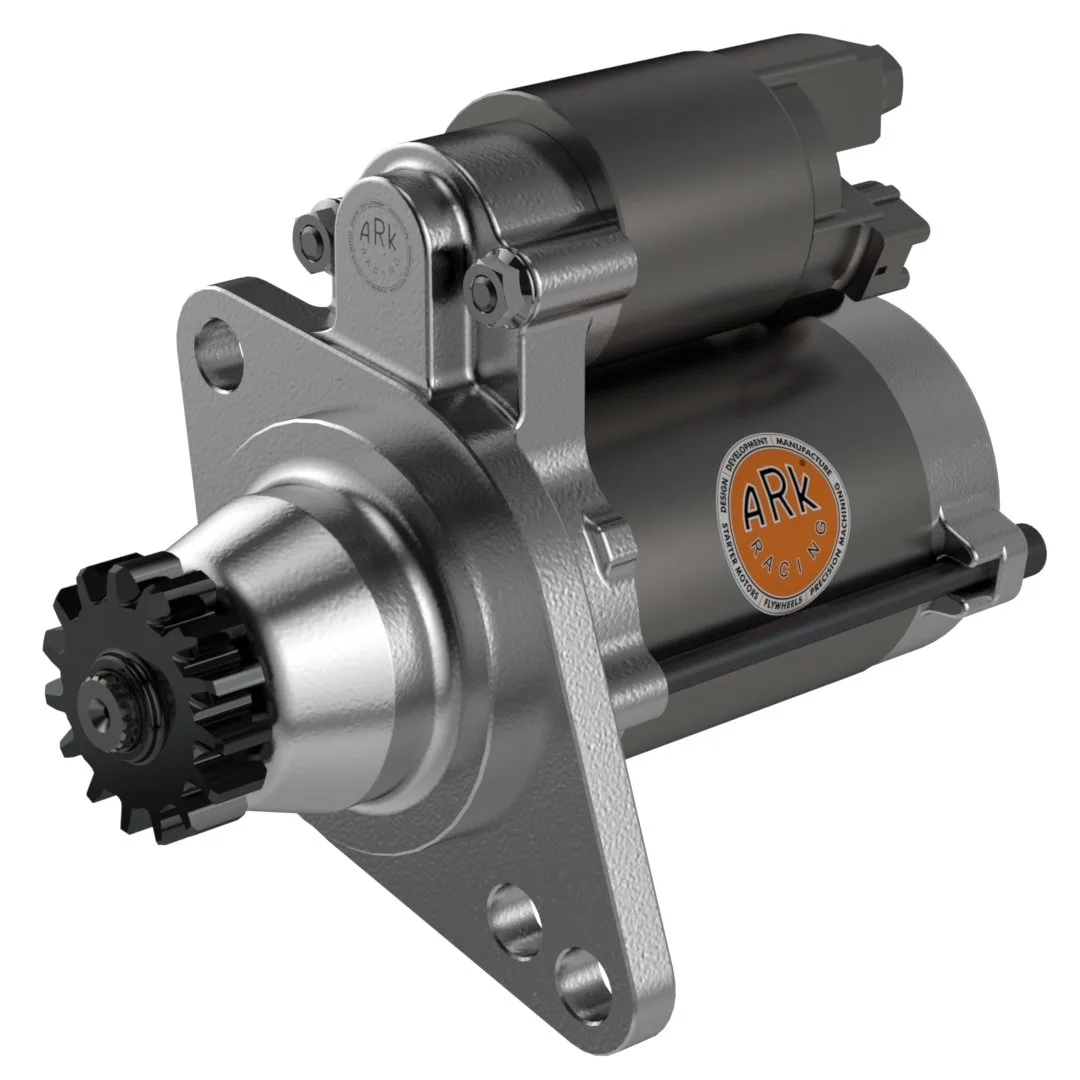
A starter is a heavy-duty electric motor. It spins your engine's crankshaft when you turn the key. That rotation pulls fuel and air into the cylinders.
It also builds compression so the spark plugs can fire. Once the engine catches, the starter disengages instantly.
What a Car Starter Actually Does in Plain English
Think of the starter as the muscle that gets your engine moving. Your engine can't run from a dead stop. It needs help spinning the crankshaft fast enough for the pistons to compress fuel and air.
That first burst of motion is what the starter delivers.
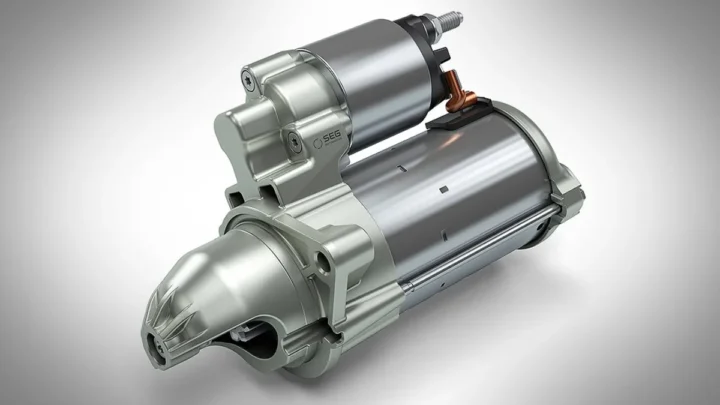
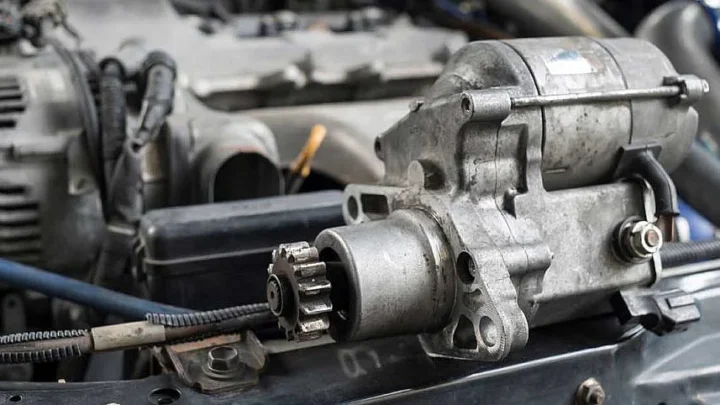
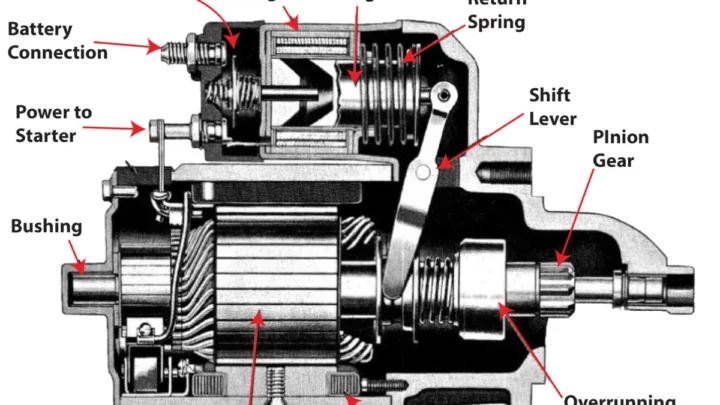
The starter is a compact DC electric motor. It draws a huge slug of current from the battery for a second or two. That energy converts into rotational force at the pinion gear on its nose.
The pinion pops out, meshes with the engine's flywheel, and cranks the engine over.
Manufacturer specifications from firms like Bosch's mobility division confirm most passenger-car starters output between 1.4 and 2.2 kW of peak power. Once the engine fires and makes its own power, the starter's job is done. A one-way clutch inside disengages so the running engine can't spin the motor back at destructive speeds.
The whole event lasts under three seconds on a healthy vehicle.
The 3-Second Sequence: Key Turn to Engine Fire
Here's the exact chain of events from finger to combustion. Nothing on a modern car happens randomly. Each stage triggers the next in a fixed order.
- Step 1: You turn the key to "Start" or press the ignition button.
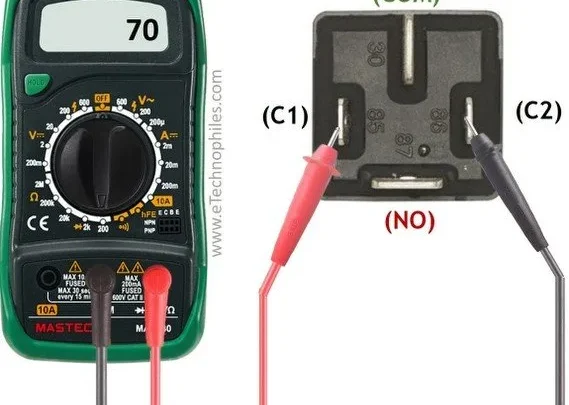
- Step 2: A low-current signal reaches the starter relay.
- Step 3: The relay energises the solenoid mounted on the starter.
- Step 4: The solenoid plunger snaps forward, shoving the pinion gear into the flywheel ring gear.
- Step 5: At the same instant, the plunger closes a heavy contact that dumps full battery current into the motor.
- Step 6: The armature spins fast, cranking the engine to roughly 200 to 300 RPM.
- Step 7: The engine fires. Once its own RPM exceeds cranking speed, the overrunning clutch releases the pinion.
- Step 8: You release the key, the solenoid de-energises, and a return spring pulls the pinion back home.
If any single link fails, the engine won't start. That's why diagnosing a no-crank means walking through this sequence in order. Miss a step and you'll swap the wrong part.
Inside the Starter Motor: Parts You'd See if You Cut One Open
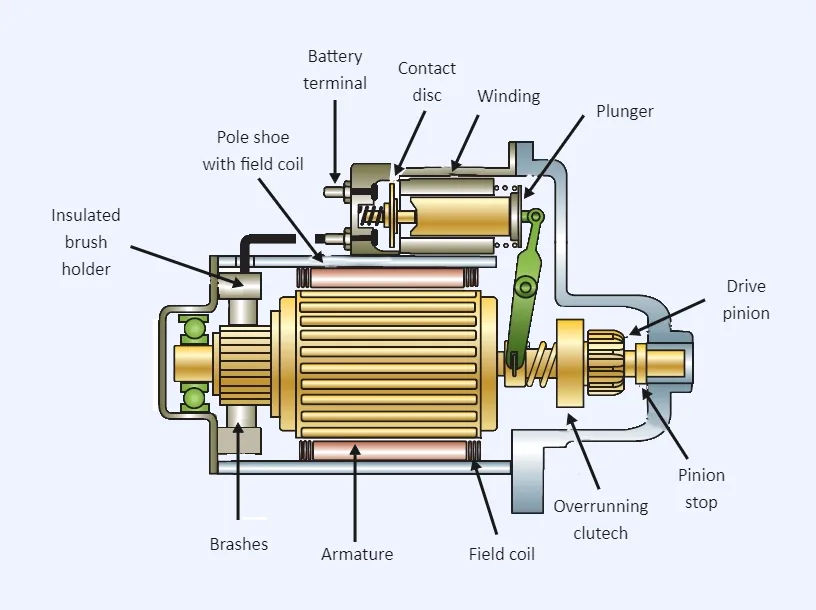
Now let's pop the housing open. A typical passenger-car starter is smaller than a soda bottle but packs surprising density. Every part inside earns its place.
The Solenoid and Plunger
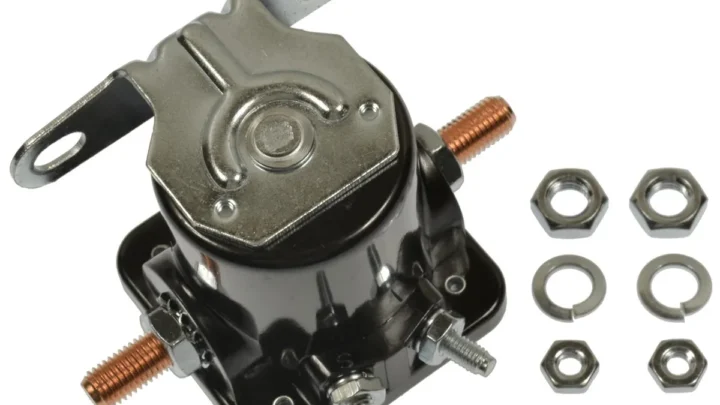
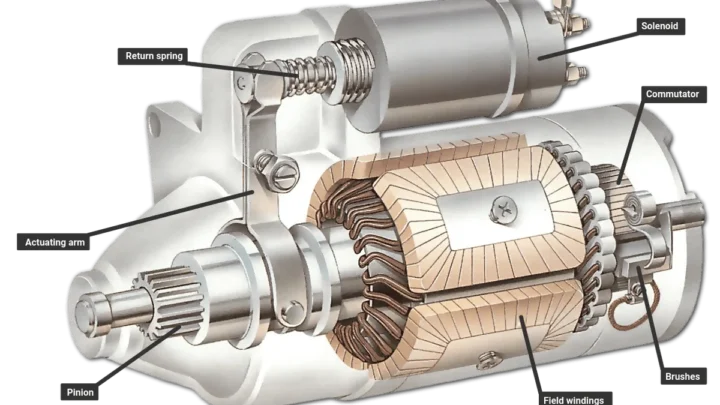
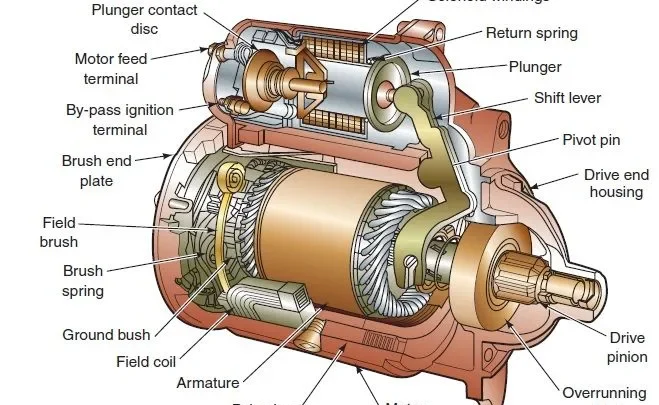
The solenoid is the cylindrical unit sitting on top of, or alongside, the starter body. It's really two things at once. It's an electromagnetic switch that closes the high-current path from the battery.
It also acts as a mechanical shove, pushing the pinion gear out to meet the flywheel through a lever arm.
The Pinion Gear and Bendix Drive
The pinion is the small gear at the nose of the starter. The Bendix drive, named after inventor Vincent Bendix, is what shoots the pinion forward and lets it spin free once the engine takes over. Inside the drive sits a one-way roller clutch that stops the running engine from back-driving the motor.
The Armature, Brushes, and Field Coils
The armature is the rotating core wrapped in copper windings. Carbon brushes ride on the commutator and feed it current. Field coils, or permanent magnets in newer units, create the magnetic field the armature pushes against.
That push is what produces torque.
How the Starter Grabs the Flywheel Ring Gear
This is the mechanical handshake that actually cranks your engine. The flywheel (on manual transmissions) or flexplate (on automatics) has a large toothed ring around its outer edge. That ring gear typically carries 100 to 160 teeth.
The starter's tiny pinion, with only 9 to 15 teeth, gives you a huge gear-reduction advantage.

When the solenoid fires, the pinion is pushed axially into the ring gear. A soft-nosed helical spline on the pinion helps it slide in even if a tooth-on-tooth collision happens for a split second. Once engaged, the small pinion spinning fast turns the big ring slowly but with enormous torque.
That's what forces the crankshaft to rotate against compression.
The moment the engine catches, its own RPM whips the ring gear faster than the pinion can follow. The overrunning clutch releases, the solenoid de-energises, and a return spring snaps the pinion back out of mesh. If any part of that timing goes wrong, you get the grinding sound every driver dreads.
Visual Signs Your Starter Is Working (or Failing)
You can learn a lot about your starter without a single tool. What you see, hear, and even smell during cranking tells the story.
Signs a starter is doing its job:
- Engine cranks smoothly at a steady speed
- Dashboard lights stay bright during crank
- No unusual smells from the engine bay
- Engine catches within one to two seconds
Signs a starter is on its way out:
- Cranking is slow or laboured even with a good battery
- You hear a metallic grinding at the moment of start
- Smoke or a hot electrical smell drifts up after cranking
- The engine sometimes needs two or three key turns before it cranks
Before blaming the starter, rule out the two lookalikes. A tired battery and a corroded ground strap can both mimic starter failure. Our guide on spotting the real culprit walks through the split.
A quick meter check, laid out in our step-by-step method, rules out the cheaper part first.
Sounds a Starter Makes and What Each One Means
Different sounds map to different failure modes. Getting the diagnosis right saves you from swapping the wrong part.
Single Loud Click
A single sharp click means the solenoid pulled in but the motor didn't spin. Nine times out of ten, that's a starter or solenoid contact problem. Sometimes it's a badly corroded battery cable dropping voltage under load.
Rapid Machine-Gun Clicking
Rapid clicking, tick-tick-tick, is almost always a battery problem, not a starter problem. The solenoid engages, voltage collapses, it disengages, then tries again. Check battery voltage and cable connections before touching the starter.
Grinding or Whirring
A metallic grinding on start says the pinion isn't meshing cleanly with the ring gear. Causes include worn pinion teeth, damaged ring-gear teeth, or a stuck Bendix drive. A high-pitched whirring after the engine catches means the pinion didn't retract.
Total Silence
Absolute silence at the key means no signal is reaching the solenoid. Suspect the ignition switch, starter relay, neutral safety switch (automatic) or clutch pedal switch (manual). A blown fuse can kill the whole circuit too.
Direct-Drive vs Gear-Reduction Starters at a Glance
Not every starter looks or works the same. The two main designs on modern cars are direct-drive and gear-reduction, and each has a specific job.
Direct-drive units send armature torque straight to the pinion. They're simple, tough, and common on older or larger engines. They're also heavier and draw more current for the same cranking power.
Gear-reduction starters add a small planetary or offset gearset between the motor and the pinion. That multiplication lets the motor spin faster on less current while still cranking hard. Most modern compact cars, hybrids, and diesels use this design.

| Feature | Direct-Drive | Gear-Reduction |
|---|---|---|
| Size and weight | Larger, heavier | Smaller, lighter |
| Current draw | Higher | Lower |
| Cranking torque | Good | Excellent per amp |
| Cost to replace | Often cheaper | Slightly higher |
| Common on | Older V8s, trucks | Modern cars, diesels |
Aggregate service data suggests gear-reduction units now outsell direct-drive by a wide margin on new-car applications.
Starter vs Solenoid vs Battery vs Alternator: Who Does What
These four parts get blamed for each other constantly. Knowing which does what saves you money and stops parts-cannon diagnosis.
| Part | Job | Fails Like |
|---|---|---|
| Battery | Stores energy for cranking | Slow crank, dim lights, rapid clicking |
| Starter motor | Spins the engine over | Grinding, single click, no crank |
| Solenoid | Switches high current, pushes pinion | Single click, stuck engagement |
| Alternator | Recharges the battery while running | Warning light, dim lights while driving |
The alternator has nothing to do with starting a resting engine. It only matters after the fact. If your battery keeps dying between starts, the alternator's role explains why.
When the pack drains overnight, our guide to a hidden parasitic draw points you at the usual suspects.
Where the Starter Sits on Your Engine and How to Spot It
The starter is bolted to the bell housing where the engine meets the transmission. That's the point where the flywheel or flexplate lives, and the starter has to reach its ring gear. On front-wheel-drive cars, it often hides on the back of the engine block, closer to the firewall.
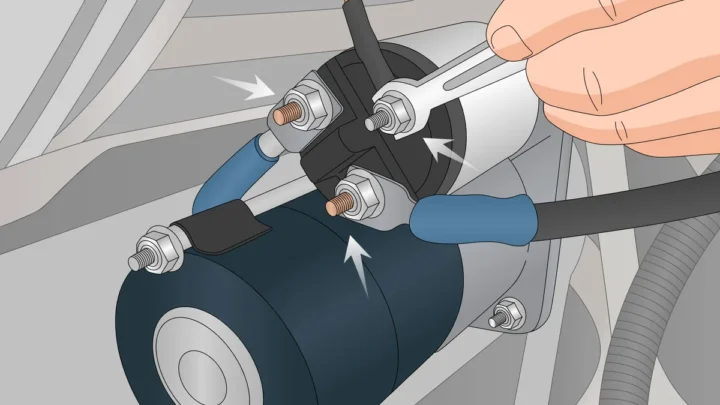
Look for a cylindrical unit about the size of a small thermos with two thick cables running to it. One is the fat positive lead from the battery. The other is the smaller signal wire from the ignition switch.
On some V-engines it's tucked between the intake manifold and the firewall, making removal a knuckle-scraper.
Common Reasons a Starter Fails Before Its Time
Starters are engineered for a long life, often 100,000 miles or more. When they die early, it's usually one of a handful of reasons.
- Heat soak from a nearby exhaust manifold cooking the solenoid windings
- Oil leaks from a failing rear main seal soaking the motor
- Extended cranking on a hard-starting engine burning up the brushes
- Repeated short trips that never fully recharge the battery
- Corroded battery cables raising resistance and cooking the internals
- A worn flywheel ring gear chewing the pinion each start
- Poor grounds between the engine block and chassis
Fixing the root cause matters as much as replacing the part. Drop a new starter into a car with a bad ground or a leaking seal and the new unit fails just as fast. The same logic applies across the whole charging and cranking system.
How Long a Starter Should Last and What Replacement Costs
Aggregate service data puts average starter life at 80,000 to 150,000 miles, though 200,000-plus is common on well-maintained cars. Diesel starters and heavy-truck units see fewer cycles but heavier loads per cycle. Expect a shorter run if you take mostly short trips or live somewhere with brutal summer heat.
Replacement costs vary with vehicle layout and part quality.
| Vehicle type | Parts cost | Typical labour | Total range |
|---|---|---|---|
| Compact car | $120 to $250 | 1 to 1.5 hrs | $250 to $500 |
| Full-size sedan | $180 to $350 | 1.5 to 2.5 hrs | $350 to $700 |
| Truck or SUV | $200 to $500 | 1.5 to 3 hrs | $400 to $900 |
| Diesel or European luxury | $350 to $800 | 3 to 6 hrs | $700 to $1,600 |
Rebuilt and remanufactured units can save 30 to 50 percent. Stick with a reputable brand and check the warranty length before you pick the cheapest bin on the shelf.
Safe Testing Steps Before You Blame the Starter
Nine out of ten no-crank complaints trace to the battery, cables, or grounds. Rule those out first, in this order.
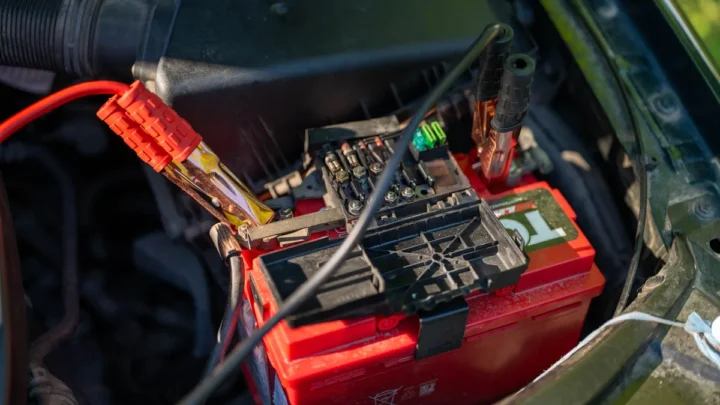
- Check battery voltage at rest. A healthy 12V battery reads around 12.6V with the engine off.
- Load-test the battery, or watch voltage while cranking. If it drops below about 9.6V, the battery is the suspect.
- Inspect and wiggle both battery cables. Green corrosion, loose clamps, or a soft cable under insulation kills current flow.
- Confirm the engine-to-chassis ground strap is clean and tight.
- With the key in "Start", listen for a click at the solenoid. A click means the signal circuit is fine.
- Do a voltage-drop test across the battery cables under crank. Anything over 0.5V per cable means bad wire.
Only after all six checks pass should the starter itself get replaced. For the battery step, our resting-voltage reference shows what a healthy pack should read.

Similar Posts