Car Battery Voltage Chart: What Healthy Numbers Mean
A car battery voltage chart is the fastest way to turn a random meter reading into a real answer about your battery's health. You point a multimeter at the terminals, get a number, and the chart tells you if you're at full charge, half-flat, or about to get stranded. That one number does a lot of work.
But only if you read it under the right conditions.
Here's the baseline. A healthy, rested 12V lead-acid battery reads about 12.6 to 12.8 volts at 100% charge, measured near 77°F (25°C). Standards groups like SAE International tie those numbers to a settled, open-circuit state, not a battery you just drove.
As of 2026, that rested reading is still the quickest honest check you can run. Let's start with what the chart is actually measuring.
Quick Answer
A car battery voltage chart maps resting voltage to state of charge. A healthy 12V battery reads 12.6 to 12.8 volts when fully charged. 12.4 volts means about 75% charge. 12.2 volts is roughly 50%. Anything near 12.0 volts or below is nearly flat.
What a Car Battery Voltage Chart Actually Tells You
A voltage chart tells you your battery's state of charge, which is how full it is right now. Think of it like a fuel gauge for stored energy. It does not tell you how healthy the battery is or how much power it can still deliver.
That gap trips a lot of people up. A tired, three-year-old battery can still show 12.6 volts sitting in the driveway. Then it dies the second you ask it to crank a cold engine.
Voltage shows the charge level. Capacity shows the strength.
So use the chart for what it's good at:
- Checking if the battery is charged, low, or dead
- Spotting a slow drain overnight
- Confirming your alternator topped it off after a drive
- Deciding whether to charge, jump, or run a real load test
If the number looks fine but the car still cranks slowly, don't stop there. You'll want to put it under load to see what the battery actually does when it's working. Voltage is the first clue, not the verdict.
The Quick Chart: Voltage to State of Charge at a Glance
Here's the reference most people come looking for. These numbers are for a standard 12V flooded lead-acid battery, rested and at roughly room temperature.
| Resting voltage | State of charge | What it means |
|---|---|---|
| 12.6 to 12.8V | 100% | Fully charged, good to go |
| 12.4V | ~75% | Healthy, slight top-up won't hurt |
| 12.2V | ~50% | Getting low, recharge soon |
| 12.0V | ~25% | Weak, may struggle to start |
| 11.9V or below | 0% | Discharged, needs charging now |
One thing to burn into memory: a "12-volt" battery that actually reads 12.0 volts is not full. It's about a quarter charged. The nominal name and the real full-charge number are not the same.
If you remember one line from this whole guide, make it 12.6 equals full.
12V Battery Voltage Chart (Resting / Open-Circuit)
Resting voltage, also called open-circuit voltage, is the reading you get with the engine off and nothing pulling power. It's the only reading that lines up cleanly with the chart above. Take it too soon and the number lies to you.
A 12V lead-acid battery is really six cells wired in series. Each fully charged cell sits around 2.1 volts. Six times 2.1 gives you that 12.6 to 12.7 figure.
When a single cell fails, the whole pack often drops by roughly 2 volts, landing near 10.5. That's a classic dead-cell signature.
For a true resting reading, give the battery time to settle:
- Let it sit 12 hours or more after driving or charging, if you can
- No headlights, no charger, no accessories running
- Short on time? Flick the headlights on for two minutes, then off, to bleed off the surface charge
If a meter isn't within reach, there are a few workarounds that give you a rough sense of charge, though none match a real voltage reading. When you do grab the meter, the right dial setting matters just as much as touching the probes to the right posts.
Reading the Numbers: Resting vs. Cranking vs. Charging Voltage
Your battery shows three different voltages depending on what's happening. Mixing them up is the number one reason people misread a battery. Here's how they split out.
Resting voltage is the engine-off, settled reading. This is the one that maps to the state-of-charge chart. Aim for 12.6V or higher.
Cranking voltage is what the battery drops to while the starter spins. A strong battery holds above about 9.6 volts during that split-second draw. Sag well below that, and the battery is weak even if it rested at 12.6.
Charging voltage is what you read with the engine running. The alternator pushes the number up to feed the battery and the car's systems. Normal range is roughly 13.7 to 14.7 volts.
| Reading | When to measure | Healthy range |
|---|---|---|
| Resting (open-circuit) | Engine off, rested | 12.6 to 12.8V |
| Cranking | While starting | Stays above ~9.6V |
| Charging (alternator) | Engine running | 13.7 to 14.7V |
So if you read it off the terminals right after a drive and see 13.2 volts, don't celebrate. That's leftover surface charge, not a true 100%. Let it rest, then read again.
AGM, EFB, and LiFePO4 Voltage Charts (They're Not the Same)
Not every battery follows the lead-acid chart. AGM, EFB, and lithium packs each read a little differently, and using the wrong chart gives you the wrong answer. This is where generic advice falls apart.
AGM (Absorbent Glass Mat) and EFB (Enhanced Flooded Battery) are still lead-acid at heart, so they track close to the standard chart. AGM just tends to read a touch higher when full, often 12.8 to 13.0 volts. When you're checking an AGM pack, treat anything under 12.8 as room to top up.
LiFePO4 (lithium iron phosphate) is a different animal. Its voltage stays almost flat across most of its usable range, hovering around 13.2 to 13.3 volts from nearly full down to nearly empty. That flat curve means voltage alone barely tells you the charge level.
You lean on the battery's management system instead.
| Battery type | Full-charge resting voltage | Reads on lead-acid chart? |
|---|---|---|
| Flooded lead-acid | 12.6 to 12.8V | Yes |
| AGM | 12.8 to 13.0V | Close, runs slightly higher |
| EFB | 12.6 to 12.8V | Yes |
| LiFePO4 (lithium) | 13.2 to 13.4V | No, flat curve |
The takeaway is simple. Match the chart to the chemistry. Deep-cycle setups in RVs and boats follow the same rule, and testing a deep-cycle pack by the wrong chart will have you second-guessing a perfectly good battery.
How to Test Your Car Battery Voltage With a Multimeter
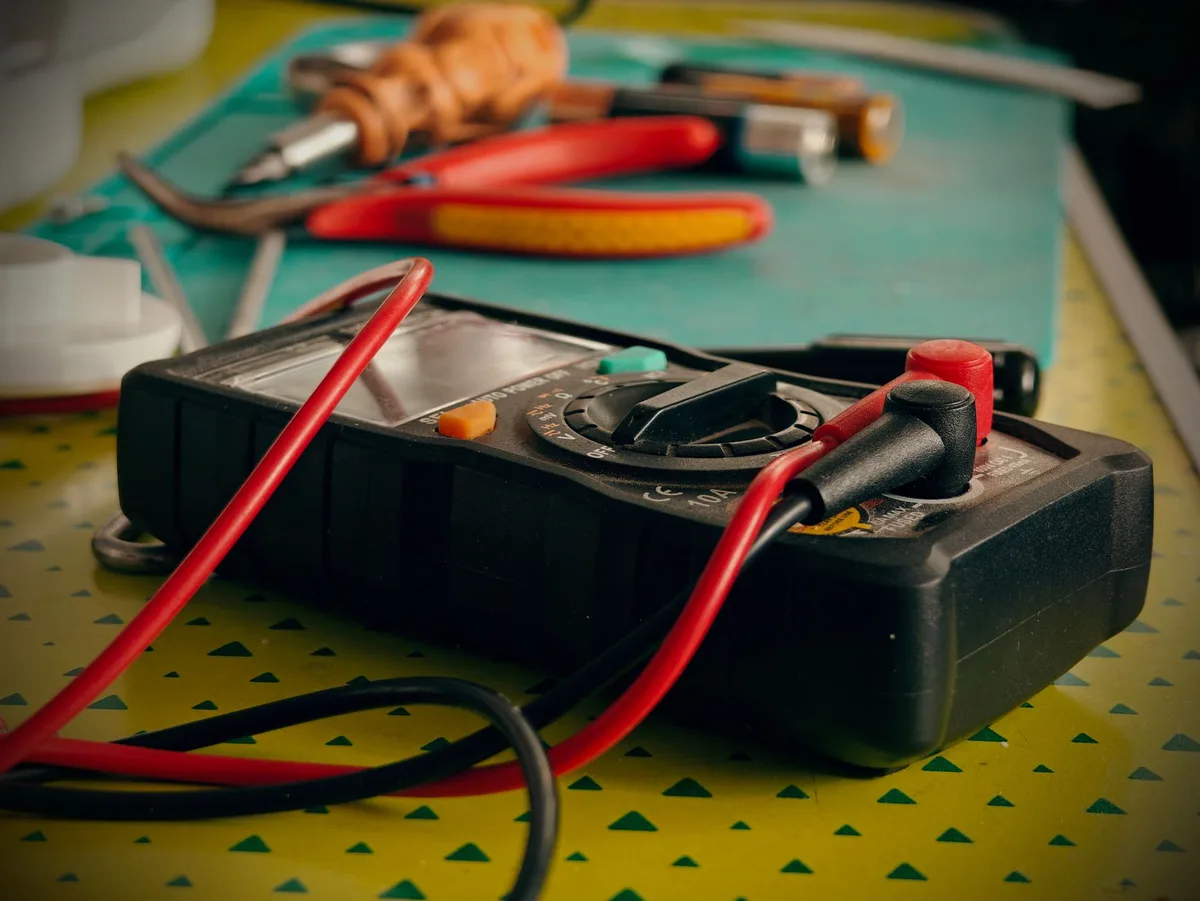
Testing takes about two minutes and a cheap digital multimeter. The trick is doing it in the right order so the number actually means something.
Step-by-Step Reading
Follow these steps for a clean reading:
- Turn off the engine, lights, and every accessory
- Set the meter to DC volts, on the 20V range
- Touch the red probe to the positive (+) terminal
- Touch the black probe to the negative (−) terminal
- Read the number and match it to the chart
If your meter isn't auto-ranging, dialing in 20V DC gives you the resolution you need for those small decimal differences. A reading of 12.55 versus 12.65 matters, so you want two decimal places.
Got the probes backward? On most digital meters you'll just see a minus sign in front of the number. No harm done.
Flip the probes and read it clean. The full terminal-to-terminal method is the same whether the battery is standard or AGM.
Killing the Surface Charge for a True Reading
Surface charge is a temporary voltage bump left over from driving or charging. It can make a half-tired battery look fully charged for an hour or two. That's why a battery can read 12.8 right after a drive, then settle to 12.3 overnight.
To clear it fast, switch on the headlights for one to two minutes, then turn them off and wait a minute. Now take your reading. What you're left with is much closer to the true resting voltage.
Why Temperature Changes Your Voltage Reading
Temperature shifts your voltage reading, and cold weather is the sneaky culprit. The chart assumes about 77°F (25°C). Read a battery in freezing conditions and the numbers drift, plus the battery simply delivers less punch.
Cold slows the chemical reaction inside the battery. A pack that cranks fine in summer can struggle at 10°F because its available power drops sharply. The resting voltage may look okay while the cranking performance quietly falls off a cliff.
Here's the practical version:
- In the cold, a "healthy" 12.5V reading has less real muscle behind it
- Heat is worse long-term, speeding up water loss and plate wear
- For accuracy, let the battery reach a stable temperature before judging the number
So don't panic over a slightly low winter reading. But don't ignore a slow crank either. That combination is your early warning that the battery is on borrowed time.
Voltage Isn't the Whole Story: When to Load Test Instead
A voltage reading shows charge, but a load test shows strength. This is the step that catches a battery about to fail. If your car cranks slowly yet the resting voltage looks fine, the load test is where the truth comes out.
Under load, a good battery holds its voltage steady while delivering current. A worn one nosedives. During cranking, watch for the voltage to stay above roughly 9.6 volts.
Drop below that and the battery can't keep up with the starter's demand.
You have two easy options:
- Watch cranking voltage on your meter while a helper starts the car
- Use a dedicated load tester or a conductance (CCA) tester for a firmer answer
Running a proper under-load check separates a battery that just needs charging from one that's genuinely done. When the numbers are borderline, a quick amp draw reading adds another data point before you spend money.
Common Mistakes That Give You a False Voltage Reading
Most bad readings come from testing at the wrong moment or blaming the wrong part. Here are the errors we see most often, and how to dodge them.
- Reading surface charge: testing right after driving inflates the number. Rest it first.
- Skipping the rest period: even 30 minutes helps, 12 hours is better.
- Confusing voltage with health: 12.6V on a dying battery still cranks poorly.
- Dirty or loose terminals: corrosion adds resistance and skews everything.
- Blaming the battery too soon: a bad ground or cable mimics a weak battery.
That last one matters. Before you condemn the battery, rule out the connections. A quick ground path check or a look at the cables themselves often finds the real fault.
A voltage drop test will expose hidden resistance that a plain terminal reading hides.
And if the battery keeps dying overnight, the issue may not be charge at all. Hunting down a parasitic drain can save you from replacing a perfectly good battery.
What Your Alternator Voltage Should Read While Running
With the engine running, your battery should read 13.7 to 14.7 volts. That higher number is the alternator doing its job: recharging the battery and powering the car at the same time. See the chart's resting range while the engine runs, and something's wrong.

Here's how to read the running numbers:
- 13.7 to 14.7V: charging system is working normally
- Below 13.0V: alternator may be underperforming, battery slowly drains
- Above 15.0V: overcharging risk, which can cook the battery and boil electrolyte
- Flickering, unstable numbers: often a failing diode or loose belt
Turn on the headlights, AC, and rear defroster, then watch the reading. A strong system holds voltage under that extra load. A weak one sags.
If the charging voltage looks off, an alternator output test confirms it, and checking the rectifier diodes pins down that flickering, unstable reading.
Safe Testing: Acid, Hydrogen Gas, and Correct Polarity
Batteries are safe to test, but they earn a little respect. A charging battery gives off hydrogen gas, which is flammable. Keep sparks, cigarettes, and open flames well away from it.
The electrolyte inside is sulfuric acid. Wear eye protection, and don't touch any weeping or crusty residue with bare hands. If acid contacts skin, rinse with plenty of water right away.
Mind your connections, too:
- Match polarity: red to positive, black to negative
- When disconnecting, remove the negative (−) cable first
- When reconnecting, attach the negative last
- Never lay a metal tool across both terminals
A bulging case, a rotten-egg smell, or heavy corrosion means stop and replace, not test. Those are signs of an overcharged or internally failing battery.
Expert Tips for Tracking Battery Health Over Time
The smartest move is logging your resting voltage every few weeks. One reading tells you today's charge. A trend tells you the battery's future.
Keep a simple habit going:
- Test at the same time of day, ideally after a long rest
- Note the number and the rough temperature
- Watch for a slow, steady decline over months
If a fully charged battery keeps settling lower each month, it's aging out. Most flooded lead-acid batteries last three to five years. Once a rested reading won't climb past 12.4V even after a full charge, its days are numbered.
One more tip: recharge a low battery promptly. Leaving it at 12.2V or below invites sulfation, which permanently steals capacity. A smart charger and quick action save many batteries that owners would otherwise toss.
When to Charge, Jump, or Just Replace the Battery
Your reading points to the right next step. Match the number to the action and skip the guesswork.
| Resting voltage | Best move |
|---|---|
| 12.6V or higher | Nothing needed, battery is charged |
| 12.2 to 12.5V | Recharge with a smart charger, then retest |
| 12.0 to 12.1V | Charge fully, then load test for hidden weakness |
| Below 12.0V | Charge and test, replace if it won't hold |
| Drops below 9.6V cranking | Battery is failing, plan a replacement |
A jump start is a get-home fix, not a cure. If you jump the car and it dies again after sitting, the battery isn't holding charge or something is draining it.
Here's the simple logic. Charges up and holds? Keep it.
Charges up but fails under load? Replace it. Won't take a charge at all?
It's done.
Frequently Asked Questions
What voltage is too low for a car battery?
Anything at or below 12.0 volts at rest is too low, sitting near 25% charge. Below 11.9 volts, the battery is essentially flat. At those levels the car may not start, and the battery needs a full recharge before you trust it again.
Is 12.4 volts a good car battery reading?
12.4 volts is decent but not full, representing about 75% state of charge. The battery will still start most cars fine. For best health, top it off with a charger or a longer drive so it climbs back toward 12.6 volts.
Why does my battery read 12.6V but still won't start the car?
Voltage shows charge, not strength. A battery can hold 12.6 volts at rest yet collapse under the starter's heavy draw. That points to low capacity, a bad cell, or corroded connections.
A load test or voltage drop check will confirm the real culprit.
What should battery voltage be while driving?
While the engine runs, expect 13.7 to 14.7 volts. That range shows the alternator is charging the battery and running the car's electronics. A reading below 13 volts suggests a weak charging system, while above 15 volts signals overcharging.
How long should a battery rest before testing?
Give it at least a few hours, and 12 hours is ideal for a true open-circuit reading. If you're in a hurry, run the headlights for two minutes to clear the surface charge, then wait one minute before measuring. This gets you close to the real number.
Does cold weather lower battery voltage?
Yes, cold reduces both the reading and the battery's available power. The chemical reaction slows in freezing temperatures, so a battery that tests fine in summer may crank weakly in winter. Slow cranking plus a slightly low reading is your cue to test capacity.

Similar Posts