Car Battery Voltage When Off: What’s Normal and What’s Not

If you've ever put a multimeter on your car battery and wondered whether that number is good news or bad news, you're in the right place. Car battery voltage when off should sit around 12.6 volts, but the real story lives in the decimals. A few tenths of a volt separate a healthy battery from one that's quietly dying in your driveway.
Manufacturer specifications from major battery brands put a fully charged 12V lead-acid battery at 12.6 to 12.8 volts at rest. Anything below 12.4 volts means trouble is already brewing. Before you can read your own battery like a pro, it helps to understand what "normal" actually looks like.
Quick Answer
A healthy car battery reads 12.6 to 12.8 volts when off. That reading is called resting voltage or open-circuit voltage. A reading of 12.4 volts means roughly 75% charge.
Below 12.0 volts, the battery is deeply discharged. Around 10.5 volts usually means a dead cell and replacement time.
Why a 12-Volt Battery Actually Reads 12.6 Volts
Here's the thing that confuses almost everyone. Your "12-volt" battery is only nominally 12 volts. The real number comes from the chemistry inside.
A standard car battery contains six cells wired in series. Each cell produces about 2.1 volts when fully charged. Six times 2.1 gives you 12.6 volts, and that's your true full-charge baseline.
If you're curious how those cells actually generate power, the lead-acid chemistry inside is worth five minutes of your time.
This matters for one big reason. If you see 12.0 volts and think "great, it's a 12-volt battery, so it's full," you've got it backwards. At 12.0 volts, your battery is sitting at roughly 25% charge.
That's not full. That's nearly empty.
The gap between "looks fine" and "is fine" lives in that 0.6-volt window. Our research across manufacturer spec sheets shows the entire usable range, from 100% down to fully discharged, spans barely one volt. Every tenth of a volt represents a meaningful chunk of charge.
That's why a cheap digital multimeter beats guessing every single time.
One more nuance. Voltage varies slightly by battery construction. A standard flooded battery tops out around 12.6 to 12.7 volts.
An AGM battery reads a touch higher, often 12.8 to 13.0 volts when fully charged. We'll cover those differences in detail later, but keep it in mind as you read your own numbers.
Car Battery Voltage Chart: What Each Reading Means When the Car Is Off
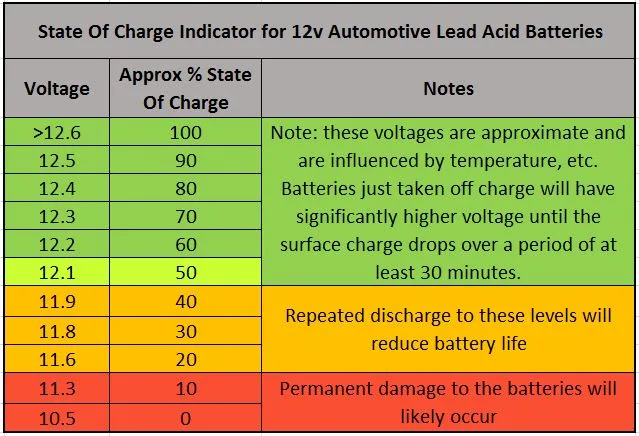
Tape this chart inside your garage cabinet. It translates every resting voltage reading into a state of charge, which is the percentage of energy your battery is actually holding.
| Resting Voltage | State of Charge | What It Means |
|---|---|---|
| 12.6V or higher | 100% | Healthy and fully charged |
| 12.4V to 12.5V | ~75% | Undercharged, needs a top-up |
| 12.2V to 12.3V | ~50% | Low, recharge soon |
| 12.0V to 12.1V | ~25% | Deeply discharged, act now |
| 11.9V or below | ~0% | Fully discharged, damage likely |
| ~10.5V | Dead cell | Replace the battery |
A few things jump out from that table. First, the difference between "perfect" and "problem" is only 0.2 volts. Second, 12.4 volts is not fine, even though it sounds close to full.
A battery living at 75% charge is slowly sulfating, which means lead sulfate crystals harden on the plates and permanently steal capacity.
Third, notice how brutal the bottom of the chart is. Lead-acid batteries hate deep discharge, and every trip below 12.0 volts shortens their life. As of 2026, typical replacement costs run $100 to $250 or more, so those decimals carry real money.
One critical caveat before you trust the chart. Resting voltage tells you state of charge, not state of health. A worn-out battery can charge to 12.6 volts and still collapse the moment your starter asks for 200 amps.
That's where cranking specs come in, and understanding cold-weather cranking ratings helps you see the full picture. We'll walk through that trap in its own section.
Before You Trust Any Reading: Surface Charge and Why Timing Matters
If you test your battery right after driving, your reading is lying to you. Not by a little, either.
Here's why. While the engine runs, the alternator pushes the system to 13.8 to 14.7 volts. When you shut the car off, the battery plates hold a temporary "skin" of extra voltage called surface charge.
A tired battery can read 12.8 volts twenty minutes after a drive, then sag to 12.3 volts by morning.
So the golden rule is simple. Test after the car has sat with everything off, and the longer the better.
- Best: let the car sit overnight, 8 to 12 hours, then test before your first start of the day.
- Acceptable: wait at least 1 to 4 hours after driving.
- In a hurry: turn the headlights on for 30 to 60 seconds, turn them off, wait two minutes, then test. The lights burn off the surface charge.
Temperature plays a role too. Battery voltage drifts down slightly in cold weather, and that's normal chemistry rather than a fault. A battery reading 12.5 volts on a freezing morning may be healthier than the number suggests.
Don't condemn a battery over 0.1 volts on a frosty day.
One more timing tip from our research. Test at the same point in your routine each time, ideally first thing in the morning. Consistent conditions turn a one-off number into a trend, and trends catch dying batteries weeks before they strand you.
How to Test Resting Voltage With a Multimeter (Step by Step)
You need a digital multimeter, ten minutes of patience, and nothing else. If you've never held one before, our walkthrough on taking your first measurement covers the basics, but the battery test below is beginner-friendly.
Follow these steps in order:
- Let the car rest. Overnight is ideal. Everything off, doors closed, key out.
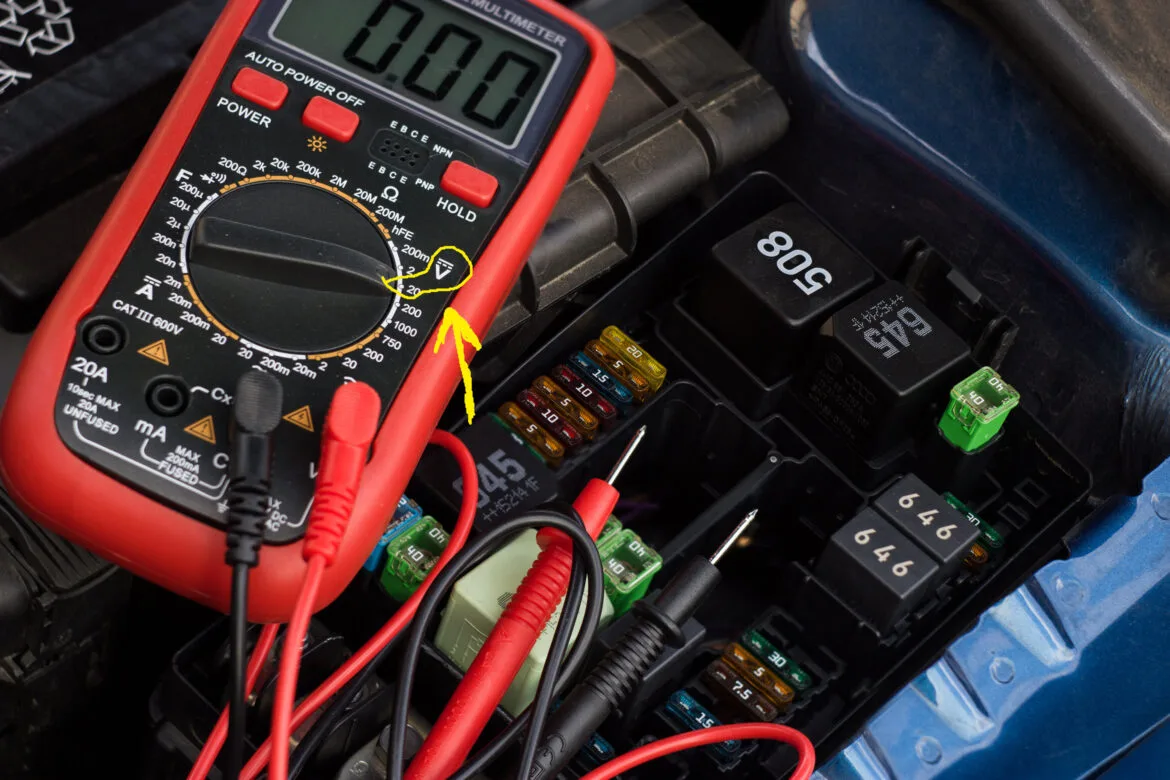
- Set the meter to DC volts. That's the V with a straight line, sometimes marked DCV. On a manual-ranging meter, pick the 20V range. If those markings look cryptic, this primer on that DCV setting clears it up fast.
- Find the battery posts. Pop the hood and locate the positive post (red cover, plus symbol) and the negative post (black, minus symbol).
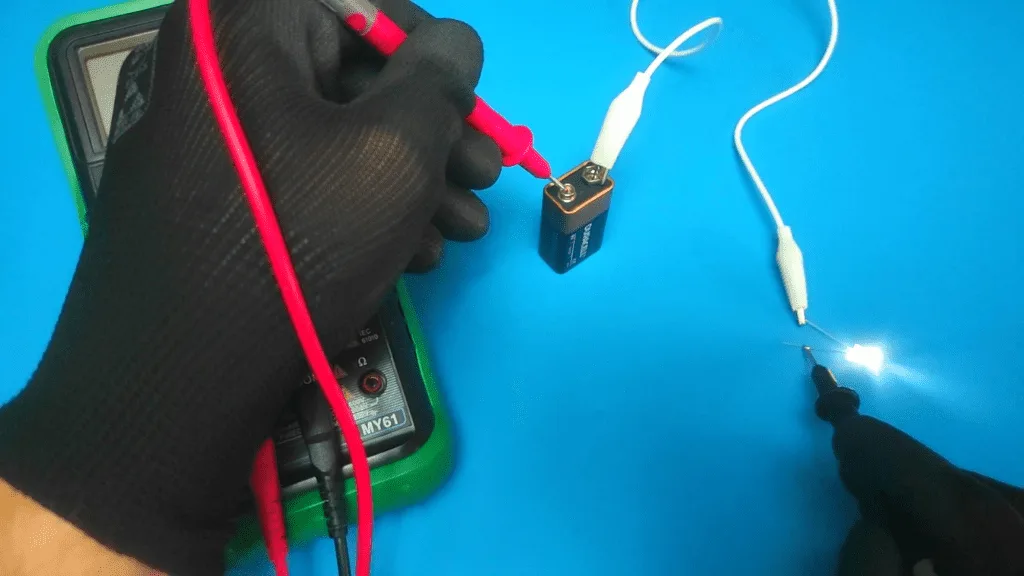
- Connect the probes. Red probe to positive post, black probe to negative post. Touch the metal posts directly, not the clamps, for the truest reading.
- Read the display. A healthy battery shows 12.6 volts or more. Note the exact number, decimals included.
- Compare against the chart. Use the table above to translate your voltage into a state of charge.
A few practical pointers make this test more reliable. Clean any white or green corrosion off the posts first, because crusty terminals can skew probe contact. Don't let the probe tips bridge both posts at once, since shorting them with metal creates serious sparks.
And if your display shows a negative number like -12.6, you've simply reversed the probes. Swap them and carry on.
Accuracy matters here more than in most DIY jobs, because you're judging a battery on tenths of a volt. Even a $15 meter is fine for this, but check its reading against a known source if results seem odd. If the display itself confuses you, our guide to making sense of the readout fills the gap.
For deeper background on lead-acid behavior, the U.S. Department of Energy publishes solid battery science resources at energy.gov.
Write your reading down with the date. Seriously. A logbook of morning voltages is the cheapest battery-health monitor money can buy, and it feeds directly into the decision tree coming next.
What to Do Based on Your Reading: The Decision Tree
You've got a number on the meter. Now let's turn it into a decision. Find your reading below and follow the branch.
12.6V or Higher: Probably Healthy, But Run One More Check
If you read 12.6 volts or better after an overnight rest, your state of charge is excellent. The charging system is doing its job and the battery is accepting a full charge.
But don't stop there if you've had symptoms. Slow cranking, dimming lights at idle, or a click on cold mornings all point past charge level to capacity. If any of those sound familiar, get a free load test at a parts store.
Voltage says the tank is full. It says nothing about the size of the tank.
If there are no symptoms, you're done. Retest in a month and keep your log going.
12.2V to 12.5V: Undercharged, Not Dead, Recharge and Retest
A reading in this band means your battery is running at 50% to 75% charge. The battery isn't necessarily bad. Something is keeping it from reaching full, and short trips are the usual suspect.
Here's the workflow. Charge the battery fully with a proper charger, not just a long drive. Let it rest overnight after charging, then test again.
- If it holds 12.6V or more: the battery is fine. Look at your driving pattern or a small parasitic draw.
- If it sags back to 12.4V or lower: the battery is losing its ability to hold charge. Load test it and start pricing replacements.
Don't ignore this band. A battery parked at 12.3 volts for weeks is sulfating the whole time, and that damage doesn't reverse.
Below 12.0V: Deeply Discharged, Here's the Recovery Path
Under 12.0 volts, your battery is nearly empty and actively being damaged. Lead-acid chemistry breaks down fast in a deep discharge. Act the same day if you can.
Put it on a smart charger and give it time, often 8 to 12 hours at low amperage. Fast charging a deeply discharged battery cooks the plates, so slow is better. Once it's charged, rest it overnight and test again.
Then apply the same fork as above. Holds 12.6? Hunt for the cause of the discharge, because healthy batteries don't drain themselves to 11.8 volts without help.
Won't hold charge? It's done. A battery that's been below 12.0 volts more than once or twice rarely recovers its full capacity.
Around 10.5V: The Dead-Cell Signature, Time to Replace
If you read roughly 10.5 volts, one cell has shorted internally. Remember the math from earlier: six cells at 2.1 volts each. Lose one and you get five times 2.1, which is 10.5 volts.
The meter is telling you exactly what broke.
No charger fixes a shorted cell. Charging it can actually be dangerous, since the failed cell overheats while the others overcharge. Skip the rescue attempts and replace the battery.
Check the expected service life numbers for your climate first, because a dead cell at year six is normal wear, while a dead cell at year two suggests a charging system problem worth fixing before you install the new battery.
Voltage Looks Fine but the Car Won't Start? State of Charge vs State of Health
Yes, a battery can read a perfect 12.6 volts and still leave you stranded. This is the single most misunderstood thing about battery testing, so let's make it concrete.
State of charge is how full the battery is right now. State of health is how much capacity the battery has left compared to when it was new. Resting voltage only measures the first one.
Think of it like a fuel gauge on a shrinking tank. A new battery at 12.6 volts might hold enough energy to crank your engine thirty times. A five-year-old battery at the same 12.6 volts might manage two cranks before collapsing.

Both show identical voltage at rest. Only one starts your car in January.
Why does this happen? Aging plates shed material and sulfate deposits eat active surface area. The battery still charges to full voltage, but "full" keeps getting smaller.
Internal resistance also climbs, so voltage crashes the instant a heavy load hits.
That's why the pros use two different tests:
| Test | What It Measures | Where to Get It |
|---|---|---|
| Resting voltage | State of charge | Your multimeter, free |
| Load or conductance test | State of health | Parts stores, usually free |
The load test applies a heavy draw and watches how far voltage falls. A healthy battery stays above roughly 9.6 volts while cranking. A worn one plunges into the 7s or 8s even when its resting voltage looked perfect.
Specs like the reserve capacity rating exist precisely because voltage alone can't describe how much work a battery can actually do.
The practical rule: use your multimeter monthly for charge, and get a load test once a year after the battery turns three. Together they catch nearly everything.
Battery Keeps Draining Overnight: Hunting a Parasitic Draw
If your battery tests healthy but keeps dying, something in the car is drinking power while it sits. That's a parasitic draw, and it's a wiring problem, not a battery problem.
Some draw is normal. Modern cars keep computers, alarms, and keyless entry modules on standby around the clock. Our research puts a normal key-off draw at 25 to 85 milliamps once all the modules go to sleep, which can take 30 to 45 minutes after locking the car.
Anything much above 100 milliamps will drain a battery over days or weeks.

Here's the classic hunt, simplified:
- Charge the battery fully first. A drained battery muddies every result.
- Set your meter to measure amps and move the red lead to the high-amp port. If you're fuzzy on that jack, here's what the dedicated amp input is actually for.
- Disconnect the negative battery cable. Connect the meter in series between the cable and the negative post.
- Wait for the modules to sleep. Give it 30 to 45 minutes with the doors closed and key away from the car.
- Read the draw. Under 85 milliamps, you're normal. Over 100, keep going.
- Pull fuses one at a time. Watch the meter as you go. When the reading drops, you've found the guilty circuit. Chase down what's on it.
The usual offenders are unglamorous. Trunk and glovebox lights that never switch off, aftermarket stereos wired to constant power, dashcams on cheap hardwire kits, and sticky relays top the list. Faulty body control modules that never sleep show up too, especially on 2010s-era vehicles.
Two warnings before you start. Never crank the engine with the meter wired in series, because starter current will vaporize the meter's fuse instantly. And if you've already blown the internal fuse once doing current tests, you'll know the amp setting deserves respect.
If the draw hunt feels beyond your comfort level, that's fair. A shop can run it with an amp clamp in under an hour, and the diagnostic fee beats buying batteries every four months.
Is It the Battery or the Alternator? The 2-Minute Rule-Out Test
One voltage reading with the engine running settles this argument. It's the fastest diagnostic in this whole article.
Start the engine. Put your meter across the battery posts exactly as before, red to positive, black to negative. Now read the number with the engine idling.
- 13.8 to 14.7 volts: the alternator is charging properly. If your battery keeps dying anyway, suspect the battery itself or a parasitic draw.
- Under 13.5 volts at idle: the charging system is weak. The battery may be an innocent victim that's simply never getting refilled.
- Over 15 volts: the voltage regulator is overcharging. That cooks batteries and can damage electronics, so get it fixed promptly.
Rev the engine to about 2,000 rpm and watch again. The reading should stay in that 13.8 to 14.7 band. If it climbs into a healthy range only when revved, worn alternator brushes or a slipping belt are likely.
Then flip on the headlights, blower fan, and rear defroster with the engine idling. Voltage should hold above roughly 13.5. A big drop under load means the alternator can't keep up with demand.
Here's why this test matters so much for your wallet. Aggregate repair data shows batteries get replaced for alternator problems constantly. The new battery works for two weeks on its factory charge, then dies, because nothing was recharging it.
Two minutes with a meter prevents that entire cycle. If both readings check out and the car still struggles, revisit the load test, since cranking power is a matter of amperage delivery rather than voltage alone.
How Temperature and Season Change Your Readings
Cold weather lowers resting voltage slightly, and that's chemistry, not failure. The electrolyte reactions inside a lead-acid battery slow as temperature drops. A healthy battery that reads 12.66 volts at 77°F might show 12.55 on a 20°F morning.
Don't panic over a few hundredths in winter.
The bigger winter problem isn't the resting number. It's available cranking power. At 0°F (-18°C), a lead-acid battery delivers only a fraction of its rated output, while your cold engine demands more current than ever.
That's why marginal batteries fail on the first hard freeze. They didn't die that morning. They'd been weak since summer.
And summer is the real killer, according to industry group Battery Council International. Heat accelerates grid corrosion and evaporates electrolyte, quietly destroying capacity during July. The damage just doesn't show up until December asks for maximum cranking amps.
Owners in Phoenix or Houston replace batteries every 3 to 4 years, while drivers in mild coastal climates often see 5 or 6.
Season your testing routine accordingly:
- Early fall: test resting voltage and get a load test. This catches summer damage before the first freeze.
- Winter mornings: allow a small voltage discount for cold. Judge trends, not single readings.
- Spring: retest anything that struggled in winter. A battery that barely survived January rarely survives the next one.
One climate-specific tip from manufacturer guidance: never charge a battery that may be frozen. A deeply discharged battery can freeze because its electrolyte is closer to plain water. Bring it somewhere warm, let it thaw fully, then charge slowly.
AGM, EFB, and Stop-Start Batteries: Slightly Different Numbers
If your car has stop-start, your battery probably isn't a standard flooded type, and the voltage targets shift a little. Modern stop-start systems use either an absorbed glass mat design or an enhanced flooded battery, both built to survive constant cycling.
The chemistry is still lead-acid, but the construction changes the resting numbers. Here's the comparison at a glance:
| Battery Type | Full Charge (Resting) | Worry Threshold |
|---|---|---|
| Standard flooded | 12.6V to 12.7V | Below 12.4V |
| EFB | 12.6V to 12.8V | Below 12.4V |
| AGM | 12.8V to 13.0V | Below 12.5V |
The trap sits in that AGM row. An AGM battery reading 12.6 volts looks perfect by flooded standards, but it's actually sitting around 90% or lower. Judge it against its own scale.
The glass-mat design details explain why the tighter plate packing produces higher resting voltage.
EFB behaves closer to a standard flooded battery on the meter. It's essentially a reinforced flooded design built for moderate stop-start duty, and this enhanced flooded construction splits the difference on both price and performance.
Two practical notes for stop-start owners. First, use a charger with an AGM mode when topping up, because standard charging profiles can overheat an AGM. Second, never downgrade a stop-start car to a cheaper flooded battery.
The system will cycle it to death within a year or two. If you're unsure what's under your hood, sorting out which construction your car uses takes two minutes on the label.
Mistakes That Ruin a Voltage Test (and Waste Money on Good Batteries)
Most bad diagnoses trace back to the same handful of testing errors. Skim this list before you condemn a battery or, worse, trust a dying one.
- Testing right after driving. Surface charge adds a false 0.2 to 0.4 volts. Test after an overnight rest, always.
- Testing with the doors open. Interior lights and awake modules pull current and drag the reading down. Close everything up.
- Judging an AGM by flooded numbers. As covered above, 12.6 volts on an AGM isn't full.
- Touching probes to corroded clamps instead of clean posts. Corrosion adds resistance and skews the number. Probe the lead posts directly.
- Reading the meter on the wrong setting. AC volts or the wrong range gives garbage. A quick refresher on what those dial markings mean prevents this entirely.
- Treating one reading as a verdict. A single number is a snapshot. Two readings a week apart, under the same conditions, tell the truth.
- Replacing the battery without checking the alternator. The two-minute running test from earlier saves you from buying a battery the charging system will just kill again.
- Calling 12.4V "close enough." It's 75% charged and sulfating. Charge it fully and find out why it wasn't.
One more subtle mistake deserves its own paragraph. People often test only when something already went wrong. By then the battery has usually been failing for months.
A monthly reading takes ninety seconds and turns every surprise no-start into a scheduled Saturday errand.
Keeping Voltage Healthy When the Car Sits for Weeks
A parked car is slowly killing its own battery. Between normal self-discharge and that 25 to 85 milliamp key-off draw, a healthy battery can drop below 12.4 volts in two to four weeks of sitting. A marginal one won't last ten days.
If your car sits for extended stretches, pick one of these strategies:
- Best option: a smart maintainer. Plug in a float charger and the battery stays at full voltage indefinitely. Modern maintainers shut off automatically and cost $25 to $60.
- Decent option: a monthly drive. Thirty minutes of real driving, not idling in the driveway. Idle speed barely charges anything.
- Last resort: disconnect the negative cable. This stops the parasitic draw completely. You'll lose radio presets and some cars need module relearns afterward, so check your owner's manual first.
Storage position matters too. Park somewhere cool if you can, since heat speeds self-discharge. And top the battery off before storage begins.
A fully charged battery resists both sulfation and freezing far better than a half-charged one.
Snowbirds and classic car owners should treat the maintainer as non-negotiable. Aggregate owner feedback consistently shows batteries on maintainers lasting a year or two beyond the typical replacement timeline, which pays for the maintainer several times over.
Frequently Asked Questions
What voltage is too low for a car battery when off?
Anything below 12.4 volts deserves attention, and below 12.0 volts is genuinely low. At 12.0 volts the battery holds only about 25% charge and is actively sulfating. Charge it fully the same day, then retest after an overnight rest to see whether it holds.
Is 12.4 volts OK for a car battery?
Not really. A resting reading of 12.4 volts means roughly 75% charge, and a battery living below full charge slowly loses capacity to sulfation. Charge it completely, let it rest overnight, and retest.
If it won't hold 12.6 volts, get a load test.
How much voltage should a car battery lose overnight?
Almost none. A healthy battery should drop no more than a few hundredths of a volt overnight. If you see 12.6 volts at bedtime and 12.2 volts by morning, suspect a parasitic draw or a failing battery, and run the fuse-pull test described earlier.
Will a car start at 11.9 volts?
Sometimes, but don't count on it. At 11.9 volts the battery is essentially discharged, and cranking voltage may sag below the 9.6-volt floor a starter needs. Cold weather makes it worse.
Charge the battery before attempting repeated starts, since deep cranking on a drained battery accelerates damage.
Why does my battery read 13 volts with the engine off?
You're almost certainly seeing surface charge from recent driving, unless it's an AGM, which can legitimately rest near 12.9 to 13.0 volts. Turn the headlights on for 30 to 60 seconds, wait two minutes, and retest. The true resting number will appear.
Can a battery show 12.6 volts and still be bad?
Yes. Resting voltage measures state of charge, not state of health. An aging battery can charge to 12.6 volts yet collapse under cranking load because its usable capacity has shrunk.
A free load test at a parts store reveals what the voltage basics alone can't.
Your Reading, Your Next Move: The 30-Second Decision Guide
Everything above collapses into this. Test after an overnight rest, then run your finger down the list.
- 12.6V or higher: healthy charge. Load test only if you've noticed slow cranking. Otherwise retest next month.
- 12.4V to 12.5V: undercharged. Charge fully, rest overnight, retest. Holds 12.6? Fix your driving pattern. Doesn't? Load test.
- 12.2V to 12.3V: half empty. Same recharge-and-retest loop, plus check for a parasitic draw if it happens twice.
- 12.0V to 12.1V: deeply discharged. Slow charge today. Find the cause before trusting the battery again.
- Below 12.0V: damage territory. Charge, retest, and expect a shortened life even if it recovers.
- Around 10.5V: dead cell. Replace the battery. No charger will save it.
Then confirm the other half of the system. Engine running, you want 13.8 to 14.7 volts at the posts. Anything outside that range is a charging problem, not a battery problem.
That's the whole discipline. One cheap meter, one rested battery, one number a month, and a chart to read it against. Do that and you'll never again stand in a cold parking lot listening to a starter click, wondering how you missed the warning signs.
The battery always tells you. You just have to ask it in tenths of a volt.