How Long to Charge a Car Battery: A Complete Guide

If you've clipped on a charger and wondered how long to charge a car battery, the honest answer is: it depends. A tiny trickle charger might need a full day. A strong charger can top things up in about an hour.
Your battery's size and how flat it is change everything.
A standard 12-volt car battery holds roughly 40 to 70 amp-hours of charge. As of 2026, most home chargers put out between 2 and 40 amps. That spread is exactly why timing swings so wildly.
Once you know your battery's capacity and its state of charge, the math gets simple.
Why "How Long to Charge a Car Battery" Has No Single Answer
Three things move the clock: battery capacity, how discharged it is, and your charger's output. Change any one and the answer shifts by hours.
Think of it in if/then terms. If your battery is only half down and you're using a 10-amp charger, then you're looking at a couple of hours. If it's stone dead and you've got a 2-amp trickle charger, then plan on a full day or more.
That's why a flat "it takes X hours" answer is misleading. A real charge time is a calculation, not a fixed number. Get those three variables straight and you'll nail it every time.
The Quick Answer: Charge Times by Amperage and Battery State
Charging a car battery takes 4 to 24 hours in most cases. A 10-amp charger fully charges a typical battery in about 4 to 6 hours. A 2-amp trickle charger can take 24 hours or more.
Higher amps charge faster but generate more heat. Fast chargers only add surface charge, not a true full charge.
Here's a rough guide for a half-drained 50 Ah battery:
| Charger output | Time to full (from ~50%) | Best for |
|---|---|---|
| 2 amps (trickle) | 12 to 24+ hours | Maintenance, small batteries |
| 4 amps | 8 to 12 hours | Overnight top-ups |
| 10 amps | 4 to 6 hours | Everyday recharging |
| 15 amps | 3 to 4 hours | Larger batteries |
| 40 amps (fast) | ~1 hour surface charge | Quick starts, not full charges |
Times climb steeply if the battery is fully dead rather than half down.
What Actually Decides Your Charge Time
Four factors set the pace. Get a handle on these and the guesswork disappears.
Battery Size (Amp-Hours)
Bigger batteries take longer, plain and simple. A compact 40 Ah battery from a small car charges faster than a 70 Ah battery from a truck or SUV. Capacity is measured in amp-hours (Ah), which tells you how much charge the battery holds.
More Ah means more energy to put back in.
How Dead the Battery Really Is
You only replace what's missing. A battery at 75% needs far less time than one at 25%. This is called state of charge, and it's the single biggest swing factor.
Charging from half-full is quick. Charging from dead is a slog.
Charger Output: 2A vs 10A vs 40A
Amperage is the flow rate. A 2-amp charger drips energy in slowly. A 40-amp charger floods it in fast.
Higher amps cut the clock, but they build heat, which is hard on the plates. That's the trade-off.
Battery Chemistry: Flooded, AGM, and Lithium
Chemistry changes the rules. Standard flooded lead-acid and AGM (Absorbed Glass Mat) batteries charge at similar rates, though AGM handles higher current a bit better. Lithium (LiFePO4) accepts charge much faster and with less tapering.
The U.S. Department of Energy tracks how these chemistries differ, and lead-acid loses roughly 15 to 20% of the energy you feed it to heat and gassing.
How to Read Your Battery's State of Charge With a Multimeter
Set a digital multimeter to DC volts, touch red to positive and black to negative, then read the number. That voltage tells you how full the battery is. It's the fastest way to know your starting point before you charge.
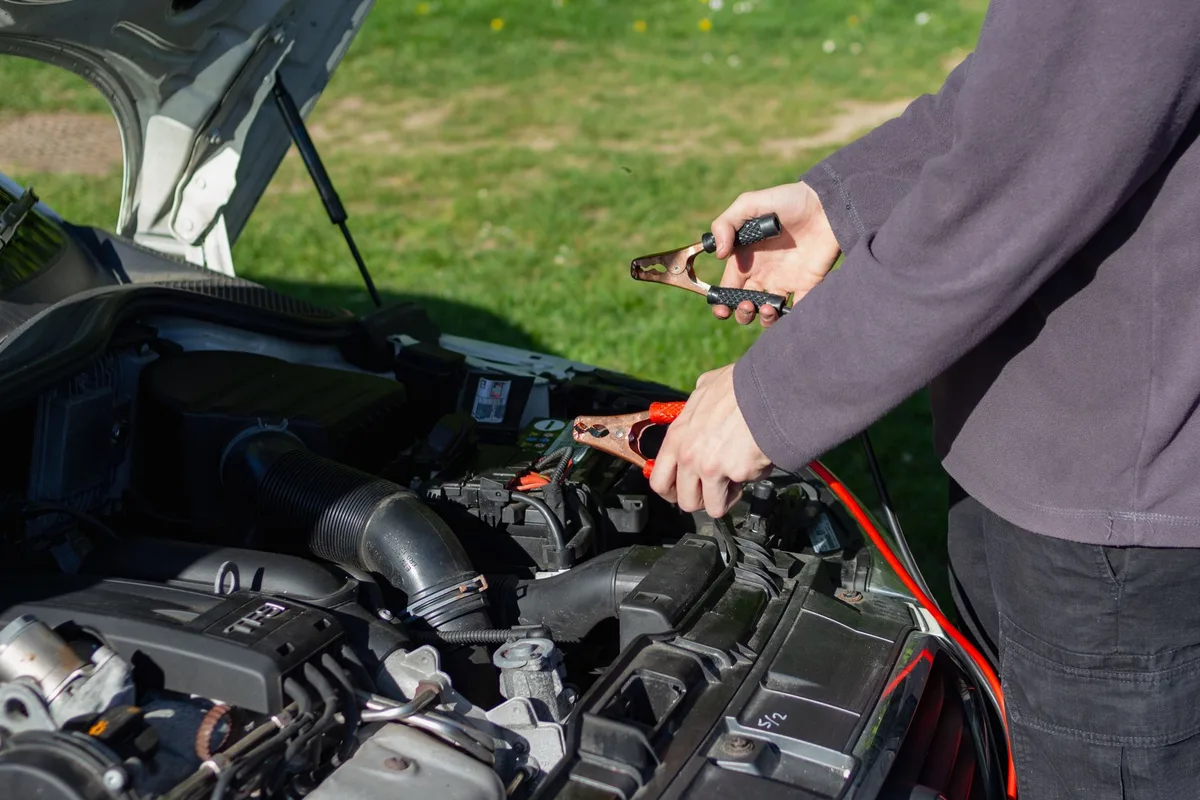
For an accurate reading, the battery should rest first. If the car just ran, let it sit a while so the surface charge settles. A quick probe on a warm battery reads high and fools you.
Voltage-to-Charge-Level Chart
| Resting voltage | State of charge |
|---|---|
| 12.6 to 12.8V | 100% |
| 12.4V | 75% |
| 12.2V | 50% |
| 12.0V | 25% |
| 11.9V or below | Fully discharged |
If your reading lands below 12.0V, you've got a deeply drained battery and a long charge ahead. Anything under 10.5V means the battery took real damage. Want to know what a healthy reading looks like across different conditions?
That baseline helps you judge whether charging will even help.
Working Out Usable Capacity Before You Start
You don't charge the whole battery, only the empty part. If a 50 Ah battery sits at 50%, you need to replace about 25 Ah, not 50. That single detail cuts your estimated time in half.
It also stops you overcharging a battery that's already half full.
One caution: a cheap meter can read off by a volt or more. If you're unsure whether your tool is trustworthy, it's worth knowing whether probing a battery can hurt the meter or throw off your numbers.
The Charge-Time Formula (And How to Use It)
Here's the simple math that turns guesswork into a real estimate:
Charge time (hours) = Amp-hours needed ÷ charger amps ÷ 0.8
That 0.8 accounts for charging inefficiency in lead-acid batteries, since some energy is lost to heat. Skip it and your estimate runs short.
Let's work a real example:
- Battery: 50 Ah, sitting at 50% (needs 25 Ah)
- Charger: 10 amps
- Math: 25 ÷ 10 ÷ 0.8 = roughly 3.1 hours
Now swap in a 2-amp trickle charger for the same battery. That's 25 ÷ 2 ÷ 0.8, which lands near 15.6 hours. Same battery, same starting point, wildly different clock.
The charger in your hand matters as much as the battery on the bench.
For lithium batteries, drop the 0.8 penalty and use about 0.95, since they charge far more efficiently. Do the math once and you'll never have to guess again.
Charge Time by Charger Type: Trickle, Smart, and Fast
Your charger type sets the ceiling on how fast you can safely go. Each one suits a different job.

- Trickle charger: 1 to 2 amps, slow and steady. Best for topping up or long storage.
- Smart charger: adjusts amps automatically through bulk, absorption, and float stages. Best for hands-off charging.
- Fast charger: 20 to 40+ amps. Best for a quick boost, not a true full charge.
A smart charger is the safest pick for most people. It ramps current down as the battery fills, then holds a float voltage so you can't overcharge. Cheap manual chargers keep pushing amps until you unplug them, which is where damage creeps in.
Comparison Table: Amperage vs Hours to Full
| Charger type | Output | Full charge time | Overcharge risk |
|---|---|---|---|
| Trickle | 1 to 2A | 24 to 48 hours | Low with float |
| Smart / multi-stage | 4 to 15A | 4 to 10 hours | Very low |
| Fast / boost | 20 to 40A | 1 hour (surface only) | High |
Fast chargers are tempting when you're in a rush. They'll crank the car, but the battery is far from full. Drive it or finish on a slower charger afterward.
Charging While Driving vs Plugging In
Driving recharges through the alternator, but it's slow and rarely gets you to 100%. A typical alternator puts back enough for a start in 20 to 30 minutes of driving. A full recharge from half-dead can take hours of highway time.
Here's the rule. If your battery is just a bit low from short trips, then a long drive helps. If it's deeply discharged, then a plug-in charger is the only real fix.
The alternator is built to maintain a healthy battery, not revive a flat one. Lean on it too hard and you overwork it. If yours seems to charge but the battery keeps dropping, the cause may not be the alternator at all.
Short-trip drivers get caught in a slow drain loop. The battery never fully recovers between starts. A weekly plug-in top-up breaks that cycle and stretches battery life.
Step-by-Step: Charging a Car Battery Safely
Charging is simple once you follow the order. Rushing the connections is where sparks happen.

- Switch the charger off and unplug it before touching anything.
- Connect the red clamp to the positive (+) terminal first.
- Connect the black clamp to a clean ground point or the negative (-) terminal.
- Set the charger mode to match your battery: flooded, AGM, or lithium.
- Choose your amperage, then turn the charger on.
- When it reads full, turn it off before removing clamps.
Always connect positive first and disconnect it last. Reversing the order near the battery risks a spark by the vent, where hydrogen gas collects. Work in a ventilated spot, never a sealed garage.
Once it's done, don't trust the charger's light alone. Let the battery rest, then confirm it holds voltage with a multimeter. A true full charge reads 12.6V or higher after resting.
Charging a Fully Dead or Deeply Discharged Battery
A battery below 12.0V needs patience, not speed. Start on a low setting, around 2 to 4 amps, to avoid heat damage. A deeply drained battery pushed at high amps can overheat and buckle.
Deeply discharged lead-acid batteries also sulfate. That's a crystal buildup on the plates that blocks charging. Many smart chargers have a desulfation mode that pulses voltage to break it down.
Expect long times here. A dead 50 Ah battery on a 4-amp charger can take 15 to 20 hours to recover fully. If it won't climb past 12.2V after a full cycle, the battery may be beyond saving.
Watch for warning signs. A battery that gets hot, hisses, or swells while charging is failing. Stop right away and don't try again.
If a fresh battery keeps draining flat overnight, the real culprit is often elsewhere in the electrical system.
Mistakes That Ruin Charge Time (and Your Battery)
Most charging problems come down to a handful of avoidable errors. Dodge these and you'll charge faster and cleaner.
- Using too many amps on a small or dead battery. Heat kills plates.
- Pulling the charger at 80% and calling it full. The last 20% takes the longest on lead-acid.
- Trusting a fast charger's surface charge. It fades fast once you drive off.
- Leaving a manual charger on overnight. Overcharging boils off electrolyte.
- Charging a frozen or swollen battery. That's a genuine explosion risk.
The 80% trap catches a lot of people. Lead-acid batteries charge quickly to about 80%, then crawl through the final stretch. Unplug early and you're left with a chronically undercharged battery that ages fast.
Another silent killer is a hidden drain. If your battery keeps dying no matter how well you charge it, something is pulling power while the car sits. No charger fixes a parasitic draw.
Track it down first, then charge with confidence.
Safety Warnings Before You Connect the Clamps
Charging a lead-acid battery releases hydrogen gas, and that gas is explosive. One spark near the vents can ignite it. Keep flames, cigarettes, and sparks well away.
Wear eye protection and gloves. The electrolyte inside is sulfuric acid, which burns skin and eyes on contact. If a battery is cracked and leaking acid, don't charge it at all.
Never charge a frozen battery. The ice inside can expand and rupture the case. Let it thaw fully at room temperature first, then inspect for damage.
A rotten-egg smell during charging is a red flag. That sulfur odor means the battery is overheating or overcharging. If you notice that smell coming off the battery, stop and let it cool.
How Temperature and Climate Change Your Charge Time
Cold slows charging down, plain and simple. A battery at 32°F accepts charge more slowly than one at 70°F. In freezing weather, expect longer times and weaker starts.
Cold also drops available capacity. A battery that reads full can still crank poorly on a frosty morning. That's why many no-start problems spike in winter, even with a decent charge.
Heat is the opposite problem. Charging in high heat speeds things up but accelerates water loss and aging. Good smart chargers use temperature compensation to adjust voltage automatically.
The sweet spot is a moderate, ventilated space. If you're charging in a cold garage, give the battery extra hours. Warming it up indoors first can shave real time off the charge.
Trickle Charging, Maintainers, and Long-Term Storage
A maintainer is the answer for any vehicle that sits. Cars, motorcycles, RVs, boats, and classic cars all self-discharge when parked. A battery maintainer holds a safe float voltage and tops off only as needed.
The difference matters. A basic trickle charger keeps pushing current, which can overcharge over weeks. A maintainer switches on and off to hold the battery at full without cooking it.
For winter storage, hook up a maintainer and leave it. Check the connections every few weeks. This one habit prevents the deep discharge that ruins batteries left idle for months.
If a parked battery still goes flat with a maintainer attached, suspect a drain. A battery that dies overnight usually points to a parasitic load, not a bad charger.
When to Stop Charging and Replace the Battery Instead
Some batteries are past charging, and forcing it wastes time. If voltage won't climb past 12.2V after a full cycle, the battery is likely done. A healthy battery rests at 12.6V or higher.
Watch for these clear replacement signs:
- Won't hold a charge after a full, proper cycle
- Case is swollen, cracked, or leaking
- Reads good voltage but still won't crank
- Over 4 to 5 years old with weak performance
That third one trips people up. A battery can show decent voltage yet fail to start the car because it can't deliver cranking amps under load. Voltage alone doesn't prove health.
If a new battery won't hold charge, don't assume it's faulty right away. Sometimes the charging system or a drain is to blame. Rule those out before you swap it.
Frequently Asked Questions
How long to charge a car battery to full?
Most batteries reach full in 4 to 12 hours on a standard charger. A 10-amp charger handles a half-drained battery in about 4 to 6 hours. A 2-amp trickle charger can take 24 hours.
A fully dead battery on a low setting may need 15 to 20 hours.
Can you overcharge a car battery?
Yes, and it damages the battery. A manual charger left on too long boils off electrolyte and warps the plates. Smart chargers prevent this by switching to a float stage once full.
For anything overnight, use an automatic charger or a maintainer.
How long should I drive to charge a dead battery?
Driving won't fully charge a dead battery. Twenty to thirty minutes gives enough for the next start. A full recharge takes several hours of driving, and the alternator isn't built for that.
Plug in a charger for a truly flat battery.
Is it better to charge a battery slowly or fast?
Slow charging is healthier for lead-acid batteries. Lower amps run cooler and reach a fuller, longer-lasting charge. Fast charging is fine for a quick boost, but it only adds surface charge.
Finish on a slower charger for the real thing.
How do I know when the battery is fully charged?
Let it rest, then check with a multimeter. A full battery reads 12.6V or higher after sitting an hour. A smart charger also shows a green light or float stage.
Don't trust a fast charger's reading right after unplugging.
Your Charge-Time Decision Guide
Match your situation to the right move and you'll never guess again.
- If the battery reads 12.4V or higher: it's only mildly low. A 10-amp charger tops it off in 2 to 4 hours.
- If it reads 12.0 to 12.4V: plan on 4 to 8 hours at 10 amps, or an overnight trickle.
- If it reads below 12.0V: start slow at 2 to 4 amps and expect 15 to 20 hours.
- If it won't pass 12.2V after a full cycle: the battery is likely dead. Replace it.
For everyday use, a smart charger is the safest bet. It handles the amperage for you and won't overcharge. For a parked or seasonal vehicle, leave a maintainer connected.
One last check before you charge: rule out a hidden drain. If a well-charged battery keeps going flat, a parasitic load or a failing charging system is the real problem. Fix that first, then charging does its job and holds.

Similar Posts