Car Battery Reading 12.4 Volts: What It Really Means
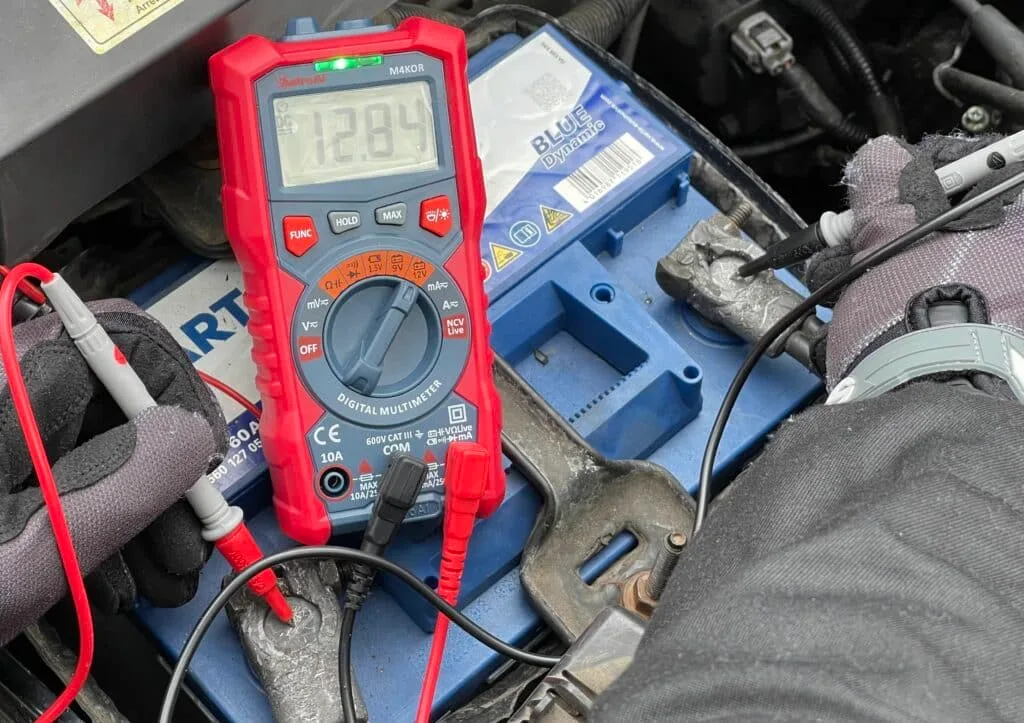
A car battery reading 12.4 volts sits in a gray zone that confuses almost everyone who puts a multimeter on their terminals. It's not dead. It's not healthy either.
That number means your battery is holding roughly 75% of its charge, and what you do next depends entirely on when and how you took the reading.
In our research, the Battery Council International state-of-charge scale puts a rested flooded battery at 12.4V right at the 75% mark, well below the 12.6V that signals a full charge. The gap sounds small, but it matters more than most drivers realize. Here's the short version first, then we'll walk through every scenario.
Quick Answer
A car battery reading 12.4 volts is about 75% charged. It will usually still start your car. It is not fully charged, and it is not failing.
A healthy rested battery should read 12.6 volts or higher. Recharge a 12.4V battery with a smart charger soon. Batteries left below 12.4V start sulfating within days.
What 12.4 Volts Actually Tells You About Your Battery
Voltage is a surprisingly honest snapshot of state of charge, as long as the battery has been resting. A 12V battery is really six 2.1-volt cells wired in series, which is why a full battery reads about 12.6 to 12.7 volts, not an even 12.0. At 12.4 volts, each cell is sitting around 2.07V, and that translates to roughly three-quarters of its stored energy.
If you're wondering why "12 volt" batteries never actually read 12.0, our breakdown of typical resting voltages covers the numbers behind the label in more detail. The short answer: 12.0V isn't normal. It's a battery at about 25% charge and in real trouble.
The Voltage-to-State-of-Charge Chart (Flooded vs AGM)
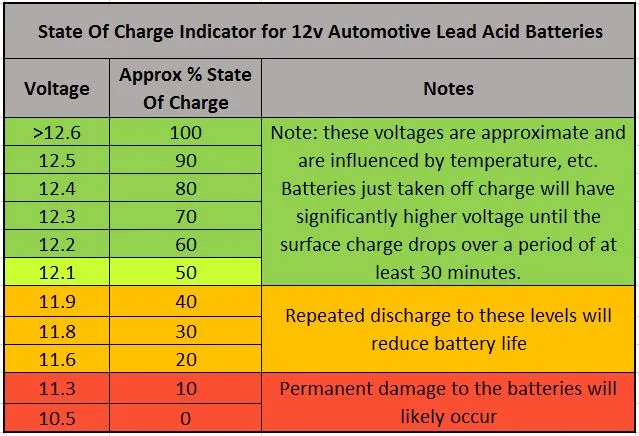
Here's the scale that matters, measured with the engine off after the battery has rested. These figures assume a temperature of around 70°F (21°C).
| Resting Voltage (Flooded) | Resting Voltage (AGM) | State of Charge | What It Means |
|---|---|---|---|
| 12.6-12.7V | 12.8-13.0V | 100% | Healthy and full |
| 12.4V | 12.5-12.6V | ~75% | Undercharged, recharge soon |
| 12.2V | 12.3V | ~50% | Sulfation actively forming |
| 12.0V | 12.1V | ~25% | Deeply discharged |
| Below 11.9V | Below 12.0V | ~0% | Effectively flat, may not recover |
Notice how tight that scale is. The entire usable range of a lead-acid battery lives inside about 0.8 volts. That's why a cheap multimeter that's off by 0.2V can make a half-charged battery look nearly full.
Why 12.4V Means Something Different for AGM Batteries
An AGM battery reading 12.4 volts is in worse shape than a flooded battery at the same number. Absorbed glass mat designs run higher resting voltages, with a full charge landing between 12.8 and 13.0 volts. So 12.4V on an AGM means closer to 60% charge, not 75%.
If you're not sure which type you have, it matters for charging too. AGM batteries need a charger with a dedicated AGM mode. Our guide to sealed glass-mat designs explains how they differ internally, and stop-start vehicles often carry enhanced flooded batteries that sit between the two chemistries.
Before You Trust That Reading: How and When You Measured Matters
A voltage reading is only as good as the conditions you took it under. If you tested five minutes after parking, your 12.4V might really be a 12.2V battery wearing a disguise. If you tested on a freezing morning, a healthy battery can read low through no fault of its own.
The rule of thumb: only trust a resting voltage taken with the engine off, after the car has sat for at least four hours. Overnight is better. Everything else needs a mental asterisk.
Surface Charge: The #1 Reason for False Readings
Surface charge is a temporary voltage boost that clings to the battery plates right after charging or driving. It can push a mediocre battery up to 12.8V or higher for an hour or more. It fools people constantly, and it's the single biggest reason home voltage tests go wrong.
Burning it off takes two minutes. If you can't wait overnight, do this:
- Turn the headlights on for 60 to 90 seconds with the engine off.
- Switch them off and wait two to three minutes.
- Then take your reading.
If the battery read 12.6V right after driving but settles to 12.4V after this, the 12.4V is the truth. That's the number to act on.
Temperature, Resting Time, and Multimeter Accuracy
Cold physically slows the chemical reaction inside the battery, so voltage readings drop as temperature falls. A battery that reads 12.4V in a freezing driveway might read 12.5V in a warm garage at the same actual state of charge. The shift is small, roughly 0.01V per degree Fahrenheit below the testing standard, but it adds up in winter.
Your meter matters too. If you're new to the tool, make sure you're on the DC voltage setting, since that DCV symbol trips up plenty of first-timers. And if the dial looks like hieroglyphics, a quick tour of the markings on the dial will get you oriented in five minutes.
The 12.4V Decision Tree: What Your Situation Means
The same 12.4V reading can mean four completely different things. Find your scenario below, because the right next step changes with each one.
| Your Situation | What 12.4V Really Means | Your Next Move |
|---|---|---|
| Sat overnight, first reading of the day | Genuinely at 75%, battery likely fine | Recharge, then investigate why it's low |
| Taken right after driving | Actual charge is lower, maybe 50-60% | Burn off surface charge, retest |
| Taken after a full charge and rest | Battery can't hold a full charge | Load test, likely replacement |
| Keeps returning to 12.4V | Charging system or drain problem | Test alternator and parasitic draw |
Reading Taken After Sitting Overnight
If your car sat for 8 to 12 hours and reads 12.4V, the reading is real. The battery itself is probably healthy, just underfed. Something is stopping it from reaching a full charge, and short trips are the most common culprit.
Then: recharge it fully with a plug-in charger, and think about your driving pattern. If you mostly do 10-minute hops, the alternator never gets enough time to top the battery off.
Reading Taken Right After Driving
This is the worrying version. After a decent drive, the alternator should have the battery at 12.6V or better, even accounting for a little settling. If you're seeing 12.4V within minutes of shutting off, either the surface charge already collapsed (a bad sign for the plates) or the charging system isn't doing its job.
Then: check charging voltage with the engine running. You want 13.5 to 14.8 volts at the terminals. Below 13.5V points at the alternator, belt, or wiring rather than the battery.
Reading Taken After a Full Charge
If you charged the battery overnight on a proper charger, let it rest a few hours, and still see 12.4V, the battery has lost capacity. It literally cannot store a full charge anymore. This is classic late-stage sulfation or worn plates.
Then: get a load test before buying anything. A battery in this state might still limp along for months, but it will pick the coldest morning of the year to quit.
Reading Keeps Dropping Back to 12.4V
If you charge to 12.6V+ and find 12.4V again two days later, something is draining it or the battery is self-discharging fast. Healthy batteries lose only 1 to 5% of charge per month sitting idle. Losing 25% in 48 hours is not normal.
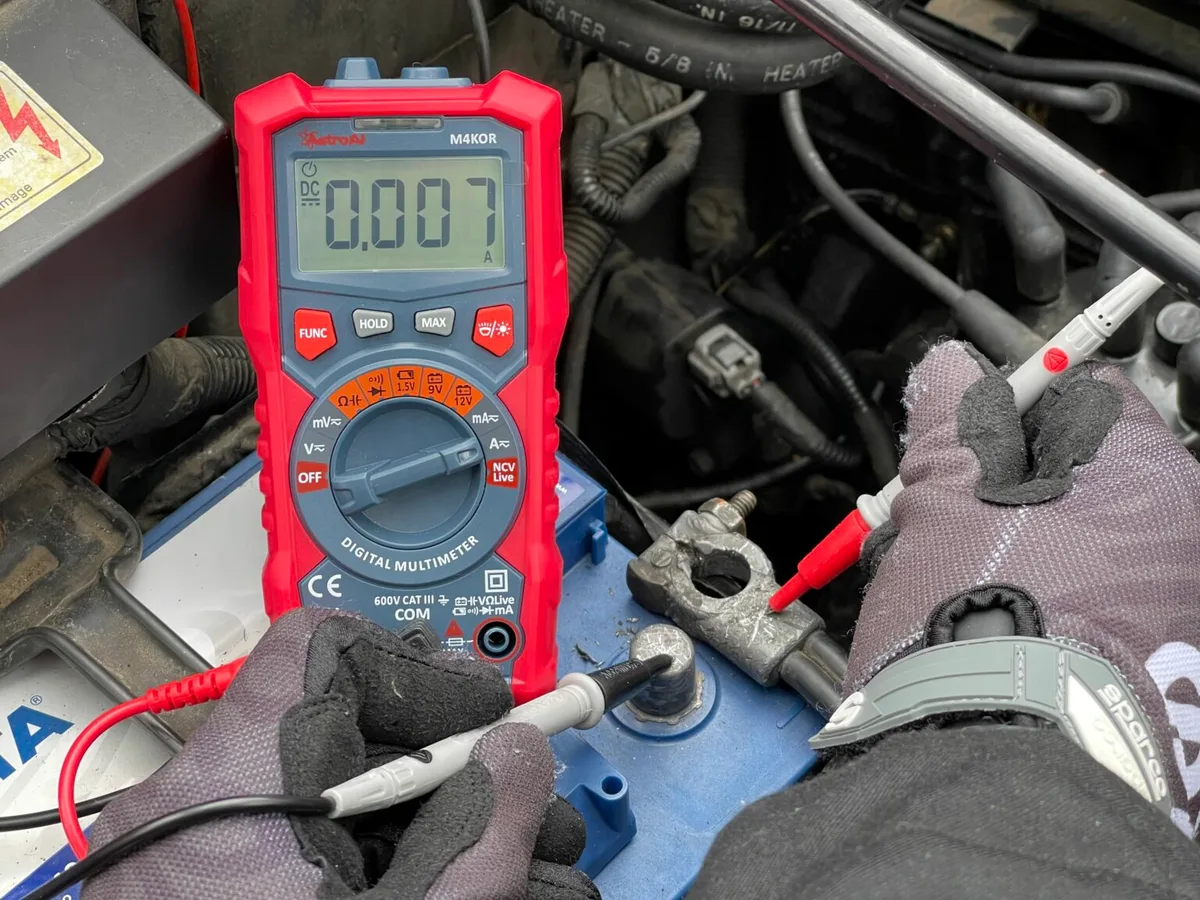
Then: test for parasitic draw. Modern cars should pull under 50 milliamps with everything off. Anything above that, and you're hunting a stuck module, glovebox light, or aftermarket accessory that never sleeps.
Will a Battery at 12.4 Volts Still Start Your Car?
Yes, in almost all cases a battery at 12.4 volts will start your car. At 75% charge, there's plenty of energy left to spin the starter, and most drivers never notice a difference. The starting threshold where things get dicey is down around 12.0V and below.
But voltage only tells you about stored charge, not cranking muscle. Starting power comes from the battery's cold cranking amps, and that CCA rating fades as plates age, even while resting voltage looks respectable. An old battery can read 12.4V all day and still fail the moment you ask it for 400 amps on a cold morning.
The real test is what happens during cranking. Watch the voltage while someone turns the key. A healthy battery stays above 9.6V under that load.
If it dives into the 8s, the battery is weak regardless of what it reads at rest.
So treat 12.4V as a working battery on borrowed time. It'll start the car today. Whether it starts the car in January is a different question, and the sections ahead show you how to answer it properly.
How to Test Properly: The 10-Minute Multimeter Workflow
One number never tells the whole story. The full workflow checks stored charge, cranking strength, and charging output in one sitting. If you've never handled the tool before, our walkthrough on getting started with the meter covers the basics in plain language.
Step 1: Remove Surface Charge and Let It Rest
Ideally, test first thing in the morning before the car has run. If that's not practical, turn the headlights on for 90 seconds with the engine off. Then switch them off and wait three minutes before measuring.
Skipping this step is how people record a 12.7V reading on a battery that's really at 12.3V. Two minutes of patience buys you an honest number.
Step 2: Check Resting Voltage the Right Way
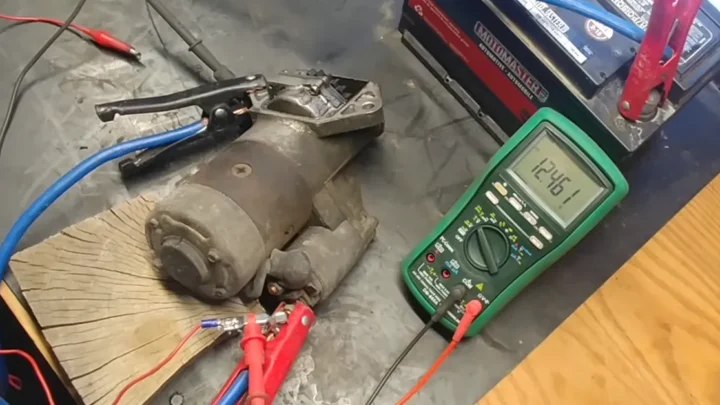
Set the meter to DC volts, using the 20V range on a manual-ranging model. Touch the red probe to the positive post and the black probe to the negative post. Press firmly on the metal posts themselves, not the clamps, since corrosion between post and clamp can skew the reading.
Write the number down. If the display jumps around or the digits look odd, our primer on making sense of the readout sorts out the common display quirks.
Step 3: Run a Cranking Voltage Test
This is the test that exposes weak batteries hiding behind a decent resting number. Keep the probes on the posts and have a helper crank the engine. Watch the lowest voltage the display hits during those two or three seconds.
- Above 9.6V during cranking: the battery has healthy reserve strength.
- 9.0 to 9.6V: marginal, expect trouble in cold weather.
- Below 9.0V: the battery is weak, get it load tested this week.
That 9.6V threshold traces back to standardized load testing methods published by SAE International, which defines how storage batteries are rated and tested. It's the same benchmark shop-grade testers are built around.
Step 4: Verify Alternator Output (13.5 to 14.8V)
Start the engine and measure across the same posts. You should see 13.5 to 14.8 volts at idle, which confirms the alternator is pushing charge back into the battery. Then switch on the headlights, rear defroster, and blower fan.
Voltage should stay above roughly 13.2V under that load.
If it sags to 12.x with the engine running, you've found your answer. The battery reads 12.4V because nothing is refilling it properly. Fix the charging system first, or the new battery you buy will end up in the same state within weeks.
Recharge or Replace? How to Make the Call
Here's the decision logic in one line: recharge first, retest after resting, and only replace when the battery fails to hold a full charge or fails a load test. Most 12.4V batteries are undercharged, not dying. Buying a new battery without testing is how people spend $150 to fix a $0 problem.
When a Smart Charger Fixes Everything
If the battery is under four years old and reads 12.4V after sitting, a full overnight charge usually restores it completely. A modern smart charger runs a multi-stage cycle, finishing with an absorption phase that a 20-minute drive can never replicate. From 75%, expect roughly 2 to 4 hours on a 10-amp charger, longer at lower amperage.
The confirmation test matters more than the charge itself. Charge fully, disconnect, let the battery rest 12 hours, then measure. If it holds 12.6V or better, the battery is fine and your job shifts to figuring out why it drifted low.
When 12.4V Is Hiding a Dying Battery
If the battery is five-plus years old, replacement odds climb steeply regardless of today's reading. Aggregate warranty data puts typical service life at three to five years, and heat shortens that considerably. Our service-life breakdown by climate shows why Phoenix batteries die years before Boston ones.
Watch for the telltale combination: reads fine at rest, cranks slowly anyway. That's lost capacity. Voltage measures how full the tank is, not how big the tank still is, and old batteries shrink internally.
A battery can pass the voltage test with a tank one-third its original size.
The Free Load Test Most People Skip
Nearly every major auto parts chain in the US will load test your battery for free, in the car, in about five minutes. The conductance tester they use measures internal resistance and estimates remaining cold cranking amps against the battery's original rating. That single printout answers the recharge-or-replace question definitively.
If you go this route, bring the battery fully charged. Load testing a battery at 75% charge produces misleading fail results, and you'll be back to guessing.
Why Your Battery Keeps Sitting at 12.4V
A battery that repeatedly settles at 12.4V has a supply problem, a demand problem, or a connection problem. If the battery itself passes a load test, one of these three is the real culprit.
Short Trips and Chronic Undercharging
Starting the engine burns a meaningful chunk of stored energy, and the alternator needs sustained driving time to pay it back. A 10-minute commute often returns less charge than the start consumed, especially in winter with the heater, lights, and heated seats running. String together weeks of short hops and the battery ratchets down to 12.4V and stays there.

Similar Posts