Can a Multimeter Test CCA? What You Need to Know

You want to know if that handheld meter can measure your battery's cranking power. Straight up: can a multimeter test CCA? No, not directly.
A standard multimeter reads volts and amps, but Cold Cranking Amps is a rated spec, not a live number you can dial up.
Per SAE J537 testing, CCA gets measured under a heavy standardized load at 0°F. Your multimeter can't recreate that. What it can do is flag a weak or dying battery through simple voltage checks.
As of 2026, that's still one of the cheapest home diagnostics around. Here's what your meter actually tells you.
Quick Answer
A multimeter cannot directly test CCA. Cold Cranking Amps is a rated lab spec, not a live reading. A multimeter measures voltage and can estimate state of charge.
It can also run a cranking voltage-drop test to spot a weak battery. To measure or estimate CCA, you need a conductance tester or a carbon-pile load tester.
What CCA Actually Means (And Why It's a Rated Spec, Not a Live Reading)
CCA stands for Cold Cranking Amps. It's the number of amps a fully charged 12V battery can deliver for 30 seconds at 0°F (-18°C) while staying above 7.2 volts. That's the short version.
The key word is rated. CCA is a spec the manufacturer prints on the label, like 650 CCA. It's measured once, in a lab, under controlled cold and a fixed load.
It isn't a value sitting inside the battery waiting to be read.
Two related numbers often confuse people:
- CA (Cranking Amps) and MCA (Marine Cranking Amps): rated at 32°F (0°C), so the figure looks higher than CCA.
- EN and IEC ratings: European batteries use a different standard than SAE J537, so numbers don't line up one-to-one.
You can find the exact test method through the SAE standards body if you want the technical detail. The takeaway is simple. CCA describes what a healthy battery could do in the cold.
It's not something a probe reads off the terminals.
What a Multimeter Can and Can't Tell You About Your Battery
Here's the honest line. Your multimeter is great at some jobs and useless at others.
What it can do:
- Read resting voltage, which reflects state of charge.
- Watch voltage sag during cranking, which hints at battery health.
- Check charging voltage with the engine running.
- Test for voltage drop across cables and grounds.
What it can't do:
- Measure rated CCA.
- Apply a heavy load the way a real tester does.
- Report the battery's state of health as a percentage.
Think of voltage as a fuel gauge and CCA as engine horsepower. A full tank doesn't prove the engine is strong. That's why a battery can read a healthy 12.6V and still fail to crank.
If you've hit that exact wall, our breakdown of why a full reading still won't start the car walks through the causes.
For the basics of hooking a meter to a battery safely, this guide on checking a battery with a meter covers the setup. And if your numbers look off, the healthy voltage ranges here give you a quick reference.
The Tools That Actually Measure or Estimate CCA
If you truly need a CCA figure, you need the right tool. Three options do the job, each in a different way.

Conductance Testers
These are the small handheld units most shops use now. You enter the battery's rated CCA, and the tester sends a tiny AC signal to measure internal conductance. From that, it estimates the battery's actual CCA and state of health.
- Fast, safe, and works on a partially charged battery.
- Gives an estimated CCA number plus a pass/replace verdict.
- Doesn't fully load the battery, so it's an estimate, not a raw draw test.
Carbon-Pile Load Testers
This is the old-school heavy hitter. It applies a real, adjustable load (often half the rated CCA) for about 15 seconds while you watch the voltage hold.
- Measures true performance under genuine load.
- Best on a fully charged battery for accurate results.
- Gets hot, draws big current, and needs care to use safely.
Free Battery Tests at Auto Parts Stores
Most parts stores run a conductance test for free. They clip on their tester, punch in your CCA rating, and print a result. If you'd rather not buy a tester for one battery, this is the easy route.
| Tool | Measures CCA? | Best for | Load applied |
|---|---|---|---|
| Multimeter | No | State of charge, quick voltage checks | None |
| Conductance tester | Estimated | Fast home/shop health checks | Minimal (AC signal) |
| Carbon-pile tester | Actual (under load) | Confirming real cranking strength | Heavy, real load |
Decision Guide: Which Test Fits Your Situation
Not sure which path to take? Match your situation to the right move.
If you only own a multimeter and want a quick health screen: check resting voltage, then run a cranking voltage-drop test. It won't give CCA, but it flags a weak battery fast.
If the car cranks slowly or dies overnight: start with the meter, then confirm with a conductance test. A slow drain often points elsewhere, and our look at how much overnight draw is normal helps you rule out a parasitic drain.
If voltage reads fine but the engine still won't turn over: you likely have a health problem a multimeter can't see. Get a conductance or load test. This is the classic case covered in why a good battery still won't start.
If you want a real, no-guessing CCA number: use a carbon-pile load tester on a fully charged battery, or let a parts store run their tester.
If you're unsure whether the battery or the charging system is the culprit: test with the engine running first. This guide on pinning down battery versus alternator shows the exact readings to watch.
Simple rule of thumb: use the multimeter to decide whether you even need a deeper test. Most of the time, it either clears the battery or tells you to grab the right tool.
How to Check Battery Health With Just a Multimeter
You can learn a lot in five minutes with a meter and a helper. Set your multimeter to DC volts on the 20V range before you start.
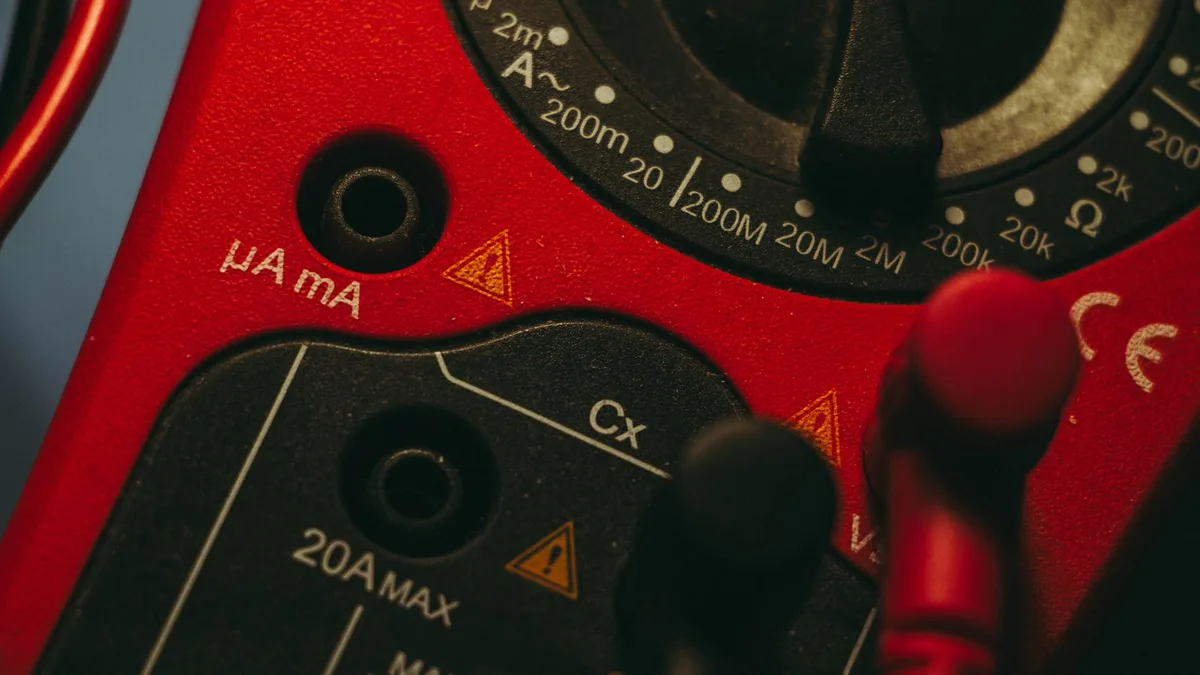
Step 1: Read Resting Voltage (State of Charge)
Let the car sit at least a few hours, ideally overnight. Touch the red probe to the positive terminal and black to negative. A healthy, rested battery reads around 12.6V to 12.8V.
If you just drove, flick the headlights on for 15 seconds first. That clears surface charge and gives you a truer number. For a full breakdown of what each reading means, the state of charge guide lays it out clearly.
Step 2: Run a Cranking Voltage-Drop Test
This is the closest a multimeter gets to a load test. Keep the probes on the terminals and have a helper crank the engine. Watch the voltage.
At around 70°F, it should stay above 9.6V while cranking. If it nosedives to 8V or lower, the battery is weak under load. A big drop here often explains a slow crank, as covered in why voltage sags on startup.
Step 3: Check the Charging System
Start the engine and read the terminals again. You want roughly 13.7V to 14.7V at idle. That confirms the alternator is charging.
Below 13V and the alternator may be failing. Over 15V points to a bad regulator. Either way, the battery isn't the whole story.
Reading the Numbers: Voltage Charts and CCA Ratings
Voltage and CCA measure two different things. Voltage tells you how full the battery is. CCA tells you how hard it can push in the cold.
Don't mix them up.
Here's the resting voltage scale for a 12V battery:
| Resting Voltage | State of Charge |
|---|---|
| 12.6V – 12.8V | 100% |
| 12.4V | 75% |
| 12.2V | 50% |
| 12.0V | 25% |
| 11.9V or less | Effectively dead |
Notice how tight the band is. A drop from 12.6V to 12.0V looks small but means a nearly flat battery. That's why a reading like 12.4 volts sits in a gray zone worth watching.
CCA ratings work differently. A typical car battery falls between 350 and 800 CCA. That number lives on the label, not in your meter.
As batteries age, real CCA fades even while resting voltage still looks fine.
Multimeter vs. Load Tester vs. Conductance Tester
Each tool answers a different question. Picking the right one saves you money and guesswork.
- Multimeter: best for state of charge and charging-system checks. Cheap, safe, no CCA reading.
- Conductance tester: best for a fast health estimate. Gives an approximate CCA and a pass/replace call.
- Carbon-pile load tester: best for confirming true cranking strength. Applies a real load, but runs hot and needs care.
Who should use what? A daily driver owner does fine with a multimeter for routine checks. Someone chasing an intermittent no-start wants a conductance tester.
A shop confirming a warranty claim reaches for the carbon-pile unit.
One practical note. Conductance testers need your battery's rated CCA entered to work. Find it on the label before you start, or the estimate will be off.
Mistakes That Wreck Your Readings (and Your Meter)
Small errors here lead to wrong conclusions and, sometimes, a fried meter. Watch for these.
- Trying to read CCA on the amps setting. A multimeter's 10A jack can't handle cranking current. You'll blow the fuse or worse.
- Testing right after a drive. Surface charge inflates voltage. Always let it rest first.
- Dirty or corroded terminals. Bad contact drops your reading and mimics a weak battery. Clean them first.
- Testing a half-charged battery. Charge it fully before any load or conductance test for honest numbers.
- Ignoring temperature. Cold lowers voltage and cranking performance, so a winter reading looks worse than the battery really is.
One more trap. If the battery reads fine but keeps dying, the problem may be a drain, not the battery. Our multimeter drain-test walkthrough shows how to track it down.
Battery Safety When Testing at Home
Car batteries hold real energy and give off hydrogen gas. Treat them with respect. A careless probe can arc, and a shorted terminal can burn.
Follow these basics:
- Wear eye protection. Batteries contain sulfuric acid.
- Never lay tools across both terminals. That's a dead short.
- Keep the amps input off the battery. Use volts for terminal readings.
- Work in a ventilated space. No sparks, no flames nearby.
- Check the terminals for swelling or a rotten-egg smell. A bulging battery case means stop and replace, not test.
If the battery is visibly swollen or leaking, don't probe it at all. Handle it as a hazard and recycle it properly. A meter reading isn't worth the risk.
Cold Weather, Heat, and How Climate Skews CCA
Temperature changes everything about cranking power. That's the whole reason CCA is rated at 0°F. A battery that spins the engine fine in July can struggle badly in January.
Here's why. Cold slows the chemical reaction inside the battery, so it delivers fewer amps. At 0°F, a battery may put out only about half its warm-weather cranking power.
Meanwhile, the cold engine oil is thicker, so the starter needs more amps, not less.
Heat plays a nastier long game. High temperatures speed up internal corrosion and water loss. That quietly kills real CCA over a couple of summers, even when resting voltage still reads healthy.
What this means for your testing:
- Test on a warm battery when you can. A cold reading looks worse than the battery's true health.
- Run a fall check before the first freeze. Catch a weak battery before it strands you.
- In hot climates, don't trust voltage alone. A conductance test catches the hidden aging that heat causes.
If your battery seems to lose charge as the temperature drops, this look at overnight voltage loss helps you separate cold weather from an actual fault.
Frequently Asked Questions
Can a multimeter read CCA directly?
No. A multimeter measures voltage and current, not rated Cold Cranking Amps. CCA is a lab spec set under a fixed cold load, so no handheld meter can display it.
Use a conductance tester or carbon-pile load tester if you need an actual CCA figure.
What voltage means my battery is bad?
A rested battery below about 12.4V is undercharged, and 12.0V or lower is nearly dead. Voltage alone won't confirm bad CCA, though. A battery can read 12.6V and still fail under load, which points to a health issue, not a charge issue.
Can I test CCA at home for free?
Yes, most auto parts stores run a free conductance test in minutes. They clip on a tester, enter your rated CCA, and print a pass or replace result. At home, a multimeter voltage-drop test gives a rough sense of battery strength without any cost.
Why does my battery pass voltage but fail to start?
Because voltage shows charge level, not cranking capacity. An aging battery loses internal strength while still holding surface voltage. Under the heavy load of starting, it collapses.
A conductance or load test reveals what the voltage reading hides.
How often should I test my car battery?
Check it twice a year, ideally before winter and summer. Most batteries last three to five years, so testing gets more important past year three. A quick voltage and cranking check catches trouble before you're stuck with a no-start.
The Bottom Line: What Your Multimeter Is Really Good For
Your multimeter isn't a CCA tester, and it never will be. What it is: a fast, cheap way to check charge, catch a weak battery under cranking, and confirm your alternator is doing its job.
Use it as your first move. Read resting voltage, run a cranking voltage-drop test, then check charging. If those numbers look fine but the battery still struggles, that's your cue to grab a conductance or load tester.
Match the tool to the question. Voltage problems, use the meter. Cranking-strength doubts, step up to a proper tester or a free shop test.
Do that, and you'll know exactly where your battery stands before the cold morning it decides to quit.

Similar Posts