Can a Multimeter Really Tell Your Battery’s Health?

If your car cranks slow and you're standing there with a meter in hand, you want one straight answer. Does a multimeter show battery health, or just a number that looks reassuring? The honest truth is that a standard multimeter measures voltage, not true health.
That's a useful clue, but it isn't the full story.
Here's the catch. A fully charged 12V lead-acid battery reads about 12.6 to 12.8 volts at rest, yet it can still die the second you ask it to crank. Real health comes down to capacity and cold cranking amps (CCA), and a plain voltmeter can't read either one.
Let's sort out what that meter is actually telling you.
Quick Answer
A multimeter shows battery voltage, not full battery health. Voltage tells you the state of charge only. It cannot measure capacity or cold cranking amps.
A battery can read 12.6 volts and still fail under load. For true health, run a load test or use a dedicated battery tester.
Does a Multimeter Actually Show Battery Health, or Just Voltage?
A multimeter shows voltage, which reflects charge level, not the battery's real health. Those two things get mixed up constantly, and that mix-up is why people get stranded with a "good" reading on the screen.
Think of voltage like the fuel gauge. It tells you how much charge is sitting in the battery right now. It says nothing about how much charge the battery can still hold, or whether it can dump enough current to spin your starter.
A tired battery with a dead cell can still show a healthy resting number. That's the trap. If you rely on voltage alone, you might trust a battery that's already on its way out.
Basic checking it with a handheld meter is a solid first step, just not the final word.
Voltage vs. State of Charge vs. State of Health: What Your Meter Is Really Telling You
These three terms sound similar, but they measure different things. Getting them straight is the whole game.
- Voltage: the electrical pressure across the terminals, measured in volts. This is all a multimeter reads.
- State of charge (SoC): how full the battery is, from 0 to 100 percent. Resting voltage maps closely to this.
- State of health (SoH): how much of the battery's original capacity and cranking power is left. This tracks aging and wear.
Your multimeter reads voltage, and from voltage you can estimate state of charge. It cannot see state of health. A brand-new battery and a five-year-old battery can both read 12.6 volts, yet only one still delivers full cranking power.
So when you check where a healthy reading sits, remember you're confirming charge, not condition. That difference is why a charged battery can still leave you stuck.
The Short Answer: What a Multimeter Can and Can't Reveal
A multimeter is genuinely handy, as long as you know its limits. Here's the clean split.
What a multimeter can tell you:
- Resting voltage and rough state of charge
- Whether a battery is flat, shorted, or has an obviously dead cell
- Charging system output with the engine running
- Parasitic drain in the milliamp range with the key off
What a multimeter can't tell you:
- Cold cranking amps or real capacity
- State of health or how much life is left
- Whether the battery will pass a proper load test
- Internal resistance in any precise way
CCA is measured under standardized conditions defined by the SAE testing standard, and that kind of high-current test needs dedicated gear. A voltmeter simply isn't built for it. Still, for spotting a failing battery early, it earns its place in the toolbox.
How a Multimeter Reads a Battery (And Why It Only Sees Voltage)
A multimeter measures the difference in electrical potential between two points. Touch the red probe to the positive terminal and the black probe to the negative, and it reports that gap in volts. That's it.
The meter has very high input impedance, often 10 megaohms or more. In plain terms, it draws almost no current while it reads. That's great for an accurate voltage number, but it means the battery is never actually stressed during the test.
And here's the key point. Health only shows up under stress. A weak battery hides its flaws until you pull real current through it.
Since the meter barely loads the battery, it never provokes the failure. As of 2026, that's still true of every standard digital multimeter on the market, no matter the price tag.
This is exactly why a battery can read a full 12.6 volts and still refuse to crank. The voltage looks fine because nothing is testing the battery's guts.
Reading the Numbers: The 12V Battery Voltage and State-of-Charge Chart
Once the battery has rested, its voltage lines up neatly with state of charge. Rested means the engine has been off for a few hours, so there's no surface charge fooling the reading.

Here's a working reference for a standard 12V lead-acid battery at around 70°F.
| Resting Voltage | State of Charge | What It Means |
|---|---|---|
| 12.6 to 12.8V | 100% | Fully charged and healthy |
| 12.4V | ~75% | Good, mild top-up helps |
| 12.2V | ~50% | Getting low, recharge soon |
| 12.0V | ~25% | Deeply discharged |
| Below 12.0V | Near empty | Suspect, may not recover |
A reading of 12.4 volts at rest is decent, not full. Anything drifting toward 12.0 or under points to a battery that's discharged or damaged. For a deeper breakdown, matching volts to charge level helps you read these numbers with more confidence.
One reminder before you trust the chart. AGM and lithium (LiFePO4) packs follow different voltage curves, so don't apply lead-acid numbers to them. We'll get into those differences next.
Where a Voltmeter Falls Short: Surface Charge, Sulfation, and Dead Cells
A voltmeter gets fooled by three things in particular. Each one can hand you a number that looks better than the battery really is.
Surface charge is the first. Right after charging or a drive, the plates hold a temporary charge that inflates the reading. A battery might show 12.9 volts fresh off the charger, then settle to 12.3 an hour later.
Turn on the headlights for a minute to bleed it off before you trust any number.
Sulfation is the sneaky one. Over time, lead sulfate crystals build on the plates and choke the battery's ability to deliver current. Voltage can still read fine, but capacity is gone.
Your meter simply can't see those crystals.
A dead or weak cell is the third. A 12V battery has six cells at roughly 2.1 volts each. If one shorts out, you lose about 2 volts and land near 10.5.
But a partly failing cell may only drop the total slightly, which is exactly why a battery that reads fine still won't start.
Testing a Battery Under Load With a Multimeter (The Cranking-Voltage Method)
Yes, you can approximate a load test with a multimeter by watching voltage while the engine cranks. It's not a lab-grade test, but it's the most useful thing your meter can do here.
Here's the method:
- Set the meter to 20V DC and clip onto the battery terminals.
- Have a helper crank the engine, or disable fuel and crank for a few seconds.
- Watch the lowest voltage the meter hits during cranking.
Read the result like this:
- Stays above 9.6V at around 70°F: the battery is holding up well.
- Dips to 9.0V or lower: the battery is weak and likely failing.
- Crashes below 8V: replace it soon.
A healthy battery sags a little under the starter's heavy pull, then recovers. A tired one collapses. If the voltage nosedives the instant you turn the key, that sag test just told you what a resting reading never could.
When You Need a Real Battery Tester Instead: CCA, Load, and Internal Resistance
Reach for a dedicated tester whenever the cranking test is borderline or the battery keeps letting you down. These tools measure what a multimeter physically cannot.

Two main types cover most jobs:
- Carbon pile load tester: applies a heavy fixed load, usually half the CCA rating, for 10 to 15 seconds. It shows whether the battery holds voltage under real stress.
- Conductance tester: sends a small AC signal through the battery to estimate CCA and internal resistance. It's quick, safe, and works even on a partly discharged battery.
Rising internal resistance is a strong aging signal. As a battery wears, its resistance climbs and cranking power fades. A conductance tester catches that trend early.
If you keep finding a good reading but a car that won't turn over, this is the gear that finally explains why.
Multimeter vs. Load Tester vs. Conductance Tester vs. Hydrometer
Each tool answers a different question, so the right pick depends on what you're chasing. Here's how they stack up.
| Tool | Measures | Best For | Limitation |
|---|---|---|---|
| Multimeter | Voltage, state of charge | Quick charge check, charging system, parasitic drain | Can't read capacity or CCA |
| Carbon pile load tester | Voltage under heavy load | Confirming crank ability | Runs hot, harder on the battery |
| Conductance tester | Estimated CCA, internal resistance | Fast health screening | Estimates, not a live load |
| Hydrometer | Electrolyte specific gravity | Flooded lead-acid, cell by cell | Only for batteries with caps |
A hydrometer is worth a mention for flooded batteries. It reads specific gravity, around 1.265 for a full charge and 1.120 when discharged. Testing each cell can reveal one weak cell the others hide.
Who needs what? A DIY owner doing a quick check is fine with a multimeter. Anyone diagnosing repeat no-starts wants a conductance tester.
A shop confirming warranty claims leans on a load tester.
Step-by-Step: Checking Battery Charge, Load, and Charging System
Run these three checks in order and you'll cover charge, cranking, and the alternator in about five minutes. Set your meter to 20V DC before you start.
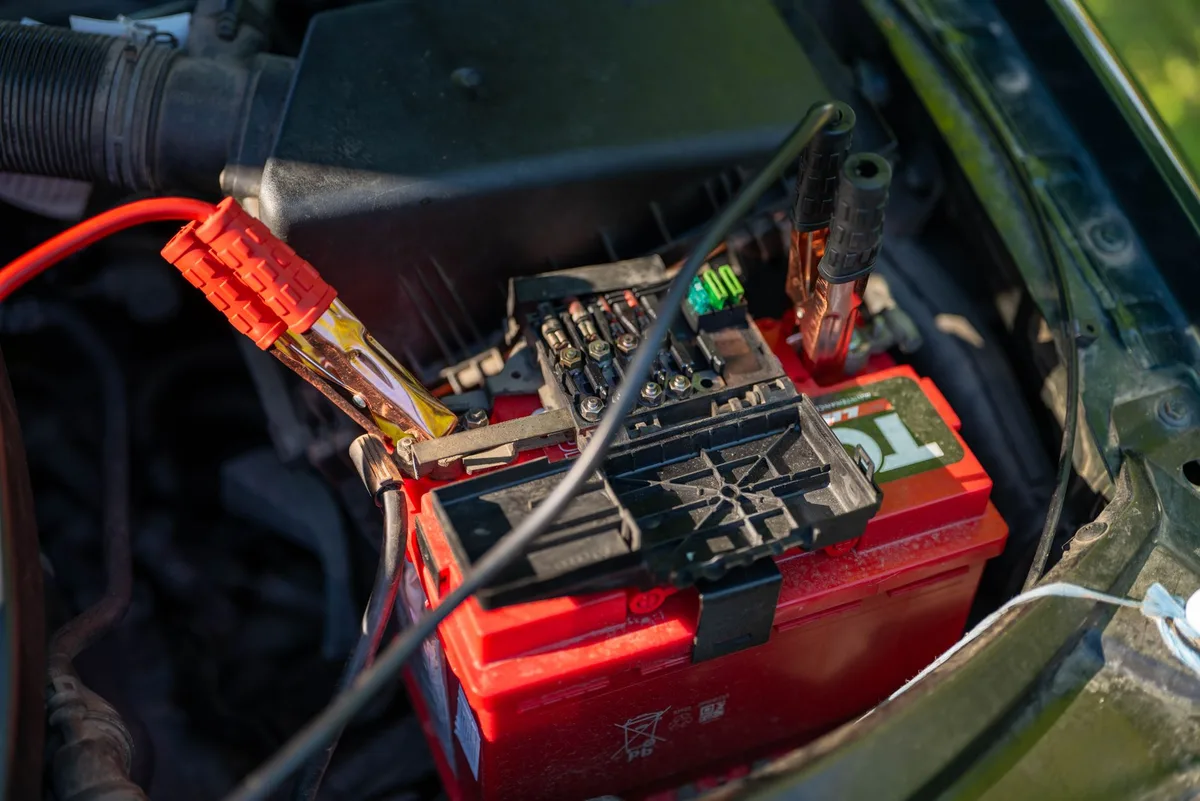
Step 1: Resting voltage.
- Engine off for a few hours, or bleed surface charge first.
- Red probe to positive, black to negative.
- 12.6V or higher means fully charged.
Step 2: Cranking voltage.
- Keep the probes on the terminals.
- Crank the engine and watch the dip.
- Above 9.6V is healthy, below 9.0V is weak.
Step 3: Charging system.
- Start the engine and read again.
- 13.7 to 14.7V means the alternator is charging.
- Under 13.5V or over 15V points to a charging fault.
If step 3 looks off, you can tell the battery from the alternator with a couple more readings. And if the battery drains while parked, switch to the milliamp range and hunt the source of the parasitic draw with the key off.
Checking for Parasitic Drain and Alternator Output With the Same Meter
Your multimeter shines at two jobs that have nothing to do with capacity. Both catch problems a health test would miss.
For alternator output, read voltage with the engine running. You want 13.7 to 14.7 volts at idle. A steady 12-point-something means the alternator isn't charging, and the battery is quietly draining every mile you drive.
For parasitic drain, switch the meter to the milliamp DC range. Put it in series between the negative terminal and the cable, with everything off. Most healthy vehicles pull 20 to 50 milliamps at rest.
Anything more is worth hunting down, and it's often why a battery goes flat sitting overnight.
One caution. Never crank the engine with the meter wired in series on the amps setting. The starter's huge current will blow the meter's fuse instantly.
Common Mistakes That Give You a False "Healthy" Reading
Most bad readings come from rushing the test. These are the errors we see trip people up the most.
- Testing right after a drive or charge, so surface charge inflates the number.
- Reading only resting voltage and skipping the cranking test.
- Trusting lead-acid voltage numbers on an AGM or lithium pack.
- Dirty or loose terminals adding resistance and skewing the result.
- Leaving accessories on, which pulls voltage down mid-test.
- Testing a cold battery without adjusting expectations, since cold cuts cranking power.
The biggest trap is confusing a charged battery with a healthy one. A battery that keeps dying despite good numbers is telling you voltage alone isn't enough. Run the load test before you call it good.
Safety Rules Before You Touch the Terminals
Batteries store real energy and vent explosive gas, so a few rules keep the job safe. Follow these every time.
- Wear eye protection. Lead-acid batteries hold sulfuric acid that burns skin and eyes.
- Keep sparks and flames away. Charging batteries vent hydrogen gas, which ignites easily.
- Never let a wrench or probe bridge both terminals. A dead short can throw sparks or burst the case.
- Set the meter to the right mode first. Touching terminals in amps mode can short the leads.
- Check the battery before testing. A swollen or bulging case means stop and replace, not test.
If a battery is hot, leaking, or misshapen, don't probe it. Handle it carefully and recycle it at a proper drop-off. Damaged batteries are a hazard, not a diagnostic puzzle.
Best For / Not Right For: When a Multimeter Is Enough
A multimeter is enough when you need a quick charge check or a charging system read. It's the wrong tool when you need proof of real capacity. Here's the clean split.
A multimeter is the right call when you're:
- Confirming state of charge before a trip
- Checking alternator output at idle
- Tracking down a parasitic drain
- Doing a fast cranking-voltage sag test
Reach for a dedicated tester instead when you're:
- Chasing repeat no-starts with good voltage
- Verifying CCA for a warranty claim
- Screening an aging battery for internal resistance
- Deciding whether a two-year-old battery still has life
For most drivers, a meter plus the cranking test answers the daily question. When the results stay borderline, that's your cue to borrow or buy a conductance tester.
Battery Health FAQs
Can a multimeter test if a car battery is bad?
A multimeter can flag an obviously bad battery, like a dead cell or a flat charge. It can't confirm a marginal battery is healthy. Pair the resting reading with a cranking-voltage test.
If voltage drops below 9.6V while cranking, the battery is likely failing.
What voltage means a battery needs replacing?
There's no single number, since voltage reflects charge, not health. A battery that won't hold above 12.4V after a full charge is suspect. One that sags under 9V while cranking is on its way out.
Confirm with a load or conductance test before replacing.
Does a higher voltage mean a healthier battery?
No. A higher resting voltage only means a fuller charge, not better health. A worn battery can still read 12.7V after charging, then collapse under load.
Capacity and cranking power decide health, and neither shows up on a voltmeter.
How do I test battery health without a multimeter?
Use a dedicated battery tester or have a shop test it. A conductance tester estimates CCA and internal resistance in seconds. Many auto parts stores run this check at no cost.
It's far more telling than any voltage reading.
Why does my battery read 12.6V but still won't start?
Because 12.6V confirms charge, not cranking power. A hidden weak cell, sulfation, or high internal resistance can leave the battery unable to deliver current. The voltage looks fine at rest.
Only a load test reveals the failure.
Your Decision Guide: Charge It, Test Further, or Replace It
Let the readings point you to one of three actions. Work through them in order.
- If resting voltage sits below 12.4V: charge it first, then retest. A low charge often looks like a bad battery when it isn't.
- If it charges to 12.6V and cranks above 9.6V: the battery is fine. Chase your no-start elsewhere, like the starter or connections.
- If it holds 12.6V but sags under 9V while cranking: run a load or conductance test. A weak reading there means the battery is failing.
- If it won't climb past 12.2V after a full charge: the battery is likely worn out. Plan to replace it.
- If a cell reads near 10.5V or the case looks swollen: replace it now. Don't keep testing a damaged battery.
The pattern is simple. Voltage tells you whether to charge. The cranking test tells you whether to worry.
A dedicated tester tells you whether to replace.
For a battery that still cranks but leaves you nervous, check it every few weeks through winter. Cold weather exposes weak batteries fast, so an early catch beats a dead battery in a parking lot. When in doubt, a free tester check at a parts store settles it in seconds.

Similar Posts