Car Battery Voltage While Running: What’s Normal?
Car battery voltage while running is one of those numbers that tells you a huge amount in about two minutes, if you know how to read it. The problem is that most guides hand you a single range, wish you luck, and never explain what to do when your meter shows something outside it. Your reading changes with engine speed, electrical load, temperature, and even the software in your car.
That's why this guide is built as a decision tree, not a trivia answer. Manufacturer specifications for traditional charging systems put the healthy running range at roughly 13.7 to 14.7 volts, and as of 2026 that's still the baseline mechanics use. To understand why your car might sit above or below it, you first need to know what that number actually represents.
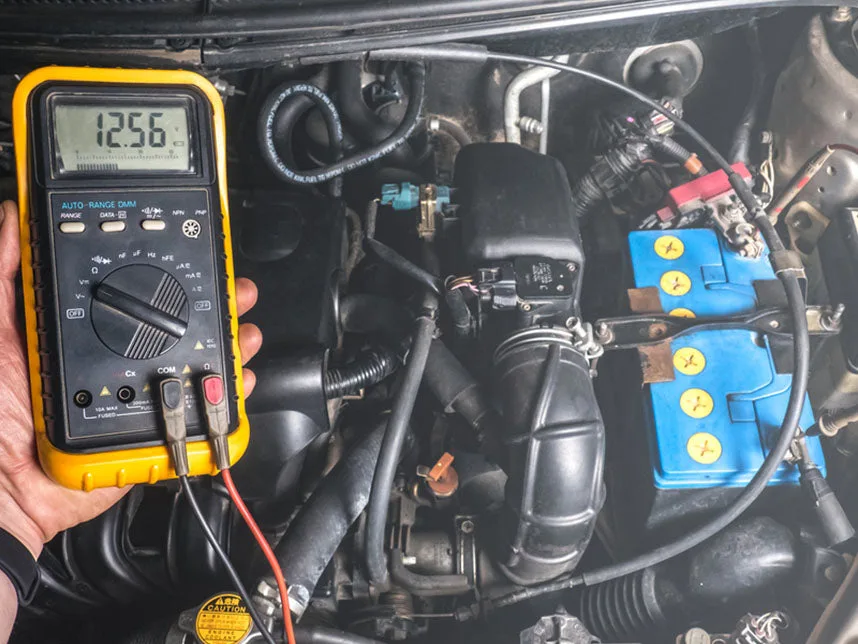
Quick Answer: 13.7 to 14.7 Volts Is Normal (With Big Exceptions)
Car battery voltage while running should read 13.7 to 14.7 volts. That number comes from the alternator, not the battery itself. Readings below 13 volts suggest a charging problem.
Readings above 15 volts point to a failed voltage regulator. Cars with smart alternators can legitimately show 12.5 to 13.2 volts.
What You're Actually Measuring While the Engine Runs
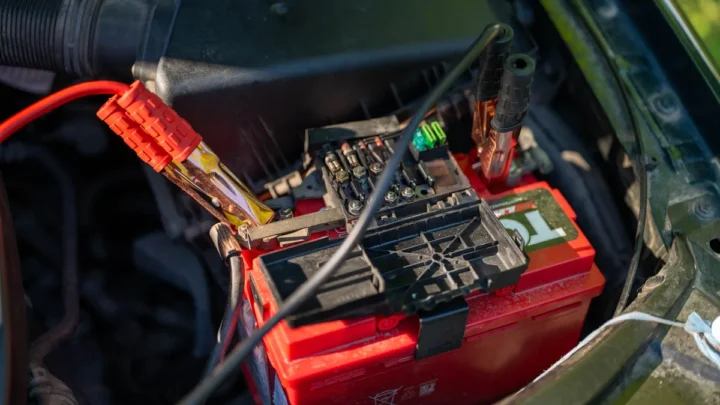
Here's the twist that confuses almost everyone: with the engine running, you're not really measuring the battery at all. You're measuring the output of the alternator, the belt-driven generator bolted to the engine. Once the engine fires, the alternator takes over and feeds every electrical system in the car.
The battery steps back into a supporting role. It smooths out voltage spikes, covers brief demand surges, and waits for the next start. If you want the full picture of how that storage side works, our breakdown of the chemistry under the hood covers it in plain terms.
Inside the alternator, a voltage regulator decides how hard to push. On older cars it's a simple internal circuit holding a fixed setpoint. On most modern cars the engine computer controls it, adjusting output based on battery temperature, state of charge, and electrical load.
Standards bodies like SAE International define the test procedures manufacturers use to rate these systems.
So when your meter reads 14.2 volts at the battery posts, that's the regulator doing its job. When it reads 12.3 volts, the alternator isn't keeping up and the battery is quietly draining while you drive. That distinction drives every branch of the decision tree below.
Resting Voltage vs Running Voltage: The Numbers People Mix Up
Resting voltage and running voltage are two different tests that answer two different questions. Resting voltage (engine off) tells you the battery's state of charge. Running voltage (engine on) tells you whether the charging system works.
Mixing them up is the number one reason people misdiagnose this stuff. A reading of 12.6 volts is excellent with the engine off. That same 12.6 volts with the engine running means your alternator is barely doing anything.
The State-of-Charge Chart (Engine Off)
Test resting voltage after the car has sat for at least 30 minutes. Here's what the numbers mean for a standard 12V lead-acid battery:
| Resting Voltage | State of Charge | What It Means |
|---|---|---|
| 12.6V or higher | 100% | Fully charged, healthy |
| 12.4V | ~75% | Fine, but keep an eye on it |
| 12.2V | ~50% | Undercharged, needs attention |
| 12.0V | ~25% | Deeply discharged |
| Below 11.9V | Near dead | Charge and load test before condemning |
Notice how tight that scale is. The entire useful range spans barely 0.7 volts, which is why a cheap analog gauge won't cut it. We cover what a healthy resting figure looks like in more depth if you want the engine-off side of the story.
Why Surface Charge Fakes You Out
Surface charge is a temporary voltage boost sitting on the battery plates right after driving. Check a battery five minutes after a highway run and it might show 13.1 volts at rest. That's not its real state of charge.
It's leftover charge that hasn't settled.
To burn it off, turn the headlights on for two minutes with the engine off, then wait a couple of minutes and test. Skipping this step makes weak batteries look healthy, and that's how people end up stranded a week after a "good" test.
How to Test Running Voltage the Right Way
This test takes five minutes and needs no mechanical skill. What it needs is the right sequence, because a single idle reading can lie to you.
What You Need Before You Start
- A digital multimeter set to DC volts (the 20V range on manual meters)
- Safety glasses
- Two minutes with the engine off, then five with it running
- A helper to hold 2,000 RPM, or a light touch with the throttle
If your meter's dial looks like hieroglyphics, our guide to the DC voltage setting sorts out which position you want. Beginners can also walk through taking a first reading before touching the car.

Step-by-Step: From Resting Baseline to Loaded Reading
- Get a resting baseline. Engine off, car sat 30+ minutes. Touch the red probe to the positive post, black to the negative post. Write the number down.
- Probe the posts, not the clamps. Corrosion between post and clamp can skew readings. Metal post, direct contact.
- Start the engine and read at idle. A healthy system jumps to 13.7 to 14.7 volts within seconds.
- Hold 2,000 RPM and read again. Some tired alternators charge fine at cruise speed but sag at idle. This step separates the two.
- Add load. Headlights on high, HVAC blower on max, rear defroster on. Voltage should stay above roughly 13.2 volts at 2,000 RPM.
- Compare all three running numbers. The pattern across idle, revved, and loaded readings tells you more than any single figure.
Keep hands, sleeves, and meter leads well clear of the belt and pulleys the entire time. A running serpentine belt will grab a dangling probe lead instantly.
Reading the Numbers: Your Voltage Decision Tree
Now the payoff. Take your loaded reading at 2,000 RPM and find your branch below. Each one follows the same logic: if you see this, it likely means that, so do this next.
Here's the whole tree at a glance:
| Running Voltage | Verdict | First Move |
|---|---|---|
| Below 13.0V | Undercharging | Check belt, connections, then alternator |
| 13.0 to 13.6V | Gray zone | Clean terminals, retest, rule out smart charging |
| 13.7 to 14.7V | Healthy | Test the battery itself if problems persist |
| 14.8 to 15.0V | Watch closely | Normal when cold, or for AGM. Retest warm |
| Above 15.0V | Overcharging | Regulator fault. Fix soon, it's killing the battery |
Below 13.0V While Running
If you see under 13 volts with the engine warmed up and revved, the charging system can't keep up. The battery is supplementing the alternator instead of charging from it, and eventually it'll run flat mid-drive.
Then work through causes cheapest first. Check the serpentine belt for glazing, cracks, or looseness. Inspect terminals and the ground strap for corrosion.
If those check out, the alternator itself (worn brushes, failed diodes, dying regulator) is the prime suspect.
One exception before you buy parts: some smart-charging cars deliberately idle down here. That's the topic of the next section, so read it before spending anything.
13.0 to 13.6V While Running
If you land here, you're in the gray zone. It might be a healthy smart-charging system loafing under light load. It might be a traditional system starting to fade.
Then run the load step again. Lights, blower, defroster, 2,000 RPM. A healthy system responds by holding 13.2 volts or better.
A fading one sags toward 12.8 and keeps dropping. Clean the terminals, verify the ground, and retest before condemning the alternator.
13.7 to 14.7V While Running
If you're in this band under load, your charging system is doing its job. Full stop.
Then, if you're still having dead-battery mornings, the problem lives elsewhere. Suspect the battery itself (get a free load test at a parts store) or a parasitic drain pulling power overnight. A charging system reading 14.2 volts cannot fix a battery with a dead cell, and it can't stop a glovebox light that never turns off.
14.8 to 15.0V While Running
If you see this range, don't panic yet. Context decides everything here.
Cold morning? Temperature-compensated regulators push the setpoint up on purpose, sometimes to 15 volts, because cold batteries accept charge poorly. AGM battery under the hood?
Their spec range runs 14.4 to 14.8 volts, and our explainer on glass-mat construction covers why they charge hotter. Then retest after 20 minutes of driving with the engine fully warm. If the number settles under 14.8, you're fine.
If it stays pinned, treat it as early regulator trouble.
Above 15.0V While Running
If you see sustained readings above 15 volts on a warm engine, that's overcharging, and it's the one branch with real urgency. A failed voltage regulator is force-feeding the battery.
Then plan a repair within days, not months. Overcharging boils electrolyte, warps plates, swells the case, and can vent flammable hydrogen gas. It also stresses every electronic module in the car.
Don't keep daily-driving it, and don't let anyone talk you into "just a new battery." The new one will cook exactly like the old one did.
The Smart Alternator Exception: When 12.8V While Driving Is Perfectly Fine
Most cars built in the last decade don't hold a steady charging voltage anymore. Smart alternators (also called variable-voltage or regenerative charging systems) let the engine computer vary output constantly to save fuel. When the battery is comfortably charged, the system backs off to 12.5 to 13.2 volts on purpose.
Then the pattern flips under braking. The computer ramps the alternator hard, sometimes past 15 volts for a few seconds, to recover energy while you slow down. Watch a dash voltmeter in one of these cars and you'll see it wander all day.
That's design, not failure.
So how do you tell a smart system from a dying alternator? Watch the behavior, not the snapshot:
- Smart charging: voltage moves between roughly 12.5 and 15 volts, changes with braking and coasting, and recovers instantly when you switch on big loads.
- Failing alternator: voltage drifts low and stays low, sags further as loads stack up, and never climbs back to the mid-14s under any condition.
If your car has stop-start, assume it has smart charging. If you're unsure, check the owner's manual or look for a small current sensor clamped around the negative battery cable. That sensor is the giveaway that a battery management system is running the show.
One practical test cuts through the ambiguity. Turn on the headlights and rear defroster while idling. A healthy smart system senses the drain and lifts voltage into the high 13s or 14s within seconds.
If it can't, you've found a genuine problem.
Battery Type Changes the "Normal" Range: Flooded vs AGM vs EFB vs Lithium
The 13.7 to 14.7 band assumes a standard flooded lead-acid battery. Swap in different chemistry and the "correct" running voltage shifts with it. This matters most after a battery replacement, because the wrong charging profile quietly shortens battery life.
| Battery Type | Typical Charging Voltage | Where You'll Find It |
|---|---|---|
| Flooded (wet cell) | 13.8 to 14.4V | Older and budget-trim vehicles |
| EFB | 14.0 to 14.6V | Entry-level stop-start cars |
| AGM | 14.4 to 14.8V | Premium and stop-start vehicles |
| Lithium (LiFePO4) | 14.2 to 14.6V | Aftermarket, some performance cars |
AGM and EFB designs tolerate the deeper cycling that stop-start driving demands. Our comparison of enhanced flooded construction explains why these two aren't interchangeable, even though they look identical from the outside.
Here's the trap. Many modern cars need the new battery registered or coded to the body computer after replacement. Skip that step after switching from flooded to AGM and the car keeps charging on the old profile.
The battery survives, but aggregate warranty data shows it often dies a year or two early.
Lithium 12V batteries play by different rules entirely. Their voltage curve is flat, so a resting reading of 13.2 volts is normal rather than alarming. If you're weighing chemistries for a replacement, our rundown of which construction fits your driving walks through the trade-offs.
Voltage That Fluctuates, Sags, or Flickers: What Each Pattern Means
A steady wrong number is one diagnosis. A moving number is another. The pattern of movement is a fingerprint, and each fingerprint points somewhere specific.
Slow rhythmic swings at idle (13.5 up to 14.5 and back): usually normal. The regulator is responding to cycling loads like the radiator fan or fuel pump. If the swings exceed a volt and the headlights visibly pulse, suspect a failing regulator.
Sharp sag when loads kick on, slow recovery: the alternator is losing capacity. A healthy unit recovers in under two seconds when the defroster snaps on. A worn one dips to 12.8 and claws back slowly.
Rapid flicker or jitter in the reading: classic failed-diode behavior. The alternator makes AC internally and rectifies it to DC. When one of the six diodes dies, ripple leaks through and the voltage trembles.

Similar Posts