Normal Car Battery Voltage: What Your Readings Mean
If your car cranked a little slow this morning and you're now staring at a multimeter, you're asking the right question. Normal car battery voltage isn't one number. It's a range that shifts depending on whether the engine is off, running, or cranking.
Read the wrong number at the wrong time and you'll replace a perfectly good battery, or trust a dying one.
Here's the anchor point: a healthy 12V battery rests at 12.6 to 12.8 volts, per Battery Council International state-of-charge guidance. With the engine running, that jumps to 13.7 to 14.7 volts. Everything below walks you through what your exact reading means and what to do about it, starting with the fast version.
Quick Answer
Normal car battery voltage is 12.6 to 12.8 volts at rest. That reading means the battery is fully charged. With the engine running, normal is 13.7 to 14.7 volts.
A resting reading of 12.4 volts means only 75% charge. Anything under 12.0 volts signals a deeply discharged battery.
Normal Car Battery Voltage at a Glance: The Numbers That Matter
Every voltage reading belongs to one of three test conditions. Mixing them up is the number one reason people misdiagnose batteries. So before anything else, get these three situations straight.
| Test Condition | Normal Range | What It Actually Tests |
|---|---|---|
| Engine off, rested 1+ hours | 12.6 to 12.8V | Battery state of charge |
| Engine cranking | Stays above 9.6V | Battery strength under load |
| Engine running | 13.7 to 14.7V | Alternator and charging system |
If your reading falls inside the matching range, that system is doing its job. If it falls outside, the rest of this guide tells you which branch to follow. As of 2026, these ranges still hold for the flooded lead-acid batteries in most cars on the road, with small differences for AGM and lithium that we'll cover later.
One quick note on tools. Any basic digital multimeter set to DC volts will do this job. A $15 meter reads battery voltage just as usefully as a $300 one for this purpose.
Why "12 Volts" Is the Wrong Answer: What Your Battery Voltage Actually Tells You
A "12-volt" battery that actually reads 12.0 volts is in trouble. That surprises almost everyone. The label is a nominal rating, not a health target.
Here's why. Inside the case sit six lead-acid cells wired in series. Each healthy cell produces about 2.1 volts when charged.
Six times 2.1 gives you 12.6 volts, the true full-charge resting number. If you want the deeper chemistry, our plain-English tour of what's happening inside the case covers it.
The brutal part is how compressed the scale is. The gap between "fully charged" and "effectively dead" is less than one volt. That means every tenth of a volt carries real information:
- 12.6V vs 12.4V looks trivial. It's the difference between 100% and 75% charge.
- 12.2V sounds close to normal. It's a half-empty battery.
- 11.9V is only 0.7 volts off full. The battery is essentially flat.
Voltage also isn't the whole story. It tells you state of charge, not cranking muscle. A battery can rest at a beautiful 12.6 volts and still fail the moment the starter demands 150+ amps.
That's why capacity ratings like cold cranking amps exist alongside voltage, and why we'll do an under-load test later in this guide.
So treat voltage as your first filter, not your final verdict. It's fast, free, and catches most problems. It just needs the follow-up tests to confirm what it hints at.
Car Battery Voltage Chart: Resting Readings and What They Mean
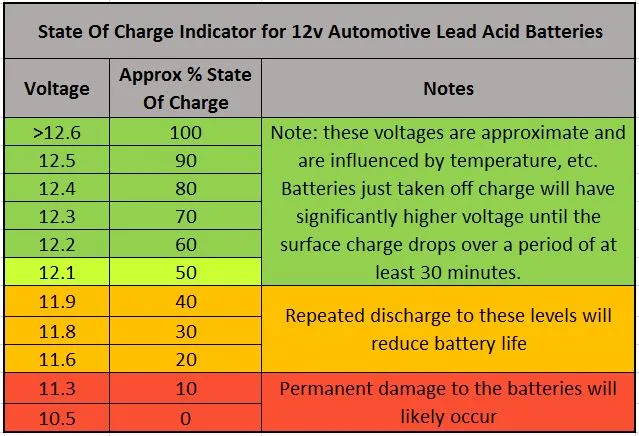
Take your resting reading (engine off, car sat for at least an hour) and find it below. Per Battery Council International reference data, here's how open-circuit voltage maps to state of charge for a flooded lead-acid battery:
| Resting Voltage | State of Charge | What to Do |
|---|---|---|
| 12.6 to 12.8V | 100% | Nothing. You're healthy. |
| 12.4V | ~75% | Charge soon. Investigate why it's low. |
| 12.2V | ~50% | Charge now. Sulfation is starting. |
| 12.0V | ~25% | Deep discharge territory. Charge and retest. |
| Below 11.9V | Discharged | Charge fully, then load test or replace. |
| ~10.5V | Dead cell likely | Replace. Charging won't fix it. |
12.6V and Above: Fully Charged and Healthy
If you read 12.6 to 12.8 volts, your battery is fully charged. That's the direct answer, and for most people it ends the diagnosis. If the car still cranks slowly at this voltage, the battery probably isn't your problem.
Look at connections, the starter, or run the cranking test coming up.
Readings slightly above 12.8 usually mean surface charge from recent driving. It's not damage. It's just a false high that fades within an hour or two.
12.4V: The Sneaky "Seems Fine" Zone
This is the reading that fools the most people. 12.4 volts is only 75% charged, and lead-acid batteries hate living below full. Lead sulfate crystals start hardening on the plates, a process called sulfation, and every week spent at 12.4 volts makes some of that capacity loss permanent.
If you see 12.4 volts, follow this logic. If the car sat unused for two or three weeks, that drain is fairly normal. Charge it fully and move on.
If you drive daily and still read 12.4, something is off: short trips that never fully recharge it, a weak alternator, or a parasitic drain.
12.0 to 12.2V: Half Dead and Sulfating
At 12.2 volts you're at roughly 50% charge. At 12.0 you're near 25%. A battery in this zone will often still start the car, which lulls owners into ignoring it.
Don't.
Charge it with a proper smart charger, not just a long drive. Then find the cause. A healthy charging system doesn't let a daily-driven battery sink this low.
If this keeps happening, the battery is being murdered by something else, and replacing it without fixing the cause just schedules the next failure.
Below 11.9V: Deeply Discharged or Dying
Under 11.9 volts, the battery is effectively flat. Deep discharge is genuinely damaging to starter batteries. One event is usually survivable.
Repeated events are not.
The path forward: fully recharge it, let it rest overnight, and measure again. If it holds 12.4 volts or better, it may have life left. If it sags back into the low 12s or worse, the plates are damaged and replacement is the honest answer.
A reading stuck around 10.5 volts means one of the six cells has died outright. No charger revives a dead cell.
How to Test Your Battery Voltage With a Multimeter (60-Second Method)
The test itself takes about a minute. Getting a reading you can trust takes a little setup. Here's the full sequence:
- Park the car and switch everything off. Ideally, let it sit overnight.
- Set your multimeter to DC volts, 20V range if it's manual-ranging.
- Touch the red probe to the positive (+) terminal.
- Touch the black probe to the negative (-) terminal.
- Read the display and compare it to the chart above.
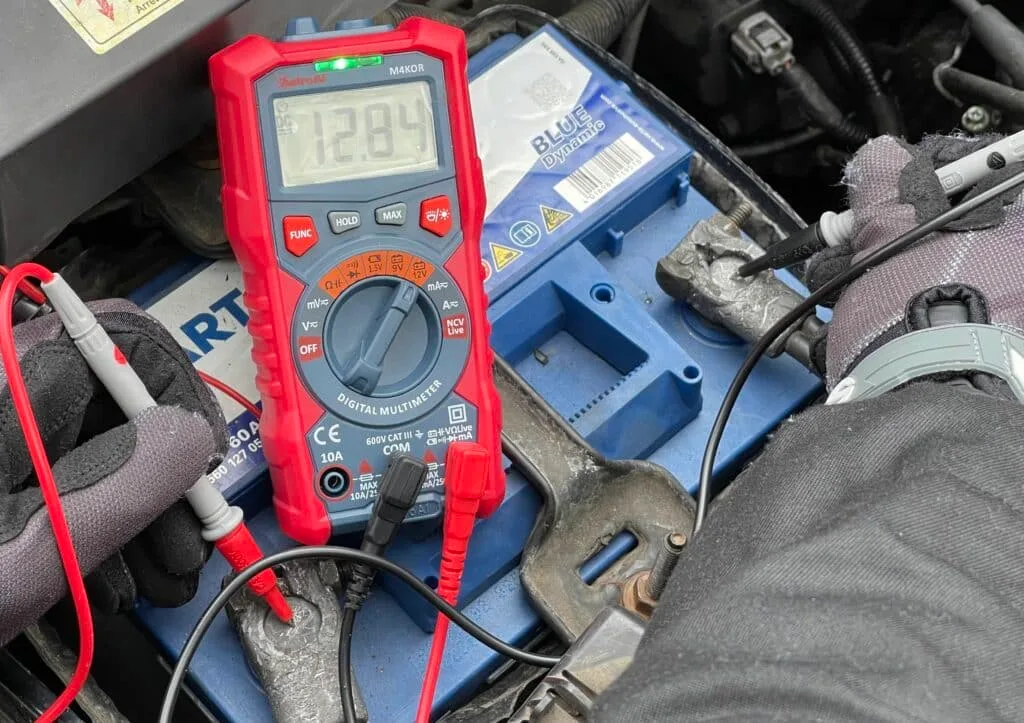
If probes and dials are new territory, our walkthrough for first-time multimeter users covers the basics without the jargon. The one setting mistake to avoid: make sure you're on DC, not AC. The DCV marking on the dial is the one you want.
Car electrical systems are direct current, and an AC setting gives you a meaningless number.
Don't panic over a reading like 12.63 versus 12.58. Probe pressure, terminal cleanliness, and meter accuracy all move the number a few hundredths. You're reading the zone, not chasing decimals.
Getting a True Resting Reading: Why Timing Matters
Measure at least one hour after the engine was last running. Overnight is better. A battery fresh off the alternator carries an inflated charge that hasn't settled, so a 7 pm reading after your commute can show 13.0 volts on a battery that's genuinely at 12.3.
The gold-standard habit is a morning test. Before the first start of the day, the battery has rested 8+ hours and the reading reflects reality. Cold overnight temperatures pull the number down slightly, which we'll cover in the temperature section, but the reading is still far more honest than a post-drive one.
Burning Off Surface Charge Before You Measure
Can't wait an hour? Burn the surface charge off manually. Turn the headlights on for one to two minutes with the engine off, switch them off, wait five minutes, then measure.
Surface charge is a thin layer of extra energy sitting on the plate surfaces after charging. It adds roughly 0.2 to 0.3 volts of false optimism. The headlight trick strips it away so you're reading the battery's true state, not its post-drive glow.
Voltage With the Engine Running: Testing Your Alternator, Not Your Battery
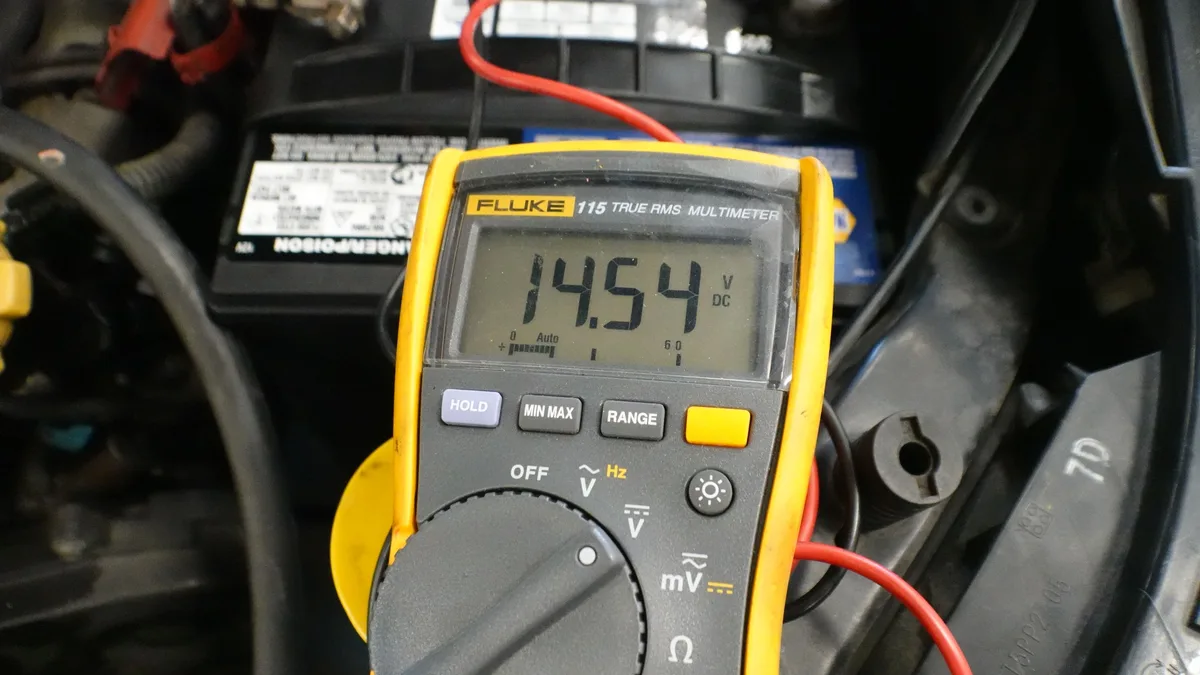
Start the engine and measure across the same two terminals. Normal is now 13.7 to 14.7 volts. Understand what changed: you're no longer testing the battery at all.
You're testing the alternator and voltage regulator, the system responsible for refilling the battery while you drive.
This distinction saves people real money. A weak resting voltage plus a healthy running voltage points at the battery or a drain. A weak running voltage points at the charging system, and no new battery fixes that.
The U.S. Department of Energy covers the underlying charging chemistry if you want the science, but the practical takeaway is simple. Diagnose the charger before you condemn the battery.
13.7 to 14.7V: The Healthy Charging Range
If you read between 13.7 and 14.7 volts at idle, your charging system is working. That's the direct answer. The exact number wanders inside that band by design.
Modern smart-charging systems adjust output based on battery temperature, state of charge, and electrical load, so don't expect a rock-steady 14.2.
Now add load. Turn on the headlights, rear defroster, and blower fan together. The reading may dip slightly, but it should hold above roughly 13.5 volts.
If it holds, the alternator has enough headroom for real-world driving.
Under 13.5V or Over 15V: Charging System Red Flags
Below 13.5 volts while running means the battery is being undercharged. Common culprits, in the order worth checking: corroded battery terminals, a loose or glazed drive belt, a failing alternator, or corroded ground straps. An undercharged battery slowly sulfates and dies young, so this is worth fixing promptly even though the car still drives.
Above 15.0 volts means the voltage regulator has likely failed and is overcharging. This one is urgent. Overcharging boils electrolyte out of the battery, warps plates, and can damage sensitive electronics throughout the car.
If you see 15.2 or higher, get the charging system inspected now, not next month.
Cranking Voltage: The Under-Load Test Most People Skip
Resting voltage can lie. A battery with high internal resistance or a weak cell can rest at 12.5 volts, then collapse the instant the starter hits it. The cranking test catches exactly that failure, and it needs no extra equipment.
Here's the method. Keep the multimeter probes on the terminals and have a helper crank the engine. Watch the display during those two or three seconds of cranking.
A healthy battery dips but stays at or above 9.6 volts at around 70°F.

Similar Posts