Car Battery Low Voltage: Signs, Causes, and Easy Fixes

Low voltage is the single most common warning sign a car battery gives before it leaves you stranded. But here's the thing about car battery low voltage: the number on your multimeter means almost nothing by itself. A 12.2V reading could mean a tired battery, a lazy alternator, a hidden drain, or just a corroded terminal doing its best impression of a dead battery.
The gap between healthy and dying is razor thin. Per Battery Council International guidance, a fully charged 12V battery rests at about 12.6V, while 12.0V means it's already down to roughly 25% charge. That half-volt difference decides whether you drive off or call for a jump, so let's start with why the number alone can mislead you.
Why Your Car Battery Is Reading Low Voltage (and Why the Number Alone Doesn't Tell You Much)
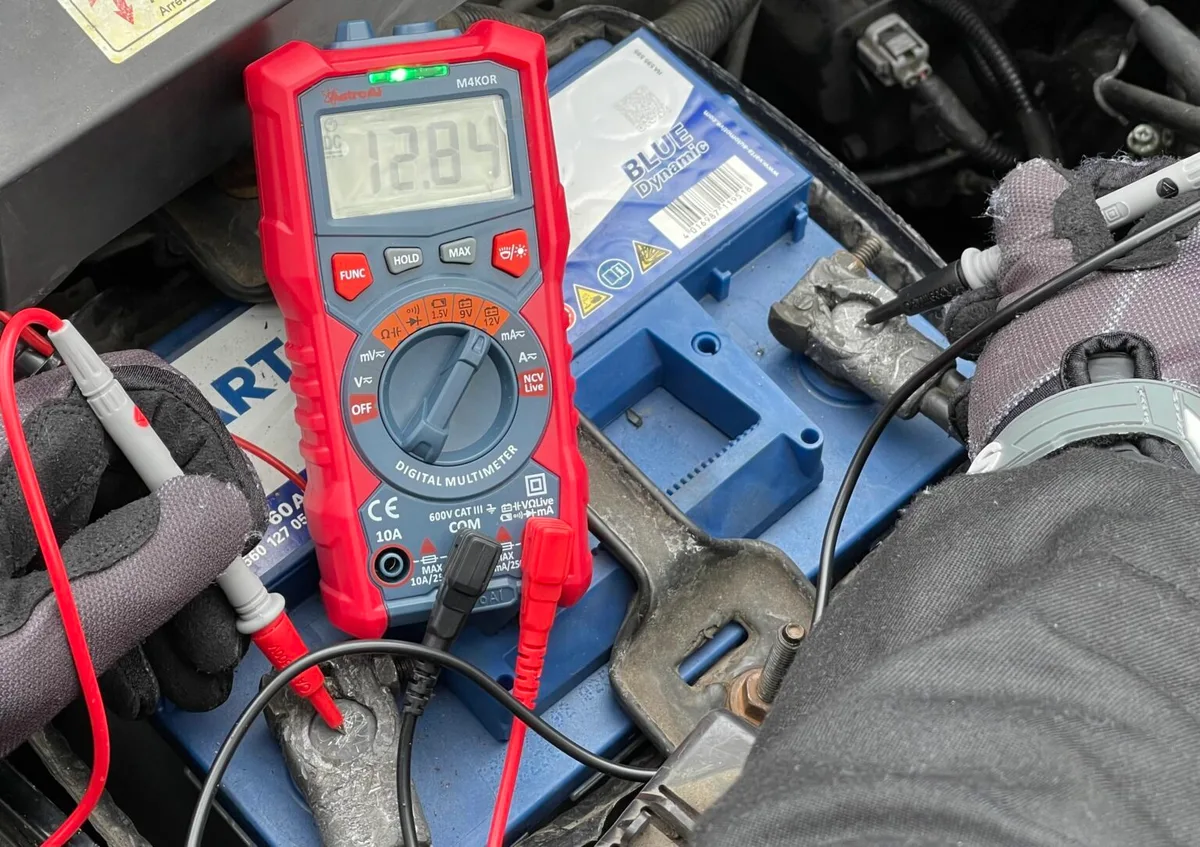
A low voltage reading is a symptom, not a diagnosis. Four completely different problems all show up as the same low number on your meter.
Here's what could actually be going on:
- The battery itself is worn out. Plates degrade, sulfation builds up, and the battery can no longer hold a full charge.
- The alternator isn't recharging it. The battery is fine, but it's slowly starving because the charging system underperforms.
- Something is draining it while parked. A parasitic draw from a dashcam, stuck relay, or glovebox light pulls power all night.
- The connections are bad. Corrosion or a loose ground makes a healthy battery read low, or deliver power poorly.
Replace the battery without knowing which branch you're on, and there's a real chance you'll be back in the same spot in two weeks. In our research, misdiagnosis is the number one frustration in owner forums. People buy a new battery, the car dies again, and the actual culprit was a $0 fix like a corroded clamp.
The good news? Three quick voltage readings, taken at the right moments, separate all four causes. First, let's define what "low" actually means.
Quick Answer: What Counts as Low Voltage on a Car Battery
A healthy car battery reads 12.6V or higher at rest. Anything below 12.4V counts as low and needs charging. Below 11.9V means the battery is deeply discharged.
Below 10.5V usually means a dead cell. While the engine runs, you should see 13.5V to 14.8V. Lower than that points to a charging problem, not the battery.
That's the short version. The longer version depends on when you take the reading, because a battery's voltage swings through the day. Right after a drive it reads artificially high.
After sitting overnight in the cold, it reads a touch low even when healthy.
If you're not sure what your battery should show in each situation, we've broken down the normal readings for a 12V system in detail.
The Voltage-to-State-of-Charge Chart
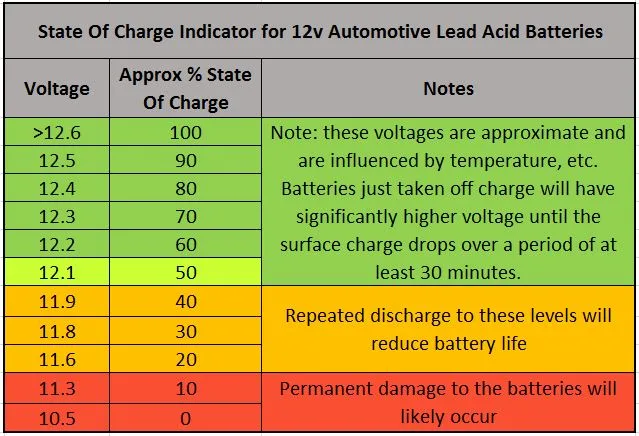
Resting voltage maps to state of charge (SoC) in a surprisingly tight pattern. This chart applies to a standard flooded lead-acid battery that's been sitting engine-off for at least an hour.
| Resting Voltage | State of Charge | What It Means |
|---|---|---|
| 12.6V or higher | 100% | Healthy and fully charged |
| 12.4V | ~75% | Acceptable, but charge soon |
| 12.2V | ~50% | Low. Charge it now |
| 12.0V | ~25% | Deeply discharged, damage risk |
| 11.9V or below | Near 0% | Sulfation likely underway |
| 10.5V or below | Failed | Probable dead cell |
Two notes on reading this chart. First, AGM batteries run slightly higher, with a full charge closer to 12.8V. If you're not sure which type you have, our explainer on absorbed glass mat designs covers how to tell them apart.
Second, notice how compressed the scale is. The entire usable range lives inside 0.7 volts. That's why a cheap analog gauge won't cut it.
You need a digital multimeter that resolves to a tenth of a volt.
How to Get a Reading You Can Actually Trust
The most common mistake isn't reading the meter wrong. It's testing at the wrong time. Voltage taken minutes after a drive, or with the doors open and lights on, will lie to you.
Here's the if/then rule: if the car has run in the last hour, your reading is inflated. If any accessory is on, your reading is deflated. Either way, you're diagnosing a ghost.
Testing With a Multimeter the Right Way
Any basic digital multimeter works for this. As of 2026, a reliable unit costs under $25, which is cheap insurance against replacing a $200 battery you didn't need to.
Follow this sequence:
- Park the car and let it sit at least one hour. Overnight is better.
- Keep doors closed, lights off, key out of the ignition.
- Set the meter to DC voltage, 20V range if it isn't auto-ranging.
- Touch the red probe to the positive (+) terminal, black to negative (-).
- Read the display and match it to the chart above.
If your meter's dial looks like alphabet soup, the setting you want is marked DCV or V with a straight line. We've explained exactly what that dial position does and how it differs from the AC setting. And if this is your first time holding one, our walkthrough on getting started with a meter covers probe placement and safety basics in five minutes.
One more tip: press the probes firmly onto clean metal. A flaky probe connection can shave a few tenths off the display and send you chasing a problem that doesn't exist.
Surface Charge: The False-High Reading That Fools Everyone
Surface charge is a temporary voltage boost that sits on the battery plates right after driving or charging. A battery fresh off a 30-minute drive can display 12.8V and still fail to crank tomorrow morning.
This is the single biggest trap in DIY battery testing. The battery looks great on the meter, so you rule it out. Then it strands you, and now you distrust your own readings.
Two ways to burn off surface charge before testing:
- Wait it out. Let the car sit for at least an hour, ideally overnight.
- Load it off. Turn the headlights on for two minutes, switch them off, wait two more minutes, then test.
If the voltage plummets from 12.8V to 12.1V after the headlight trick, that high number was surface charge. The 12.1V is the truth.
The Three Readings That Diagnose Everything
This is the heart of the whole diagnosis. Three readings, taken in order, tell you whether the problem is the battery, the connections, or the charging system. Each one rules causes in or out.
| Reading | When to Take It | Healthy Range | Points To If Low |
|---|---|---|---|
| Resting voltage | Engine off, 1+ hour rest | 12.4V to 12.8V | Discharge, drain, or aging battery |
| Cranking voltage | During engine start | Above 9.6V | Weak battery or bad connection |
| Charging voltage | Engine running at idle | 13.5V to 14.8V | Alternator or belt problem |
Resting Voltage (Engine Off)
This is your baseline, taken exactly as described above. It tells you the battery's state of charge, but not yet why it's low.
If resting voltage is 12.4V or higher, the battery is reasonably charged. A car that still cranks poorly at that voltage has a connection or starter problem, not a charge problem. If it's below 12.4V, something has drained it or it can't hold charge anymore.
The next two readings sort out which.
Cranking Voltage (During Start)
Watch the meter while a helper starts the engine. Voltage will dip hard for a second, and that dip is the diagnostic gold.
A healthy battery stays above roughly 9.6V during the crank at around 70°F. If it dives to 8V or lower, the battery can't deliver current under load, even if its resting voltage looked fine. That's the classic signature of a battery with high internal resistance or a failing cell.
Cold matters here. Cranking demand shoots up in winter while battery output drops, which is exactly what the CCA rating measures. If you've never dug into that spec, our breakdown of cold cranking performance explains why a marginal battery passes in July and fails in January.
Charging Voltage (Engine Running)
Start the engine and measure across the same terminals. You should now see 13.5V to 14.8V, which is the alternator pushing charge back into the battery.
Here's the if/then logic:
- If you see 13.5V to 14.8V: the charging system works. Your problem lives in the battery or a drain.
- If you see under 13.2V: the alternator or voltage regulator is underperforming. The battery is being starved, not failing.
- If you see over 15V: the regulator is overcharging, which cooks batteries. Get it checked promptly.
One caveat for newer cars. Many vehicles built in the last decade use smart charging that deliberately varies alternator output, sometimes dropping to 12.8V briefly when the battery is full. If your reading fluctuates, rev to 2,000 rpm and switch on the headlights and rear defroster.
Output should climb into the mid-14s under that load.
Decision Branch 1: Low Voltage After Sitting Overnight
You tested in the morning and got 12.2V or lower. The car sat overnight with nothing left on. This branch covers the most common real-world scenario, and it splits three ways.
First, check the battery's age. Look for the date code sticker on the case. Most batteries last 3 to 5 years, and less in hot climates where heat accelerates plate corrosion. If yours is past year four and reads low every morning, age is the likely story.
Our data on typical service life shows failure rates climbing sharply after the fourth year.
Second, think about your driving pattern. Short trips are quiet battery killers. A cold start pulls a big chunk of charge out, and a 10-minute drive doesn't put it all back. String together weeks of school runs and errands, and a perfectly healthy battery drifts down to 12.1V.
The if/then test here is simple. If a full overnight charge with a smart charger brings the battery back to 12.6V and it holds that for two days parked, the battery is fine. Your usage was the problem, and an occasional maintenance charge solves it.
Third, suspect a drain if the numbers don't add up. A healthy battery loses only about 1% of charge per month to self-discharge. If yours drops from 12.6V to 12.2V over three parked days, electricity is going somewhere. That's Decision Branch 3 territory, and we'll run the parasitic draw test there.
Before moving on, run one quick sanity check. Charge the battery fully, let it rest an hour, and test again. If it won't climb past 12.4V even straight off the charger, stop chasing drains.
The battery itself can no longer hold a full charge, and no amount of alternator or wiring work will fix that.
Decision Branch 2: Low Voltage While the Engine Is Running
If the meter shows under 13.2V with the engine idling, stop blaming the battery. The alternator isn't doing its job, and any battery you bolt in will slowly drain the same way.
Work through the causes from cheapest to priciest:
- Loose or glazed serpentine belt. A slipping belt can't spin the alternator at full output. Listen for squeal on cold starts and check for cracks or a shiny glazed surface.
- Corroded alternator connections. The output cable from alternator to battery passes serious current. Resistance here eats charging voltage before it arrives.
- Failing voltage regulator. Modern alternators carry the regulator inside. When it fails, output drifts low, high, or erratic.
- Worn alternator itself. Brushes and diodes wear out, often between 100,000 and 150,000 miles.
Here's a quick isolation test. Measure at the battery terminals, then measure at the alternator's output stud with the engine running. If the alternator stud shows 14.2V but the battery only sees 13.0V, the fault is in the cable or connections between them, not the alternator.
Watch for the flickering clue too. If your dash lights pulse or the headlights breathe brighter and dimmer at idle, that's a failing regulator or a bad diode. A diode failure also leaks AC ripple into the system, which can confuse cheap meters.
This is one place where true RMS measurement earns its keep.
One warning before you road-test anything. A car with a dead alternator runs purely on battery, and most vehicles manage only 30 to 60 minutes before the ignition and injectors shut down. If charging voltage is low, drive straight home or straight to the shop, not on a road trip.
Decision Branch 3: Battery Drains After Days of Sitting, Finding a Parasitic Draw
If the battery reads 12.6V after a drive but drops to 12.1V after four parked days, something is drinking current with the key off. That's a parasitic draw, and it's the branch that stumps people the longest.
Some key-off drain is normal. Modern cars keep alarms, keyless entry receivers, and ECU memory alive around the clock. A healthy system settles between 20 and 50 milliamps once the modules go to sleep.
Anything above 85mA will flatten a battery in a week or two of sitting.

How to Run the Draw Test
You'll need a multimeter that measures DC amps, connected in series with the battery. Here's the sequence:
- Charge the battery fully and close all doors. Latch the hood switch if there is one.
- Disconnect the negative battery cable.
- Connect the meter between the negative post and the disconnected cable, using the 10A setting.
- Wait 30 to 45 minutes. Modules need time to go to sleep, and early readings run high.
- Read the settled draw. Under 50mA is fine. Over 85mA means you hunt.
Set the meter to amps before connecting, and never crank the engine during this test. Starter current will destroy the meter's fuse instantly. It's the most common way people end up wondering why the internal fuse popped mid-test.
Finding the Guilty Circuit
With a high reading on the meter, pull fuses one at a time and watch the display. When the number drops, you've found the circuit feeding the drain.
The usual suspects, from our review of owner-forum diagnostics:
- Aftermarket dashcams hardwired in parking mode
- Trunk, glovebox, or vanity lights that never switch off
- Aftermarket alarms and remote-start modules
- Stuck relays, often for fuel pumps or HVAC blowers
- Infotainment units that fail to sleep after a software glitch
If pulling every fuse changes nothing, suspect the alternator itself. A leaky diode can pull current backward through the charging circuit around the clock. Disconnect the alternator's output cable and see if the draw disappears.
When It's Not the Battery at All: Terminals, Grounds, and Corroded Connections
A surprising share of "low voltage" complaints trace back to a connection problem, not a power problem. Corrosion between the post and clamp acts like a resistor. The battery holds a healthy charge it simply can't deliver.

The telltale sign is a mismatch between readings. Voltage measured directly on the lead posts looks fine, but the car clicks instead of cranking. Or the reading jumps around when you wiggle the cable.
Either symptom points at the connection.
That white, green, or blue crust forms when battery acid vapor reacts with the metal clamps. It grows fastest on batteries that vent slightly, which is common in old flooded designs. Knowing what sits inside the case makes it obvious why the positive terminal usually corrodes first.
The Voltage Drop Test
This test finds bad connections that look clean. With a helper cranking the engine, measure between the battery post itself and the clamp around it. A good connection shows under 0.1V during cranking.
Anything higher means resistance is stealing power right at the joint.
Run the same check on the ground path. Probe from the negative post to bare metal on the engine block while cranking. More than 0.2V of drop means a corroded or loose ground strap, which is one of the most misdiagnosed faults in all of car electrics.
The Ten-Minute Fix
Cleaning terminals costs almost nothing:
- Disconnect the negative clamp first, then the positive.
- Scrub posts and clamps with a wire brush and a paste of baking soda and water.
- Rinse lightly, dry completely.
- Reconnect positive first, negative last, and tighten until the clamps won't twist by hand.
- Coat with dielectric grease or terminal protector spray.
Retest your resting and cranking voltage afterward. In plenty of cases, this ten-minute job ends the whole investigation.
Recharge or Replace? Making the Call
You've isolated the problem to the battery itself. Now the branch splits one last time: is this battery recoverable, or done? The answer hinges on three things: how low it went, how long it sat there, and how old it is.
When a Smart Charger Can Save the Battery
If the battery reads between 11.9V and 12.4V and hasn't sat discharged for weeks, a proper recharge usually brings it back. The key word is proper. A 20-minute drive won't do it, and repeated jump-starts just paper over the problem.

Use a smart charger or maintainer at 4 to 8 amps. Expect 6 to 12 hours for a deeply discharged battery. Slow charging lets the chemistry recover evenly, where fast charging just heats the plates.
Match the charger mode to your battery type. AGM and enhanced flooded designs want different voltage profiles than a standard flooded battery, and most smart chargers have a dedicated setting. If you're unsure which chemistry sits under your hood, our comparison of the main battery constructions shows how to identify each from the label.
Then run the verdict test. Charge fully, rest an hour, and confirm 12.6V. Park the car for two or three days and test again.
If it holds above 12.4V, the battery is healthy and your problem was usage or a drain you've since fixed.
When the Battery Is Done (Dead Cells, Deep Discharge, Age)
Some batteries aren't coming back, and recognizing them early saves wasted weekends. Replace instead of recharging when you see any of these:
- Voltage stuck near 10.5V or below. That's the signature of a shorted cell. Each of the six cells contributes about 2.1V, and losing one is permanent.
- Won't climb past 12.4V straight off the charger. The plates have sulfated or shed material. Capacity is gone even if voltage looks okay.
- Charges fine but dies in days with no parasitic draw. High self-discharge from internal damage.
- Physical symptoms. A swollen case, rotten-egg smell, or visible leakage means replace it, full stop.
- Age past five years with any of the above. Recovery attempts on old batteries rarely hold.
Desulfation modes on premium chargers can sometimes revive a battery that sat discharged for a month or two. Manufacturer documentation from charger brands puts realistic success rates well under half, so treat it as a free long shot, not a plan.
When you do replace, hand the old battery in. Lead-acid batteries are the most recycled consumer product in the US, with the EPA noting a recycling rate around 99%. Retailers take cores back and refund your core charge.
What It'll Cost You: Battery vs. Alternator vs. DIY Fixes
Cost is where accurate diagnosis pays for itself. The same symptom, a car that won't hold voltage, spans a $0 fix to an $800 repair depending on the branch you landed on.
| Fix | Typical Cost (2026, US) | When It's the Answer |
|---|---|---|
| Cleaning terminals and grounds | $0 to $10 | Voltage drop across connections |
| Digital multimeter | $15 to $40 | One-time tool purchase |
| Smart charger/maintainer | $40 to $130 | Discharged but healthy battery |
| New flooded battery | $100 to $180 | Dead cell, sulfation, old age |
| New AGM battery | $180 to $280 | Start-stop and premium vehicles |
| Alternator replacement | $300 to $800 | Low charging voltage confirmed |
| Shop parasitic draw diagnosis | $100 to $200 | Drain you can't isolate yourself |
A few notes on the numbers. Battery prices swing with group size and cold cranking specs, so check the size your vehicle calls for before pricing anything. Buying more reserve capacity than your climate needs is money spent on nothing.
Alternator costs split roughly half parts, half labor. Remanufactured units cut the parts bill by 30 to 40% with warranties that now commonly match new units.
And don't overlook the free option. Most major auto parts chains test batteries and charging systems at no cost. Their conductance testers estimate capacity in seconds, which is a solid second opinion before you spend anything.
Just take the reading with the surface charge caveat from earlier in mind.
Mistakes That Lead to Replacing Parts You Didn't Need To
The pattern behind almost every wasted repair is testing out of order. These are the errors that show up over and over in aggregate owner reports:
- Trusting a post-drive reading. Surface charge hides a weak battery. Always test after an hour of rest.
- Replacing the battery without checking charging voltage. If the alternator only pushes 12.9V, the new battery dies the same slow death.
- Skipping the terminals. A $150 battery swap that "fixed" the problem often worked only because the clamps got cleaned during installation.
- Jump-starting on repeat. Every jump treats the symptom and deepens the discharge damage.
- Testing the parasitic draw too early. Reading before the modules sleep makes a normal car look like it has a drain.
- Buying the wrong replacement type. Putting a standard flooded battery in a start-stop car kills it within a year or two. Those systems need AGM or enhanced flooded construction.
One more that's specific to newer cars. Some European makes require registering a new battery with the body control module. Skip that step and the smart charging system keeps charging on the old battery's profile, which shortens the new one's life.
Staying Safe Around a Low or Charging Battery
Charging lead-acid batteries release hydrogen gas, and hydrogen ignites from a single spark. Keep flames, cigarettes, and grinder sparks well away, and charge in a ventilated space.
The non-negotiables:
- Disconnect the negative cable first and reconnect it last. This kills the chance of a wrench arcing to the body.
- Never let a metal tool bridge both terminals. A car battery can dump hundreds of amps through it instantly.
- Wear eye protection around flooded batteries. The electrolyte is sulfuric acid.
- Never charge a frozen battery. A deeply discharged battery can freeze near 20°F, and charging it risks rupturing the case.
- Follow the jump-start sequence in your owner's manual, ending with the chassis ground point rather than the dead battery's negative post.
If the battery case is swollen or hissing, don't charge it at all. Ventilate the area, let it settle, and replace it.
Keeping Voltage Healthy Long-Term: Short Trips, Storage, and Maintainers
Prevention is mostly about matching charge input to charge drain. If your weekly driving is all short hops, plug in a maintainer overnight once or twice a month. That single habit erases the slow drift toward 12.1V mornings.
For cars that sit, the math is simple. Self-discharge plus a normal 30mA key-off draw will pull a battery low in three to six weeks. If a vehicle parks longer than two weeks, connect a float-mode maintainer or disconnect the negative terminal.
Twice a year, spend five minutes on upkeep:
- Check resting voltage and log it. A downward trend across months flags a battery entering its final year.
- Inspect and clean the terminals before corrosion builds.
- Confirm the hold-down clamp is tight. Vibration shakes plate material loose and shortens life.
Climate sets your schedule. In hot regions, start testing monthly once the battery turns three. Our aggregated failure data in the year-by-year lifespan breakdown shows southern-climate batteries failing a full year or more earlier than northern ones.
FAQs About Car Battery Low Voltage
What voltage is too low to start a car?
Most cars struggle to start below 11.8V resting voltage and won't start reliably near 11.5V. The real killer is voltage under load. If the battery falls below 9.6V while cranking, the starter can't spin fast enough, no matter what the resting number showed.
Can a car battery recover from low voltage on its own?
No. Driving helps only if the discharge was mild and the trip is long, think 30 minutes of highway. A battery below 12.2V needs a dedicated charger.
Below 11.9V, recovery requires a slow overnight charge, and the longer it sat discharged, the less capacity comes back.
Why does my battery read 12.4V but the car won't start?
Almost always a connection or delivery problem. Check for corroded terminals, a loose ground strap, or a failing starter. Run the voltage drop test from earlier: more than 0.1V across any single connection during cranking pinpoints the fault.
The battery's charge isn't the issue.
Is 12.2 volts low for a car battery?
Yes. A reading of 12.2V means roughly 50% state of charge, which is the threshold where charging becomes urgent. The car will probably still start, but lead-acid batteries sulfate when they sit below full charge.
Charge it overnight, then investigate why it got that low.
Does cold weather cause low battery voltage?
Cold lowers voltage slightly and cuts available power a lot. At 0°F a battery delivers roughly 40 to 60% less cranking power while the engine demands more. A battery that read marginal in fall becomes a no-start in January, which is why winter exposes weak batteries first.
How long can a car sit before the battery voltage drops too low?
A healthy battery with normal key-off draw lasts three to six weeks parked. Newer cars with heavy electronics can flatten one in two weeks. If storage runs longer, use a float maintainer or pull the negative cable, which stretches standby time to months.
The Full Diagnostic Flowchart in Plain Words
Here's the whole decision tree in one pass. Follow it top to bottom and you'll land on the right fix without guessing.
- Rest the car an hour, then test. 12.4V or higher? Voltage isn't your problem, check connections and starter. Lower? Continue.
- Test while cranking. Drops below 9.6V? Weak battery or bad connection. Run the voltage drop test to split the two.
- Test with the engine running. Under 13.2V? It's the alternator branch, belt, connections, or the unit itself. 13.5V to 14.8V? The charging system is fine, keep going.
- Charge fully and let it rest. Won't reach 12.6V off the charger? The battery is done. Replace it.
- Park it two or three days and retest. Holds above 12.4V? You're fixed, blame short trips. Drops fast? Run the parasitic draw test and hunt the circuit.
Print that list, tape it inside a cabinet door, and you'll never diagnose blind again. The meter does the thinking. Ten minutes of readings beats hundreds of dollars of guessing every single time.