What Is Normal Parasitic Draw on a Car Battery?

If your car fires right up one day and cranks slow the next after sitting, a small hidden current is usually to blame. So what is normal parasitic draw on a car battery? For a healthy vehicle, it's a tiny trickle of roughly 20 to 85 milliamps once everything powers down.
That's the sip your alarm, clock, and memory circuits take while the key is out.
Here's the catch. Modern cars don't switch off the instant you lock the doors. Manufacturer key-off current specs show many modules stay awake for 20 to 60 minutes first.
Measure too early and a perfectly good car looks like it's bleeding power. Let's sort out what's normal, what isn't, and how to tell the difference.
Quick Answer
Normal parasitic draw on a car battery is about 20 to 85 milliamps. Older, simpler cars often sit near 20 to 50 mA. Modern cars with more electronics run 50 to 85 mA.
Anything above 100 mA after the car sleeps is suspect. Always wait 20 to 60 minutes before you trust the reading.
What Parasitic Draw Actually Means When Your Car Is Off
Parasitic draw is the current your car keeps using after you shut it off and walk away. Engineers call it key-off load or quiescent current. It's the power draw of everything that never fully dies.
Think of the clock, the security alarm, the keyless entry receiver, and the radio's memory. All of these need a trickle of electricity to stay ready. That trickle is completely normal.
The problem starts when something draws far more than it should. A stuck relay, a trunk light that won't switch off, or a poorly wired accessory can flatten your battery overnight. The whole point of a draw test is separating that healthy trickle from a real leak.
If you want the hands-on version, our guide on checking key-off current with a meter walks through the setup.
The Short Answer: How Many Milliamps Is Normal
For most cars on the road as of 2026, a normal parasitic draw lands between 20 and 85 milliamps. That's it. Once the car has fully gone to sleep, a reading in that window means your electrical system is behaving.
A rough sanity check used by many techs: your draw shouldn't exceed about 1 mA for every amp-hour of battery capacity. So a 60 Ah battery can tolerate up to roughly 60 mA without much worry.
| Reading (after sleep) | What it usually means |
|---|---|
| 20 to 50 mA | Normal for older or basic cars |
| 50 to 85 mA | Normal for modern, module-heavy cars |
| 85 to 100 mA | Borderline, worth watching |
| Over 100 mA | Likely a real parasitic drain |
These numbers only count once the modules have powered down. A fresh reading taken the moment you shut the door will always look scary.
Why Modern Cars Pull More Than Older Ones Do
A 1995 sedan might have a handful of electronic modules. A new car can carry 30 or more. Each one, the body control module, infotainment head unit, and telematics unit, needs a little standby power.
Add them up and the baseline naturally climbs.
These modules also talk to each other over a shared network called the CAN bus. As long as that network is chattering, the modules stay awake and keep drawing current. They only settle once the bus goes quiet.
The Module Sleep Cycle and the 20 to 60 Minute Wait
Modern modules don't sleep the second you leave. They run a timed shutdown, staying alert for messages before powering down in stages. That process often takes 20 to 60 minutes, and some cars take longer.
So if you clamp a meter on right after locking up, you might see 300, 500, even 800 mA. That's not a fault. It's the car still winding down.
Wait for the modules to sleep, then read again. This single mistake fools more people than any other, so patience beats any fancy meter.
Normal Draw Ranges by Car Type and Age
What counts as normal shifts with the vehicle. A stripped-down older car and a loaded new SUV live in different worlds electrically. Here's a realistic breakdown.
| Vehicle type | Typical normal draw |
|---|---|
| Classic or basic older car | 15 to 40 mA |
| Standard modern sedan | 30 to 60 mA |
| Modern car with keyless, telematics, start-stop | 50 to 85 mA |
| Car with added dashcam, alarm, or amp | Add 5 to 40 mA on top |
Aftermarket gear is the wild card. A hardwired dashcam in parking mode or a GPS tracker adds its own steady load. That extra draw can be fine, or it can be the exact thing killing your battery if it's wired to an always-hot circuit.
Cold weather makes any draw hurt more too, since a chilled battery holds less usable charge, as our notes on battery behavior in the cold explain.
What Counts as Too Much: The Numbers That Signal a Real Drain
A sustained draw above 100 milliamps, measured after the car sleeps, is your red flag. Once you're past 150 to 200 mA, something is genuinely wrong and your battery will pay for it.
Here's the simple logic to apply:
- If the reading settles under 85 mA, you're fine. Stop and move on.
- If it hovers between 85 and 100 mA, note it and recheck in a week.
- If it stays above 100 mA, start hunting the circuit.
- If it reads 500 mA or more and won't drop, a device is stuck fully awake.
Before blaming a draw, rule out the basics. A tired battery or a weak charging system can mimic these symptoms. It's worth confirming your charging output sits in range and that the battery still holds a load.
Once those check out, a high key-off reading points squarely at a parasitic drain worth chasing down.
How Long a Bad Draw Takes to Kill Your Battery
The math is simple once you know your draw and your battery size. Divide the usable capacity by the current, and you get a rough runtime. A healthy battery only gives up about half its rated capacity before it can't crank.
Take a common 50 Ah battery with roughly 25 usable amp-hours. A normal 50 mA draw would take around 500 hours to flatten it, close to three weeks. A 200 mA drain cuts that to about 125 hours, or five days.
| Parasitic draw | Approx. time to no-start (50 Ah battery) |
|---|---|
| 50 mA (normal) | ~18 to 21 days |
| 100 mA (borderline) | ~9 to 10 days |
| 300 mA (bad) | ~3 to 4 days |
| 700 mA (severe) | ~1.5 days |
This is why a car that sits over a weekend can betray you Monday morning. A weak or aging battery has even less reserve, so the same draw kills it faster.
Testing Your Own Parasitic Draw Step by Step
You've got three solid ways to measure a draw at home. The classic in-series meter method, a non-invasive clamp meter, and the voltage-drop-across-fuse trick. Each has a place depending on your tools and patience.

Before any of them, fully charge the battery and confirm it's good. A draw test on a dying battery just wastes your time. If you're unsure, our walkthrough on reading battery voltage with a meter covers the baseline check.
In-Series Multimeter Method
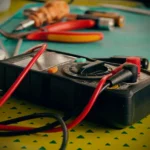
This is the most accurate way, and the most fiddly. Set your digital multimeter to DC amps, using the 10A jack first for safety.
- Turn everything off and remove the key.
- Disconnect the negative battery cable.
- Connect the meter between the cable and the negative post, so all current flows through it.
- Wait 20 to 60 minutes for the modules to sleep.
- Read the settled current in milliamps.
The catch: opening a door to reach the meter wakes the car again. Route the leads so you can shut everything and walk away. Getting the meter onto the right amp setting is half the battle for first-timers.
Low-Current Clamp Meter Method
A low-current DC clamp meter is the easiest option by far. You clamp it around the negative cable without disconnecting anything, so the modules never wake up.
Because nothing gets unplugged, you skip the whole sleep-cycle headache. The downside is accuracy. Cheap clamps struggle to read below 100 mA cleanly, so buy one rated for low DC current if you want reliable numbers.
Voltage-Drop-Across-Fuse Method
Here you measure tiny millivolt drops across each fuse instead of amps. Set the meter to DC millivolts and probe both test points on top of a fuse. A powered circuit shows a small voltage drop that maps to current.
It's slower and needs a fuse-current chart, but it never breaks the circuit. That makes it a favorite for cars with touchy modules. The technique borrows straight from a standard voltage-drop diagnostic.
Finding the Guilty Circuit With the Fuse-Pull Test
Once you've confirmed a high total draw, the fuse-pull test tells you where it's hiding. You pull fuses one at a time and watch for the reading to drop.
Keep your meter connected and settled. Pull one fuse, note the current, then reinsert it before moving on. When the draw suddenly falls to normal, the last fuse you pulled feeds the guilty circuit.

From there, match the fuse to its circuit using the owner's manual or the diagram on the fuse box lid. Say pulling the trunk lamp fuse drops your draw from 400 mA to 60 mA. Now you know the trunk light circuit is your problem, and you can chase the switch or bulb.
A few things to watch during the pull:
- Work both the interior and under-hood fuse boxes.
- Give the car a few seconds to settle after each pull.
- Some modules re-wake when you touch the box, so stay patient.
- If no single fuse fixes it, suspect the alternator or a direct battery connection.
Mistakes That Wreck the Test and Blow Your Meter Fuse
The number one error is reading too soon. People clamp on, see 500 mA, and panic before the modules have gone to sleep. Give it the full settle time every single test.
The second is frying your meter. If you're on the 10A jack and switch on the ignition, the surge from a fuel pump or blower can blow the meter's internal fuse instantly. Never turn anything on while the meter is wired in series.
Other common slip-ups:
- Leaving a door open, which keeps the dome light and modules awake.
- Using the low-current jack (often 400 mA) when the real draw is higher.
- Forgetting the radio and security codes reset when you disconnect the battery.
- Blaming a draw when the real issue is a bad ground or corroded terminal.
That last one trips up a lot of folks. A poor connection can mimic a dead battery, so confirm the ground path is solid before you go fuse-hunting.
When It's the Battery, the Alternator, or an Accessory You Added
Not every overnight death is a parasitic draw. Sometimes the battery is simply worn out, sometimes the charging system never topped it off, and sometimes an add-on is the leak.
Here's how to tell them apart:
- Battery: cranks weak even after a full charge, or fails a load test. Age past four or five years is a red flag.
- Alternator: battery keeps dying while you drive, or the light flickers. A failed diode can even feed current backward at rest.
- Accessory: the trouble started right after installing a dashcam, amp, alarm, or tracker.
A leaking alternator diode is a sneaky one. It adds a steady draw that looks just like a module fault, and it only shows up on a diode test. If your fuse-pull points at the charging circuit, that diode is the prime suspect.
Aftermarket gear deserves a hard look too. A dashcam in 24-hour parking mode can pull 40 mA or more on its own, which is normal for the device but rough on a car that sits all week.
Pro Tips for Cars That Sit for Days or Weeks
If your car naps for long stretches, a normal draw can still drain it over time. The fix isn't always chasing a fault. Sometimes it's just managing the sit.
- Plug in a battery maintainer (trickle charger). It offsets the key-off load and keeps the battery topped off.
- Disconnect the negative terminal for long storage. Just expect to reset the clock and radio codes.
- Pull the fuse for any parking-mode dashcam before a long layup.
- Start and drive the car for 20 minutes weekly to recover charge.
For seasonal vehicles like an RV, boat, or motorcycle, a maintainer is the cheapest insurance you'll buy. Standards bodies such as SAE International publish the key-off current specs automakers design to, which is why healthy draws stay so low.
Safety Notes Before You Touch the Battery
A car battery looks tame, but it deserves respect. Lead-acid batteries vent hydrogen gas, which is flammable. Keep sparks and flames away from the battery while you work.
- Wear eye protection. Battery acid and a stray spark are a bad mix.
- Remove rings and watches so you don't bridge a terminal by accident.
- Never switch the ignition on with your meter wired in series on the 10A jack.
- Double-check you're on DC amps or DC millivolts, not the resistance setting.
One more practical note. Disconnecting the battery clears stored settings, radio presets, and sometimes security codes. Have the radio code handy before you pull the cable, especially on European cars.
Frequently Asked Questions
Is 30 milliamps a normal parasitic draw?
Yes. A settled draw of 30 mA sits comfortably in the normal range for most cars. Older or simpler vehicles often read even lower, closer to 20 mA.
As long as the number holds steady after the modules sleep, 30 mA is nothing to worry about.
How long should I wait before measuring parasitic draw?
Wait 20 to 60 minutes after shutting the car and closing all doors. Modern modules power down in timed stages, not instantly. Read too soon and you'll catch them still awake, showing hundreds of milliamps.
Some vehicles need even longer, so patience gives you the true number.
Can a parasitic draw ruin a car battery?
Yes, if it's high enough and left long enough. Repeated deep discharges damage lead-acid plates and shorten battery life fast. A draw over 100 mA on a parked car can flatten and stress the battery within days.
Catching it early protects both the battery and your starter.
Does a bigger battery reduce parasitic draw?
No. The draw depends on the car's electronics, not the battery size. A larger amp-hour battery just takes longer to run flat under the same load.
It buys you time during long sits, but it won't fix an actual electrical leak.
What's the most common cause of excess parasitic draw?
Aftermarket accessories and stuck circuits top the list. Hardwired dashcams, alarms, and amps often draw more than expected. Stuck relays, trunk lights that never switch off, and failing alternator diodes are the other usual suspects.
The fuse-pull test finds them quickly.
What a Healthy Reading Should Tell You to Do Next
If your settled draw lands between 20 and 85 mA, you're done. Your electrical system is healthy, and any dead battery is pointing you toward the battery or charging system instead. Load-test the battery and check your alternator output next.
If the number sits above 100 mA, start the fuse-pull hunt. Track the current until one circuit gives it away, then chase the specific part. A trunk light, a bad diode, or a wired-in accessory is usually waiting at the end.
And if the car mostly sits, lean on a maintainer rather than tearing into the wiring. A normal draw over weeks of parking is a charging problem, not a fault. Confirm the battery is sound first with a quick under-load check, and you'll know exactly where to spend your time.

Similar Posts