Skip to content

Car Battery Reading 11.9 Volts? What It Really Means

·20 min read·by
car battery reading 11.9 volts

A car battery reading 11.9 volts is not "a little low." It's the battery telling you it's almost completely flat. Most drivers see that number on a multimeter, shrug, and try the key anyway. Then they get the dreaded slow crank, or a click, or nothing at all.

Here's the good news. A fully charged 12V battery rests at 12.6 to 12.8 volts, and 11.9 volts sits near 0 to 10 percent state of charge. That's a big gap, but it doesn't automatically mean the battery is dead for good.

What it means depends on why it got there, and that's exactly what we'll figure out first.

Quick Answer

A car battery reading 11.9 volts is deeply discharged. It holds roughly 0 to 10 percent charge. The car may not start at this level.

Recharge it fully with a smart charger, not just a drive. Then retest after 12 hours of rest. If it drops back below 12.4 volts, replace the battery.

What Voltage Should Car Battery Be?!via Mechanic Mindset

What 11.9 Volts Actually Tells You About Your Battery
car battery reading 11.9 volts

Your battery is built from six cells wired in series. Each healthy cell produces about 2.1 volts, which is why a full battery reads around 12.6 to 12.8 volts at rest. At 11.9 volts, each cell is averaging just under 2 volts.

That's a battery running on fumes.

Voltage is a stand-in for state of charge, which is the percentage of usable energy left in the plates. The relationship isn't linear, and that trips people up. The difference between 12.6V and 11.9V looks tiny on the meter.

In reality, it's the difference between a full tank and an empty one.

There's a second problem hiding in that number. Lead-acid chemistry starts to sulfate once resting voltage falls below roughly 12.0 volts. Sulfation means hard lead-sulfate crystals form on the plates and stop accepting charge.

The longer a battery sits at 11.9V, the more permanent capacity it loses. If you're fuzzy on how those plates and cells work together, our breakdown of the guts of the unit covers what sits under the caps in plain terms.

So an 11.9V reading is really two messages at once. Message one: this battery needs a full charge today, not next weekend. Message two: something drained it, and you need to find out what.

Car Battery Voltage Chart: Where 11.9V Falls on the Scale

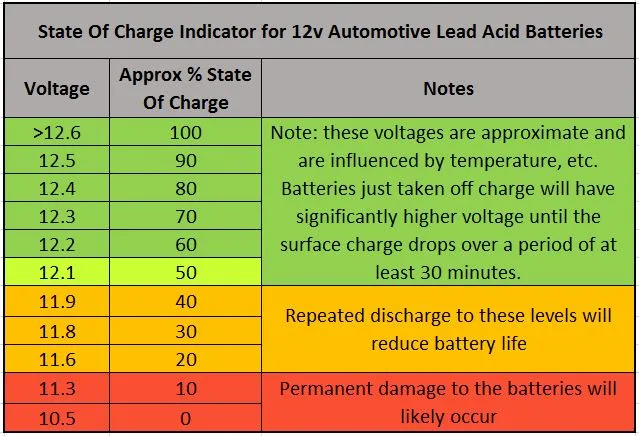
The chart below shows resting voltage against state of charge for a standard flooded 12V battery. Resting means the engine has been off for at least four hours with no accessories running.
car battery voltage chart

Resting VoltageState of ChargeWhat It Means
12.6 to 12.8V100%Fully charged and healthy
12.4V~75%Fine, but worth a top-up
12.2V~50%Charge soon, don't ignore it
12.0V~25%Sulfation risk begins
11.9V0 to 10%Deeply discharged, charge now
10.5V or lessDead flatPossible dead cell or deep damage

Two readings on that chart deserve extra attention. First, 11.9V sits right at the bottom of the usable scale, so starting the car is a coin flip at best. Cranking a starter motor pulls 150 to 400 amps, and a battery this low usually can't deliver that current without collapsing.

Second, a reading near 10.5V often points to a dead cell rather than simple discharge. One shorted cell removes about 2.1 volts from the total, and no amount of charging brings it back. Keep that number in mind for the retest stage later.

One more nuance. AGM batteries run slightly higher resting voltages, with full charge closer to 12.8 to 13.0 volts. If your car has stop-start tech, you likely have an AGM or EFB under the hood.

We've explained how absorbed glass mat designs differ, and why enhanced flooded versions handle constant restarts better than standard batteries. For AGM, treat 11.9V as even more urgent, since deep discharge hurts them just as much despite their tougher build.

Before You Panic: Was Your Reading Even Accurate?

Before you condemn the battery, confirm the number is real. In our research, a surprising share of "dead battery" panic comes from a reading taken at the wrong time or with the meter set up wrong. Two quick checks rule that out.

Surface Charge and Why Timing Skews Your Test

Surface charge is a temporary voltage boost that sits on the plates right after driving or charging. It can push a mediocre battery up to 13.0V or more and make it look healthier than it is. The reverse matters too.

Testing seconds after a failed start can read artificially low.

Here's the fix. If you just drove or charged, either let the car sit for four or more hours, or burn off the surface charge manually. Turn the headlights on for one to two minutes, switch everything off, wait a minute, then test.

The gold-standard reading is first thing in the morning. The car has rested overnight, nothing has run, and the voltage you see is the true open-circuit voltage. If that morning number says 11.9V, trust it.

Multimeter Setup Mistakes That Fake a Low Reading

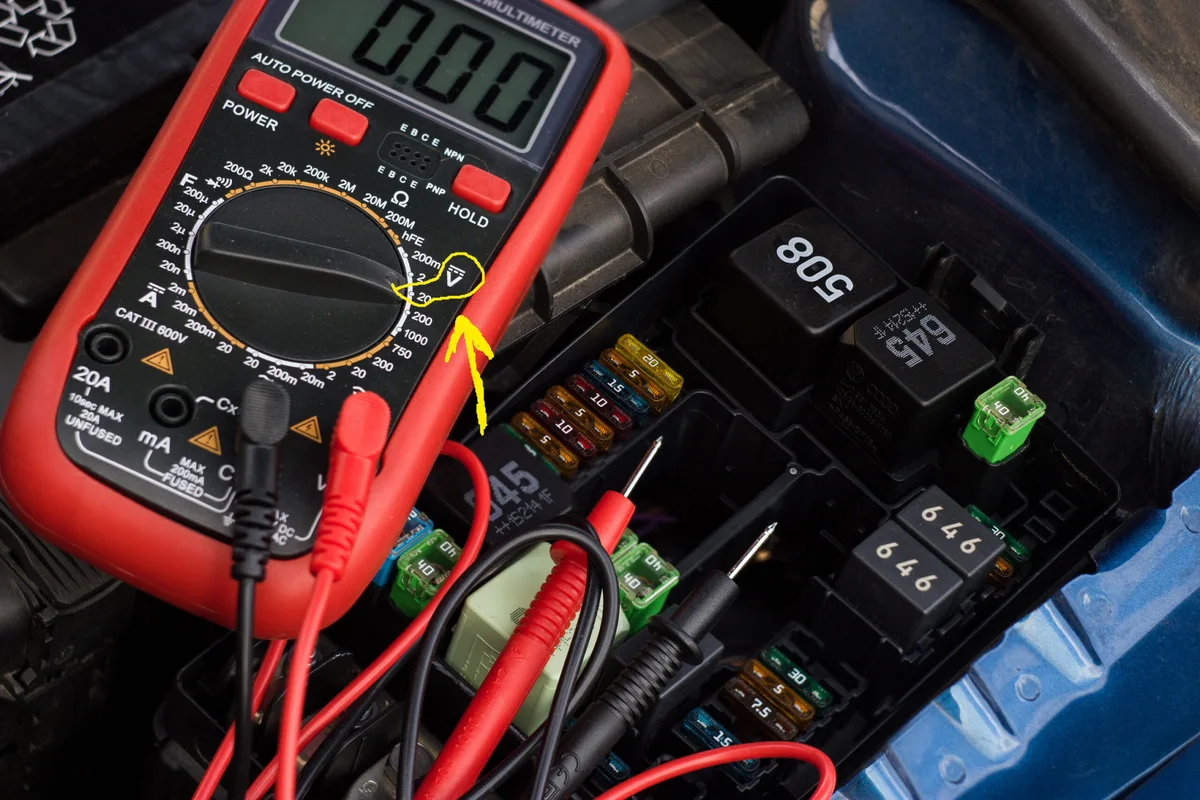
A multimeter only tells the truth when it's set up right. The most common error is selecting the wrong mode or range, especially on manual-ranging meters. You want DC voltage, and if you've ever wondered what that setting actually measures, our guide to the DC voltage mode clears it up in two minutes.

Run through this checklist before believing any low reading:

  • Set the dial to DC volts (V with a straight line, not the wavy AC symbol)
  • On manual-range meters, pick the 20V range, not 200V or 2V
  • Red probe on the positive terminal, black probe on the negative
  • Press probes firmly onto clean metal, not onto corrosion or paint
  • Test at the battery posts themselves, not the cable clamps

That last point matters more than people think. Corrosion between post and clamp creates resistance, and testing on the clamp can show a lower number than the battery actually holds. Scrape the probe tips gently on the lead posts for solid contact.

If the meter's markings still look like hieroglyphics, we've decoded every dial position so you're never guessing mid-test.

If the reading still says 11.9V after a proper rest and a proper setup, the number is real. Now we find the cause.

The Three Reasons a Battery Drops to 11.9 Volts

Every 11.9V battery got there through one of three doors. Your entire repair path depends on which door it was, so don't skip this diagnosis. Guess wrong and you'll either buy a battery you didn't need or watch a brand-new one die the same death.

A Discharged but Healthy Battery

This is the best-case scenario, and it's common. Something used up the charge, but the battery itself is fine. Typical culprits include a dome light left on overnight, a phone charger left plugged in, hazard lights, or a car that sat parked for three or more weeks.

Batteries also self-discharge at roughly 1 to 5 percent per month, faster in heat. A car parked at the airport for a month in summer can come home reading 11.9V with nothing actually wrong. Short-trip driving does it slowly too, because ten-minute drives never replace what starting the engine takes out.

If this is your situation, a full recharge usually brings the battery right back. The younger the battery, the better the odds. As of 2026, most standard flooded batteries still last three to five years, so a two-year-old battery that got accidentally drained deserves a second chance.

A Failing Battery That Won't Hold Charge

Door number two is age and wear. After years of heat cycles and vibration, the plates shed material and sulfation builds up. The battery still charges, but it can't hold that charge.

You top it up, it reads 12.6V, and two days later it's back at 11.9V with no lights left on.

The telltale signs of a failing battery include:

  • Slow cranking that's been getting gradually worse for weeks
  • Voltage that drops noticeably overnight after a full charge
  • A battery past the four-year mark
  • A swollen case or rotten-egg smell (stop and replace immediately)

Age math matters here. Check the date code sticker on the case. If the battery is five years old and reading 11.9V, recharging is a temporary patch at best.

Our data on typical service life shows most failures cluster in years four through six, and climate shifts that window a lot.

A Charging System or Parasitic Drain Problem

Door three is the one that costs people the most money, because the battery isn't the problem at all. Two separate faults live here.

The first is a weak alternator. Your alternator should push 13.7 to 14.7 volts to the battery while the engine runs. If it's only producing 12.8V, or a worn belt is slipping, the battery slowly starves over days of driving.

You'll replace the battery, and the new one will drift down to 11.9V within weeks.

The second is a parasitic drain. Every modern car draws a small current while parked to keep computers and alarms alive. Normal draw is under 50 milliamps.

A stuck relay, a faulty module, or an aftermarket stereo wired wrong can pull 500mA or more, and that flattens a healthy battery in a few nights.

Here's the quick sorting logic. If the battery dies repeatedly with no lights left on, suspect a drain. If the battery light flickers or voltage stays below 13.5V with the engine running, suspect the alternator.

If either fault is present, fix it first. A new battery dropped into a broken system is just a more expensive victim.

Your Decision Path: What to Do Based on Your Situation

Now match your situation to the branch below. Each one starts from the same 11.9V reading but ends in a different action. Pick the one that fits and follow it in order.

If the Car Sat Unused or Something Was Left On

If you know the cause, recharge and move on. A dome light, a dashcam hardwired to constant power, or a month of sitting explains 11.9V completely. The battery is probably fine.

Put it on a smart charger overnight, then do the retest covered two sections down. If the retest passes, you're done. No parts needed, no shop visit.

One caution for repeat offenders. Each deep discharge below 12.0V permanently steals a little capacity from a flooded battery. Drain it flat three or four times and even a young battery starts cranking slow in winter.

If the Battery Died Overnight With No Obvious Cause

If nothing was left on and the battery still hit 11.9V overnight, suspect a parasitic drain or a dying battery. A healthy battery with a healthy car cannot lose 0.7 volts in eight hours. Something is pulling current or a cell is failing internally.

Do this in order. First, charge the battery fully so you're testing from a known state. Second, run the overnight retest.

If voltage holds, the battery is fine and the hunt moves to a parasitic draw test, which means putting a meter in series with the negative cable and looking for anything above 50mA.

Common drain sources worth checking before you pay a shop:

  • Trunk or glovebox light staying on (feel the bulb after 10 minutes closed)
  • Aftermarket stereo, alarm, or tracker wired to constant power
  • A relay stuck closed (often warm to the touch)
  • Doors not fully latching, keeping modules awake

If the Reading Is 11.9V Right After Driving

If you see 11.9V minutes after shutting off the engine, the charging system is the prime suspect. A working alternator should leave the battery near 12.8V or higher with surface charge. Landing at 11.9V after a drive means the alternator never filled the tank.

Start the engine and measure across the battery posts again. You want 13.7 to 14.7 volts at idle. Below 13.5V, have the alternator and drive belt inspected before you spend anything on a battery.

There's one exception. A battery so sulfated it can no longer accept charge will also read low after driving, even with a perfect alternator. The engine-running test separates the two.

Good charging voltage plus a low resting number afterward points back at the battery.

If It Reads 11.9V Again After a Full Charge

If a fully charged battery falls back to 11.9V within a day or two, replace it. This is the clearest verdict in the whole flowchart. The battery accepted the charge but the plates can't store it, and no charger fixes shed plate material.

Confirm nothing external is draining it first. Disconnect the negative cable after charging and let the battery sit isolated for 24 hours. If it still drops below 12.4V while disconnected, the failure is internal and final.

How to Recharge a Battery at 11.9 Volts the Right Way

Skip the "just drive it around" advice. Idling and short trips restore a few percent at best, and an alternator isn't designed to rebuild a deeply discharged battery from near zero. Aggregate charger manufacturer specs put full recovery from 11.9V at 4 to 12 hours on a proper charger, depending on amperage and battery size.

smart battery charger

A smart charger is the right tool because it adjusts voltage and current through distinct stages. Many models also include a desulfation or recovery mode that pulses high-voltage bursts to break down early sulfate crystals. On a battery that hit 11.9V, that mode earns its keep.

Follow this sequence:

  1. Park somewhere ventilated. Charging lead-acid batteries releases hydrogen gas.
  2. Turn the ignition off and remove the key.
  3. Connect the red clamp to the positive terminal first.
  4. Connect the black clamp to a bare metal ground away from the battery, or the negative post if the battery is out of the car.
  5. Select the correct mode. Standard flooded and AGM batteries charge at different voltages, so match the setting to your battery type.
  6. Let it run to completion. A 4 to 10 amp charger needs most of a day for a typical 50 to 70Ah battery.
  7. Disconnect in reverse order: black first, then red.

Resist the urge to yank it off the charger at 80 percent. The final absorption stage is slow on purpose, and it's the stage that actually reverses light sulfation. Cutting it short leaves the battery weaker than the meter suggests.

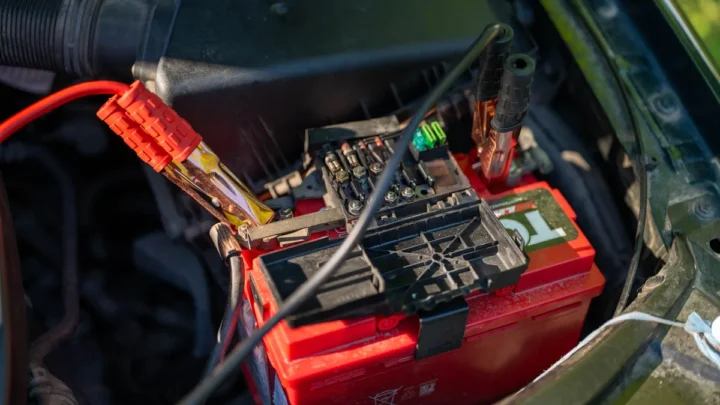
What about jump-starting instead? A jump gets the engine running but hands the recharge job to your alternator, which then works overtime for an hour pushing high current. That stresses the alternator and still leaves the battery only partially filled.

Use a jump for emergencies, then get the battery on a real charger the same day.

Alternator charging system voltage test.#shorts #youtubeshortsvia Aakash.A.T.13

Testing After the Recharge: The Step That Tells You Everything

The recharge wasn't the diagnosis. The retest is. Everything you learned from that first 11.9V reading gets confirmed or overturned by what the battery does over the next 12 to 24 hours.

The 12-Hour Resting Voltage Retest

Charge the battery fully, disconnect the charger, and let the car sit overnight without starting it. In the morning, before touching anything else, measure the resting voltage at the posts. If you want a refresher on getting a clean measurement, our walkthrough for first-time meter users covers probe placement and range selection step by step.

Read the result against this table:

Morning Retest ReadingVerdict
12.6V or higherBattery recovered, monitor it for a week
12.4 to 12.5VMarginal, expect reduced lifespan
12.0 to 12.3VFailing, plan replacement soon
Below 12.0VReplace now
~10.5VDead cell, replace immediately

That 10.5V line is worth flagging again. A battery that charges to 12.6V and crashes to 10.5V overnight has lost a full cell. It will never hold six cells' worth of voltage again.

Load Test: Will It Hold Up When Cranking?

A battery can pass the resting test and still fail in real life. Resting voltage measures stored energy, not the ability to deliver 200-plus amps on a cold morning. That delivery ability is what cold cranking amps measure, and our explainer on cranking amp ratings shows why it fades years before resting voltage does.

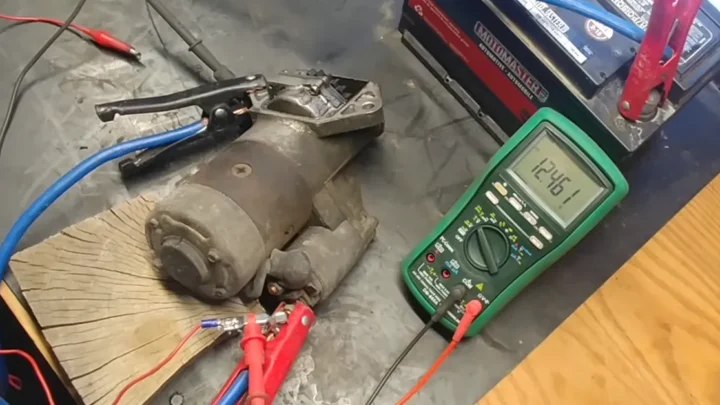
The DIY version is simple. Connect your meter to the battery, have a helper crank the engine, and watch the lowest number during cranking. A healthy battery stays above 9.6 volts.

A dip into the 8s or 7s means the battery is done, regardless of what it reads at rest.

The better option costs nothing. Most major US auto parts chains run a conductance tester on your battery for free, in or out of the car. That test estimates measured CCA against the rating on the label and prints a pass/fail slip you can trust more than a voltage number alone.

Checking the Alternator While You're At It

Spend two extra minutes here and you'll never wonder about the charging system. Engine running, meter on the posts, all accessories off: you want 13.7 to 14.7 volts. Then flip on the headlights, blower, and rear defroster.

Voltage should stay above roughly 13.5V under that load.

Two failure patterns show up in this test. Steady voltage below 13.5V means weak output, often worn brushes or a failing voltage regulator. Voltage that jumps around erratically usually points to a bad diode, which can also create a parasitic drain that flattens the battery overnight.

Either result explains a recurring 11.9V reading better than the battery does.

Recover or Replace? Making the Call

Here's the decision distilled. Recover when the cause was external and the retests pass. Replace when the battery itself failed either test, or when its age makes recovery a short-term loan.

Run through these questions in order:

  • Did you find a clear external cause (light left on, long sit, drain, alternator)? If yes, lean recover.
  • Did the battery hold 12.6V after the 12-hour rest? If yes, lean recover.
  • Did it stay above 9.6V during cranking or pass a store load test? If yes, recover with confidence.
  • Is the battery under three years old? Recovery odds are strong.
  • Is it past four years, or has it been run flat multiple times? Replace even if it limps through the tests.

The economics support honest testing either way. A quality replacement runs $100 to $250 as of 2026, with AGM units at the top of that range. Testing costs you a multimeter you likely already own and one overnight wait.

Guessing costs you either a wasted battery purchase or a tow bill when the gamble fails on a cold morning.

If you do replace, match the group size, CCA rating, and chemistry your vehicle calls for, and check the date code so you're not buying a battery that sat on the shelf for a year. Our size-lookup walkthrough shows where to find the right spec in seconds. And don't bin the old one.

Lead-acid batteries are about 99 percent recyclable, and the Environmental Protection Agency notes they're among the most recycled consumer products in the country. Any parts store will take the core, and most charge you a core fee until you hand one over anyway.

Mistakes That Kill Batteries (or Your Wallet)

Most of the money wasted around an 11.9V reading traces back to a handful of repeatable mistakes. Every one of them is avoidable.

battery terminal corrosion

Ignoring corroded terminals. That white-green crust is more than cosmetic. It adds resistance, weakens charging, fakes low readings, and can leave a healthy battery unable to crank. Clean posts and clamps with a baking soda solution and a wire brush before trusting any diagnosis.

Replacing the battery without testing the alternator. This is the most expensive mistake on the list. A weak alternator kills the new battery the same way it killed the old one, and now you've paid for both.

Letting a flat battery sit for weeks. Sulfation hardens with time. A battery charged the same day it hit 11.9V often recovers fully. The same battery left flat in the driveway for a month usually doesn't.

Trusting a single voltage reading. Voltage is a snapshot, not a verdict. The overnight retest and a load test are what separate a drained battery from a dying one.

Chronic short-tripping. Ten-minute drives never repay the starter's withdrawal. If your driving is mostly short hops, a monthly top-up on a maintenance charger keeps resting voltage out of the danger zone and can add a year or more of service life.

Safety Rules for Charging and Jump-Starting a Low Battery

A deeply discharged battery is more hazardous to handle than a healthy one, not less. Deep discharge encourages gassing during recovery charging, and hydrogen gas ignites from a single spark. Per OSHA guidance for shop charging areas, ventilation and spark control are the two non-negotiables.

Follow these rules every time:

  • Charge in open air or a ventilated garage, never a sealed trunk or closet
  • No smoking, flames, or grinding sparks near a charging battery
  • Wear eye protection. Battery electrolyte is sulfuric acid.
  • Make the final clamp connection away from the battery so any spark happens at a distance
  • Never charge a battery with a cracked, bulging, or leaking case
  • Disconnect the negative terminal first when removing a battery, and reconnect it last

Jump-starting adds its own risks on modern cars. Connect in strict order: red to the dead battery's positive, red to the donor positive, black to the donor negative, and black to bare metal on the dead car's engine block. That last ground connection keeps sparks away from the battery's hydrogen vents.

One more modern-car caution. Voltage spikes during a sloppy jump can damage control modules that cost far more than any battery. If your owner's manual specifies remote jump posts under the hood, use those instead of the battery terminals.

Cold Weather, Short Trips, and Other Real-World Factors

Climate and driving habits decide how urgent an 11.9V reading really is. The same number that's an inconvenience in a mild spring is a guaranteed no-start in a January cold snap.

Cold is the great exposer. A battery at 0°F (-18°C) delivers roughly 35 percent less cranking power than at room temperature, while cold, thick oil makes the engine harder to spin. A battery limping along at 11.9V in October simply won't turn the engine over in deep winter.

If your battery is marginal in fall, fix it before the first freeze, not after.

Heat is the silent killer on the other end. Sustained high temperatures speed up plate corrosion and evaporate electrolyte, which is why batteries in Phoenix or Texas often fail in year three while the same battery lasts six years in Seattle. Hot-climate drivers should treat any 11.9V reading in a three-year-old battery as a replacement signal.

Driving patterns matter just as much as weather:

  • Short-trip city driving. Each start costs more charge than a ten-minute drive returns. Resting voltage drifts down week by week.
  • Stop-start systems. These cycle the battery dozens of times per commute, which is exactly why they ship with AGM or EFB batteries rated for it.
  • Seasonal vehicles. A car stored for winter self-discharges to the danger zone in two to three months. A maintenance charger solves it for around $30 to $60.
  • Accessory-heavy builds. Dashcams, trackers, and inverters raise the parked draw and shrink the safe sitting time.

If any of those describe your situation, make a resting voltage check part of your monthly routine. Thirty seconds with a meter beats a tow. And since capacity, not just voltage, determines how long a battery survives these patterns, it's worth knowing how reserve minutes are rated when you shop for the replacement.

Frequently Asked Questions

Is 11.9 volts enough to start a car?

Usually not reliably. At 11.9 volts the battery holds under 10 percent charge, and cranking pulls 150 to 400 amps. Some engines may still catch, especially small ones in warm weather, but expect slow cranking or a click.

Treat any start at this voltage as borrowed luck and recharge immediately.

Can a car battery at 11.9 volts be recovered?

Often, yes. If the discharge was caused by something external, like a light left on, a full charge on a smart charger usually restores it. Recovery odds drop sharply if the battery sat flat for weeks, is over four years old, or fails the 12-hour resting retest afterward.

Will driving the car recharge a battery from 11.9 volts?

Not fully. An alternator maintains a charged battery, it doesn't rebuild a flat one. Even 30-plus minutes of highway driving typically restores only a partial charge from 11.9V, while stressing the alternator.

Use a dedicated charger for 4 to 12 hours, then let the car's system maintain it.

Why does my battery read 11.9 volts after charging?

That points to an internal failure. A battery that won't rise above roughly 11.9V after a full charge cycle, or drops back there within a day, has sulfated plates or a weak cell. Rule out a parasitic drain by retesting with the negative cable disconnected.

If it still sags, replace it.

What voltage means a car battery is completely dead?

About 10.5 volts is the true dead point for a 12V lead-acid battery. Below that, permanent damage accelerates fast. A battery that rests near 10.5V despite charging has almost certainly lost a cell, since each of the six cells contributes about 2.1 volts to the total.

Should I replace a 5-year-old battery reading 11.9 volts?

Yes, in nearly every case. Most car batteries last three to five years, and a deep discharge at that age rarely ends in lasting recovery. Even if it passes a retest, its cranking reserve is thin.

Replace it on your schedule rather than waiting for a failure on a cold morning.

Ryan Carter is the founder of AutoVerse Authority. A self-taught gearhead from just outside Kansas City, he's spent 15 years buying, fixing, and living with cars — and now shares honest, hands-on advice so everyday drivers can save money and skip the dealership traps.

Share.

Similar Posts

What Should Alternator Voltage Be…Car Battery Reads 12V but Won&#82…How to Set a Multimeter to 20V DC…How Long to Drive After a Jump St…How to Test Parasitic Draw With a…Why Your Battery Voltage Drops Wh…Multimeter Setting for Car Batter…How to Test a Car Battery Without…How to Test a Car Battery With a …How to Use Back Probe Pins on a M…
Share