How Much Parasitic Draw Is Normal? Amps to Watch For
The question "how much parasitic draw is normal" trips up more DIY battery diagnostics than any other test. One shop tells you 50 mA. Another says under 30.
Your meter reads 340 mA and you have no idea if that's a fault or just your car waking up because you opened the door.
The honest answer sits between 20 mA and 85 mA on most vehicles built after 2000, once every module has finished its sleep cycle. Older cars pull less. Modern trucks with telematics pull more.
As of 2026, factory service data and SAE reference material still point to that same window, so you can trust it once you know how to measure it right. That last part is where most readings go sideways.
Quick Answer
Normal parasitic draw sits between 20 mA and 85 mA on most vehicles. Cars from 1990 to 2005 usually pull under 40 mA. Modern vehicles with telematics can hold 60 to 85 mA.
Anything sustained above 100 mA points to a real drain. Always wait 30 to 45 minutes for modules to sleep before trusting the reading.
What Parasitic Draw Actually Means on a Modern Vehicle
Parasitic draw is the current your car pulls from the battery when the ignition is off. Some of it is required. Your ECU keeps volatile memory alive.
The body control module watches for a key fob. The alarm listens for door triggers. That baseline current is normal and expected.
The problem starts when something stays awake that shouldn't. A stuck relay, a glovebox light that never clicks off, an aftermarket amp still drawing bias current. Those small loads compound over hours and days.
A healthy 60 Ah battery at 50% state of charge holds roughly 30 amp-hours of usable capacity. At a steady 300 mA drain, that battery reaches a no-start point in about four days. At 50 mA it lasts weeks.
That's why the difference between 50 mA and 300 mA is not academic. It's the difference between a car that starts on Monday and one that doesn't.
The Short Answer: Normal Parasitic Draw Ranges by Vehicle Type
Below is what our research across factory service manuals and SAE reference material shows as the typical settled draw once the vehicle is fully asleep.
| Vehicle era | Typical settled draw | Common features running |
|---|---|---|
| Pre-1995 | 5 to 20 mA | Clock, radio memory, minimal modules |
| 1996 to 2005 | 20 to 40 mA | OBD-II ECU, immobilizer, basic BCM |
| 2006 to 2015 | 30 to 60 mA | CAN bus, keyless entry, TPMS |
| 2016 to present | 40 to 85 mA | Telematics, smart key, always-on connectivity |
| Trucks with OnStar, FordPass, uConnect | 50 to 100 mA | Cellular modem cycling |
Treat those numbers as the goalposts. If your reading sits inside the band for your car's era and stays flat, you don't have a drain problem. You have a normal car.
If your reading is double the top of the band and holding, keep digging. If it's ten times the top, you've almost certainly got something stuck awake.
Why Normal Depends on Your Car's Age, Modules, and Sleep Cycle
Three things move the "normal" number for your specific vehicle. Ignoring any one of them is how good techs still misdiagnose drains.
- Age and module count. A 1998 sedan has maybe four modules. A 2024 pickup has forty or more. Each module needs a trickle of standby power.
- Optional equipment. OnStar, factory remote start, air suspension compressors, and heated-seat memory all add measurable draw. A base-trim version of the same truck can pull 25 mA less than the loaded one.
- Sleep-cycle depth. Most controllers have three power states. Full wake, partial sleep, and deep sleep. Baseline current in deep sleep is usually one third of what you'll read one minute after locking the doors.
There's also the alternator. A shorted diode inside the rectifier bridge can leak battery current back through the B+ post 24 hours a day. If you suspect the charging system leaking to ground, pull the alternator's B+ cable during your test and see if the draw drops.
How Long to Wait Before Trusting Your Meter Reading
This is where 80% of DIY drain tests fail. Modules don't go to sleep the moment you shut the door. They run a timer.
The instant a door opens or a key wakes the bus, that timer resets.
Here's the pattern most modern vehicles follow:
- 0 to 5 minutes after lockup: everything is awake. You'll see 300 to 800 mA. This is normal.
- 5 to 20 minutes: modules start dropping off. Draw falls in steps as each bus segment sleeps.
- 20 to 45 minutes: most vehicles reach settled current.
- 45 to 90 minutes: European vehicles, especially BMW, Mercedes, and Audi, sometimes need this long.
Do not open a door during the wait. Do not unlock with the fob. If you have to reach the meter, roll the window down first or route the leads out before you close up.
When you use a clamp meter over the negative cable you don't have to break anything, which is why it's the best tool for a wait test. Reading a good resting voltage on the battery first also confirms it's healthy enough to sit through the test.
How to Measure Parasitic Draw the Right Way
There are three methods that actually work. Each has a trade-off. Pick based on your meter and how confident you are working around a live battery.
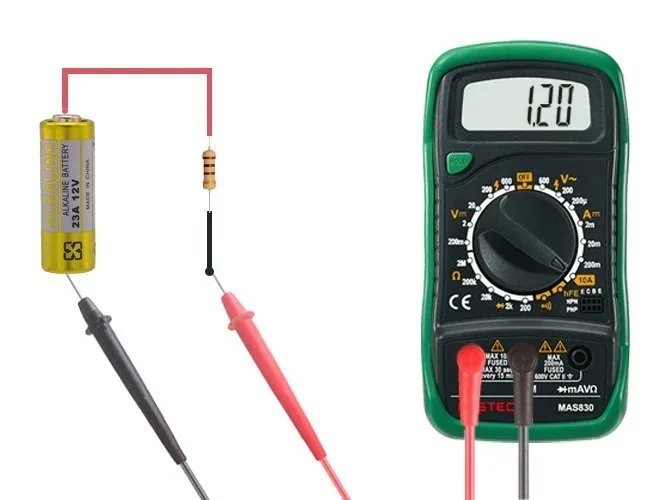
Series DMM Method on the Negative Cable
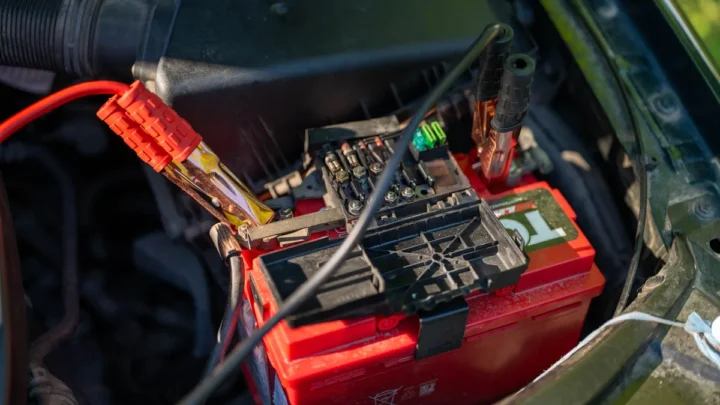
This is the classic. Set your multimeter to the 10A DC range using the correct high-current jack. Disconnect the negative battery cable.
Connect one meter lead to the battery negative post and the other to the disconnected cable end. Current now flows through the meter. Wait for modules to sleep, then read.
The catch: if anything wakes the car and pulls more than 10A, you'll blow the meter fuse instantly. Never open a door with the meter in circuit. Never let anyone crank the engine.
If you're new to this, the right meter setting matters more than the brand of meter you own.
Low-Current DC Clamp Meter Method
Clamp meters are the safe option. A low-current DC clamp reads down to 1 mA of resolution and never breaks the circuit. Clamp around the negative cable, zero the meter, and read.
You can open doors, wake the car, and watch the current spike and settle in real time. That live view is enormously useful. The trade-off is cost.
A meter capable of clean sub-100 mA DC readings costs more than a basic DMM.
Fuse Voltage-Drop Method for Live Circuits
Every fuse has resistance. Current flowing through it creates a small voltage drop across its terminals. Roughly 10 mV on a mini fuse equals about 100 mA on that circuit.
Set your DMM to DC millivolts, backprobe both fuse test points without pulling the fuse, and read the drop. Nothing wakes up because nothing gets disconnected. It won't give you an exact number, but it's fast for isolating which circuit owns the drain, and it pairs perfectly with probe placement basics you already know from voltage checks.
For reference tables of fuse resistance values, SAE International publishes the underlying test standards most OEMs work to.
Decision Guide: Is My Reading Normal, Borderline, or a Real Drain?
Use this as your sanity check once the vehicle has fully slept.
- Under 50 mA: Normal for almost any car. Stop chasing ghosts.
- 50 to 85 mA: Normal for modern vehicles with telematics, keyless entry, or a factory alarm. Cross-check against the service manual spec if you have one.
- 85 to 150 mA: Borderline. Something isn't sleeping fully, or an aftermarket accessory is pulling more than it should.
- 150 to 500 mA: Real drain. A module, relay, or accessory is stuck awake.
- Over 500 mA: Something is fully powered. Interior lights, a cooling fan, or a shorted circuit.
If your reading swings up and down instead of holding steady, a module is cycling. Telematics modems, TPMS receivers, and remote-start units all wake on a schedule. Watch the meter for at least ten full minutes before you decide.
What Pushes Draw Above Spec (Even on a Healthy Car)
Not every high reading is a fault. Real-world conditions can push a perfectly healthy car above its published spec.
- Cold weather. Battery internal resistance rises. The same load looks worse on the meter.
- A recently jumped or disconnected battery. Modules relearn and stay awake longer than usual.
- Charging system leakage.Warning signs of a fading alternator sometimes mimic drain, especially diode leakage back through the B+ post.
- Retained accessory power. Many GM and Ford vehicles keep radio and window circuits live for up to ten minutes after key-off.
- A recent scan-tool session. Plugging in an OBD-II scanner wakes the entire bus. Wait 30 minutes after unplugging.
If you're reading 120 mA on a cold morning right after a scan-tool session, that's not a drain. That's a car doing exactly what it was designed to do.
Tracing an Abnormal Draw Fuse by Fuse
Once you've confirmed a real drain, isolating the circuit is straightforward if you're patient.

Work through this order:
- Leave your meter in place, whether clamp or series.
- Pull one fuse. Wait five seconds. Watch the reading.
- If the draw drops sharply, you've found the circuit. Reinsert that fuse and keep testing to confirm no second drain is hiding.
- If nothing changes, put it back and move on.
- Test the underhood box, the interior panel, and any secondary boxes.
Write down each fuse label as you go. Some vehicles have three fuse boxes. Don't forget the trunk-mounted panel on European sedans and full-size SUVs.
When the current drops, cross-reference that fuse to its circuit list in the owner's manual. That gives you the components on the leg. From there it's a matter of unplugging suspects one at a time until the current stays low with the fuse back in.
Aftermarket Accessories That Quietly Add Milliamps
Aftermarket wiring is the single most common cause of "sudden" parasitic drain. The car worked fine for years. Then someone hardwired a dashcam and now the battery dies over a long weekend.
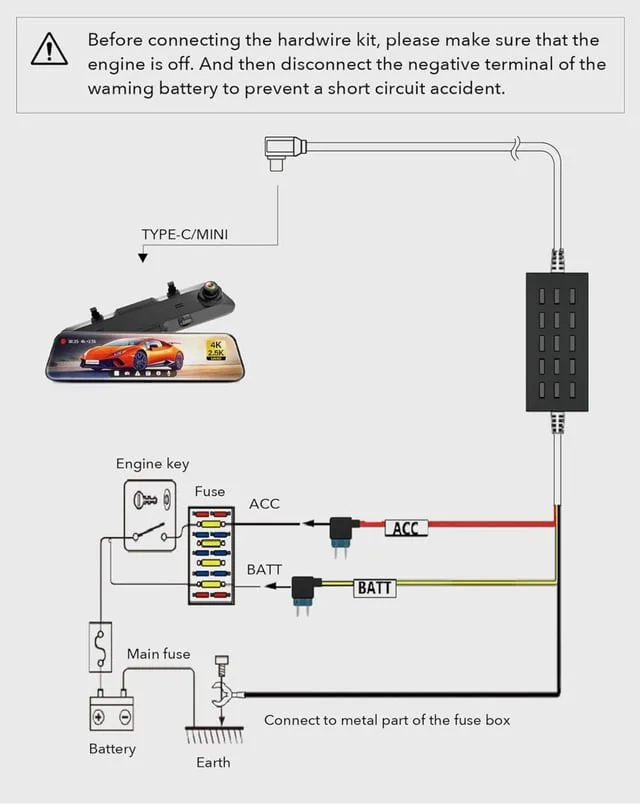
The usual suspects:
- Hardwired dashcams. Even in parking mode a decent cam draws 5 to 15 mA. A cheap one can pull 100 mA continuously.
- GPS trackers. Cellular trackers wake and phone home. Baseline 20 to 60 mA, plus periodic spikes.
- Aftermarket amplifiers. A leaky remote-turn-on wire keeps the amp partly biased. Look for 100 to 300 mA.
- Remote-start and alarm modules. Bad installs bleed constantly through miswired ignition feeds.
- USB adapters and inverters. Cheap units don't fully switch off with the ignition.
If your drain started within days of an install, start there. Pull the accessory's fuse tap. If the drain vanishes, the accessory wiring is the fault, not the vehicle.
Signs the Battery Is the Problem, Not a Drain
Sometimes there's no drain at all. The battery is simply done. A tired battery holds only a fraction of its rated capacity, so even a normal 30 mA drops voltage fast.
Telltale signs it's the battery:
- Cranks fine right after a highway drive, dies after two days sitting.
- Rested open-circuit voltage under 12.4 V even after a full charge.
- Load-test failure at any parts store.
- Age over four to five years for a standard flooded battery, seven for a premium AGM.
Before spending hours chasing milliamps, load-test the battery. If it fails, replace it and retest current afterward. A brand-new battery on a car with a real 200 mA drain will still die, just slower.
A weak battery on a car with a healthy 40 mA drain looks identical to a drain problem from the driver's seat. Sorting battery from charging faults is worth ten minutes before you unbolt a fuse box.
Mistakes That Give You a False High Reading
The most common cause of a shocked "my car pulls 400 mA!" post online is a testing mistake, not an actual fault. Rule these out first.
- Testing too soon. Modules haven't slept yet. Wait the full 30 to 45 minutes.
- Opening a door mid-test. Instant reset of every sleep timer.
- Meter set to the wrong range. Auto-ranging DMMs sometimes get stuck. Force the 10A or mA range manually.
- Leads in the wrong jack. Some meters have separate mA and 10A ports. Wrong jack means either a blown fuse or a reading that's off by orders of magnitude.
- Alarm armed and cycling. Factory alarms sweep the interior. Draw pulses every 60 seconds. Sit and watch the average.
- Keys within fob range. Modern proximity systems keep the receiver awake as long as the fob is nearby. Walk 20 feet away.
A useful sanity move: repeat the test twice, half an hour apart. If your readings match, you have a real baseline. If they disagree, one of the mistakes above snuck in.
Safety Rules Before You Touch the Terminals
Parasitic draw testing looks harmless. It isn't always. Live batteries dump serious current into wrenches, meter leads, and jewelry without warning.
Keep these habits:

Similar Posts