How to Test a Motorcycle Battery With a Multimeter
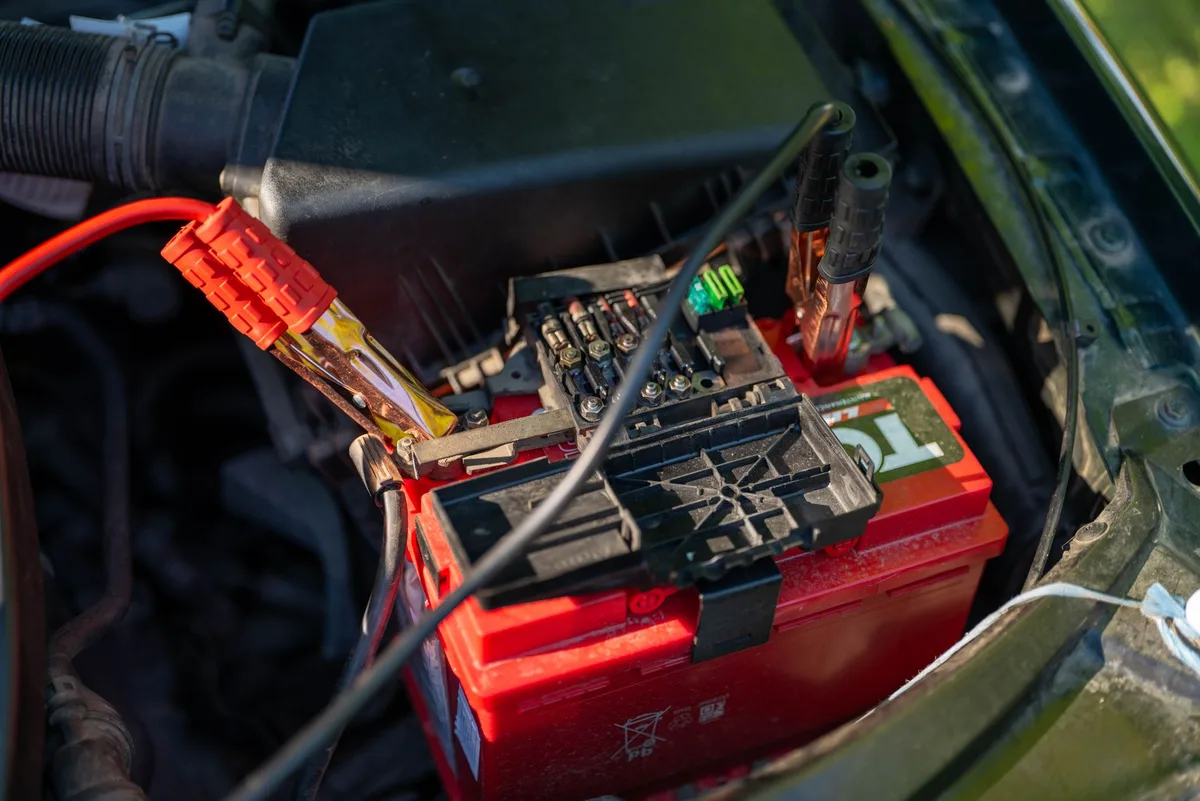
Your bike cranks slow, clicks, or does nothing at all. Learning how to test a motorcycle battery with a multimeter tells you in about two minutes whether the battery is at fault or something else is. A multimeter is a small electrical tester that reads voltage, and voltage is the fastest window into your battery's health.
The number to remember is 12.6 volts. That's a fully charged 12V motorcycle battery at rest, per most manufacturer specifications as of 2026. Anything lower means the battery is partly discharged, tired, or failing.
Below we'll walk through the readings, the exact steps, and the one test most people skip.
Quick Answer
Set your multimeter to 20V DC. Touch the red probe to the positive terminal. Touch the black probe to the negative terminal.
A healthy resting battery reads 12.6 to 12.8 volts. Below 12.4 volts means it needs charging, and readings near 12.0 volts signal a weak or failing battery.
Why a Multimeter Beats Guessing When Your Bike Won't Start
A no-start is frustrating, and it's easy to blame the battery straight away. A multimeter turns that guess into a fact. It shows the actual voltage sitting in the battery right now.
Here's why the tool earns its place in your kit:
- It's cheap. A decent digital multimeter runs about $15 to $60.
- It's fast. One reading takes under a minute.
- It saves money. You avoid tossing a battery that just needs a charge.
- It's reusable. The same meter checks your charging system, fuses, and wiring.
The logic is simple. If the battery reads healthy but the bike still won't fire, the fault lives elsewhere. That points you toward the starter, the fuse, or the charging system.
The same voltage-reading approach works on four wheels too, as our guide on reading a car battery's charge explains.
What the Numbers Actually Mean: The Motorcycle Battery Voltage Chart
Voltage maps directly to state of charge. A 12V battery is really six cells at about 2.1 volts each. When those cells drop, the total voltage drops with them.
Keep this chart handy. It's the reference you'll come back to every time.
| Resting Voltage | State of Charge | What It Means |
|---|---|---|
| 12.6–12.8V | 100% | Fully charged, healthy |
| 12.4V | ~75% | Slightly low, usable |
| 12.2V | ~50% | Needs charging soon |
| 12.0V | ~25% | Deeply discharged |
| 11.9V or below | Near empty | Weak or failing |
| ~10.5V | Dead cell | Likely needs replacement |
One catch worth knowing. A battery can show a solid 12.6V and still fail the moment you hit the starter. Resting voltage tells you what's stored.
It doesn't tell you if the battery can deliver power under load. That's why the cranking test further down matters so much.
What You Need Before You Start Testing
You don't need a workshop full of tools. The list is short.
- A digital multimeter (analog works, but digital is easier to read)
- Your bike, parked on a level surface
- Safety glasses
- A wire brush or rag for dirty terminals
- Access to both battery terminals
Before you probe anything, kill the ignition. Switch off every accessory, including lights, indicators, and any alarm you can pause. A resting reading only counts when nothing is drawing power.
Timing matters too. If you just rode the bike or pulled it off a charger, wait. A battery holds a "surface charge" that reads high and lies to you.
Let it sit one to two hours for an honest number.
Setting Your Multimeter to the Right DC Voltage
Turn the dial to DC volts, not AC. Batteries are direct current, so AC gives you nonsense readings. This single mistake trips up more beginners than any other.
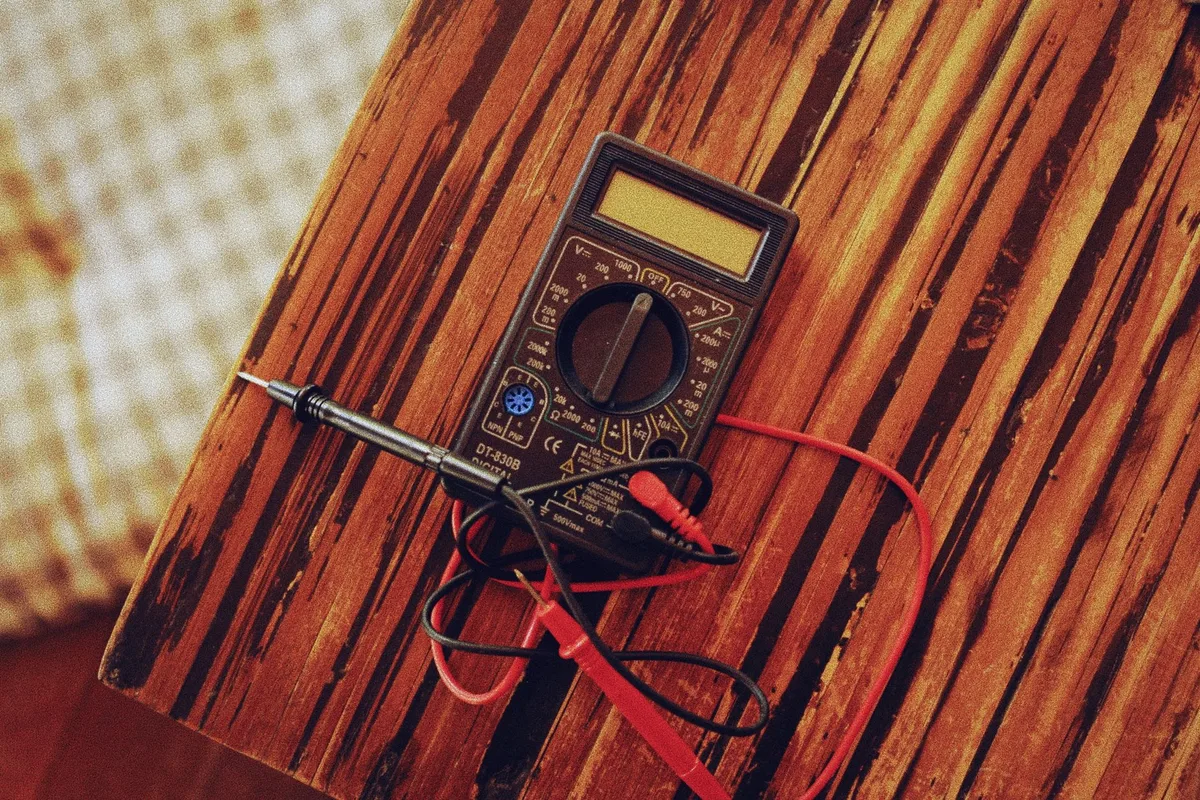
On a manual-ranging meter, pick the 20V range. That covers a 12V battery with room to spare. If your meter is auto-ranging, just select DC volts and it sorts the range itself.
The DC setting is usually marked with a V and a straight line, sometimes with a dotted line beneath it. Multimeter makers like Fluke label this clearly on the dial.
Reading the Terminals: Red to Positive, Black to Negative
Match the probes to the posts. Red goes to positive, marked with a plus sign or "POS." Black goes to negative, marked with a minus sign or "NEG."
Get them backwards and nothing breaks. The meter simply shows a negative number, like minus 12.6 instead of 12.6. It's harmless, but it's your cue to swap the probes.
Press each probe firmly onto clean metal. Corrosion or paint between probe and post will drag your reading down and fool you.
How to Test Your Motorcycle Battery's Resting Voltage
This is the core test, and it takes under a minute. Follow the steps in order.
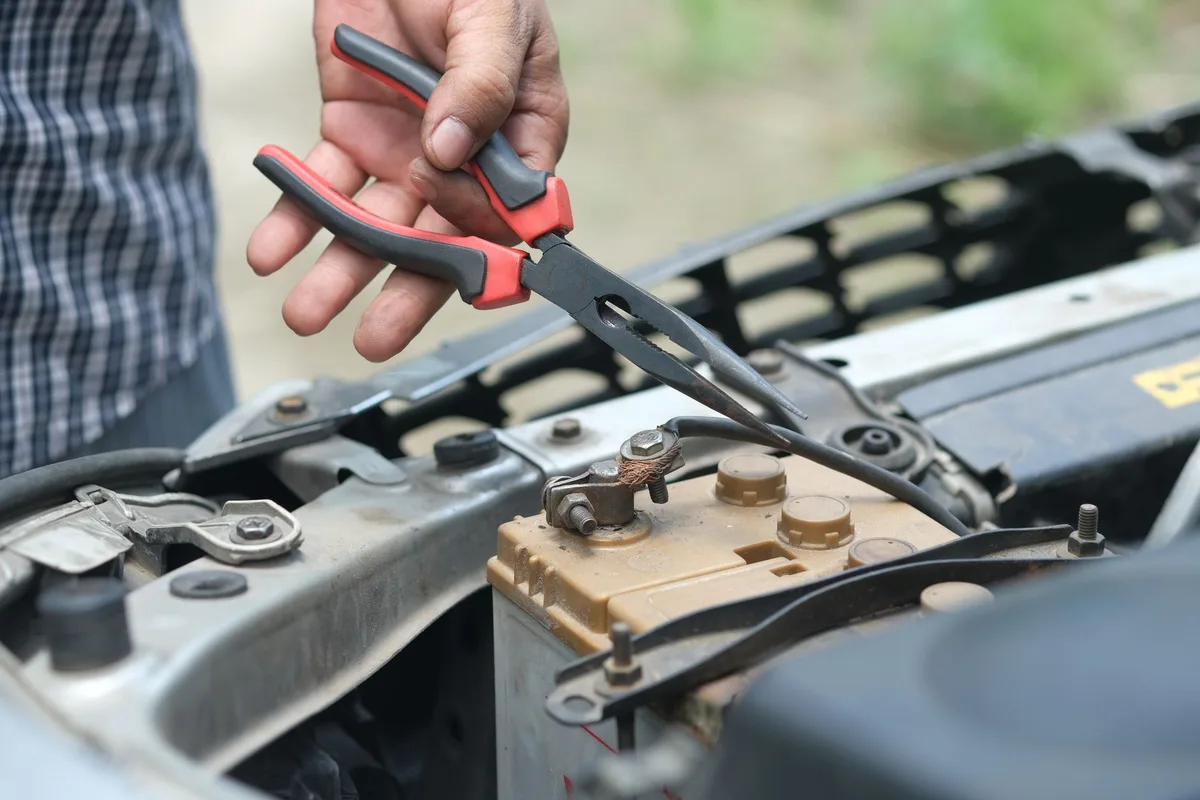
- Confirm the ignition and all accessories are off.
- Set the meter to 20V DC.
- Touch the red probe to the positive terminal.
- Touch the black probe to the negative terminal.
- Read the number on the display.
Now compare that number to the chart above. A reading of 12.6V or higher means the battery is charged and holding well. Land between 12.4V and 12.6V, and it's fine but could use a top-up.
Anything under 12.4V says charge it before you ride.
If the meter shows 12.1V or lower, the battery is deeply discharged. Charge it fully, then test again. A healthy battery climbs back to 12.6V and stays there.
One that slumps back down within a few hours has an internal fault. The voltage-check routine mirrors what we cover for keeping a car battery in check, just at a smaller scale.
The Cranking Test: Why a "Good" Battery Can Still Be Dead
Resting voltage only tells half the story. The cranking test shows whether your battery can actually deliver power when the starter demands it. This is the step most people skip, and it's the one that catches a dying battery.
Here's how to run it safely. You'll want a helper, or a way to reach the starter button while watching the meter.
- Leave the multimeter on 20V DC, probes on the terminals.
- Keep the red probe on positive, black on negative.
- Have someone press the starter while you watch the display.
- Note the lowest voltage the meter drops to.
Watch that dip closely. A healthy battery sags but holds above roughly 9.5 to 10 volts during cranking. If the number crashes below that, or plummets toward 6 or 7 volts, the battery can't carry a load.
It may read fine at rest and still be finished.
This load behavior is the real test of battery health. The same principle drives the deeper under-load checks we run on car batteries, where a strong resting number can still hide a weak cell. If your battery passes at rest but tanks under cranking, replacement is usually the honest answer.
Reading the Display: Healthy, Weak, and Dead-Cell Signs
The display tells a clear story once you know what to look for. Three patterns cover almost every battery you'll test.
A healthy battery reads 12.6V or higher at rest and holds above 9.5V while cranking. That's the pass. A weak battery reads in the low 12s at rest and sags hard under load.
It might start the bike on a warm day, then fail on a cold morning.
A dead cell is the ugly one. It shows around 10.5V and won't climb past it no matter how long you charge. One shorted cell drags the whole pack down by roughly 2 volts.
When you see a stubborn 10.5V reading, stop charging and plan a replacement.
Watch for a battery that charges up fine but drops fast. Charge it to 12.7V, unplug, and check again after a few hours. A slide back to 12.2V or lower points to sulfation or a tired cell.
Common Testing Mistakes That Give You False Readings
Most bad readings come from user error, not a bad battery. Here are the traps to sidestep.
- Wrong dial setting: AC instead of DC returns garbage. Always confirm DC volts.
- Testing too soon: surface charge after a ride or charge reads high. Wait an hour or two.
- Dirty terminals: corrosion blocks contact and lowers the number. Wipe the posts first.
- Loose probes: a shaky touch gives a jumpy reading. Press firmly on bare metal.
- Accessories left on: a live alarm or ignition drains current mid-test.
One subtle issue is a low battery in the meter itself. A dying 9V cell inside your multimeter skews readings. If numbers look off across several batteries, swap the meter's battery.
These same accuracy habits carry over when you measure current draw rather than voltage.
Battery Reads Fine but Bike Still Won't Start? Check the Charging System
If the battery passes both tests but won't hold a charge, the charging system is the likely culprit. A bike with a weak stator or failing regulator/rectifier drains the battery faster than it refills it. You end up recharging a perfectly good battery over and over.
The multimeter checks this too. You're looking for the voltage the engine feeds back into the battery while running. Too low means undercharging.
Too high means the regulator is cooking your battery.
Voltage Test at Idle vs 3,000 RPM
Start the engine and read the battery voltage at the terminals. At idle, a healthy system shows around 13.0 to 13.5 volts. Now rev to about 3,000 rpm and watch the number climb.
A good charging system settles between 13.5 and 14.5 volts at 3,000 rpm. Below 13V means it's not charging enough, so suspect the stator or rectifier. Above 15V means overcharging, which boils off electrolyte and ruins batteries.
The approach mirrors the voltage-under-power checks used on cars, only the target range is tighter on a bike.
AGM, Lithium, and Flooded: How Test Numbers Differ by Battery Type
Not every battery reads the same, and lithium throws the biggest curveball. Knowing your chemistry keeps you from misreading a healthy pack as a dying one.

Flooded and AGM batteries follow the standard 12.6V to 12.8V full-charge range. Lithium (LiFePO4) sits higher and flatter. A full lithium pack reads about 13.2 to 13.3 volts, and it barely drops as it discharges.
| Battery Type | Full Charge (Resting) | Notes |
|---|---|---|
| Flooded (wet cell) | 12.6–12.8V | Standard chart applies |
| AGM | 12.8–13.0V | Slightly higher than flooded |
| Lithium (LiFePO4) | 13.2–13.3V | Flat curve, sudden drop when empty |
That flat lithium curve is the gotcha. A lithium battery can read near-full right up until it falls off a cliff. Don't judge it by the flooded chart, or you'll misdiagnose a good battery.
Multimeter vs Load Tester vs Conductance Tester
A multimeter is the best all-round starter tool, but it isn't the only option. Each tester answers a slightly different question.
| Tool | What It Shows | Best For |
|---|---|---|
| Multimeter | Voltage at rest and under crank | Everyday DIY diagnosis, cheapest option |
| Load tester | Voltage held under a fixed amp load | Confirming a suspect battery under stress |
| Conductance tester | Estimated CCA and health % | Fast shop-style check, no cranking needed |
For most riders, the multimeter wins. It's cheap, it doubles as a charging-system checker, and it answers the core question fast. A dedicated load tester helps when a battery passes at rest but you still doubt it.
A conductance tester suits shops that test dozens of batteries a day and want a quick health percentage.
If you only buy one tool, buy the multimeter. It covers the widest range of checks for the least money.
Safety Rules When Testing a Lead-Acid Battery
A motorcycle battery is small, but it still packs enough energy to burn you or spark a fire. A few simple habits keep the job safe.
- Wear eye protection. Flooded batteries hold sulfuric acid that can splash.
- Work in a ventilated spot. Charging batteries release flammable hydrogen gas.
- Remove rings and metal watches. A dropped wrench across the terminals causes a violent short.
- Never touch the two probes together on live terminals with metal in between.
If you spot a cracked case, a bulging side, or leaking fluid, stop. Don't test or charge a damaged battery. Handle any spilled electrolyte with gloves, and neutralize it with baking soda and water.
When a battery reaches the end of its life, recycle it. Lead-acid batteries are toxic and shouldn't go in the trash. Most auto parts shops take them back free.
Pro Tips for More Accurate Battery Readings
Small habits separate a reliable reading from a misleading one. These are the ones that matter most.
- Test at a stable temperature. Cold lowers voltage and can read a good battery as weak. Let the bike warm to room temperature when you can.
- Kill the surface charge on purpose. Flip the headlight on for 30 to 60 seconds, then test for a truer resting number.
- Clean before you probe. A wire brush on the terminals removes the film that drags readings down.
- Log your numbers. Jot the resting and cranking voltage each month. A slow decline warns you before a dead-morning surprise.
One overlooked tip: check the battery after it's fully rested, not just fully charged. Verified buyer feedback often blames a "bad" battery that was simply read too soon after charging.
When to Charge, When to Replace, and When to See a Shop
The right move depends on how the battery behaves across both tests. Use this simple guide.
- If resting voltage is 12.4V to 12.6V: charge it and ride. The battery is fine.
- If it reads 12.0V to 12.3V: charge fully, then retest. Holds 12.6V? Keep it.
- If it charges but drops back below 12.4V within hours: replace it. The cell won't hold.
- If it reads near 10.5V and won't climb: replace it. That's a dead cell.
- If the battery passes but the charging system reads under 13V or over 15V: see a shop for a stator or regulator check.
A typical motorcycle battery lasts three to five years. If yours is in that window and failing tests, replacement is the smart call. Take it to a shop when the battery checks out but the bike still drains it, since that points to wiring or charging faults beyond a simple swap.
Frequently Asked Questions
What voltage is a bad motorcycle battery?
A resting reading below 12.0 volts signals a battery in trouble. Around 11.9V it's nearly empty, and near 10.5V you likely have a dead cell. Anything that won't climb above 12.4V after a full charge should be replaced rather than trusted.
Can I test a motorcycle battery without removing it?
Yes, you can test it in place. Turn off the ignition and all accessories, then touch the probes to the terminals. You only need access to both posts.
Removing the battery isn't necessary for a voltage or cranking test.
Why does my battery read 12.6V but still won't start the bike?
Resting voltage shows stored charge, not delivery power. A battery can hold 12.6V and still collapse under the starter's load. Run the cranking test and watch the dip.
If it falls below 9.5V, the battery can't carry the load and needs replacing.
Should the multimeter be on AC or DC to test a battery?
Always use DC volts. Batteries produce direct current, so the DC setting reads them correctly. Set a manual meter to the 20V DC range.
AC will give you meaningless numbers and lead to a wrong diagnosis.
How often should I test my motorcycle battery?
Check it monthly during riding season and before any long trip. Test it before and after winter storage too. Batteries self-discharge while parked, so a spring check catches a weak one before it strands you on the first warm ride.
Do lithium motorcycle batteries test the same as lead-acid?
No, lithium reads higher and flatter. A full LiFePO4 battery sits around 13.2 to 13.3 volts and barely drops until it's nearly empty. Don't judge it by the lead-acid chart, or you'll misread a healthy pack as failing.

Similar Posts