Can You Use a Bigger Battery in Your Car? Explained
Yes, you can put a bigger battery in your car, and in most cases nothing bad happens. But "bigger" hides three very different meanings, and only one of them is truly plug-and-play. The catch isn't some mystery about overpowering your engine.
It's whether the thing physically fits and connects the way it should.
Most drivers reach for a bigger battery after a slow crank, a dead morning, or a new stereo that keeps flattening things. Here's the reassuring part. As of 2026, manufacturer specs and BCI group standards make it easy to size up safely, as long as you match a few numbers.
Let's break down what actually matters before you buy.
Quick Answer
Yes, you can use a bigger battery in your car. More capacity is almost always safe. Your alternator only supplies what the battery actually needs.
Higher cranking amps won't harm the electrical system. The real limits are physical size, terminal position, and hold-down fit.
What "Bigger" Actually Means: Capacity vs Cranking Amps vs Physical Size
"Bigger" isn't one thing. It splits into three, and mixing them up is where people go wrong.
- Higher capacity means more reserve, measured in Amp-hours (Ah) or Reserve Capacity (RC). This is how long the battery runs accessories with the engine off.
- Higher cranking power means more Cold Cranking Amps (CCA), the burst of current that spins your starter on a freezing morning.
- Bigger physical size means a larger case, which follows the BCI group size, not the electrical rating.

Here's the simple version of what each one does.
| Type of "bigger" | What it measures | What it changes for you |
|---|---|---|
| More Ah / Reserve Capacity | Stored energy | Longer engine-off runtime, better with parasitic loads |
| More Cold Cranking Amps | Starting burst | Stronger, more reliable cold starts |
| Larger case (group size) | Physical dimensions | May or may not fit your tray |
You can raise capacity or CCA on the exact same size battery. That's the easiest upgrade of all. Going up in physical group size is the one that needs measuring first.
If your slow starts come with a big dip in voltage while cranking, more CCA is often the fix, and a voltage dip on start-up tells you a lot about what the battery can still deliver.
How Your Car's Charging System Decides What the Battery Draws
Your car doesn't force a set amount of charge into the battery. It regulates by voltage, not by battery size. That single fact clears up most of the fear around upsizing.
The alternator and voltage regulator hold a target of roughly 13.8 to 14.7 volts while the engine runs. The battery then pulls only the current it needs to reach that voltage. A bigger battery doesn't demand more just because it can hold more.
So what changes with a larger battery? It may take a little longer to recharge fully after a deep drain, because there's more capacity to top off. On normal driving that difference is tiny.
If you want to sanity-check your own setup, knowing what healthy alternator output looks like helps you confirm the system is charging correctly after any swap.
One real limit: a very undercharged battery paired with very short trips can stay chronically low. That's not the battery's fault. That's a driving pattern, and we'll cover it below.
The Bigger Battery Myth: Will It Damage Your Alternator or Add Power?
No, a bigger battery won't fry your alternator, and no, it won't give your car more power. This is the myth that stops people from making a smart upgrade.
The alternator works to hold voltage, not to fill the battery to the brim in one go. A healthy charging system charges a larger battery the same way it charges a stock one, just for slightly longer after a heavy drain. It isn't running flat-out the whole drive.
The "more power" idea is the flip side of the same misunderstanding. Your engine's performance comes from fuel, air, and spark, not battery size. A higher CCA rating gives you a stronger start, nothing more.
Once the engine's running, the alternator carries the electrical load.
Where problems do show up is a weak or failing alternator that already struggles. Adding a big battery on top won't fix that. If your battery keeps going flat, rule out a failing charging component before blaming the battery.
A mystery drain that kills a fresh battery overnight usually points to hidden parasitic drain, not the size you picked.
The 4 Things That Actually Limit Your Battery Size
Forget the electrical worries. The real constraints are physical and mechanical. Get these four right and a bigger battery is a non-issue.

Battery Tray and Hood Clearance
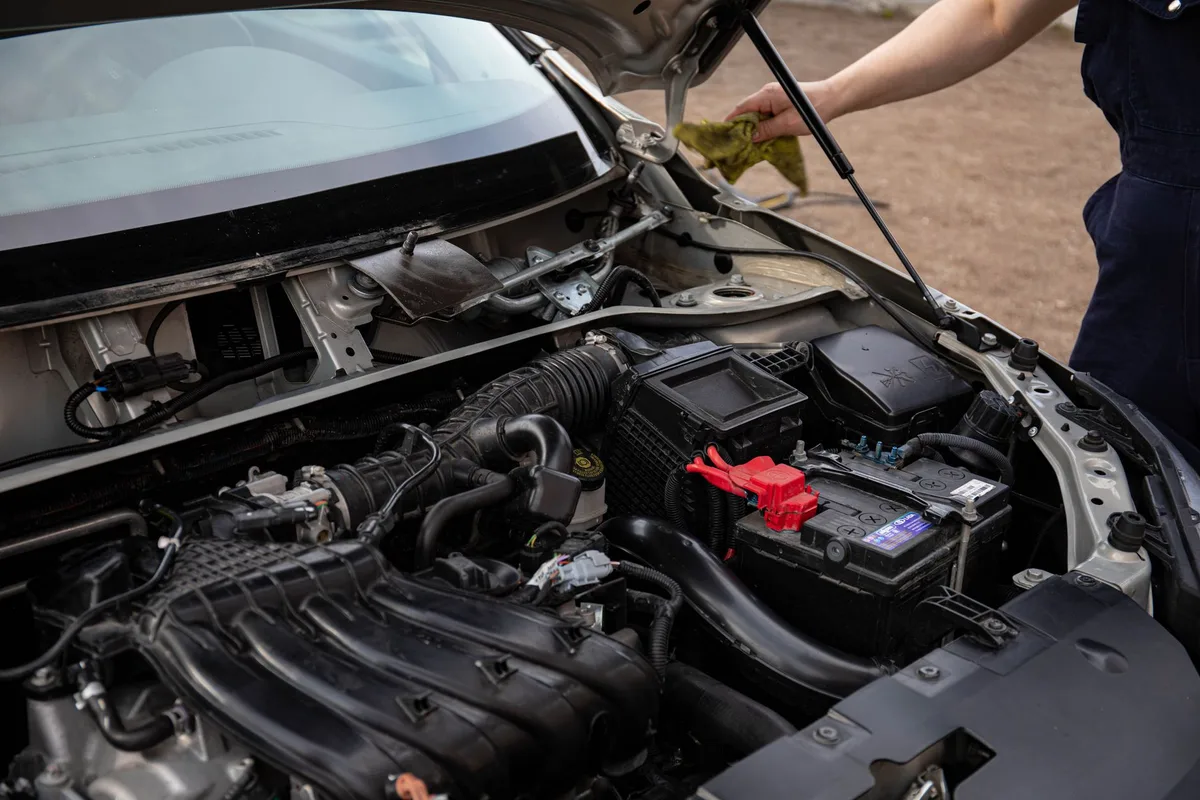
The battery has to sit flat in the tray and clear everything above it. Measure the tray's length, width, and depth before you shop. Then check the height against the hood and any nearby covers.
A taller battery is a common trap. If the terminals sit too close to the hood or a metal brace, you risk a short. Leave real clearance, not a millimeter.
Terminal Position and Type
Terminals must match your cables in both style and side. Top-post and side-post batteries aren't interchangeable without adapters. Post polarity also matters, so the positive and negative need to line up with where your cables reach.
Get this wrong and the cables either won't stretch or they cross over awkwardly. Both invite strain and bad connections.
Hold-Down Clamp Fit
Every battery needs a secure hold-down. A loose battery vibrates, and vibration is one of the top killers of battery life. It also lets terminals shift toward metal, which is a fire risk.
If a larger case won't accept the stock clamp, you'll need a proper bracket that fits. Don't leave it wedged in and hope.
BCI Group Size Compatibility
Group size is the shorthand that ties all of this together. It defines the case dimensions, terminal layout, and hold-down style in one code, like 24F, 35, 47/H5, or 65. The Battery Council International group system is the standard most North American fitment guides follow.
The safest upgrade path is simple. Stay in your factory group size and pick a version with higher CCA or more reserve. You get the "bigger" that helps without touching a single physical limit.
Cold-weather starts especially benefit, since cold mornings drain reserves and a higher CCA rating gives you margin when it counts.
When a Bigger Battery Is a Smart Upgrade
Sizing up pays off when your electrical demands have outgrown the stock battery. If any of these match your situation, more capacity or CCA earns its keep.
Cold-Climate Starting and Higher CCA
If you live where winters bite, higher CCA is the upgrade that matters most. Cold thickens engine oil and saps battery output at the same time. A battery loses a big chunk of its cranking power at 0°F compared to room temperature.
Bumping CCA above the factory number gives you starting margin on the worst mornings. Match your group size, pick the higher CCA version, done. That headroom is why a healthy resting reading still translates to a strong crank when it's freezing.
Heavy Electrical Loads and Added Accessories
More reserve capacity helps when you've added gear that draws power. Think winches, inverters, big audio amps, dash cams, or aftermarket lighting. These loads pull hard, sometimes with the engine off.
A higher Ah or RC rating buffers those draws without leaving you stranded. It also handles a stronger parasitic pull from add-ons better than a minimum-spec battery.
Off-Grid, Overlanding, and Reserve Capacity
For camping and overlanding, reserve capacity is your runtime budget. Running a fridge, lights, or a fan overnight eats into stored energy fast. More RC simply buys you more hours before things go dark.
That said, if you're regularly running loads with the engine off, a dedicated deep-cycle or auxiliary battery beats one oversized starter battery. We'll get to that comparison shortly.
When a Bigger Battery Is the Wrong Call
Sometimes a bigger battery masks a problem instead of fixing it. Here's when to hold off.
Short-Trip Driving and Chronic Undercharging
If most of your drives are five or ten minutes, a bigger battery can actually make things worse. Short trips don't give the alternator time to replace what starting used up. A larger battery just means more capacity sitting chronically undercharged.
That low state of charge leads to sulfation, which permanently cuts capacity over time. The fix isn't a bigger battery. It's a longer drive now and then, or an occasional top-up with a smart charger.
Start-Stop Vehicles and Battery Registration
Start-stop cars need the right chemistry and often a registration step, not just any bigger battery. These systems are built around AGM or EFB batteries with matched specs. Drop in a standard flooded battery and the system can misbehave or wear it out quickly.
Many European models also store the battery's profile in the ECU. Swap the battery without registering it, and the charging logic stays wrong. If your car has start-stop, match the exact chemistry and get it coded with an OBD tool.
Higher CCA vs Higher Amp-Hours: Which Upgrade You Actually Need
Pick CCA for starting problems and Ah for runtime problems. They solve different complaints, so match the number to your symptom.
| Your symptom | The rating to raise | Why |
|---|---|---|
| Slow or weak cold starts | Cold Cranking Amps (CCA) | More starting burst |
| Accessories dying with engine off | Amp-hours / Reserve Capacity | More stored energy |
| Big drop in cranking voltage | CCA | Stronger current delivery |
| Long stops running fridge or lights | Ah / RC | Longer runtime buffer |
Overshooting CCA is harmless, since the starter only pulls what it needs. Undershooting it is the risky move, especially in the cold. If you're not sure how much starting current your engine calls for, our guide on how much cranking current you need breaks down the numbers by vehicle type.
Battery Chemistry Options: Flooded vs AGM vs EFB vs Lithium
Chemistry decides how a battery handles deep drains, heat, and repeated cycling. Going "bigger" often means going to a better chemistry, not just a larger case.
| Chemistry | Best for | Trade-off |
|---|---|---|
| Flooded (standard) | Everyday cars, budget builds | Weakest deep-cycle life |
| EFB | Entry start-stop, light cycling | Costs more than flooded |
| AGM | Start-stop, heavy accessories | Pricier, needs correct charging |
| Lithium (LiFePO4) | Weight savings, deep cycling | Highest cost, cold-charging limits |
AGM is the common upgrade for cars with real electrical loads. It handles deep discharges better and resists vibration well. Just make sure your charging voltage suits it, since AGM likes a slightly tighter window.
Lithium is light and cycles beautifully, but it's a bigger commitment. Cost is high, and many lithium packs won't accept charge below freezing without a heater. For a straightforward daily driver, a quality flooded or AGM battery in the right group size is usually the smart money.
One Bigger Battery vs a Dual-Battery Setup
A dual-battery setup beats one oversized battery when you regularly run heavy loads with the engine off. It keeps your starting battery protected while a second battery handles accessories.
The logic is about separation. Your starter battery stays fresh for cranking. A dedicated auxiliary or deep-cycle battery takes the abuse of running fridges, lights, and inverters overnight.
- Choose one bigger battery if you just want stronger starts or a bit more reserve.
- Choose a dual-battery setup if you camp, overland, or run big loads while parked.
- Choose a dual setup if you've ever drained your battery too low to start.
The downside of dual batteries is complexity and cost. You'll need a battery isolator or DC-DC charger, a mounting spot, and wiring. For most drivers, a single right-sized battery covers the job.
Reserve the dual approach for genuine off-grid power needs.
Step-by-Step: How to Safely Fit a Larger Battery
A battery swap takes about 20 to 30 minutes if the specs check out first. Work in order and you'll avoid sparks and shorts.

Checking Specs, Measuring, and Disconnect Order
Confirm the numbers before you touch a wrench. Pull your factory group size and CCA from the owner's manual. Then measure the tray, hood clearance, and terminal side.
- Disconnect the negative terminal first, then the positive.
- Remove the hold-down clamp and lift the old battery out.
- Set the new battery in, matching terminal positions.
- Reconnect positive first, then negative last.
- Secure the hold-down snugly with no wobble.
Negative-first on removal and negative-last on install keeps you from shorting a wrench against the body.
Battery Registration and Post-Install Voltage Check
Register the battery if your car uses start-stop or stores a battery profile. An OBD tool tells the ECU a fresh battery is fitted, so the charging logic adapts. Skip this on those cars and the new battery may never charge right.
Finish with a voltage check. At idle you want roughly 13.8 to 14.7 volts at the terminals. A reading near 12 volts that won't crank after install points to a loose connection or a charging fault, not the battery.
Mistakes People Make When Upsizing a Car Battery
Most upsizing regrets trace back to skipping the measuring step. Here are the ones that bite people.
- Buying by CCA alone and ignoring case size and terminal side.
- Forcing a taller battery under a hood with no clearance.
- Leaving a big battery loose because the stock clamp won't reach.
- Fitting a standard battery to a start-stop car that needs AGM.
- Assuming more capacity fixes a weak alternator or a parasitic drain.
That last one matters most. If a fresh battery keeps dying, the cause is usually elsewhere. Running a quick multimeter check on the battery saves you from throwing money at the wrong part.
Battery Specs, Ratings, and Numbers Worth Knowing
A handful of numbers tell you almost everything about a car battery. Keep these in your back pocket.
| Spec | Typical value | What it tells you |
|---|---|---|
| Resting voltage (full) | 12.6 to 12.8V | State of charge |
| Charging voltage | 13.8 to 14.7V | Alternator health |
| CCA (passenger cars) | 400 to 850 | Cold starting power |
| Reserve Capacity | 25A discharge test | Engine-off runtime |
| Service life | 3 to 5 years | Replacement window |
CCA is rated at 0°F, so it reflects worst-case starting. Reserve Capacity is measured at a steady 25-amp draw. A resting reading well under 12.4V means the battery is low and worth charging before you judge it.
Safety, Warranty, and Compliance Points to Watch
Treat a battery swap with the same care you'd give any live electrical job. The stored energy is real, and so are the risks.
- Wear gloves and eye protection, especially with flooded batteries.
- Keep terminals clear of the hood to prevent a short or fire.
- Vent flooded batteries, since charging releases hydrogen gas.
- Never reverse polarity, which can damage electronics instantly.
On warranty, fitting a non-spec battery can void coverage on some vehicles, particularly start-stop models. Recycle the old lead-acid battery through the retailer, since most charge a core fee and are set up to take it back. Proper recycling isn't optional for lead-acid units.
Frequently Asked Questions
Will a bigger battery hurt my alternator?
No. Your alternator regulates by voltage, not battery size, so it only supplies the current the battery needs. A larger battery may take slightly longer to fully recharge after a deep drain.
On normal driving, the difference is negligible and harmless.
Does a bigger battery give my car more power?
No, engine power comes from fuel, air, and spark, not the battery. A higher CCA rating only gives you a stronger, more reliable start. Once the engine runs, the alternator carries the electrical load, so battery size doesn't add performance.
Can I put a higher CCA battery in my car?
Yes, and it's one of the safest upgrades. Overshooting CCA is harmless because the starter only draws what it needs. Higher CCA helps most in cold weather.
Just keep the same group size so it fits your tray and cables.
Is it OK to use a battery with more amp-hours?
Yes, more amp-hours or reserve capacity is fine and often useful. It buffers accessories and parasitic draws better. The one caveat is short-trip driving, where a bigger battery can stay chronically undercharged.
An occasional longer drive or smart charger fixes that.
The Bottom Line: Should You Size Up Your Car Battery?
If you want stronger starts or more reserve, size up within your factory group size and pick higher CCA or capacity. That's the safe, simple win. The electrical worries are myths, so focus on fit instead.
Go dual-battery only if you run heavy loads with the engine off. Match AGM or EFB and register the battery on start-stop cars. Measure the tray, check the terminals, secure the clamp, and you're set.

Similar Posts