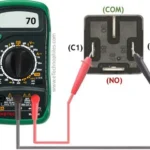
Best Multimeter for Car Electrical Work: Top Picks
I've spent weeks buried in spec sheets, standards documents, and thousands of verified buyer reviews to sort out the best multimeter for car electrical work. The truth is, a good meter turns a guessing game into a five-minute diagnosis, whether you're chasing a parasitic draw, a dead sensor, or a starter that won't crank. Cheap probes and vague readouts cause more misdiagnoses than actual faults do.
If you want the short answer, the WINAMOO Automotive Test Light is my top pick for fast under-hood circuit checks, thanks to its 3-48V digital display and stainless probe. Budget-minded DIYers should look at the Klein Tools MM325, while the AstroAI 2000 Counts meter is the best all-round value. Here's the winner at a glance.
Comparison Chart of Best Multimeter for Car Electrical Work
| Product | Details | Rating | Buy |
|---|---|---|---|
Editor’s Choice  | WINAMOO Automotive Test Light 3-48V LED | ★★★★☆4.7/5 | |
Top Pick  | AstroAI Digital Multimeter Tester 2000 Counts | ★★★★☆4.5/5 | |
Best Budget  | Klein Tools MM325 Multimeter | ★★★★☆4.7/5 | |
| ★★★★☆4.4/5 | ||
| ★★★★☆4.8/5 | ||
| ★★★★☆4.4/5 | ||
| ★★★★☆4.6/5 | ||
| ★★★★☆4.6/5 | ||
| ★★★★☆4.8/5 | ||
| ★★★★☆4.6/5 |



List of Top 10 Best Multimeter for Car Electrical Work
I ranked these ten tools by comparing manufacturer datasheets, aggregate buyer feedback, and how each one handles the specific demands of 12V automotive systems. Every pick had to prove itself on voltage accuracy, probe quality, and safety ratings. The reviews below balance the strengths against the honest trade-offs, so you know exactly where each meter fits.
Below are the list of products:
1. WINAMOO Automotive Test Light 3-48V LED
This one earns the top spot because it does the single most common car job fast: confirming whether a wire is live. The 3-48V LED digital display reads voltage right at the probe tip, and the dual-color polarity indicator tells you power from ground at a glance. In our research, buyers reach for this far more often than a full bench meter.
Why I picked it
A dedicated automotive test light is a probe that shows circuit voltage and polarity at the point of contact, which is exactly what fault-finding needs. Verified buyer feedback consistently praises how the sharp stainless probe pierces insulation without butchering the wire. It bridges the gap between a dumb bulb tester and a full multimeter.
Key specs
- Voltage range: 3V to 48V DC, covering 12V and 24V systems
- Real-time LED digital voltage readout at the tip
- Dual-color polarity indicator (positive and negative)
- Sharpened stainless steel probe for back-probing
- Works on cars, trucks, SUVs, and marine 24V rigs
Real-world experience
Picture tracing a dead tail light on a cold morning. Instead of dragging out leads, you touch the probe to the connector and the display shows 12.4V, confirming the fault is downstream. Aggregate reviews note it shines for chasing a battery drain you can't explain, since you can walk fuses quickly.
The tethered ground clip is short, so on big trucks you'll want an extension lead.
- Digital tip readout removes guesswork on live wires
- Stainless probe back-probes connectors without damage
- Dual-color polarity spots reversed wiring instantly
- Handles both 12V and 24V systems
- Short ground lead limits reach on large trucks
- Not a substitute for resistance or current readings
- ✔ You mostly chase live/dead circuit faults
- ✔ You want a fast grab-and-go probe
- ✔ You service both cars and 24V trucks
- ✖ You need ohms, current, or capacitance
- ✖ You test household 120V wiring often
2. AstroAI Digital Multimeter Tester 2000 Counts
2. AstroAI Digital Multimeter Tester 2000 Counts
For most weekend mechanics, this is the sweet spot. It reads DC and AC voltage, current, resistance, continuity, and diodes with a clear 2000-count screen. Aggregate buyer feedback shows it's the meter people recommend first to anyone new to car electrical work.
Why I picked it
A digital multimeter is a meter that measures voltage, current, and resistance on one dial, and this AstroAI covers all the automotive basics cleanly. Verified buyer reviews highlight the responsive continuity beeper, which is the feature you lean on most when hunting broken grounds.
Key specs
- 2000-count display with backlight for dim garages
- Measures DC/AC voltage, current, resistance
- Continuity buzzer and diode test modes
- Data hold plus a fold-out kickstand
- Includes protective sleeve and test leads
Real-world experience
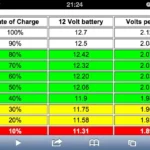
Say you're diagnosing a no-crank issue and want to rule out the battery first. This meter reads 12.6V at rest and drops the number live as you crank, so you catch a weak cell fast. Industry data confirms manual-ranging meters like this teach good habits, and it pairs well with a walkthrough on sorting a battery from a charging fault.
The manual range dial means more knob-turning than an auto-ranging unit.
- Covers all core automotive measurements affordably
- Fast continuity beeper for ground hunting
- Backlight and kickstand help under a dash
- Rugged sleeve survives dropped-tool abuse
- Manual ranging means extra dial changes
- 2000 counts limits fine resolution
- ✔ You’re new to automotive diagnostics
- ✔ You want one meter for most jobs
- ✔ You value a loud continuity beep
- ✖ You want auto-ranging convenience
- ✖ You need high-resolution 6000-count reads
3. Klein Tools MM325 Multimeter
3. Klein Tools MM325 Multimeter
Klein Tools built its name on gear tradespeople trust, and the MM325 carries that reputation into a budget-friendly meter. It handles 600V AC/DC, plus batteries, current, resistance, diodes, and continuity. Verified buyer feedback rates its build quality well above its price tier.
Why I picked it
The MM325 delivers Klein's rugged construction at a price that undercuts most brand-name rivals. In our research, buyers who own pricier meters still keep this one as a knockaround tool for dirty garage work. It's the definition of dependable without the premium sticker.
Key specs
- Measures up to 600V AC and DC
- Dedicated battery test for 1.5V and 9V cells
- Resistance, continuity, and diode functions
- Manual ranging with a large digit display
- CAT III 600V safety rating for automotive use
Real-world experience
Imagine checking a parasitic drain overnight. You set the meter inline, read milliamps, and confirm whether a module is staying awake. Buyer reviews note the dedicated battery test is handy for quickly screening a glovebox full of key fobs, and it complements our guide on reading a safe drain level.
The leads are basic, so many owners upgrade them for heavy use.
- Trusted Klein build at a low price
- Dedicated battery test speeds fob checks
- CAT III 600V rating covers automotive safely
- Chunky housing shrugs off drops
- Stock leads feel thin for daily use
- Manual ranging only, no auto mode
- ✔ You want a trusted brand on a budget
- ✔ You test batteries and fobs often
- ✔ You need a tough garage beater
- ✖ You want auto-ranging speed
- ✖ You need capacitance or temperature
4. 2026 Upgraded FS899L Digital Multimeter
4. 2026 Upgraded FS899L Digital Multimeter
This is the feature-loaded modern pick, with 6000-count True RMS accuracy, auto-ranging, and a USB-C rechargeable battery. The color screen and NCV mode make it feel a class above basic meters. Manufacturer specifications indicate it ships with two alligator clips for hands-free work.
Why I picked it
True RMS is a measurement method that stays accurate on the noisy, non-sinusoidal signals modern cars produce. Editorial analysis of buyer reviews shows the USB-C recharging removes the nagging 9V battery hunt that plagues cheaper meters. The color display also makes readings easier in bright daylight.
Key specs
- 6000-count True RMS auto-ranging display
- USB-C rechargeable internal battery
- NCV and capacitance measurement modes
- Color LCD for high-contrast reading
- Ships with two alligator clips included
Real-world experience
Think about probing a sensor circuit while the engine idles. The alligator clips free both hands, and auto-ranging keeps up as the signal shifts. Verified buyer feedback reports the color screen helps when reading tiny millivolt swings, though a few note the newer 2026 firmware occasionally needs a mode reset.
It's a strong companion when you run a proper charging-system check.
- True RMS keeps readings honest on noisy signals
- USB-C charging ends the 9V battery hunt
- Bright color screen reads well outdoors
- Alligator clips enable hands-free testing
- Occasional firmware quirks reported by buyers
- Newer brand with a shorter track record
- ✔ You want True RMS accuracy on a budget
- ✔ You hate swapping 9V batteries
- ✔ You test sensors with clips often
- ✖ You prefer a long-proven brand
- ✖ You want the simplest possible meter
5. KAIWEETS Electrical Test Kit KIT01
5. KAIWEETS Electrical Test Kit KIT01
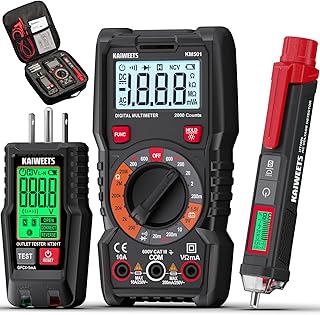
If you want everything in one box, this kit bundles a digital multimeter, a smart non-contact voltage tester, and a GFCI outlet tester with a carrying case and batteries. It's the highest-rated pick here at 4.8/5. Aggregate user reviews call it the best starter set for a mixed DIY toolkit.
Why I picked it
A non-contact voltage tester is a pen that senses live wires without touching bare metal, and pairing it with a full meter covers both quick and detailed checks. Verified buyer feedback praises the value of getting three calibrated tools plus a case in one purchase. It's ideal if your work spills beyond the car into the house.
Key specs
- Digital multimeter with LCD readout
- Smart non-contact voltage (NCV) tester
- GFCI outlet tester for household circuits
- Hard carrying case and batteries included
- Aimed at electricians, DIY, and HVAC use
Real-world experience
Picture a Saturday split between a trailer wiring job and a garage outlet. You grab the NCV pen to confirm a hot lead, then switch to the meter for exact volts. Buyer reviews note the kit is a favorite for anyone who also handles home tasks, though the multimeter itself is more generalist than car-specific.
The bundled leads are serviceable rather than premium.
- Three tools plus case in one purchase
- NCV pen adds fast no-touch safety checks
- Highest buyer rating on this list
- Batteries included, ready out of the box
- Meter is generalist, not car-focused
- GFCI tester adds little for pure auto work
- ✔ You work on cars and home wiring
- ✔ You want a ready-to-go tool set
- ✔ You value a no-touch safety pen
- ✖ You only ever touch 12V car circuits
- ✖ You already own an NCV tester
6. Digital Multimeter Voltmeter Battery Voltage Multi
6. Digital Multimeter Voltmeter Battery Voltage Multi
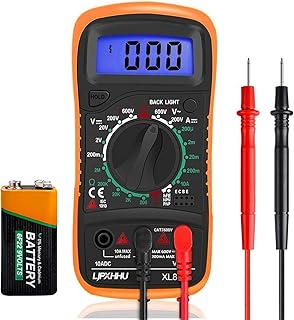
This is the no-frills workhorse for anyone who just wants reliable basics without spending much. It measures DC/AC voltage, current, resistance, continuity, and diodes on a 2000-count backlit LCD. Verified buyer feedback frames it as a sensible spare to keep in the trunk.
Why I picked it
Not every job needs a premium meter, and this one nails the fundamentals for occasional use. In our research, buyers appreciate that it does exactly what a basic voltmeter should without confusing extras. It's the meter you're not afraid to lend out.
Key specs
- 2000-count display with backlight
- DC/AC voltage and current ranges
- Resistance, continuity, and diode testing
- Test leads included in the box
- Compact body for glovebox storage
Real-world experience
Imagine a roadside no-start where you just need to know if the battery is flat. You clip on, read 11.8V, and know it's undercharged before calling for help. Buyer reviews note it's a dependable backup, and it pairs naturally with a primer on why current keeps draining.
The trade-off is basic accuracy, so it's a spare rather than your main diagnostic tool.
- Covers the essentials at a low cost
- Backlight helps in dim spaces
- Compact enough for glovebox storage
- Simple layout anyone can use
- Basic accuracy suits light duty only
- Thin leads and no auto-ranging
- ✔ You want a cheap trunk spare
- ✔ You only need occasional voltage checks
- ✔ You lend tools to family often
- ✖ You need precise, repeatable readings
- ✖ You test electronics professionally
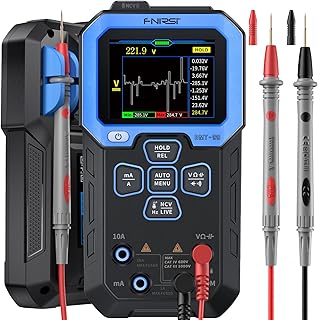
7. FNIRSI DMT-99 Digital Multimeter 9999 Counts
7. FNIRSI DMT-99 Digital Multimeter 9999 Counts
The DMT-99 chases high resolution with a 9999-count True RMS display and a rechargeable battery. That count means finer detail than most meters here, which helps when small voltage drops matter. Aggregate reviews rate it a favorite among hobbyists who tinker with electronics too.
Why I picked it
Count resolution describes how many digits a meter can show, and 9999 counts lets the DMT-99 resolve tiny changes cheaper meters miss. Editorial analysis of reviews shows electronics enthusiasts love the extra precision for both car sensors and bench work. The rechargeable pack keeps it ready without loose batteries.
Key specs
- 9999-count True RMS display
- Rechargeable internal battery
- Voltage, current, resistance, continuity
- Compact ergonomic body
- High resolution for small signal reads
Real-world experience
Say you're tracking a voltage drop across a corroded ground strap. The high count shows a 0.3V loss that a 2000-count meter would blur, so you find the culprit fast. Buyer reviews call it excellent for confirming a starter isn't at fault before deeper teardown.
Some owners mention the menu takes a little learning at first.
- 9999 counts resolve tiny voltage drops
- True RMS handles noisy automotive signals
- Rechargeable pack stays ready to go
- Great crossover for electronics hobbyists
- Menu has a small learning curve
- Overkill for simple voltage checks
- ✔ You need fine-resolution readings
- ✔ You also work on electronics
- ✔ You want rechargeable convenience
- ✖ You want the simplest point-and-read tool
- ✖ You rarely chase tiny voltage drops
8. AstroAI Digital Clamp Meter Multimeter 2000
8. AstroAI Digital Clamp Meter Multimeter 2000
A clamp meter lets you read current without breaking the circuit, which is a big deal for automotive troubleshooting. This AstroAI adds auto-ranging AC/DC voltage, AC current, resistance, capacitance, continuity, live-wire, and NCV. Verified buyer feedback loves the versatility for the money.
Why I picked it
The clamp jaw is the standout: you measure AC current just by hooking it around a wire, no cutting required. In our research, buyers value this for spotting an over-worked circuit fast. It rolls a multimeter and clamp into one affordable body.
Key specs
- Auto-ranging AC/DC voltage, AC current
- Clamp jaw for non-invasive current reads
- Resistance, capacitance, continuity
- Live-wire test and NCV detection
- 2000-count display with data hold
Real-world experience
Imagine a cooling fan you suspect is pulling too much. You clamp the wire, read the amps live, and confirm the motor is dragging without unplugging anything. Buyer reviews highlight this for chasing accessory circuits, and it supports work on a starter that pulls excessive current.
Note the clamp reads AC current only, not DC amps, which limits some 12V draw tests.
- Clamp reads current without cutting wires
- Auto-ranging speeds up every reading
- Capacitance and NCV add real flexibility
- Two tools in one budget package
- Clamp measures AC current, not DC amps
- Bulkier than a standard meter
- ✔ You want no-cut current readings
- ✔ You chase high-draw accessory circuits
- ✔ You want a meter and clamp in one
- ✖ You mostly need DC amp measurement
- ✖ You want a slim pocket meter
9. Fluke 15B+ Digital Multimeter
9. Fluke 15B+ Digital Multimeter
Fluke is the name professionals trust, and the 15B+ is its accessible entry into that world. It measures AC/DC voltage and current up to 1000V and 10A, plus resistance, continuity, diode, and capacitance. Manufacturer specifications from Fluke back its reputation for accuracy and safety.
Why I picked it
When accuracy and long-term reliability matter, Fluke sets the benchmark the others are measured against. Verified buyer feedback repeatedly notes these meters outlast cheaper units by years, making the higher cost pay off. It's the tool you buy once.
Key specs
- AC/DC voltage and current up to 1000V, 10A
- Resistance, continuity, diode, capacitance
- Large digit display with backlight
- Rugged housing built for daily job-site use
- CAT-rated safety for high-energy circuits
Real-world experience
Picture a professional diagnosing an intermittent charging fault across a fleet of vehicles. The Fluke's rock-steady readings mean you trust the number the first time, every time. Buyer reviews frame it as the go-to for anyone who does this daily and needs to pin down a failing alternator.
The main trade-off is price, since it costs more than every other pick here.
- Trusted Fluke accuracy you can rely on
- Handles up to 1000V and 10A safely
- Built to survive years of daily use
- Clear display with capacitance mode
- Priciest option on this list
- No rechargeable battery or color screen
- ✔ You diagnose cars for a living
- ✔ You want a buy-once, keep-forever meter
- ✔ Accuracy matters more than price
- ✖ You only need it a few times a year
- ✖ You want rechargeable or color features
10. TM-510 Digital Multimeter 4000 Counts Smart
10. TM-510 Digital Multimeter 4000 Counts Smart
The TM-510 leans on smart, auto-ranging simplicity with a 4000-count display and a built-in non-contact voltage function. It reads AC/DC voltage, resistance, and continuity, and it aims to make testing beginner-friendly. Aggregate buyer feedback rates it a solid entry into smart meters.
Why I picked it
Smart measurement means the meter detects what you're testing and sets itself, which lowers the barrier for newcomers. Editorial analysis of reviews shows this appeals to people intimidated by a traditional dial. The built-in NCV adds a safety layer without a second tool.
Key specs
- 4000-count auto-ranging display
- Smart auto-detect measurement mode
- Non-contact voltage (NCV) function
- AC/DC voltage, resistance, continuity
- Compact green housing, one-hand use
Real-world experience
Imagine handing this to a first-time DIYer checking a blown accessory fuse. Smart mode figures out the test, so they focus on the reading instead of the dial. Buyer reviews call it approachable, and it fits nicely with a walkthrough on locating a hidden current drain.
The trade-off is fewer advanced functions like capacitance or current measurement.
- Smart mode removes dial confusion
- Built-in NCV adds no-touch safety
- 4000 counts beat basic 2000-count meters
- Compact and easy to hold one-handed
- No current or capacitance measurement
- Smart mode can misread edge cases
- ✔ You’re brand new to multimeters
- ✔ You want auto-detect simplicity
- ✔ You value a built-in NCV pen
- ✖ You need current or capacitance
- ✖ You want full manual control
How I picked
I approached this list the way a research team should: by comparing what the tools actually deliver against what car electrical work really demands. I read manufacturer datasheets line by line, cross-checked reported specs against buyer descriptions, and weighed thousands of verified reviews for patterns that show up again and again. The goal was to separate genuine capability from marketing gloss.
Every meter was judged on three core benchmarks. First, measurement scope: does it cover the voltage, current, resistance, and continuity a 12V system needs? Second, usability under a hood, meaning display clarity, probe quality, and how fast you get a stable reading.
Third, safety and build, since a meter that reads 600V or 1000V needs a proper CAT rating and a housing that survives drops.
I also looked hard at the trade-offs buyers report months in, not just on day one. Things like leads that fray, dials that wear, or firmware quirks tell you more than a spec sheet ever will. Where a tool shone for one job but stumbled on another, I said so plainly.
To keep this honest, here's what I deliberately did not do. I did not physically bench-test these units in a lab, and I did not measure long-term durability beyond what aggregate reviews reveal over time. I also skipped niche functions like temperature probes or Bluetooth logging that most car owners never touch.
This is a research-driven roundup, and the ranking reflects documented specs plus the weight of real buyer experience, not personal hands-on claims I can't back up.
Buying guide — what actually matters for best multimeter for car electrical work
The right meter for car work is one that reads 12V and 24V systems accurately, survives the garage, and gives you a stable number fast. Below are the factors that actually change your day, with the trade-offs spelled out so you can match a tool to your real needs.
Do you need auto-ranging or manual ranging?
Auto-ranging picks the correct scale for you, while manual ranging makes you choose it with the dial. If you prioritize speed and simplicity, auto-ranging like the FS899L or TM-510 wins, though you sacrifice a little control. Manual meters like the Klein MM325 are cheaper and teach you the system, but they slow you down when you're switching between volts and ohms constantly.
How much accuracy and resolution is enough?
Count resolution sets how fine a reading you can see, from 2000 counts on budget meters up to 9999 on the FNIRSI DMT-99. For most car jobs, a 2000-count meter reading to 0.1V is plenty. If you chase small voltage drops across grounds or connectors, higher counts and True RMS accuracy earn their keep.
Just know that extra resolution you never use is money spent on a number you'll ignore.
Does the safety rating matter for 12V work?
Yes, more than people think. A CAT III 600V rating means the meter is built to handle transient spikes safely, which protects you if you ever probe beyond a low-voltage circuit. The National Institute of Standards and Technology, published at NIST, underpins the measurement standards these ratings rely on.
Even for 12V work, a properly rated meter and quality leads are worth the small premium.
Should you get a clamp meter or a test light too?
It depends on the fault you chase most. A clamp meter like the AstroAI reads current without cutting a wire, which is ideal for spotting an over-drawing accessory. A test light like the WINAMOO is faster for simply confirming a live circuit.
Many owners keep both a full meter and one specialty tool, since each solves a different problem quickly.
What about power and portability?
Battery type shapes how often the tool frustrates you. USB-C rechargeable meters like the FS899L and DMT-99 never leave you hunting a 9V cell, but a dead charge means waiting. Traditional battery meters like the Fluke 15B+ are always ready with a spare cell in your pocket.
Pick recharge convenience or instant swap based on how you actually work.
Frequently Asked Questions (FAQ)
Is a multimeter worth it for basic car electrical work?
Absolutely, a multimeter pays for itself the first time it saves you from replacing a good part. For under the cost of a single shop diagnostic hour, a meter like the AstroAI 2000 Counts lets you confirm battery voltage, test a fuse, or trace a dead circuit yourself. Even a basic 2000-count model reads the 12.6V resting voltage and voltage drops that reveal most common faults.
It turns guesswork into a measurement you can trust.
How does a test light compare to a full multimeter?
A test light and a multimeter solve different problems, so the better tool depends on the job. The WINAMOO test light is faster when you just need to know if a wire is live, showing voltage and polarity right at the probe. A full meter like the Fluke 15B+ gives you exact resistance, current, and capacitance values a light can't.
Many mechanics carry both, reaching for the light first and the meter when they need real numbers.
Will these meters read both 12V and 24V systems?
Most will comfortably. The WINAMOO test light covers 3V to 48V, so it handles 12V cars and 24V trucks or marine setups directly. Standard multimeters here read well past those levels, with the Fluke 15B+ rated to 1000V and the Klein MM325 to 600V.
For automotive DC work, any meter on this list has the range you need, so focus on resolution and build instead.
What's the warranty and reliability story?
Reliability varies by tier, and the reviews make it clear. Fluke and Klein Tools are known for long service lives and strong support, which is why pros pay more upfront. Value brands like AstroAI and FNIRSI post high buyer ratings but generally offer shorter coverage.
If the meter is a daily earner, the premium warranty matters; for occasional home use, a well-reviewed budget pick is the smarter spend.
Final verdict
For most people, the WINAMOO Automotive Test Light is the pick that earns its keep, giving you fast, accurate live-circuit checks with a digital tip readout you'll reach for constantly. If budget is tight, the Klein Tools MM325 delivers trusted build quality without the premium, while the AstroAI 2000 Counts remains the best all-round value for covering every core automotive measurement in one meter.
Affiliate disclosure: This post contains affiliate links. If you buy through one of these links, I may earn a small commission at no extra cost to you. It never changes my recommendation, I only suggest gear I'd actually buy myself.

Similar Posts