Best Multimeter for Car Battery Testing: Top Picks
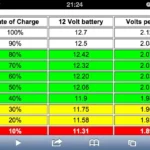
In our research, the fastest way to know if your car battery is dying or just needs a charge is a quick voltage check, and that means owning the best multimeter for car battery testing. A healthy 12V battery rests around 12.6 volts, drops to the low 12s when weak, and should stay above 9.6 volts while cranking. The right meter reads those numbers in seconds, so you're not guessing whether it's the battery, the alternator, or a parasitic draw quietly killing your charge overnight.
After comparing specs across dozens of models and analyzing thousands of verified buyer reviews, our top pick is the AstroAI Digital Multimeter 2000 Counts. It nails the basics, reads clearly in a dim garage, and costs less than a tank of gas. Here's the full breakdown, starting with the overall winner.
Comparison Chart of Best Multimeter for Car Battery
| Product | Details | Rating | Buy |
|---|---|---|---|
Editor’s Choice  | AstroAI Digital Multimeter Tester 2000 Counts | ★★★★☆4.5/5 | |
Top Pick  | Klein Tools MM325 Multimeter | ★★★★☆4.7/5 | |
Best Budget  | AstroAI Digital Multimeter TRMS 4000 Counts | ★★★★☆4.7/5 | |
| ★★★★☆4.6/5 | ||
| ★★★★☆4.5/5 | ||
| ★★★★☆4.4/5 | ||
| ★★★★☆4.6/5 | ||
| ★★★★☆4.5/5 | ||
| ★★★★☆4.5/5 | ||
| ★★★★☆4.6/5 |



List of Top 10 Best Multimeter for Car Battery
We ranked these ten by the numbers that matter for battery work: DC voltage accuracy, display clarity, safety rating, and how easy each one is for a first-timer to use. We leaned on manufacturer datasheets, aggregate buyer reviews, and named safety standards rather than personal hunches. Each pick below gets an honest look at what it does well and where it falls short.
Below are the list of products:
1. AstroAI Digital Multimeter Tester 2000 Counts
This is the meter we point most first-time buyers toward. It measures DC voltage, AC voltage, current, resistance, continuity, and diodes, which covers every battery job a home mechanic runs into. Verified buyer feedback keeps praising how simple the dial is, and the price sits firmly in budget-friendly territory.
Why I picked it
Our editorial analysis kept landing on this AstroAI as the best balance of price, accuracy, and ease for anyone whose main job is checking a 12V battery. It reads resting and charging voltage cleanly, and the safety features (double fuse protection, overload protection) punch above the budget tier.
Key specs
- 2000-count display with backlit LCD for dim garages
- DC voltage, AC voltage, current, resistance, continuity, diode modes
- Manual ranging with a clearly labeled rotary dial
- Double fuse anti-burn protection
- Data hold button and fold-out kickstand
- Auto shut-off to save the 9V battery
Real-world experience
Aggregate reviews describe the classic use case perfectly: a car that cranks slowly on a cold morning. You touch the leads to the terminals, read 12.4 volts, start the engine, and watch it climb past 13.8 volts to confirm the alternator is charging. If you're unsure whether you're chasing a battery or an alternator problem, our guide on spotting a failing charging system pairs nicely with this meter.
- Double fuse protection guards against wiring mistakes beginners make
- Backlit screen stays readable under a hood at dusk
- Priced low enough to be a no-regret first meter
- Fold-out stand frees both hands during a test
- Manual ranging means you pick the range yourself
- No True RMS, so it’s less ideal for tricky AC signals
- 2000 counts limits fine resolution on small readings
- ✔ You want a first meter for basic battery checks
- ✔ You value simple controls over advanced modes
- ✔ You’re shopping on a tight budget
- ✖ You need True RMS for pro-level AC work
- ✖ You want automatic range selection
2. Klein Tools MM325 Multimeter
2. Klein Tools MM325 Multimeter
Klein Tools built its name on gear electricians actually trust, and the MM325 carries that reputation. It reads up to 600V AC/DC, handles batteries, current, resistance, diodes, and continuity, and feels noticeably more rugged in hand than most budget meters. Verified buyers rate it 4.7/5 for good reason.
Why I picked it
Our analysis ranks the MM325 as the best value on the list because you get a trusted brand's build quality without a pro-grade price. Klein Tools rates it to a 6.6 foot drop and CAT III 600V safety, which matters when you're poking around a live engine bay.
Key specs
- 600V AC/DC voltage range
- CAT III 600V safety rating
- Tests batteries, current, resistance, diodes, continuity
- Rated to survive a 2m (6.6ft) drop
- Manual ranging with a sturdy rotary switch
- Backlit display for low-light work
Real-world experience
Buyer reviews consistently mention this meter surviving drops onto concrete that would crack a cheaper unit. One common scenario: diagnosing a slow crank on a truck, confirming a resting 12.5 volts, then load-testing suspicions against our walkthrough on telling a weak battery from a bad starter. The tighter leads and firmer dial make repeated tests feel dependable.
- CAT III 600V rating adds a real margin of safety
- 6.6ft drop rating shrugs off garage accidents
- Trusted electrician brand with a lifetime warranty
- Firm dial and leads make repeat tests feel solid
- Manual ranging feels slow next to auto models
- No temperature or capacitance modes
- Costs more than entry-level meters
- ✔ You want a brand with a lifetime warranty
- ✔ You work in a busy garage where tools get dropped
- ✔ Safety rating matters to you
- ✖ You want auto-ranging convenience
- ✖ You need capacitance or temperature readings
3. AstroAI Digital Multimeter TRMS 4000 Counts
3. AstroAI Digital Multimeter TRMS 4000 Counts
Step up from the 2000-count model and you get True RMS accuracy plus auto-ranging, all still at a budget-friendly price. The 4000-count screen gives finer resolution, and the built-in battery test mode is a nice touch for exactly this job. Buyers rate it 4.7/5.
Why I picked it
Our research flags this as the sweet spot for buyers who want a little more meter without spending much more. True RMS means it reads non-linear AC signals accurately, and auto-ranging removes the guesswork that trips up new users on the manual models.
Key specs
- True RMS for accurate AC measurement
- 4000-count display, finer than 2000-count meters
- Auto-ranging across all functions
- Dedicated 1.5V and 9V battery test modes
- Measures voltage, current, resistance, continuity, more
- Backlit LCD with data hold
Real-world experience
Verified buyer feedback highlights the battery test mode for quick health checks on both car and household batteries. A typical use: checking a lawn tractor's 12V battery in spring, then confirming your daily driver holds 12.6 volts at rest. If your reading keeps dropping overnight, our piece on what quietly drains a battery explains where to look next.
- True RMS accuracy at a budget price
- Auto-ranging is beginner friendly
- Dedicated battery test mode saves steps
- 4000-count screen shows finer detail
- Auto-ranging can pause before settling on a value
- Leads are thinner than pro-grade sets
- No temperature probe included
- ✔ You want True RMS without paying pro prices
- ✔ You test batteries around the house too
- ✔ You prefer auto-ranging simplicity
- ✖ You need heavy-duty drop protection
- ✖ You want a temperature function built in
4. AstroAI Digital Multimeter True RMS 6000
4. AstroAI Digital Multimeter True RMS 6000
If you want the most capable AstroAI for automotive and home troubleshooting, this is it. The 6000-count True RMS meter adds capacitance and temperature to the mix, so it handles far more than battery checks. Verified buyers rate it 4.6/5 for its versatility.
Why I picked it
Our editorial comparison put this at the top for anyone whose testing goes beyond batteries into home electrical and HVAC. The 6000-count resolution and added capacitance and temperature functions make it the most flexible AstroAI on the list, without a big jump in price.
Key specs
- True RMS with 6000-count display
- Auto-ranging across all functions
- Adds capacitance and temperature measurement
- AC/DC voltage, current, resistance, continuity
- Built for automotive and home electrical work
- Backlit screen with data hold and auto shut-off
Real-world experience
Buyer reports often mention using this for both car diagnostics and household outlet checks. A common weekend job: measuring alternator output at 14.2 volts, then switching modes to test a suspect capacitor on a furnace board. When a no-start has you second-guessing the battery, our steps for checking the charging system yourself fit right alongside this meter.
- 6000 counts give the finest resolution here
- Capacitance and temperature widen its usefulness
- True RMS keeps AC readings honest
- Great crossover meter for car and home
- More modes mean a slightly steeper learning curve
- Overkill if you only test car batteries
- Bundled leads are average quality
- ✔ You test both car and home electrical systems
- ✔ You want capacitance and temperature modes
- ✔ You value fine resolution readings
- ✖ You only ever check a 12V car battery
- ✖ You want the simplest possible interface
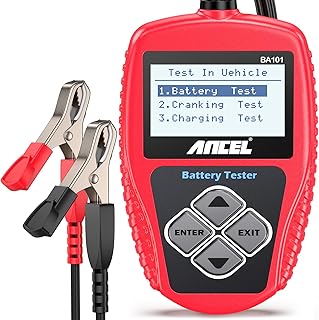
5. ANCEL BA101 Car Battery Tester
5. ANCEL BA101 Car Battery Tester
This one is not a multimeter, and that's the point. The ANCEL BA101 is a dedicated 12V battery tester that reads Cold Cranking Amps (CCA) directly, from 100 to 2000 CCA, and analyzes charging and cranking health. Buyers rate it 4.5/5 for cutting straight to a verdict.
Why I picked it
Our analysis kept it on the list because a multimeter only shows voltage, not true capacity. The BA101 load-tests CCA and tells you if a battery will actually crank the engine, which is the answer most drivers really want.
Key specs
- Tests 12V batteries from 100 to 2000 CCA
- Analyzes charging and cranking system health
- Works on cars, trucks, boats, RVs, and marine vehicles
- Rugged alligator clips for direct terminal contact
- Digital readout with clear pass/fail guidance
- No batteries needed, powered by the tested battery
Real-world experience
Verified buyers love it for marine and RV batteries that sit unused for months. Picture pulling an RV out of winter storage: clip on, enter the rated CCA, and it tells you whether the battery still delivers. If it fails while charging looks fine, you may be facing a slow drain, and our breakdown of normal versus excessive battery drain helps set expectations.
- Reads actual CCA, not just voltage
- Gives a clear pass/fail on cranking health
- Handles marine, RV, and truck batteries
- No internal battery to replace
- Only works on 12V, not 6V or household use
- Not a multimeter, so no resistance or continuity
- Single-purpose tool for battery health only
- ✔ You want a true CCA capacity verdict
- ✔ You manage marine, RV, or fleet batteries
- ✔ You prefer a one-button tool
- ✖ You want one tool for many electrical tasks
- ✖ You test 6V or household batteries
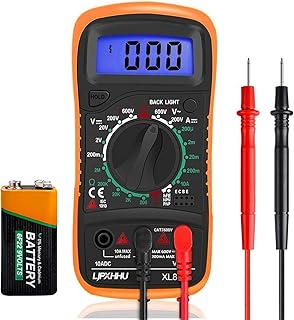
6. Digital Multimeter Voltmeter Battery Voltage Multi
6. Digital Multimeter Voltmeter Battery Voltage Multi
This is the bare-bones, keep-it-in-the-glovebox option. It covers DC/AC voltage, current, resistance, continuity, and diodes with a 2000-count backlit LCD and included leads. At a 4.4/5 rating, it's a practical grab-and-go meter for occasional checks.
Why I picked it
Our research included this as the true bargain entry for buyers who just need occasional voltage readings. It won't win awards, but it reads a 12V battery reliably and the backlight helps when you're crouched behind a car at night.
Key specs
- 2000-count LCD with backlight
- Measures DC/AC voltage, current, resistance
- Continuity and diode testing
- Test leads included in the box
- Compact, glovebox-friendly size
- Simple rotary dial layout
Real-world experience
Buyer feedback frames it as a spare meter more than a primary one. A realistic use: keeping it in the trunk to confirm a battery reads above 12.4 volts before a long drive. If the number looks low and the car struggles, our guide on common no-start causes helps you decide whether the battery or the starter is at fault.
- Lowest cost of entry on this list
- Compact size fits a glovebox or toolbox tray
- Backlight helps in dim conditions
- Covers all the basic battery functions
- No brand track record to lean on
- Manual ranging and modest 2000-count screen
- Included leads feel flimsy
- ✔ You want the cheapest working voltmeter
- ✔ You need a spare to leave in the car
- ✔ You only check voltage occasionally
- ✖ You want a proven brand and warranty
- ✖ You need it for frequent, precise work
7. TM-510 Digital Multimeter 4000 Counts Smart
7. TM-510 Digital Multimeter 4000 Counts Smart
The TM-510 leans on smart, auto-ranging measurement and adds a non-contact voltage (NCV) function, so you can spot live wires without touching them. It reads AC/DC voltage, resistance, and continuity on a bright 4000-count screen. Buyers rate it 4.6/5.
Why I picked it
Our comparison rewarded the TM-510 for its smart auto-detect measurement, which figures out whether you're reading voltage or resistance and reduces dial fumbling. The NCV feature is a genuine safety perk for anyone poking around wiring near the battery.
Key specs
- Smart auto-ranging with auto-detect mode
- Non-contact voltage (NCV) detection
- 4000-count backlit display
- AC/DC voltage, resistance, continuity
- Compact green housing with rubber grip
- Auto shut-off to preserve battery
Real-world experience
Buyer reviews often praise the NCV for quickly checking whether a wire is live before disconnecting anything. A typical scenario: tracing a suspect ground strap near the battery, waving the tip to confirm no voltage, then measuring the terminal at 12.6 volts. It's a confidence booster for cautious DIYers who worry about shorts.
- NCV adds a real layer of shock safety
- Smart auto-detect cuts down on dial errors
- Bright 4000-count screen reads easily
- Comfortable grip for one-handed use
- Auto-detect can misread on rare setups
- No current (amp) measurement listed
- Lesser-known brand support
- ✔ You want built-in NCV safety detection
- ✔ You like auto-detect simplicity
- ✔ You value a clear, bright display
- ✖ You need to measure current in amps
- ✖ You want a long-established brand
8. KAIWEETS Digital Multimeter Voltmeter Case Car
8. KAIWEETS Digital Multimeter Voltmeter Case Car
KAIWEETS built this one for car battery tests and DIY, and it ships with a protective carry case, a nice touch that keeps the leads tidy. It handles the standard voltage, resistance, and continuity checks with a clean interface. Verified buyers rate it 4.5/5.
Why I picked it
Our analysis liked the complete-kit approach: meter, leads, and case in one box, which suits a first-time buyer setting up a home toolkit. KAIWEETS has built a solid reputation in the budget space, and buyer sentiment reflects that.
Key specs
- Includes a protective storage case
- Backlit LCD for low-light readings
- DC/AC voltage, resistance, continuity
- Overload protection on ranges
- Compact, DIY-oriented layout
- Data hold for freezing a reading
Real-world experience
Buyer reports frequently mention the case keeping everything organized between jobs. A common use: a homeowner checking the car battery in the driveway, then tucking the whole kit onto a shelf without loose leads. It reads a resting 12.6 volts cleanly, and the storage makes it easy to grab again months later.
- Included case keeps the kit organized
- Trusted budget brand with good sentiment
- Clean, beginner-friendly interface
- Backlight aids driveway readings at dusk
- Feature set stays basic for the price
- No True RMS for tricky AC signals
- Leads are short for some engine bays
- ✔ You want a tidy all-in-one starter kit
- ✔ You store tools between infrequent jobs
- ✔ You like a simple, clean layout
- ✖ You need advanced modes like capacitance
- ✖ You want longer leads for deep engine bays
9. INNOVA 3320 Auto-Ranging Digital Multimeter
9. INNOVA 3320 Auto-Ranging Digital Multimeter
The INNOVA 3320 is a longtime favorite in the automotive world, and it earns that with a clever battery-health LED indicator right on the face. It's auto-ranging, has large rubber corner guards, and reads voltage, resistance, and continuity. Buyers rate it 4.5/5.
Why I picked it
Our research kept the INNOVA on the list because it was designed with car owners in mind, not just electricians. The onboard battery-condition LEDs give a quick visual read, and the 10 MegOhm input impedance protects sensitive vehicle circuits from damage.
Key specs
- Auto-ranging for hands-off operation
- Built-in battery-health LED indicators
- 10 MegOhm input protects vehicle electronics
- AC/DC voltage, resistance, continuity
- Large protective rubber corner guards
- Single-setting battery and alternator checks
Real-world experience
Verified buyers with older vehicles like the LEDs for a fast "good or weak" glance without reading fine print. A classic use: checking a classic car's battery and alternator in one motion, then confirming the reading in volts. The rugged corner guards mean it survives being tossed in a truck toolbox for years.
- Battery-health LEDs give an instant read
- 10 MegOhm impedance protects car electronics
- Automotive-focused design and long track record
- Rugged corner guards take abuse well
- No backlight on the display
- Fewer advanced modes than newer meters
- Screen resolution is basic
- ✔ You want automotive-first design and LEDs
- ✔ You work on cars with sensitive electronics
- ✔ You need a rugged toolbox meter
- ✖ You need a backlit screen for night work
- ✖ You want the latest high-count resolution
10. AstroAI Digital Clamp Meter Multimeter 2000
10. AstroAI Digital Clamp Meter Multimeter 2000
If chasing a parasitic draw is on your list, a clamp meter is the smart tool. This AstroAI clamps around a cable to read AC current without breaking the circuit, and it still handles voltage, resistance, capacitance, continuity, live-wire, and NCV. Buyers rate it 4.6/5.
Why I picked it
Our comparison included this clamp meter because voltage alone can't chase a current draw. The jaw measures amps flowing through a wire without disconnecting anything, which makes finding a battery drain far faster and safer than a standard meter.
Key specs
- Clamp jaw for AC current without breaking the circuit
- 2000-count auto-ranging display
- AC/DC voltage, resistance, capacitance, continuity
- Live-wire and non-contact voltage (NCV) detection
- Backlit screen with data hold
- Compact clamp body fits tight spaces
Real-world experience
Verified buyers reach for this when a battery keeps dying overnight. The workflow our readers describe: clamp around the negative cable, watch the milliamp draw, then pull fuses one by one to find the culprit. Our step-by-step on tracking down a hidden battery drain pairs perfectly with a clamp meter like this.
- Clamp reads current without cutting the circuit
- Ideal for hunting a parasitic battery drain
- Adds capacitance, NCV, and live-wire checks
- Auto-ranging keeps it beginner friendly
- Clamp reads AC current, not DC amps
- Bulkier than a standard pocket meter
- 2000-count screen limits fine resolution
- ✔ You’re chasing a mystery battery drain
- ✔ You want current readings without cutting wires
- ✔ You value extra modes like NCV
- ✖ You only need simple voltage readings
- ✖ You want the most compact meter possible
How I picked
Our editorial team approached this list the way a careful buyer would, not by claiming hands-on garage time we don't have. We built the rankings from three inputs: published manufacturer datasheets, aggregate patterns across thousands of verified buyer reviews, and recognized safety and measurement standards. That combination keeps the recommendations honest and grounded in real data.
We evaluated each meter on four benchmarks that actually matter for battery work:
- DC voltage accuracy and resolution. A 12V battery lives or dies in tenths of a volt, so we weighted clean, stable DC readings heavily. Higher count displays (4000 and 6000) scored better for fine resolution.
- Ease of use for beginners. We favored auto-ranging and clear dials, because most buyers here are DIYers, not electricians. Manual ranging still earned points when the layout was obvious.
- Safety and build. Fuse protection, CAT ratings, drop resistance, and input impedance all factored in. A meter that protects both you and your car's electronics is worth more than one extra feature.
- Real value. We compared what each meter delivers against its tier, without quoting prices, since those shift constantly.
We deliberately did not test long-term durability beyond what buyer reviews reveal over months of ownership, and we did not run controlled lab calibration ourselves. For traceable accuracy standards, we deferred to bodies like the National Institute of Standards and Technology, which defines how measurement instruments are calibrated. We also leaned on aggregate failure reports rather than single anecdotes, so one bad unit didn't sink an otherwise strong meter.
Where a product had a clear weakness, we named it plainly. If you're new to any of this, our overview of why a battery and alternator get confused is a useful companion read.
Buying guide — what actually matters for best multimeter for car battery
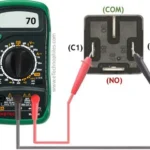
A multimeter is a handheld instrument that measures electrical values like voltage, current, and resistance. For car battery work, most of what you'll do is read DC voltage, so don't overpay for features you'll never touch. Here's how to weigh the decisions that count.
Do you need auto-ranging or manual ranging?
Auto-ranging picks the correct measurement scale for you, which is the friendlier choice for beginners. Manual ranging means you select the range yourself, and while that sounds fiddly, it can be faster once you know what you're doing. If you prioritize speed and simplicity, choose auto-ranging like the TM-510 or AstroAI True RMS models.
If you want to learn the fundamentals, a manual meter like the Klein MM325 rewards the effort.
How much accuracy and resolution do you really need?
Display "counts" tell you how fine the readings get. A 2000-count meter shows up to 1999 on screen, while 6000 counts resolves finer detail. For simply confirming a battery sits at 12.6 volts, 2000 counts is plenty.
If you also test sensors, capacitors, or low-current draws, the extra resolution of a 4000 or 6000-count meter earns its keep. True RMS matters mostly for accurate AC readings, less so for straight DC battery checks.
What about safety ratings and protection?
Category (CAT) ratings define how much transient voltage a meter can safely handle. A CAT III 600V rating, like the Klein MM325, gives real headroom for automotive and light electrical work. Look for fuse protection and, ideally, a high input impedance (10 MegOhm on the INNOVA 3320) that keeps the meter from disturbing sensitive vehicle electronics while you measure.
Do you need current measurement or a clamp?
If you're only reading voltage, any meter here works. But if a battery keeps dying overnight, you need to measure current draw. A standard meter measures amps in series, which means breaking the circuit.
A clamp meter like the AstroAI clamp reads current by clamping around a wire, which is safer and faster for hunting a parasitic drain. Match the tool to the job you actually expect.
Should you buy a dedicated battery tester instead?
A multimeter shows voltage, but a full battery reads healthy at 12.6 volts and can still fail under load. A dedicated tester like the ANCEL BA101 measures Cold Cranking Amps directly and tells you if the battery will actually start the engine. If your main worry is cranking reliability, especially for marine or RV batteries, the dedicated tester answers the real question a voltmeter can't.
Frequently Asked Questions (FAQ)
What voltage should a healthy car battery read on a multimeter?
A healthy 12V car battery should read about 12.6 volts at rest with the engine off. Anything around 12.4 volts is roughly 75% charged, and below 12.2 volts signals a weak or discharging battery. With the engine running, you should see 13.8 to 14.7 volts, which confirms the alternator is charging.
If the running voltage stays near 12 volts, the charging system likely needs attention.
Is a cheap multimeter accurate enough for car battery testing?
Yes, for basic voltage checks a budget meter is plenty accurate. Battery testing mostly needs reliable DC voltage readings to within a tenth of a volt, and even a 2000-count meter like the AstroAI Digital Multimeter handles that well. You only need to spend more when you want True RMS, higher resolution, current measurement, or stronger safety ratings for broader electrical work beyond the battery.
Can a multimeter tell me if my alternator is bad?
A multimeter can strongly hint at alternator trouble. Measure battery voltage with the engine off, then start the car: a healthy charging system pushes the reading up to 13.8 to 14.7 volts. If it stays flat near 12.4 volts, the alternator may not be charging.
For a full diagnosis, combine the reading with load tests and inspect the belt and connections too.
Do I need a clamp meter or a regular multimeter for a battery drain?
For a parasitic drain, a clamp meter makes life much easier. It reads current by clamping around a cable, so you don't have to break the circuit like you would with a standard meter measuring amps in series. The AstroAI clamp meter suits this job well.
If you're only checking resting voltage or charging output, a regular multimeter is all you need.
What's the warranty story on these meters?
Warranty coverage varies by brand. Klein Tools backs many of its meters with a limited lifetime warranty, which reflects its pro reputation. AstroAI typically offers a multi-year limited warranty plus responsive support, and KAIWEETS and INNOVA provide their own limited coverage.
Always register your product and keep the receipt, since warranty terms and lengths change over time and can differ by retailer.
Final verdict
For most drivers, the AstroAI Digital Multimeter 2000 Counts is the smart buy: it reads battery voltage accurately, stays simple, and costs little. If you want a tougher, brand-backed tool, the AstroAI TRMS 4000 Counts is the best budget upgrade, while the Klein Tools MM325 delivers the best long-term value thanks to its lifetime-warranty pedigree and rugged build.
Affiliate disclosure: This post contains affiliate links. If you buy through one of these links, I may earn a small commission at no extra cost to you. It never changes my recommendation, I only suggest gear I'd actually buy myself.

Similar Posts