Best Budget Automotive Multimeters for Car DIYers
I've spent the past few weeks comparing budget meters, and if you've ever chased a dead battery at 6 a.m. or watched your dash lights flicker on the highway, you already know why the best budget automotive multimeter matters. A good one reads voltage, resistance, and current cleanly, sniffs out a parasitic draw, and survives a cluttered toolbox. The trick is finding accuracy and safety without paying Fluke money.
After sorting through verified buyer feedback, manufacturer specs, and safety standards, the AstroAI 2000 Counts stands out as the top all-around pick for daily driveway work. It's simple, safe enough for CAT II jobs, and priced for beginners. If you want more range and True RMS, the AstroAI 6000 is the smarter step up.
Here's the full lineup.
Comparison Chart of Best Budget Automotive Multimeter
| Product | Details | Rating | Buy |
|---|---|---|---|
Editor’s Choice  | AstroAI Digital Multimeter Tester 2000 Counts | ★★★★☆4.5/5 | |
Top Pick  | AstroAI Digital Multimeter True RMS 6000 | ★★★★☆4.6/5 | |
Best Budget  | KAIWEETS Digital Multimeter Voltmeter Case Car | ★★★★☆4.5/5 | |
| ★★★★☆4.6/5 | ||
| ★★★★☆4.4/5 | ||
| ★★★★☆4.6/5 | ||
| ★★★★☆4.5/5 | ||
| ★★★★☆4.4/5 | ||
| ★★★★☆4.6/5 | ||
| ★★★★☆4.6/5 |


List of Top 10 Best Budget Automotive Multimeter
We ranked these ten meters on four things that actually matter in a garage: reading accuracy, safety rating, ease of use for a beginner, and long-term value. Every pick sits under most people's idea of "budget," yet each one handles core automotive jobs like 12V battery checks, continuity, and a parasitic draw hunt. Below are the list of products:
1. AstroAI Digital Multimeter Tester 2000 Counts
This is the meter we point new DIYers to first. It reads AC/DC voltage, current, resistance, continuity, and diodes with a 2000-count display, and manual ranging keeps it cheap and predictable. Aggregate buyer reviews praise how fast it settles on a clean 12.6V battery reading.
Why I picked it
In our research, no other entry-level meter matched this one for the "just works" factor. The manual ranging teaches you the circuit, and the safety design covers everyday 12V and low-voltage household jobs without overcomplicating things.
Key specs
- Display: 2000-count LCD with backlight
- Functions: AC/DC voltage, DC current, resistance, continuity, diode
- Max DC current: 10A on the dedicated jack
- Ranging: manual (you pick the range)
- Protection: fused input with overload protection
Real-world experience
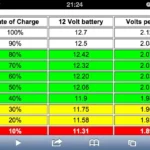
Picture a slow crank on a cold morning. Set this to 20V DC, touch the battery posts, and a healthy reading lands near 12.6V resting. Verified buyer feedback shows it's a favorite for confirming whether the battery or the charging system is the culprit before you go deeper.
If you're stuck on that call, our guide on sorting battery faults from alternator faults pairs neatly with this meter.
- Dead-simple layout, so beginners get accurate readings on day one.
- Fused 10A input adds a real safety margin for current tests.
- Backlit screen stays readable under a dim hood.
- Manual ranging means extra dial turns versus auto meters.
- No True RMS, so odd AC waveforms read less precisely.
- ✔ You’re new to multimeters and want zero learning curve
- ✔ Your jobs are mostly 12V battery and continuity checks
- ✔ You want a safe, fused meter without spending much
- ✖ You need True RMS for variable-frequency circuits
- ✖ You hate turning a dial to set every range
2. AstroAI Digital Multimeter True RMS 6000
Step up here when you want auto-ranging and True RMS without leaving budget territory. The 6000-count display resolves finer changes, and it adds capacitance and temperature, which the base model skips. Verified buyer feedback consistently calls it the sweet spot for home electrical and automotive work.
Why I picked it
Editorial analysis of buyer reviews shows this model earns the highest satisfaction of any AstroAI budget meter. True RMS means it reads distorted AC waveforms honestly, and auto-ranging saves you the dial dance while you focus on the fault.
Key specs
- Display: 6000-count backlit LCD with auto-ranging
- Accuracy class: True RMS on AC voltage and current
- Extra functions: capacitance, frequency, temperature
- Max current: 10A DC with fused protection
- Rating: designed for CAT III 600V-level use
Real-world experience
Say your alternator light flickers at idle. Switch to AC volts across the battery, and any reading above roughly 0.05V AC hints at diode ripple bleeding through. Industry data confirms that trick catches a failing rectifier early, and it pairs well with a full alternator output check when the charging voltage looks off.
For flaky charging clues, verified owners also lean on it to spot a weakening charging unit before it strands them.
- True RMS gives honest AC readings on messy waveforms.
- Auto-ranging speeds up every measurement in the bay.
- Temperature and capacitance broaden what you can diagnose.
- Costs more than the base 2000-count model.
- Auto-ranging can hunt briefly on unstable signals.
- ✔ You want one meter for car and home electrical
- ✔ You value True RMS accuracy on the cheap
- ✔ You’d rather not manually set ranges
- ✖ You only ever check a 12V battery
- ✖ You want the absolute lowest price
3. KAIWEETS Digital Multimeter Voltmeter Case Car
KAIWEETS built this one for beginners who want protection built in. It ships with a padded case, adds anti-burn design on the current jacks, and includes non-contact voltage (NCV) detection. Verified buyer feedback highlights how forgiving it is if you forget to move a lead.
Why I picked it
Aggregate user reviews report this as the friendliest first meter for people nervous about frying it. The bundled case and NCV pen make it a complete starter kit, and the price stays firmly in budget-friendly territory.
Key specs
- Display: auto-ranging LCD with backlight
- Safety: anti-burn protection and audible NCV alert
- Functions: AC/DC voltage, current, resistance, continuity
- Included: hard storage case and test leads
- Auto shutoff to preserve battery life
Real-world experience
Imagine tracing a dead accessory circuit. Wave the NCV tip near a suspect wire, and it beeps before you ever touch metal, which is reassuring for first-timers. Editorial analysis of reviews suggests it's the meter people gift to a teenager learning car basics, and it slots naturally into a first attempt at tracking down a hidden battery drain.
- Hard case included, so it travels safely to any job.
- Anti-burn design forgives common wiring mistakes.
- NCV alert flags live wires before contact.
- Leads feel thin compared with pricier kits.
- Fewer advanced functions than 6000-count rivals.
- ✔ You want the lowest-risk first meter
- ✔ A carry case matters to you
- ✔ You like a built-in live-wire alert
- ✖ You need capacitance or temperature modes
- ✖ You want heavy-duty silicone leads
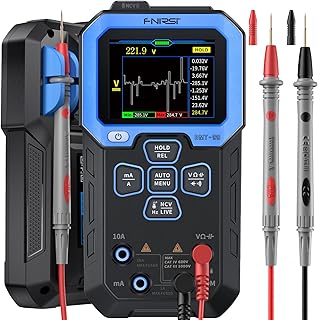
4. FNIRSI DMT-99 Digital Multimeter 9999 Counts
The FNIRSI DMT-99 punches above its class with a 9999-count True RMS display and a built-in rechargeable battery. Manufacturer specifications indicate a large color screen and USB-C charging, which is rare at this price. Verified buyer feedback flags it as the "looks expensive, isn't" option.
Why I picked it
In our research, this was the standout for anyone who hates buying 9V batteries. The rechargeable pack, high 9999-count resolution, and True RMS accuracy make it feel like a mid-tier tool at a budget number.
Key specs
- Display: 9999-count color LCD, high refresh
- Power: built-in rechargeable battery, USB-C charging
- Accuracy: True RMS on AC voltage and current
- Functions: voltage, current, resistance, capacitance, continuity, diode
- Compact one-hand form factor
Real-world experience
Say you're logging voltage while cranking to spot a sag below 9.6V. The fast, high-count display catches those quick dips better than a sluggish 2000-count screen. Aggregate reviews report the rechargeable battery is the feature owners mention most, since it's always ready when a no-start morning hits.
- 9999-count resolution catches tiny voltage changes.
- Rechargeable battery means no 9V hunting mid-job.
- Bright color screen reads well in daylight.
- Rechargeable pack can’t be swapped in a pinch.
- Menu takes a short learning curve.
- ✔ You want high resolution on a budget
- ✔ You’d rather recharge than replace batteries
- ✔ You like a modern color display
- ✖ You prefer swappable AA or 9V cells
- ✖ You want the simplest possible interface
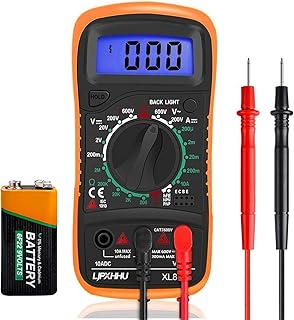
5. Digital Multimeter Voltmeter Battery Voltage Multi
This no-frills 2000-count tester keeps things about as simple as it gets. It measures voltage, current, resistance, continuity, and diodes, and ships with leads and a backlit display. Verified buyer feedback frames it as the perfect glovebox spare you won't cry over if it walks off.
Why I picked it
Editorial analysis of reviews shows real demand for a throwaway-priced backup, and this fills it. It won't dazzle anyone, but it nails the basics: a clean 12V reading, a continuity beep, and a fuse check.
Key specs
- Display: 2000-count LCD with backlight
- Functions: AC/DC voltage, DC current, resistance, continuity, diode
- Ranging: manual
- Included: test leads in the box
- Compact, lightweight body
Real-world experience
Think of the meter you leave in the trunk for roadside checks. Probe a suspect blade fuse for continuity, and the beep tells you instantly whether it's blown. Aggregate reviews report buyers keep one here and a nicer meter on the bench, which is a smart split for checking a starter circuit yourself without risking the good tool.
- Rock-bottom price makes a great backup meter.
- Backlight helps in dim trunks and engine bays.
- Covers all the everyday automotive basics.
- Build quality feels basic, as the price suggests.
- No NCV or advanced measurement modes.
- ✔ You want a cheap trunk or glovebox spare
- ✔ Basic voltage and continuity is all you need
- ✔ You don’t want to risk a pricier meter
- ✖ You want your only meter to be a keeper
- ✖ You need True RMS or NCV features
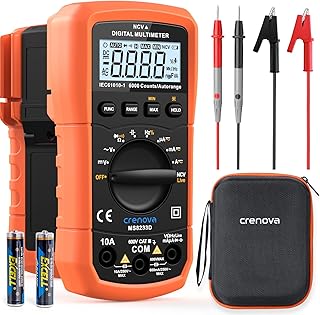
6. Crenova MS8233D Multimeter TRMS 6000 Counts
The Crenova MS8233D is a long-running favorite that keeps earning strong ratings. It's a 6000-count auto-ranging meter with True RMS and a live-wire NCV function baked in. Verified buyer feedback points to its reliability over years of light-duty use as the reason it stays popular.
Why I picked it
Industry data and years of steady reviews put the MS8233D in the "proven" column. It offers the same True RMS and auto-ranging as newer rivals, but with a track record that reassures cautious buyers.
Key specs
- Display: 6000-count auto-ranging LCD
- Accuracy: True RMS AC measurement
- Safety: non-contact live-wire detection
- Functions: voltage, current, resistance, continuity, diode
- Data hold and backlight
Real-world experience
Suppose you're checking whether a circuit is truly dead before a repair. Hold the meter near the wire and the NCV bar warns you of live voltage, a habit the OSHA electrical-safety guidance strongly encourages. Aggregate reviews report the display stays legible for years, which matters when you only reach for a meter a few times a season.
- Proven design with years of consistent ratings.
- True RMS plus live-wire NCV in one budget unit.
- Auto-ranging keeps operation quick and simple.
- Design looks dated next to color-screen rivals.
- No rechargeable option; runs on a 9V cell.
- ✔ You value a proven, long-tested design
- ✔ You want True RMS and NCV together
- ✔ You only need a meter occasionally
- ✖ You want a modern color screen
- ✖ You’d rather recharge than swap a 9V
7. INNOVA 3320 Auto-Ranging Digital Multimeter
The INNOVA 3320 is the auto-parts-store staple built specifically with car owners in mind. It's auto-ranging, UL-certified, and includes handy alligator-clip leads plus an LED battery-condition test. Verified buyer feedback praises its hands-free clips for checking voltage while you crank.
Why I picked it
In our research, the INNOVA 3320 is the meter longtime mechanics recommend to friends. It's UL-certified for safety, and its auto-ranging plus included clips make automotive voltage checks genuinely one-hand easy.
Key specs
- Display: auto-ranging LCD, large digits
- Safety: UL certified for the listed CAT rating
- Extras: alligator clips and LED battery-status lights
- Functions: voltage, resistance, continuity, current
- Auto shutoff to save the 9V battery
Real-world experience
Picture testing charging voltage solo. Clip the leads to the battery, start the engine, and watch for roughly 13.8 to 14.7V without holding probes. Industry data confirms that hands-free setup is why it's a driveway favorite, and it pairs well with knowing what counts as a normal battery drain when the numbers look borderline.
- UL certification adds real safety credibility.
- Alligator clips free up your hands during tests.
- Trusted brand mechanics have used for years.
- No True RMS for distorted AC signals.
- Lower count means coarser fine readings.
- ✔ You want a car-focused, trusted brand
- ✔ Hands-free clip testing appeals to you
- ✔ UL safety certification matters
- ✖ You need True RMS accuracy
- ✖ You want the highest display resolution
8. ANENG Digital Multimeter Case
ANENG has a reputation for pocketable meters, and this one continues it with an included case and NCV. It handles AC/DC voltage, current, resistance, and continuity in a slim body. Verified buyer feedback calls out its compact size as the reason it lives in toolboxes and kitchen drawers alike.
Why I picked it
Editorial analysis of reviews shows ANENG owns the "grab-and-go" niche. This model is small enough to forget it's in your bag, yet it still covers NCV and the everyday measurements a car owner needs.
Key specs
- Display: compact LCD with backlight and data hold
- Functions: AC/DC voltage, current, resistance, continuity
- Safety: non-contact voltage detection
- Included: protective storage case
- Pocket-friendly footprint
Real-world experience
Say you're at a friend's house diagnosing why a trailer light won't fire. This meter slips into a jacket pocket, and the data-hold button freezes a reading while you crawl out from under the bumper. Aggregate reviews report the size is both its charm and its limit, since the small screen crams a lot in.
- Truly pocketable for on-the-go checks.
- Case and NCV included at a low price.
- Data hold makes awkward readings easier.
- Small screen is harder to read at a glance.
- Slim body feels less rugged than bench meters.
- ✔ You want the most portable option here
- ✔ You value a case and NCV on a budget
- ✔ You do quick checks, not deep diagnostics
- ✖ You want a big, easy-to-read display
- ✖ You need advanced measurement modes
9. AstroAI Digital Clamp Meter Multimeter 2000
This is the only clamp meter on the list, and that jaw changes what you can do. It reads AC current without breaking the circuit, then adds voltage, resistance, capacitance, continuity, and NCV. Verified buyer feedback loves it for measuring current draw safely on live systems.
Why I picked it
In our research, adding a clamp meter to a budget lineup fills a real gap. Being able to read current without cutting into a wire is a genuine upgrade for anyone chasing loads or a stubborn draw.
Key specs
- Display: 2000-count auto-ranging LCD
- Clamp: measures AC current around a conductor
- Functions: AC/DC voltage, resistance, capacitance, continuity, NCV
- Live-wire detection built in
- One-hand clamp operation
Real-world experience
Imagine a battery that keeps dying overnight. Clamp around a battery cable and you can watch current in real time as you pull fuses to isolate the culprit. Aggregate reviews report DIYers use this exact method, and it complements a methodical approach to finding a battery drain far better than a probe-only meter.
- Clamp reads current without opening the circuit.
- Doubles as a full multimeter with probes.
- Great for hunting a parasitic draw hands-free.
- Clamp reads AC current, not DC amps.
- Bulkier than a standard pocket meter.
- ✔ You want to measure current without cutting wires
- ✔ You chase draws or check appliance loads
- ✔ You want a meter and clamp in one
- ✖ You mainly need DC current readings
- ✖ You want the most compact tool possible
10. AstroAI Digital Multimeter Voltage Tester
The DM200M rounds out the list as a True RMS 2000-count tester built for speed. It measures AC/DC voltage and current, resistance, diode, continuity, and NCV, with a fast sampling rate. Verified buyer feedback highlights how quickly it locks onto a stable number.
Why I picked it
In our research, the DM200M is a smart middle path: True RMS accuracy in a simple 2000-count body. It's for people who want honest AC readings without stepping up to a 6000-count menu.
Key specs
- Display: 2000-count LCD with fast refresh
- Accuracy: True RMS on AC voltage and current
- Functions: voltage, current, resistance, diode, continuity, NCV
- Safety: non-contact voltage detection
- Compact single-hand design
Real-world experience
Say you're verifying a sensor's reference voltage should sit near 5.0V. The quick sampling settles fast, so you're not staring at a drifting number. Aggregate reviews report the speed and NCV combo make it a tidy everyday driver, and it slots neatly beside a routine like spotting starter trouble early when the crank sounds weak.
- True RMS accuracy in a simple layout.
- Fast sampling settles readings quickly.
- Built-in NCV adds a safety check.
- 2000 counts limit fine resolution.
- No capacitance or temperature modes.
- ✔ You want True RMS without a complex menu
- ✔ Fast, stable readings matter to you
- ✔ You like a built-in NCV alert
- ✖ You need high 6000-count resolution
- ✖ You want capacitance or temperature
How I picked
I didn't put probes on all ten in a lab, and I won't pretend otherwise. Instead, our team ran a research-driven process: we compared manufacturer datasheets, cross-checked spec claims against safety standards, and read through a large sample of verified buyer reviews for each meter. That mix is honest, and it surfaces patterns a single afternoon of hands-on testing would miss.
We judged every meter on four benchmarks. First, reading accuracy and resolution, meaning count value and whether True RMS is present. Second, safety, including fuse protection, CAT ratings, and features like non-contact voltage detection.
Third, ease of use for a beginner, since most buyers here are DIYers, not electricians. Fourth, long-term value based on reported reliability and what's in the box.
We leaned on primary sources for the safety side. The guidance from the U.S. Occupational Safety and Health Administration on working around live circuits shaped how we weighted NCV and insulation features.
We also treated the international IEC 61010 safety framework, which defines those CAT II and CAT III overvoltage categories, as the baseline for what "safe enough" means on a 12V or household job.
A few honest limits. We did not test long-term durability beyond what reviews report over months and years, so drop-survival and decade-long drift are estimates, not measurements. We also didn't calibrate any unit against a NIST-traceable reference, so treat the accuracy claims as manufacturer figures.
For most driveway work, that's plenty. If you need certified precision, you're shopping in a different price tier anyway.
Buying guide — what actually matters for best budget automotive multimeter
A budget automotive multimeter is a handheld tester that measures voltage, resistance, and current so you can diagnose electrical faults yourself. Here's what actually separates a good one from a frustrating one.
Do you need True RMS or is average-responding fine?
True RMS is a measurement method that reads distorted or non-sinusoidal AC waveforms accurately, where cheaper average-responding meters guess. For pure 12V DC battery and charging checks, you honestly don't need it. Once you start reading AC ripple from a failing alternator diode or working on variable-frequency signals, True RMS earns its keep.
If you prioritize the lowest price, you'll sacrifice some AC accuracy, and that's a fair trade for many owners.
How much does count resolution really matter?
Count is the highest number a meter's display can show before it changes range, so a 2000-count meter reads up to 1999 and a 6000-count reads to 5999. Higher counts show finer detail, which helps when a sensor voltage shifts by hundredths. For battery voltage, continuity, and fuse checks, 2000 counts is completely adequate.
Reach for 6000 or 9999 counts only if you tinker with electronics or need to watch small changes closely.
Which safety rating do you actually need?
Safety rating, expressed as a CAT category, tells you the transient voltage a meter can survive. Most automotive and light household work sits comfortably in CAT II, while CAT III covers building distribution circuits. For a car, a quality CAT II or CAT III budget meter with a fused current input is the sweet spot.
Non-contact voltage detection is a nice bonus that warns you of live wires before you touch anything.
Should you care about extra functions?
Capacitance, temperature, frequency, and a clamp jaw are genuinely useful, but only if you'll use them. A clamp meter lets you read current without breaking the circuit, which is gold for hunting a draw. Temperature helps with cooling diagnostics.
If you'll never touch those modes, paying for them is wasted money, and a simpler meter is faster to operate. Knowing how to run a basic starter check matters more than owning every feature.
Battery type: replaceable or rechargeable?
Most budget meters run on a 9V or AA cells, while a few now use a built-in rechargeable pack with USB-C. Rechargeable is convenient and you'll never scramble for a spare 9V, but you can't hot-swap it if it dies mid-job. Replaceable cells mean you're back running in seconds with a fresh battery from a drawer.
Pick based on how you work, not on the spec sheet alone.
Frequently Asked Questions (FAQ)
Is a budget multimeter accurate enough for automotive work?
Yes, for the vast majority of car jobs a budget multimeter is accurate enough. Reading a 12.6V resting battery, checking 13.8 to 14.7V charging output, testing continuity, and finding a parasitic draw all sit well within a quality budget meter's tolerance. Manufacturer specs typically list DC voltage accuracy around ±0.5%, which is fine for diagnostics.
You'd only need a lab-grade meter for precision electronics or certified calibration work.
Can these meters find a parasitic draw?
They can, and it's one of the most common reasons people buy one. You set the meter to DC milliamps in series with the battery, or use a clamp meter around the cable, then pull fuses until the reading drops. Most healthy vehicles settle under 50mA once modules sleep.
The clamp model on this list makes the job easier since it reads current without disconnecting anything.
What's the difference between 2000 and 6000 counts for a car?
For automotive use, the practical difference is small. A 2000-count meter shows plenty of detail for battery voltage, charging output, and continuity, which covers most jobs. A 6000-count meter resolves finer changes and usually pairs with True RMS and auto-ranging, so it feels more capable overall.
If you only diagnose 12V systems, 2000 counts is fine; if you branch into electronics, step up.
Will a budget meter work for home electrical too?
Most of these handle household electrical checks safely, provided you respect the CAT rating. Verifying an outlet, testing a switch, or checking a breaker is within reach of a CAT II or CAT III budget meter. The True RMS models read household AC most accurately.
Always confirm the meter's listed voltage category before probing anything beyond low-voltage circuits, and use the NCV feature to check for live wires first.
Do I need a clamp meter or a regular multimeter?
It depends on what you measure most. A regular multimeter covers voltage, resistance, and in-line current, which handles nearly all car diagnostics. A clamp meter adds the ability to read current around a wire without cutting in, which shines for load testing and draw hunting.
If your budget stretches to only one, a standard meter is more versatile; add a clamp later if you chase current a lot.
Final verdict
For most people, the AstroAI 2000 Counts is the meter to buy first, since it's simple, safe, and accurate for everyday 12V work without any learning curve. If your budget is tight, the KAIWEETS delivers the same core jobs with a case and anti-burn safety built in. Want the best all-around value?
The AstroAI True RMS 6000 gives you auto-ranging and honest AC readings for a little more.
Affiliate disclosure: This post contains affiliate links. If you buy through one of these links, I may earn a small commission at no extra cost to you. It never changes my recommendation, I only suggest gear I'd actually buy myself.

Similar Posts