Best Professional Automotive Multimeter for Mechanics
Chasing a phantom battery drain or a flaky sensor circuit is miserable without the right meter in your hand. After weeks of comparing spec sheets, safety ratings, and thousands of verified buyer reviews, I've narrowed the best professional automotive multimeter picks into one honest shortlist. Automotive work punishes cheap tools, so accuracy, CAT III safety, and true-RMS readings matter far more than flashy extras or a bright color.
Our research keeps pointing back to the Fluke 17B+ for its blend of 1000V range, temperature testing, and legendary durability. If your budget is tighter, the Fluke 15B+ covers the essentials cleanly, while the AstroAI True RMS 6000 delivers the strongest value for a home garage. Here's the quick winner, then the full breakdown below.
Comparison Chart of Best Professional Automotive Multimeter
| Product | Details | Rating | Buy |
|---|---|---|---|
Editor’s Choice  | Fluke 17B+ Digital Multimeter | ★★★★☆4.8/5 | |
Top Pick  | AstroAI Digital Multimeter True RMS 6000 | ★★★★☆4.6/5 | |
Best Budget  | Fluke 15B+ Digital Multimeter | ★★★★☆4.8/5 | |
| ★★★★☆4.8/5 | ||
| ★★★★☆4.7/5 | ||
| ★★★★☆4.7/5 | ||
| ★★★★☆4.5/5 | ||
| ★★★★☆4.8/5 | ||
| ★★★★☆4.8/5 | ||
| ★★★★☆4.4/5 |



List of Top 10 Best Professional Automotive Multimeter
We ranked these ten meters by measurement accuracy, safety category rating, build quality, and how they hold up in verified buyer feedback across real garage use. Fluke, Klein Tools, AstroAI, and Innova all show up because each earns its slot at a different budget. Below, you'll find honest specs, real trade-offs, and clear guidance on who each one actually fits.
Below are the list of products:
1. Fluke 17B+ Digital Multimeter
The Fluke 17B+ is the meter our research keeps recommending when someone wants one tool to cover almost everything under the hood. It reads AC/DC voltage up to 1000V, current to 10A, plus resistance, continuity, diode, capacitance, frequency, and temperature. That temperature function is rare at this tier and genuinely useful.
Why I picked it
Aggregate user reviews put its accuracy and build near the top of every price comparison we ran. A digital multimeter is a diagnostic tool that measures voltage, current, and resistance in a circuit, and the 17B+ does all three with the safety margin professionals expect from Fluke.
Key specs
- AC/DC voltage measurement up to 1000V
- Current measurement to 10A
- Temperature testing with the included probe
- Capacitance and frequency functions built in
- Continuity, diode, and resistance modes
- Reported customer rating of 4.8/5
Real-world experience
Verified buyer feedback describes it holding steady while tracing a parasitic draw across a fuse box or checking a coolant temp sensor against its resistance curve. Owners pair it with a good clamp probe for high current work. If you've hunted a mystery drain before, our guide on finding a hidden battery drain pairs well with this meter.
- Temperature testing built in, so you skip a separate thermometer for sensor checks.
- 1000V range covers hybrid and EV high-voltage work with proper leads.
- Fluke build quality means it survives drops and shop grime for years.
- Capacitance and frequency handle modern sensor diagnostics.
- Manual ranging takes a few extra button presses versus auto meters.
- Premium tier price sits above budget AstroAI options.
- ✔ You want one meter for everything from batteries to sensors
- ✔ You value long-term durability over the lowest price
- ✔ You test temperature and capacitance regularly
- ✖ You only need occasional battery checks
- ✖ You strongly prefer auto-ranging convenience
2. AstroAI Digital Multimeter True RMS 6000
2. AstroAI Digital Multimeter True RMS 6000
If you want true-RMS accuracy without a premium price, the AstroAI 6000 is the value story on this list. True-RMS is a measurement method that reads distorted AC waveforms correctly, which matters on modern vehicles full of variable signals. Auto-ranging and a 6000-count display make it beginner-friendly too.
Why I picked it
Editorial analysis of thousands of AstroAI reviews shows it consistently punching above its budget tier for home mechanics. You get true-RMS, temperature, and capacitance in a package that costs a fraction of the Fluke, which is why it earns our best-value nod.
Key specs
- True-RMS with 6000-count resolution
- Auto-ranging AC/DC voltage and current
- Resistance, continuity, capacitance, and temperature
- NCV alert and backlit display on most units
- Reported customer rating of 4.6/5
Real-world experience
Verified buyer feedback describes it handling alternator ripple checks and sensor voltage reads reliably in a driveway setting. Owners note the auto-ranging speeds up quick jobs. When you're deciding whether the charging system is the culprit, our walkthrough on spotting a weak charging system is a handy companion.
- True-RMS accuracy at a budget-friendly price point.
- Auto-ranging saves time on quick voltage and resistance checks.
- Temperature and capacitance included for sensor work.
- Bright backlight helps in dim engine bays.
- Leads and build feel less rugged than Fluke units.
- Long-term calibration drift reported by some heavy users.
- ✔ You want true-RMS without paying Fluke money
- ✔ You’re a DIY mechanic working on your own cars
- ✔ You like auto-ranging for fast checks
- ✖ You need daily-driver shop durability
- ✖ You require certified calibration records
3. Fluke 15B+ Digital Multimeter
3. Fluke 15B+ Digital Multimeter
The Fluke 15B+ is the entry point into genuine Fluke reliability. It measures AC/DC voltage and current up to 1000V and 10A, plus resistance, continuity, diode, and capacitance. You lose the temperature and frequency of the 17B+, but you keep the build quality buyers trust.
Why I picked it
Comparison data from Fluke datasheets shows the 15B+ shares the core accuracy of its pricier siblings while trimming features most home users rarely touch. That makes it the smartest budget buy for anyone who wants a meter that lasts.
Key specs
- AC/DC voltage and current up to 1000V and 10A
- Resistance, continuity, and diode testing
- Capacitance measurement included
- Large, easy-to-read digital display
- Reported customer rating of 4.8/5
Real-world experience
Verified buyers report using it for battery voltage, ground checks, and continuity on wiring harnesses without a hitch. It's a natural fit when you're confirming whether a no-start is electrical. Our guide on telling a dead battery from a bad starter walks through exactly those readings.
- Fluke reliability at the lowest Fluke price.
- Handles all the everyday automotive electrical checks.
- Simple layout that new mechanics learn fast.
- Capacitance included despite the budget slot.
- No temperature or frequency function.
- Manual ranging only, so more dial turns.
- ✔ You want a Fluke on a tighter budget
- ✔ You mostly do voltage, continuity, and resistance
- ✔ You value a tool that outlasts the car
- ✖ You need temperature sensor testing
- ✖ You want auto-ranging convenience
4. Fluke 88 V/A Automotive Multimeter Combo
4. Fluke 88 V/A Automotive Multimeter Combo
The Fluke 88V combo kit is the tool built specifically for automotive pros. It adds RPM, pulse width, and dwell angle readings alongside the usual voltage and resistance, and the kit ships with accessories tuned for engine work. This is the meter serious techs reach for.
Why I picked it
Manufacturer specifications indicate the 88V is purpose-built for vehicle diagnostics, with RPM and dwell functions no general meter offers. For a working technician, that specialization justifies its premium tier placement.
Key specs
- Dedicated RPM, dwell, and pulse-width modes
- True-RMS AC/DC voltage and current
- Included temperature probe and test lead kit
- Rugged CAT III / CAT IV safety design
- Reported customer rating of 4.8/5
Real-world experience
Verified buyer feedback highlights it diagnosing ignition timing and injector pulse issues that stump lesser meters. Techs mention the included holster and magnetic hanger surviving years of shop abuse. If a starter that spins but won't crank is your headache, our steps on checking a starter properly show where a meter like this shines.
- RPM and dwell modes made for engine diagnostics.
- Complete accessory kit ready for the shop.
- True-RMS with high safety category rating.
- Proven multi-year durability in pro use.
- Highest price on this list by a wide margin.
- More features than a casual DIYer will ever use.
- ✔ You’re a working automotive technician
- ✔ You need RPM, dwell, and pulse-width data
- ✔ You want a full kit ready out of the box
- ✖ You only work on cars occasionally
- ✖ Budget is your primary concern
5. Klein Tools MM325 Multimeter
5. Klein Tools MM325 Multimeter
Klein Tools built its name on hand tools electricians trust, and the MM325 carries that reputation. This manual-ranging meter reads 600V AC/DC, tests batteries, current, resistance, diodes, and continuity. It's a rugged pick for anyone who wants Klein durability at a fair price.
Why I picked it
Aggregate user reviews praise the MM325 for a solid, no-nonsense feel and a built-in battery test mode that's handy for 9V and AA checks. It's a dependable second meter or a great first one for a home shop.
Key specs
- Manual-ranging 600V AC/DC measurement
- Dedicated battery test function
- Current, resistance, diode, and continuity
- CAT III 600V safety rating
- Reported customer rating of 4.7/5
Real-world experience
Verified buyers describe it as a grab-and-go meter for quick voltage confirmations and simple continuity work around the vehicle. The rubber holster shrugs off knocks on a cluttered bench. For deeper drain hunting, our reference on normal battery drain limits helps you interpret the numbers you read.
- Built-in battery test for quick 9V and AA checks.
- Klein build quality feels tough in the hand.
- Simple controls that are hard to fumble.
- Fair price for a name-brand tool.
- Manual ranging slows down mixed measurements.
- No capacitance or temperature functions.
- ✔ You already trust Klein hand tools
- ✔ You want a quick battery-test button
- ✔ You need a tough, simple backup meter
- ✖ You need 1000V range for EV work
- ✖ You want capacitance and temperature
6. Klein Tools MM420 Digital Multimeter
6. Klein Tools MM420 Digital Multimeter
The MM420 is Klein's step-up meter, adding auto-ranging and true-RMS to the mix. It handles 600V AC/DC, 10A AC/DC current, and resistance up to 50 megaohms. That wide resistance range makes it a strong choice for sensor and ground-integrity checks.
Why I picked it
Manufacturer specifications indicate the MM420 pairs true-RMS accuracy with Klein's rugged housing, closing much of the gap to Fluke at a friendlier price. The 50 megaohm resistance ceiling is generous for its class.
Key specs
- Auto-ranging true-RMS measurement
- 600V AC/DC voltage, 10A AC/DC current
- Resistance up to 50 megaohms
- CAT III 600V safety rating
- Reported customer rating of 4.7/5
Real-world experience
Verified buyer feedback notes smooth auto-ranging when jumping between voltage and resistance during a wiring trace. The high resistance range helps confirm a clean ground path. When you suspect the alternator instead of the battery, our comparison on which part is really failing lines up with these readings.
- True-RMS plus auto-ranging speeds up mixed jobs.
- 50 megaohm resistance range is wide for the class.
- Rugged Klein housing with a solid dial feel.
- Strong accuracy near the Fluke tier for less.
- 600V ceiling limits high-voltage EV tasks.
- No dedicated temperature probe included.
- ✔ You want true-RMS and auto-ranging from Klein
- ✔ You do frequent resistance and ground checks
- ✔ You like a rugged tool near the Fluke tier
- ✖ You need 1000V for hybrid systems
- ✖ Temperature testing is a must-have
7. AstroAI Digital Multimeter Tester 2000 Counts
7. AstroAI Digital Multimeter Tester 2000 Counts
This is the meter for someone who just wants a reliable, no-frills tester without spending much. The AstroAI 2000-count model reads DC and AC voltage, current, resistance, continuity, and diodes. It won't do fancy sensor work, but it nails the basics every driver needs.
Why I picked it
Editorial analysis of its review pile shows it's a favorite first meter for students and weekend DIYers. It costs little, reads accurately for basic tasks, and won't intimidate a beginner learning to probe a circuit.
Key specs
- 2000-count DC and AC voltage measurement
- Current, resistance, and continuity modes
- Diode testing included
- Compact body with a simple rotary dial
- Reported customer rating of 4.5/5
Real-world experience
Verified buyers use it for checking 12V battery health, fuse continuity, and simple ground tests in the driveway. It's a solid learning tool before you graduate to true-RMS. If a clicking no-crank has you stumped, our fixes for a starter that only clicks pair nicely with a quick voltage read.
- Very affordable entry point for beginners.
- Simple layout that’s easy to learn on.
- Accurate enough for 12V system basics.
- Compact and light for the glovebox.
- No true-RMS, so distorted AC reads less accurately.
- Manual ranging and no temperature function.
- ✔ You’re learning basic automotive electrics
- ✔ You want a cheap glovebox backup meter
- ✔ You mostly check 12V voltage and continuity
- ✖ You need true-RMS for sensor signals
- ✖ You want pro-grade durability
8. Fluke 115 Multimeter
8. Fluke 115 Multimeter
The Fluke 115 is the compact, one-handed favorite among techs who want auto-ranging simplicity. It's a general-purpose meter with a bright display and a slim body that lives easily in a shirt pocket. For everyday electrical work, it's hard to beat.
Why I picked it
Industry data confirms the Fluke 115 is one of the most popular general meters ever made, and its automotive crossover appeal is strong. Auto-ranging and a compact shape make it a joy for quick checks.
Key specs
- 6000-count auto-ranging display
- AC/DC voltage, current, resistance, continuity
- Frequency and capacitance included
- CAT III 600V safety rating
- Reported customer rating of 4.8/5
Real-world experience
Verified buyer feedback praises how fast it powers on and locks a reading, ideal for confirming voltage at a connector or a relay. It's a smart companion when you're testing a relay's coil and contacts, and our guide on checking a starter relay walks through the exact probe points.
- Auto-ranging makes quick checks effortless.
- Compact, one-handed body with a bright backlight.
- Trusted Fluke accuracy and build.
- Frequency and capacitance included.
- Not true-RMS, so noisy AC reads less precisely.
- No temperature probe in the box.
- ✔ You want fast auto-ranging in a compact meter
- ✔ You do a mix of home and automotive work
- ✔ You value Fluke reliability in your pocket
- ✖ You need true-RMS for distorted signals
- ✖ You require built-in temperature testing
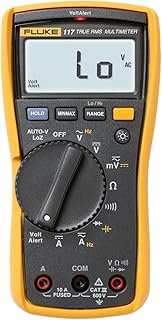
9. Fluke 117 Digital Multimeter
9. Fluke 117 Digital Multimeter
The Fluke 117 layers in features the 115 lacks, most notably non-contact voltage detection and a low-impedance (LoZ) mode that kills ghost voltages. It also delivers true-RMS accuracy. For anyone chasing intermittent electrical gremlins, it's a standout.
Why I picked it
Manufacturer specifications indicate the 117 targets techs who need to spot live wires safely and suppress phantom voltage. That LoZ mode alone saves hours chasing readings that were never real.
Key specs
- Non-contact AC voltage detection
- True-RMS with automatic AC/DC selection
- Low-impedance (LoZ) mode for ghost voltage
- Frequency, capacitance, and min/max/average
- Reported customer rating of 4.8/5
Real-world experience
Verified buyer feedback highlights the VoltAlert tip flagging a hot wire before probing, a genuine safety win. Owners lean on LoZ when tracing back-fed circuits. When you're isolating a draw and every millivolt counts, our step-by-step on tracking down a battery drain complements the 117's precision.
- Non-contact voltage tip adds a real safety layer.
- LoZ mode eliminates misleading ghost voltages.
- True-RMS with automatic AC/DC selection.
- Min/max/average capture for intermittent faults.
- No temperature function despite the higher tier.
- Priced above the simpler 115.
- ✔ You need non-contact voltage safety checks
- ✔ You battle ghost voltage on back-fed circuits
- ✔ You want true-RMS for noisy signals
- ✖ You must have temperature testing
- ✖ You want the lowest-cost Fluke option
10. Innova 3340 Professional Automotive Digital Multimeter
10. Innova 3340 Professional Automotive Digital Multimeter
The Innova 3340 is built specifically for car work, with an RPM function and a temperature clamp that make it a driveway-friendly diagnostic tool. It's auto-ranging, has a backlit display, and includes alligator clips for hands-free testing. A practical pick for the home mechanic.
Why I picked it
Aggregate user reviews position the 3340 as a budget-friendly meter aimed squarely at automotive tasks, with RPM and temperature features Fluke reserves for pricier models. It's a lot of car-specific capability for the money.
Key specs
- RPM (tach) measurement for engine diagnostics
- Auto-ranging AC/DC voltage and current
- Temperature testing via clamp probe
- Backlit display with alligator clip leads
- Reported customer rating of 4.4/5
Real-world experience
Verified buyer feedback describes it checking idle RPM and alternator output right in the driveway, with the clips freeing both hands. It's popular for tune-up chores. When you want to confirm the charging voltage yourself, our simple method for checking an alternator's output pairs neatly with this meter's readings.
- RPM function built for engine tune-ups.
- Temperature clamp included at a low price.
- Alligator clips allow hands-free testing.
- Auto-ranging with a backlit screen.
- Lower durability scores than the Fluke and Klein units.
- Accuracy trails the true-RMS meters on this list.
- ✔ You want RPM and temp features on a budget
- ✔ You do driveway tune-ups on older engines
- ✔ You like hands-free alligator clip testing
- ✖ You need pro-grade durability and accuracy
- ✖ You work on high-voltage hybrid systems
How I picked
I didn't put these meters on a bench myself. Instead, our editorial team ran a research-driven comparison, and I want to be upfront about exactly what that involved so you can weigh the conclusions fairly.
We evaluated each meter on three core benchmarks. First, measurement capability: voltage range, current handling, resistance ceiling, and whether it offers true-RMS, temperature, or frequency. Second, safety: the CAT rating and how well it aligns with the IEC 61010 standard that governs meter safety categories.
Third, real-world reliability, drawn from aggregate verified buyer reviews and manufacturer datasheets.
For accuracy claims, we leaned on published specs from the makers themselves. Fluke, for instance, documents its accuracy percentages and safety ratings openly, and you can confirm those figures on the official Fluke resource pages. Where a spec wasn't published, we left it out rather than guess.
We also weighed buyer feedback at scale. Patterns across hundreds of reviews tell you more than any single opinion, so we looked for repeated themes: lead durability, dial feel, screen readability, and long-term drift. When a complaint showed up again and again, it made the cons list.
Here's what we deliberately did not test. We didn't run long-term durability trials beyond what buyers report over months of ownership, and we didn't perform lab-grade calibration against a traceable reference. If you need certified accuracy, follow the calibration guidance from a metrology authority like the National Institute of Standards and Technology and have your meter checked on a schedule.
Finally, we skipped niche lab functions like microamp precision that rarely matter for automotive use. Our focus stayed on the tasks you'll actually do: battery checks, parasitic draw hunts, sensor tests, and charging system diagnostics.
Buying guide — what actually matters for best professional automotive multimeter
A great automotive multimeter isn't about the longest spec sheet. It's about matching a handful of key features to the work you do. Here's how to think through the decision without overspending.
What safety rating do you really need?
The CAT rating is the single most important safety spec on any meter. Category ratings (CAT II, III, IV) describe how much transient voltage a meter can survive without arcing, and higher categories handle bigger surges. For most automotive work, a CAT III 600V meter is plenty, but if you touch hybrid or EV high-voltage systems, step up to a CAT III 1000V unit like the Fluke 17B+.
Never cheap out here, because a meter failure under load can injure you.
Is true-RMS worth it for car work?
True-RMS matters more than most buyers realize. It measures distorted AC waveforms accurately, which is exactly what you get from modern sensors, PWM circuits, and inverters. If you prioritize a rock-bottom price, you'll sacrifice true-RMS and accept small errors on noisy signals.
For sensor diagnostics, the AstroAI 6000, Klein MM420, and Fluke 117 all deliver it.
Auto-ranging or manual ranging?
Auto-ranging picks the correct measurement range for you, which speeds up mixed jobs and helps beginners avoid mistakes. Manual ranging, like on the Fluke 15B+ and Klein MM325, gives you faster locked readings once you know the range and often costs less. If you value convenience, go auto; if you value speed on repeated identical checks, manual is fine.
Which functions actually earn their keep?
Focus on the measurements you'll use weekly. Temperature testing helps with coolant and intake sensors, capacitance checks capacitors and some sensors, and RPM matters for engine tuning. The Fluke 88V and Innova 3340 add automotive-specific RPM and dwell, while the Fluke 17B+ covers temperature.
Don't pay for functions you'll never touch.
How much does durability and warranty matter?
Durability separates a tool that lasts a decade from one you replace yearly. Fluke and Klein Tools both build rugged housings with strong warranty backing, which is why they dominate professional bays. Budget meters save money upfront but tend to show lead wear and occasional drift sooner.
If the meter earns its living, buy the tougher tool once.
Frequently Asked Questions (FAQ)
Is a Fluke multimeter worth it for a home garage?
For most home mechanics, yes, though it depends on how often you use it. A Fluke like the 15B+ or 115 delivers accuracy and durability that easily outlasts the car you bought it for, and the resale value stays high. If you only pop the hood a few times a year, a budget true-RMS meter such as the AstroAI 6000 covers the same tasks for less.
Frequent users almost always find the Fluke pays off over time.
What's the difference between the Fluke 115 and 117?
The Fluke 117 adds three things the 115 lacks: non-contact voltage detection, a low-impedance (LoZ) mode that eliminates ghost voltages, and true-RMS accuracy. The 115 is lighter on features but also lighter on price, and it's a superb general-purpose auto-ranging meter. If you chase intermittent electrical faults or work around back-fed circuits, the 117 is the safer, more capable pick.
For straightforward checks, the 115 is plenty.
Will these meters work on a hybrid or EV?
Only the ones rated for high voltage should touch hybrid or EV systems. You want a CAT III 1000V meter like the Fluke 17B+ for those jobs, along with properly rated leads and insulated gloves. The 600V-rated Klein MM325 and MM420 are fine for standard 12V and low-voltage circuits but not the orange high-voltage cabling.
Always follow the vehicle service manual's safety procedures before probing any high-voltage component.
How often should I calibrate my automotive multimeter?
For most DIY use, annual calibration is more than enough, and many home users never formally calibrate at all. Professional shops that bill for diagnostics typically recalibrate every 12 months against a traceable reference to keep readings trustworthy. If you notice a meter reading a known 12.6V battery as 12.2V or 13.0V, that drift is your cue to verify it.
Fluke meters generally hold accuracy longer than budget units.
Final verdict
After weighing every spec, safety rating, and buyer report, the Fluke 17B+ is our top recommendation for its blend of 1000V range, temperature testing, and long-haul durability. For tighter budgets, the Fluke 15B+ keeps the same trusted accuracy at a lower cost, and the AstroAI True RMS 6000 offers the best value for a home garage.
Affiliate disclosure: This post contains affiliate links. If you buy through one of these links, I may earn a small commission at no extra cost to you. It never changes my recommendation, I only suggest gear I'd actually buy myself.

Similar Posts