What Does the W in 5W-30 Really Stand For?
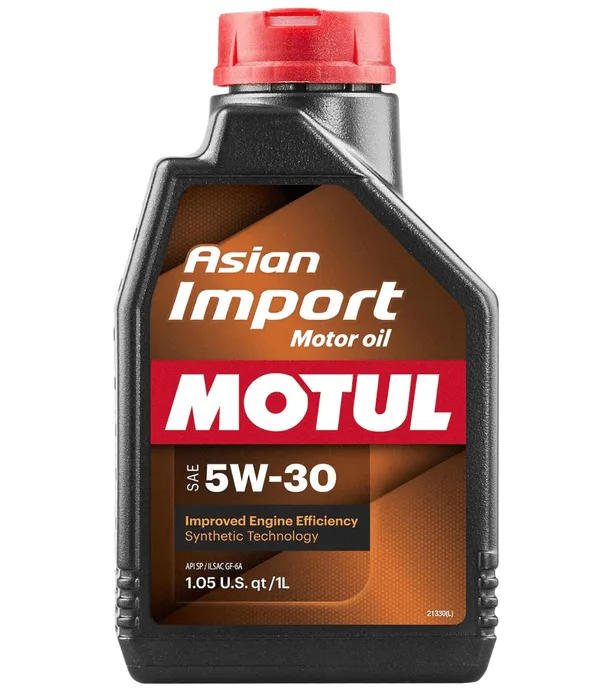
If you've ever stared at a bottle of engine oil and wondered what does the W in 5W-30 stand for, the short answer is Winter. It's not weight, it's not a random letter, and it has nothing to do with the brand. The "W" is a rating that tells you how the oil behaves when your engine is cold, not when it's hot.
That distinction matters more than most drivers realise. As of 2026, every multi-grade motor oil sold in North America and Europe follows the SAE J300 viscosity classification standard set by SAE International, which is the exact rulebook that defines what "5W" is allowed to mean. Get the W-grade wrong for your climate and you're risking real cold-start engine wear, so let's break down what that single letter is actually measuring.
Quick Answer
The "W" in 5W-30 stands for Winter. It's a cold-weather viscosity rating defined by SAE J300. The number before the W (the "5") shows how easily the oil flows at low temperatures.
Lower numbers flow better in the cold. The "30" after the dash is a separate rating for how the oil behaves at normal engine operating temperature (around 100°C).
What the "W" in 5W-30 Actually Stands For
The W is short for Winter. That's it. There's no hidden second meaning, no reference to "weight," and no manufacturer code buried in it.
SAE International introduced the W designation to give drivers one clear signal about cold-temperature performance. Before multi-grade oils became standard, people literally swapped to a thinner oil in winter and a thicker one in summer. The W rating solved that mess by letting a single oil cover both jobs.
So when you read "5W-30," you're really reading two viscosity grades in one bottle. The first tells you how it flows when the engine is cold. The second tells you how it flows once the engine is fully warmed up.
If you want a fuller walkthrough of engine fluids in practice, our beginner-friendly oil change walkthrough covers what to look for on the label.
Why This One Letter Matters More Than Most Drivers Realise
Most engine wear happens in the first few seconds after a cold start. Manufacturer research and SAE technical papers have said this for decades. When your engine sits overnight, oil drains off the internal parts and pools in the sump.
On startup, the pump has to move that cold oil back to the top end before anything gets properly lubricated. That's the window where the W rating earns its keep. A lower W number keeps the oil fluid enough at low temperatures to reach the valvetrain and bearings faster.
Here's the practical takeaway:
- A 0W oil pumps faster than a 5W at very low temperatures.
- A 5W pumps faster than a 10W.
- The number after the W (the "30") has almost no effect on cold-start behaviour.
Pick the wrong W-grade for a genuinely cold climate and you're stacking the deck against your engine every morning.
How SAE J300 Defines the "W" Grade
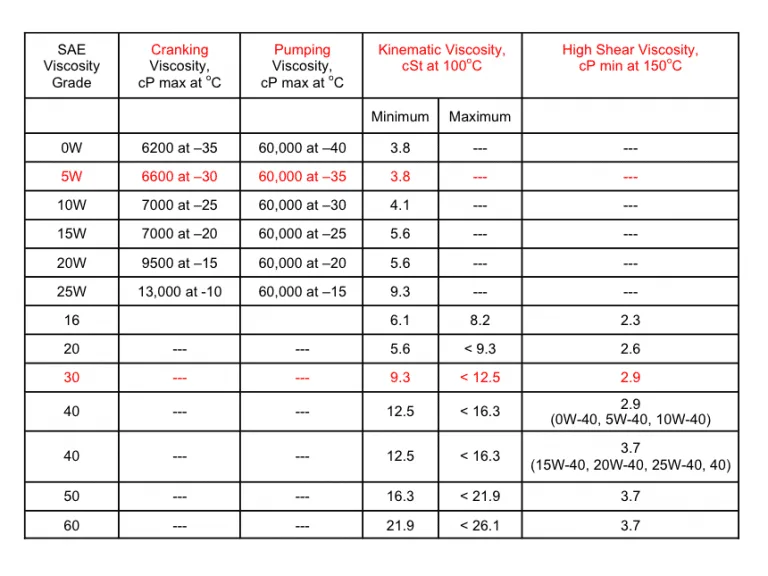
SAE J300 is the official viscosity classification standard for engine oils published by SAE International. It sets hard limits on how thick or thin an oil is allowed to be at specific temperatures. To wear a "5W" label, an oil has to pass two separate low-temperature tests.
Cold Cranking Viscosity (CCS Test)
The Cold Cranking Simulator test (ASTM D5293) measures how much resistance the oil offers to the starter motor when the engine is very cold. For a 5W-rated oil, the maximum allowed cranking viscosity is 6,600 centipoise (cP) at -30°C.
In plain language, the oil has to stay thin enough at -30°C for your starter to actually crank the engine. If it fails this test, it can't legally be sold as a 5W.
Low-Temperature Pumping Viscosity (MRV Test)
The Mini-Rotary Viscometer test (ASTM D4684) simulates whether the oil pump can move the oil once the engine starts. For a 5W rating, the oil must stay under 60,000 cP at -35°C without forming a yield stress (a gel-like structure that blocks flow).
Fail this test and you get the worst-case scenario. The engine cranks, but no oil reaches the top of the engine for several seconds. That's the setup for catastrophic wear.
Here's a quick reference of the SAE J300 low-temperature limits for the most common W-grades:
| W-Grade | Max CCS Viscosity | Max MRV Viscosity |
|---|---|---|
| 0W | 6,200 cP at -35°C | 60,000 cP at -40°C |
| 5W | 6,600 cP at -30°C | 60,000 cP at -35°C |
| 10W | 7,000 cP at -25°C | 60,000 cP at -30°C |
| 15W | 7,000 cP at -20°C | 60,000 cP at -25°C |
| 20W | 9,500 cP at -15°C | 60,000 cP at -20°C |
You can review the current SAE viscosity classification directly through SAE International, which publishes and updates the J300 standard.
Breaking Down the Full 5W-30 Label
Multi-grade oil labels look cryptic until you know they're just two ratings stapled together with a dash. Once you break it apart, it makes sense fast.
What the "5" Before the W Means
The 5 is the winter viscosity number. It tells you how the oil performs in the cold. Lower is thinner at low temperatures, which is what you want for reliable cold starts.
A "5W" oil will pump reliably down to roughly -35°C, based on the SAE J300 pumping limit. That covers almost every winter in the continental US, most of Europe, and a good chunk of Canada.
What the "30" After the Dash Means
The 30 is the high-temperature viscosity grade. It measures how thick the oil is at 100°C, close to normal engine operating temperature. Per SAE J300, a grade-30 oil must fall between 9.3 and 12.5 centistokes (cSt) of kinematic viscosity at 100°C.
There's also a related spec called High-Temperature High-Shear (HTHS) viscosity, measured at 150°C. For a 30-grade oil, the HTHS minimum is 2.9 cP. That number matters for engine protection under load, like towing or hard highway driving.
Put simply:
- The 5W protects you at startup.
- The 30 protects you at cruising temperature.
You get both jobs handled by one oil, which is the whole point of a multi-grade formulation.
The Science of Cold-Start Engine Wear

Cold-start wear isn't a marketing scare tactic. Multiple SAE technical studies and OEM durability data show that a large share of an engine's total lifetime wear happens in the first 10 to 20 seconds after a cold start. That's why the W-grade exists in the first place.
Here's what actually happens mechanically:
- The engine sits overnight and oil drains down into the sump.
- The upper engine parts (cam lobes, rocker arms, valve stems) are running on a thin residual film.
- You crank the engine and it fires within a second or two.
- The oil pump then has to move cold, viscous oil up to the top end.
- Until pressure builds, moving metal parts wear against each other with minimal lubrication.
The colder the ambient temperature, the thicker the oil, and the longer that unlubricated window lasts. An oil that flows quickly at low temperatures shortens the risky window and gets a protective film in place faster.
This is also why modern owner's manuals lean toward lower W-grades over time. Tighter engine tolerances, direct injection, and turbocharging all raise the stakes on fast oil delivery at startup. If you're checking a used car and want to confirm the seller used the right viscosity, our pre-purchase inspection checklist covers where to look in the service history.
How the "W" Number Changes Cold-Weather Performance
The W number is essentially a thermometer for how cold your oil can get before it stops flowing properly. Every step down (from 10W to 5W to 0W) buys you roughly 5°C of extra cold-flow headroom.
That headroom translates directly into how quickly the oil pump can push lubricant through the engine on a frosty morning. A 0W oil can hit full oil pressure a second or two faster than a 10W in sub-zero conditions. That's a big deal for parts that were running dry all night.
Real-world impact by W-grade:
- 0W: Reliable pumping down to about -40°C.
- 5W: Reliable pumping down to about -35°C.
- 10W: Reliable pumping down to about -30°C.
- 15W and 20W: Suited to mild and warm climates only.
The high-temperature number (the "30" in 5W-30) doesn't change any of this. Two oils with different W ratings can protect identically at 100°C while behaving very differently at 5 a.m. in January.
0W vs 5W vs 10W: How Winter Grades Compare
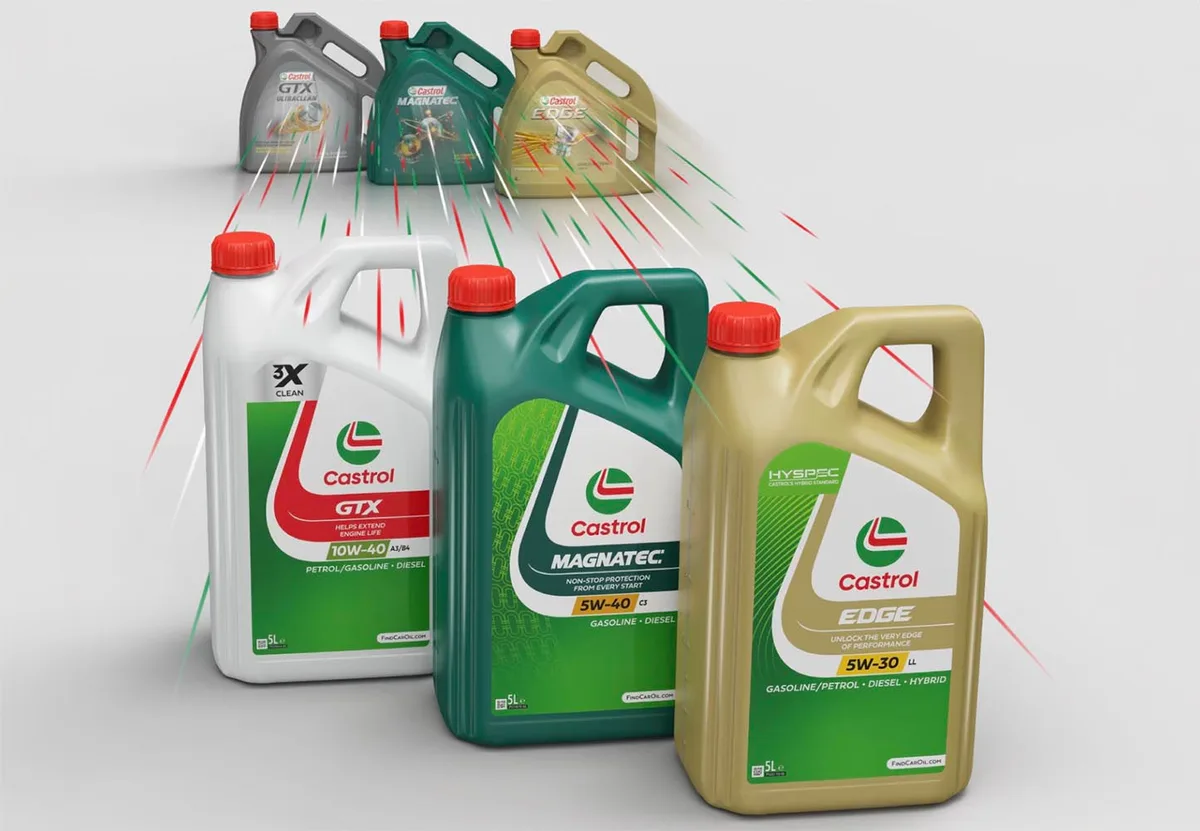
All three grades can carry the same "-30" suffix and still behave very differently in the cold. The choice comes down to your climate and what your manufacturer specifies.
| Grade | Best For | Cold-Start Limit | Trade-Off |
|---|---|---|---|
| 0W-30 | Very cold winters (Canada, northern US, Scandinavia) | Down to about -40°C | Usually full synthetic, higher cost per quart |
| 5W-30 | Moderate to cold winters (most of the US, UK, Europe) | Down to about -35°C | Best all-round balance for modern engines |
| 10W-30 | Warm to mild climates, older engines | Down to about -25°C | Slower cold-start protection in freezing weather |
Who each one is best for:
- 0W-30 suits anyone who parks outdoors in genuinely cold winters. It also helps modern direct-injection engines that need fast oil delivery.
- 5W-30 is the default for most passenger cars sold in North America and Europe. It handles winter and summer without drama.
- 10W-30 makes sense in warmer states or on older engines built before tighter cold-start specs became standard.
If your owner's manual lists more than one grade, pick the lower W-number for winter service.
Matching the W Rating to Your Climate
Your lowest expected overnight temperature is the number that matters. Not the daytime average, not the annual mean. The coldest morning your engine has to survive.
Here's a simple climate-based rule of thumb, following manufacturer viscosity charts commonly used by GM, Ford, and Toyota:
- Overnight lows above 0°C most of the year: 10W-30 or 5W-30 is fine.
- Overnight lows down to -20°C: 5W-30 is the safe default.
- Overnight lows below -25°C: switch to 0W-30 or 0W-20 (if approved).
- Extreme cold (Alaska, northern Canada, Siberia): 0W grades only.
If you split your year between very different climates, follow the coldest one. There's no penalty for running a 0W oil in summer, provided the second number matches your manufacturer's spec. The synthetic base oils used in modern 0W formulations easily handle summer heat.
One more practical note. Block heaters and garaged parking effectively raise your "starting temperature," so a garage-kept car in a cold zone can sometimes get away with a higher W-grade than a driveway-parked car nearby.
Common Myths About the "W" in Motor Oil
The W has picked up a lot of folklore over the decades. Most of it is wrong, and some of it costs people money or engine life.
Myth 1: The W stands for weight. It doesn't. It stands for Winter.
"Weight" is casual slang that stuck because oil used to be sold as a single "weight" (like SAE 30 or SAE 40) before multi-grades existed.
Myth 2: 5W-30 is two different oils mixed together. Also no. It's one oil with a viscosity profile that meets both a 5W cold rating and a 30 hot rating.
Myth 3: A higher W number gives more protection. The opposite is usually true in cold weather. A higher W means thicker oil at low temperatures, which slows down oil delivery on startup.
Myth 4: Once the engine is warm, the W stops mattering. Correct, but the engine doesn't stay warm forever. Every cold start puts the W rating back to work.
Myth 5: Switching from 5W-30 to 10W-30 will "seal" a leak. It might mask a slow drip briefly, but it also slows cold-start oil delivery and can void your warranty if the oil is off-spec.
Mistakes Drivers Make When Choosing a W-Grade
Even careful owners get tripped up here. These are the errors that show up most often in service-bay conversations and warranty disputes.
- Ignoring the owner's manual and going by feel. Modern engines are engineered around a specific viscosity window. Guessing costs you protection.
- Using a higher W-grade "because it's cold outside." That's backwards. Cold weather calls for a lower W number, not a higher one.
- Reusing an old habit from a previous car. A 1998 sedan's 10W-30 recommendation doesn't carry over to a 2024 turbo.
- Assuming all 5W-30 oils are interchangeable. Two bottles can meet the SAE viscosity grade but differ on API, ILSAC, ACEA, or OEM approvals.
- Topping up with a different W-grade "just this once." Small volumes are usually fine, but making a habit of it shifts the whole viscosity profile.
- Skipping the API donut and ILSAC starburst check. Those symbols confirm the oil meets current performance standards, not just the viscosity spec.
A quick label scan takes ten seconds and prevents most of these mistakes.
How to Read Your Owner's Manual for the Right Viscosity
Your owner's manual is the single source of truth for viscosity. Every automaker publishes a specific recommendation for your engine, usually printed in two places: the maintenance section and a temperature chart near the back.

Similar Posts