What Do the Numbers on Motor Oil Actually Mean?
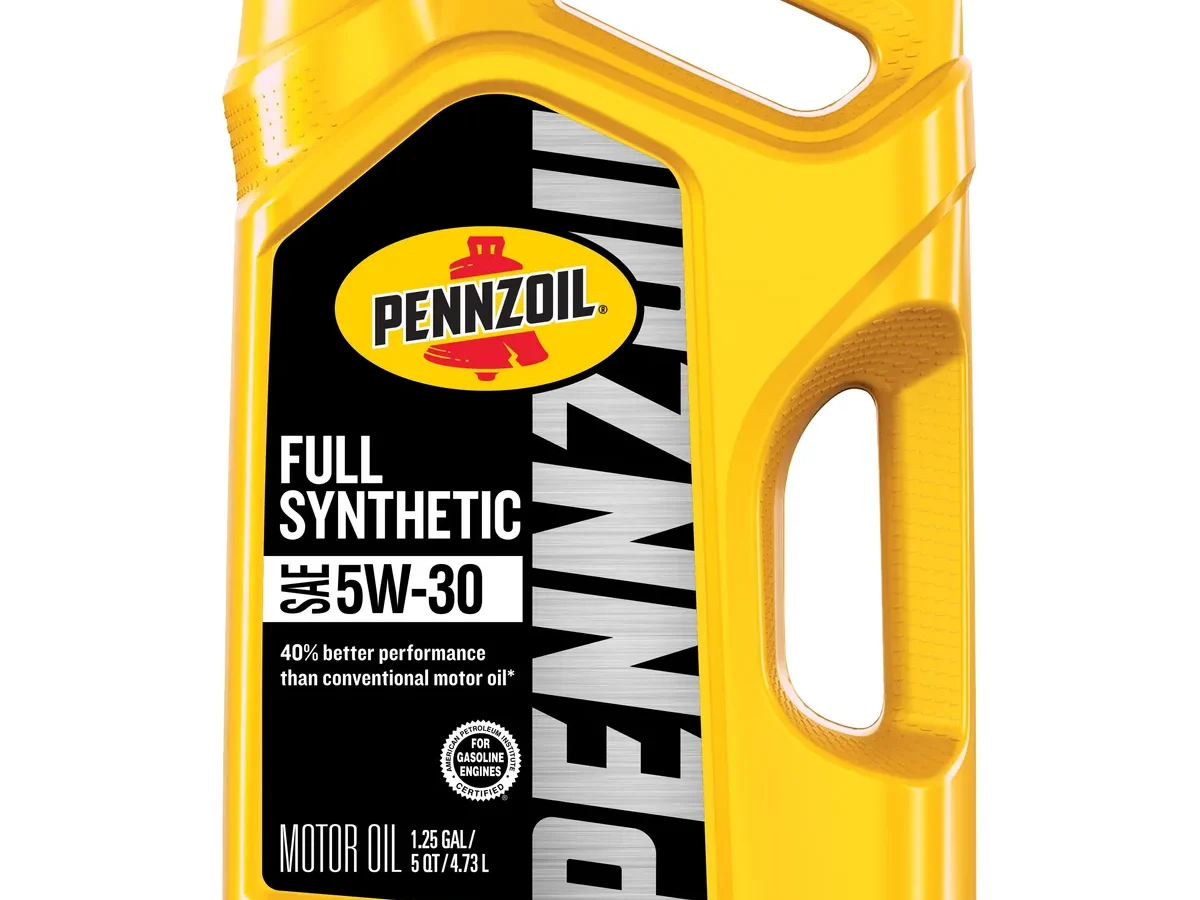
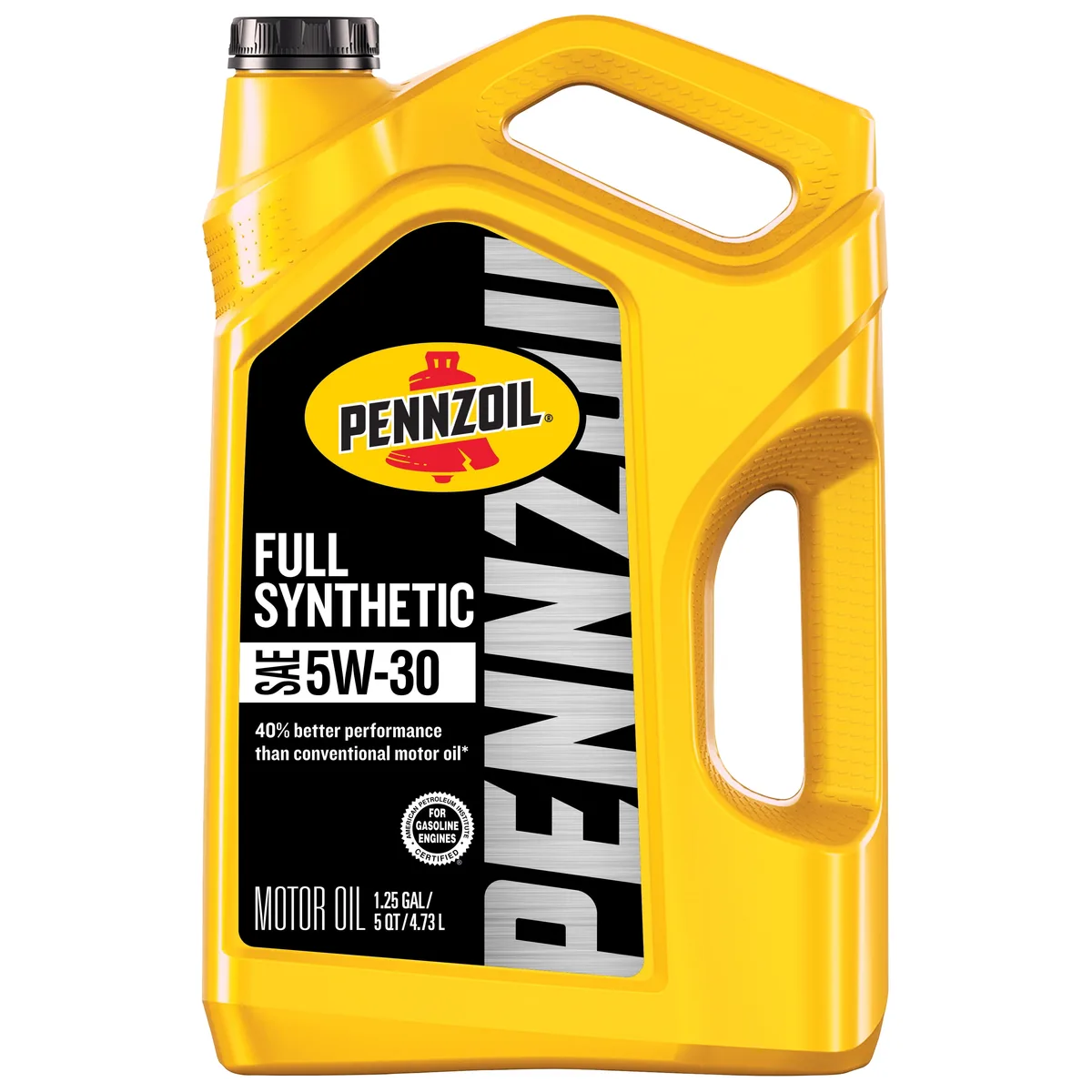
Ever stared at a bottle of 5W-30 in the auto aisle and wondered what do the numbers on motor oil mean? You're not alone. Those tiny characters actually decode two very different things about how the oil behaves in your engine.
The first number tells you how it flows when cold. The second tells you how it holds up when hot.
The whole system comes from a single global standard called SAE J300, published by SAE International and updated on a regular cycle. As of 2026, it's still the reference every oil bottle in the world uses. Get the grade wrong and you can lose fuel economy, wear parts faster, or void your warranty.
Get it right and your engine runs the way its designers intended.
Quick Answer
The numbers on motor oil are SAE viscosity grades. The first number with the "W" (like 5W) shows how well the oil flows in cold weather. Lower is thinner when cold.
The second number (like 30) shows how thick the oil stays at 100°C. Higher is thicker when hot. Always match the exact grade listed in your owner's manual.
The Quick Breakdown: Reading 5W-30 in Plain English
Take 5W-30 as your reference point. The "5W" is the cold rating, and the W stands for winter. The "30" is the hot rating at normal running temperature.
Together they mean the oil stays thin enough to pump on a freezing morning and thick enough to protect at 100°C.
The same logic applies across every grade you'll see on a shelf. A 0W-20 is thinner cold and thinner hot than a 5W-30. A 15W-40 is thicker on both ends.
Each number is measured against very specific lab tests written into SAE J300.
Here's the key idea most drivers miss. A multigrade oil like 5W-30 isn't two oils mixed together. It's one oil engineered with polymer additives so it behaves like a thin oil when cold and a thicker oil when hot.
What the "W" Really Stands For (Hint: It's Not Weight)
The W means winter, not weight. That single letter causes more confusion at the parts counter than anything else on the bottle. Plenty of mechanics loosely say "oil weight," but the W is a strict cold-temperature spec set by SAE.
The lower the W number, the better the oil flows in freezing conditions. A 0W will still pump at temperatures a 20W simply can't survive. That matters because most engine wear happens in the first few seconds of a cold start, before oil reaches the top of the engine.
Modern engines increasingly demand low W numbers. Tight-tolerance direct-injection engines, turbo motors, and hybrids often spec 0W-20 or 0W-16 to protect against cold-start scuffing. If you're doing the job yourself, our beginner-friendly oil change walkthrough covers what to check before you pour.
The First Number: How Your Oil Behaves When It's Cold
The W number is tied to two separate lab tests. Cold cranking viscosity measures how easily your starter can turn the engine over on a freezing morning. Pumpability measures whether the oil pump can push oil through the passages before internal parts run dry.
Here's the practical cheat sheet for how low each W grade can safely go, straight from the SAE J300 pumpability limits:
- 0W: down to about -40°C (-40°F)
- 5W: down to about -35°C (-31°F)
- 10W: down to about -30°C (-22°F)
- 15W: down to about -25°C (-13°F)
- 20W: down to about -20°C (-4°F)
If winter temperatures in your area regularly dip below your oil's limit, cold-start wear climbs sharply. That's why northern drivers move to 0W or 5W oils, even when the manual technically allows a higher W grade. In warm regions, a higher W number is fine because the oil never gets cold enough for it to matter.
The Second Number: How Your Oil Holds Up When It's Hot
The second number is the oil's kinematic viscosity at 100°C, roughly the temperature of a fully warmed engine. Higher numbers mean a thicker oil film at operating temperature. Thicker isn't automatically better.
Modern engines are designed around a target viscosity. Go thicker than the spec and you can starve tight bearings, drop fuel economy, and strain the oil pump. Go too thin and you may not protect the engine under high load or sustained heat.
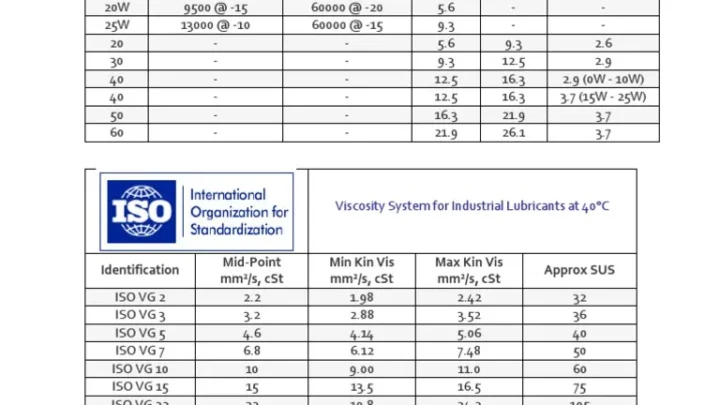
Each hot number covers a defined viscosity band. The 30-grade sits between 9.3 and 12.5 cSt at 100°C. The 40-grade sits between 12.5 and 16.3 cSt.
There's also a second high-temperature spec called HTHS (high-temperature high-shear) viscosity. HTHS measures how strong the oil film stays under real engine pressure, and that's where European specifications like ACEA A3/B4 get strict.
The SAE J300 Viscosity Chart at a Glance
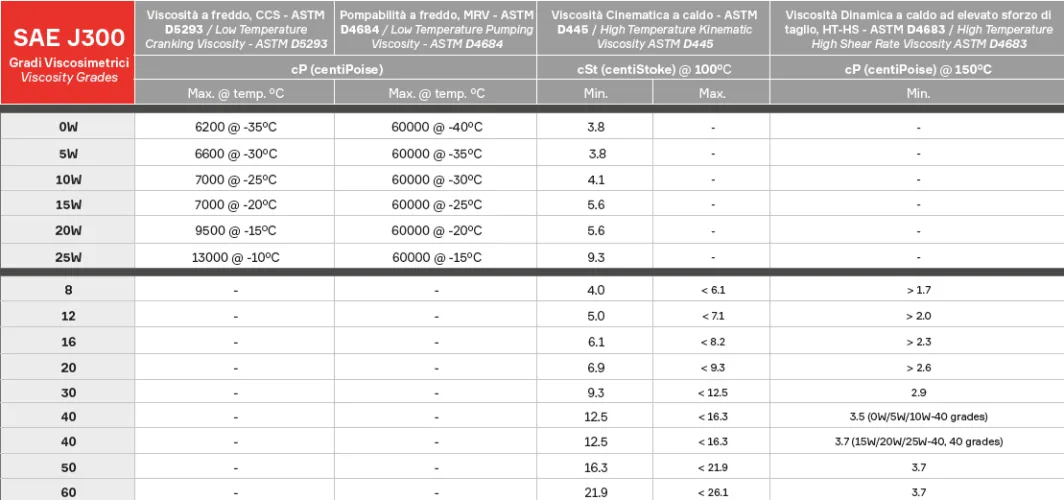
The full SAE J300 chart maps every grade to lab-tested cold and hot values. You don't need to memorize the numbers, but seeing them lined up makes it obvious why 5W-30 and 10W-40 aren't casual swaps for each other.
Here's a simplified view of the grades you'll actually see on the shelf:
| SAE Grade | Cold Pumping Limit | Viscosity at 100°C (cSt) | Typical Use |
|---|---|---|---|
| 0W-20 | -40°C | 6.9 to 9.3 | Modern hybrids, direct-injection engines |
| 5W-20 | -35°C | 6.9 to 9.3 | Late-model gas engines, many Fords |
| 5W-30 | -35°C | 9.3 to 12.5 | Most current passenger cars |
| 10W-30 | -30°C | 9.3 to 12.5 | Older gas engines, small trucks |
| 10W-40 | -30°C | 12.5 to 16.3 | Older engines, some motorcycles |
| 15W-40 | -25°C | 12.5 to 16.3 | Heavy-duty diesel, older trucks |
| 20W-50 | -20°C | 16.3 to 21.9 | Air-cooled, classic, racing engines |
Two takeaways. Oils that share the same second number (like 5W-30 and 10W-30) protect similarly once hot, but behave very differently on a January morning. Jumping to a much thicker grade "for extra protection" usually hurts more than it helps in any engine built in the last twenty years.
Multigrade vs Monograde Oil: Why Modern Engines Use Both Numbers
A monograde oil has one viscosity rating, like SAE 30 or SAE 40. It works fine at one temperature range and struggles outside of it. Straight-30 oil in a Minnesota January will barely pump.
Multigrade oils solve that problem with polymer viscosity modifiers. Those long-chain molecules stay coiled when cold and stretch out when hot, keeping the oil in a usable range across a wide temperature swing. That's how 5W-30 can act thin at -30°C and still hold film strength at 100°C.
Monograde oil still has a place. Small air-cooled engines, some vintage motors, and certain industrial equipment still spec it. Everything else on the road today runs multigrade for a reason.
Matching the Right Viscosity to Your Climate

Your owner's manual usually lists a primary grade plus alternate grades keyed to ambient temperature. That chart exists because climate really does change the math.
Cold-Climate Picks (Below Freezing Winters)
If winter temperatures regularly drop below -20°C, go with a 0W or 5W. A 0W-20 or 5W-30 will pump quickly at start-up and reach the top of the engine in a couple of seconds. In extreme cold, a 10W oil can leave the top end dry for painful seconds while wear stacks up.
Hot-Climate Picks (Desert and Southern Summers)
In consistently hot regions, the second number matters more than the first. A 5W-30 works fine in Phoenix. Older engines that burn a little oil in Arizona summers sometimes benefit from bumping to 5W-40, but only if the manufacturer allows it.
Never jump grades on a modern turbo without checking the manual.
Matching Viscosity to Your Engine Type and Age
Climate is only half the picture. Engine design and mileage push the choice in specific directions.
New and Turbocharged Engines
Late-model engines run tight clearances and high oil temperatures, especially with a turbo. They almost always spec 0W-20, 5W-20, or 5W-30. Follow the manual to the letter.
The wrong grade in a modern turbo can cause timing chain wear, LSPI (low-speed pre-ignition), and voided warranty coverage.
High-Mileage and Older Engines
Older engines with looser clearances often tolerate a slightly thicker oil. A high-mileage 5W-30 or 10W-30 can quiet lifter tick and reduce oil burn. Don't jump two grades.
Move up one step and see how the engine responds.
Diesel and Heavy-Duty Trucks
Diesel pickups and commercial trucks usually run 15W-40 or 5W-40 with heavy-duty certifications like API CK-4 or FA-4. These oils carry stronger detergent packages to handle soot loading. If you're eyeing a used truck, a proper pre-purchase walkthrough will flag oil sludge and past service shortcuts fast.
The Other Symbols on the Bottle: API Donut, ILSAC Starburst, and ACEA Ratings
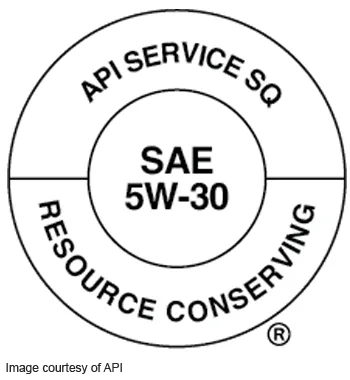
The viscosity grade is only part of the label. The circular API donut lists the API service category (currently API SP for gasoline engines, API CK-4 for diesel), the SAE grade in the center, and any resource-conserving claim on the bottom.
The starburst symbol is the ILSAC certification, currently ILSAC GF-6. That mark tells you the oil met a full set of fuel economy, wear, and emissions tests for modern engines. If your manual asks for it, look for the starburst on the front label.
ACEA ratings appear on European-spec oils. Codes like A3/B4 or C3 tell you the oil meets specific European sequences for wear, high-temperature protection, and catalyst compatibility. A German or Italian car probably needs an ACEA-approved oil, not just an API-rated one.
OEM Specifications That Override the Viscosity Number
Even the perfect viscosity can fail your engine if it doesn't carry the manufacturer's own approval. Automakers publish their own specs on top of SAE and API. Common ones include GM dexos1 Gen 3, Ford WSS-M2C946-B1, Chrysler MS-6395, VW 502.00 or 508.00, BMW Longlife-01, and Mercedes-Benz 229.5.
These specs cover things the SAE grade can't. Additive chemistry, catalyst protection, timing chain wear, LSPI resistance, and drain interval targets all live inside OEM approvals. Using a non-approved oil in a car under warranty is one of the fastest ways to hand the dealer a reason to deny a claim.
The rule is simple. Match the SAE grade first, then match the OEM approval printed in your manual. If the bottle doesn't list your carmaker's exact spec, put it back.
Common Mistakes People Make When Choosing Motor Oil by the Numbers
A few mistakes come up over and over at the parts counter and in aggregate user reviews:
- Thinking "W" means weight. It means winter. Cold flow only.
- Going thicker on a modern engine. Bumping a 0W-20 car up to 5W-30 for "extra protection" can hurt oil pressure, fuel economy, and timing chain wear.
- Ignoring the OEM approval. Same viscosity, wrong additive package. The engine pays the price.
- Reusing an old grade after a rebuild. Rebuilt clearances often match the modern spec, not the 1990s one.
- Mixing grades to "average" them. The result meets neither spec.
- Switching brands with every change. Not harmful, but you lose the benefit of a consistent additive chemistry.
Get the grade right the first time and none of these bite you.
When It's Safe to Switch Grades and When It Isn't
If your manual lists more than one acceptable grade (many do, keyed to temperature), switching between them is fine. A car rated for 5W-20 or 5W-30 will run happily on either.
Switching outside the manual's range is riskier. A high-mileage engine with real oil consumption can sometimes move up one grade to slow the burn. That's the exception, not the rule.
Never switch grades in a modern turbo, hybrid, or direct-injection engine without checking with the manufacturer. The wrong viscosity can trigger LSPI, chain stretch, or warranty problems. When in doubt, stick with the primary grade printed on the oil cap.
A Simple Decision Guide for Picking the Right Oil
Use this quick flow the next time you're standing in the aisle:
- Open the owner's manual. Find the recommended SAE grade and the OEM spec.
- Check your climate. If winters run below your W rating, drop one W step lower.
- Consider engine age. Under 75,000 miles, follow the manual exactly. Over 100,000 with oil burn, consider a high-mileage version of the same grade.
- Verify the certifications. Look for the API donut, the ILSAC starburst, and the exact OEM approval on the back label.
- Pick synthetic if the manual asks for it. Modern engines that spec synthetic will not last on conventional oil.
Follow those five steps and the numbers on the bottle stop being a mystery.
FAQs About Motor Oil Numbers and Viscosity Grades
Is a higher second number always better protection?
No. A higher second number just means a thicker oil at 100°C. Modern engines are engineered for a target viscosity.
Going thicker can starve tight bearings, reduce fuel economy, and stress the oil pump. Only move up a grade if the manufacturer allows it or the engine has real high-mileage oil consumption.
Can I use 5W-30 instead of 5W-20?
Only if your owner's manual lists both as acceptable. The two share the same cold rating but 5W-30 is thicker when hot. In an engine designed strictly for 5W-20, using 5W-30 can trigger check-engine codes on some models and may void warranty coverage.
Always follow the manual.
What does the W really mean on motor oil?
The W stands for winter. It rates the oil's ability to flow at cold temperatures. A lower W number means better cold-weather performance.
A 0W will pump at roughly -40°C, while a 20W struggles below about -20°C. It has nothing to do with the oil's weight.
Do synthetic oils use the same number system?
Yes. Full synthetic, synthetic blend, conventional, and high-mileage oils all use the same SAE J300 grades. A 5W-30 synthetic and a 5W-30 conventional meet the same viscosity spec.
The difference lies in base oil quality, additive chemistry, and how long the oil holds its viscosity under heat and shear.
Does the API donut matter as much as the SAE grade?
Yes. The SAE grade tells you how thick the oil is. The API donut tells you what performance category it meets, like API SP for current gasoline engines or CK-4 for heavy-duty diesel.
An oil with the correct viscosity but the wrong service category can leave your engine short on wear protection, detergent capacity, or emissions-system compatibility.

Similar Posts