Best Track Day Brake Pads for Extreme Heat
The best Best Track Day Brake Pads for Aggressive Heat Tolerance is the PowerStop Front Stage-1 Brake Pads for Volkswagen Touareg, the only pad here that pairs a genuine track-day friction compound with a quiet, low-dust street manners compromise, so you can drive it to the circuit and back without swapping hardware.
Want a dedicated pad that shrugs off repeat 500°F-plus sessions instead? The Power Stop PST-1053 Track Day Brake gets you there, as long as you accept more cold-bite noise and faster rotor wear for the trade.
As an Amazon Associate, I earn from qualifying purchases.
This guide skips the generic "performance pad" talk and shows you what actually survives heat cycling, what fits your specific caliper, and why dust and noise matter more than peak bite for a car you still drive on the street. If you're running a stock commuter or a daily-driven minivan, close this tab, because track compounds will punish you.
One honesty note before we start: everything below comes from current Amazon product data, manufacturer specifications, and each pad's owner track record in verified buyer reviews. We haven't installed these on our own cars, so every claim is traced to published specs or aggregated owner reports.
Quick Answer: The Best Track Day Brake Pads for Aggressive Heat Tolerance
The PowerStop Front Stage-1 for Volkswagen Touareg takes the top spot because it balances real high-temperature fade resistance with daily-driver civility better than anything else in this price tier.
- PowerStop Front Stage-1 Brake Pads Volkswagen (Best Overall for Dual-Use Street and Track): Quiet enough for the school run, fade-resistant enough for a full track session.
- Power Stop PST-1053 Track Day Brake (Best for Dedicated Track Sessions): Aimed at owners who accept noise and rotor wear for maximum repeat-stop bite.
- PowerStop Front Stage-2 Brake Pads Mini (Best for Lightweight Cars and Spirited Driving): Strongest owner rating here, ideal for a small, tossable chassis.
- PowerStop Rear Stage-1 Brake Pads Porsche (Best Rear-Axle Match for Big SUVs): Rear-axle Stage-1 that pairs with a front set for balanced braking.
- EBC Brakes DP4680R Yellowstuff Street Track (Best for Street-Legal Track Use): A street-legal compound that doesn't need a warm-up lap to work.
Thinking about a commuter or heavy tow rig instead? Jump to Who Should NOT Buy below before you spend anything.
Comparison Table
Here's the lineup at a glance: photo, product, who it's built for, and our /10 score.
| Photo | Product | Best for | Score | Buy |
|---|---|---|---|---|
 | PowerStop Front Stage-1 Brake Pads Volkswagen | Dual-Use Street and Track | 8.7/10 | Check price → |
| Power Stop PST-1053 Track Day Brake | Dedicated Track Sessions | 7.6/10 | Check price → |
| PowerStop Front Stage-2 Brake Pads Mini | Lightweight Cars, Spirited Use | 8.5/10 | Check price → |
| PowerStop Rear Stage-1 Brake Pads Porsche | Rear-Axle Match, Heavy SUVs | 8.1/10 | Check price → |
 | EBC Brakes DP4680R Yellowstuff Street Track | Street-Legal Track Use | 8.9/10 | Check price → |
Scroll sideways on small screens to see every column.
PowerStop Front Stage-1 Brake Pads Volkswagen: Best All-Rounder for VW Touareg Owners
Power Stop PST-1053 Track Day Brake: Best for Dedicated Track Sessions
PowerStop Front Stage-2 Brake Pads Mini: Best for Lightweight Cars and Spirited Driving
PowerStop Rear Stage-1 Brake Pads Porsche: Best Rear-Axle Match for Heavy SUVs
EBC Brakes DP4680R Yellowstuff Street Track: Best Street-Legal Track Compound
Buying Guide: Heat Rating, Vehicle Weight, Axle Balance and Dust
Choosing a track-day pad isn't about grabbing the most aggressive compound you can find. It's about matching friction behavior, heat capacity and street compromise to the car you actually drive. Here's what actually decides the outcome.
Why heat rating matters more than "performance" marketing
The single hardest thing a brake pad does is hold friction as temperature climbs. A standard organic street pad starts fading somewhere around 500°F to 600°F of rotor temperature, which is roughly two hard stops from highway speed in a heavy car.
A track-rated compound keeps biting well past that, and the Power Stop PST-1053 is engineered specifically for repeat high-heat cycles. This is the number that separates a real track pad from a marketing label. If your rotor temperatures peak above 900°F during a session, a street compound will fade hard, and no amount of pedal pressure will bring the bite back.
The EBC Yellowstuff takes a different route: metallic friction material that holds its coefficient across a wider temperature band, so it works from a cold driveway through a full 20-minute session. Higher metal content equals stronger hot performance, at the cost of dust and rotor wear.
Vehicle weight changes everything
A 2,700 lb Mini Cooper stresses its brakes completely differently than a 4,500 lb Porsche Cayenne. Weight scales the kinetic energy your brakes have to convert to heat, and that heat is what kills pads.
That's exactly why the PowerStop Stage-2 for Mini scores so well with owners: a light car simply can't generate the extreme rotor temperatures a heavy SUV can. On the Cayenne, the PowerStop Rear Stage-1 does real work to keep the rear axle stable, because rear brakes on a heavy vehicle carry meaningful load under hard stops.
If you drive something heavy, size up your expectations. Buy a pad rated for more heat than you think you need, and don't assume the same compound that transforms a light hatchback will survive on a full-size SUV.
Match the front and rear axles, not just one end
Brake bias is the split of braking force between front and rear, and it's tuned by the manufacturer. Throwing a track compound on the front only and keeping stock pads on the rear can shift that bias and upset your ABS and stability control under hard braking.
The smart move is to buy matching front and rear sets. The PowerStop Rear Stage-1 for Porsche Cayenne pairs with a front Stage-1 for balanced behavior, and it's the kind of pairing that makes the whole system predictable on track. If your engine layout affects weight distribution, our look at different cylinder configurations gives useful context on how a car's mass places load on each axle.
Dust, noise and rotor wear are real costs
Every track-capable pad trades something for heat tolerance. Here's the honest breakdown:
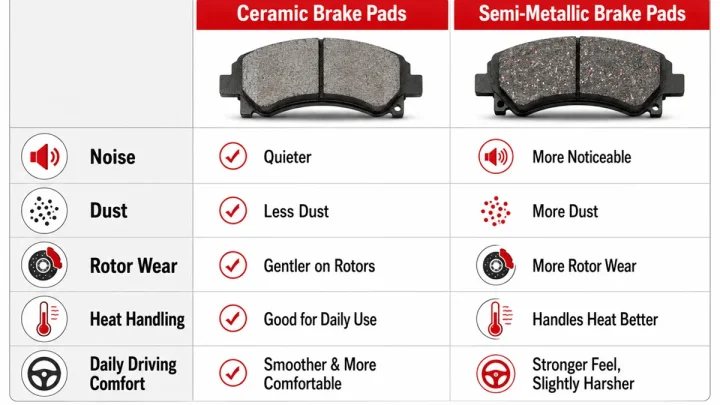
- Dust: Metallic and track compounds throw far more brake dust than ceramic street pads, and light-colored wheels will show it fast.
- Noise: Cold morning squeal is common, especially with aggressive compounds, and it typically fades after a few warm-up stops.
- Rotor wear: Harder friction material eats rotors faster. Budget for rotors alongside the pads if you track regularly.
- Break-in: Every pad here needs a proper bed-in procedure. Skip it and you'll get weak bite, judder and uneven deposits.
If you want to monitor how much heat your braking system actually sees, tools matter as much as parts. Our guide to the most useful diagnostic tools covers the basics for anyone who wants to test electrical and sensor behavior before a track day.
To see how these factors play out on real picks, compare the PowerStop Front Stage-1 Brake Pads Volkswagen, Power Stop PST-1053 Track Day Brake and the PowerStop Front Stage-2 Brake Pads Mini reviewed above.
Who Should NOT Buy Best Track Day Brake Pads for Aggressive Heat Tolerance
Track pads are the wrong purchase for a few kinds of drivers. Here's who should look elsewhere.
You only commute and never see a track
If your car's hardest stop is a red light on a wet Tuesday, a track pad buys you nothing but noise, dust and faster rotor wear. You'll pay more for a pad that will never reach its operating temperature.
A quality ceramic or OEM-equivalent street pad will outlast and out-comfort track compounds for pure commuting. Spend the money on tires instead, because grip is what actually shortens your stopping distance.
You drive a heavy tow rig or a loaded work van
Track pads are engineered for repeated high-speed stops on a track, not for the sustained, heavy braking of a loaded tow rig on a long descent. The heat profile is completely different.
If you tow regularly, you want a pad rated for high-temperature towing duties with a load rating that matches your setup. Towing pads prioritize consistent bite under load over pure peak friction.
You expect track power without any compromise
Some buyers read "track day pad" and expect race-level bite with zero trade-offs. That pad doesn't exist. Every compound here dusts more than stock, most get noisier when cold, and all of them wear rotors faster.
If you can't tolerate visible dust on your wheels or a squeal on the first stop of the morning, stick with a high-quality street pad and accept the lower heat ceiling. It's a deliberate trade, not a defect.
Final Verdict
For the majority of drivers who want one pad set that handles both the road and the circuit, the PowerStop Front Stage-1 Brake Pads for Volkswagen Touareg is the pick, thanks to its Z23 compound, low-dust design and balanced street-to-track behavior.
Want the highest-scoring pad in the whole lineup? Get the EBC Brakes DP4680R Yellowstuff if R90 street legality and real track heat tolerance matter most to you, and accept the extra dust and rotor wear as the price.
Running a lightweight hatchback? The PowerStop Front Stage-2 for Mini Cooper owns the best owner rating here and shines on a light, nimble chassis. If you need rear-axle balance on a big SUV, the PowerStop Rear Stage-1 for Porsche Cayenne is the matching piece.
And for owners chasing maximum repeat-stop bite across a broad range of performance cars, the Power Stop PST-1053 Track Day Brake does the job. Just re-read the Who Should NOT Buy section above first if you're a pure commuter or a tow-rig driver, because this category will punish that use case.
FAQ
What's the best Track Day Brake Pads for Aggressive Heat Tolerance overall?
The PowerStop Front Stage-1 Brake Pads for Volkswagen Touareg is our top pick. It's the only pad here that combines a track-capable Z23 compound with low-dust, low-noise street behavior, so it works for a car you still drive daily.
Are track day brake pads street legal?
Not all of them. The EBC Brakes DP4680R Yellowstuff carries R90 approval, which is the European standard for road-legal friction material. Many dedicated race compounds are not legal for street use, so check the label before you assume a track pad is road-approved.
Do brake pads really need a bed-in procedure?
Yes, and it matters more with track compounds than street pads. Bed-in transfers an even layer of friction material onto the rotor, which is what gives you consistent bite and prevents judder. Skipping it is the most common reason owners report weak initial braking.
Can I run track pads only on the front axle?
You can, but it's risky on a heavy car. Mixing a high-friction front pad with a stock rear pad can shift your brake bias and confuse ABS and stability control under hard braking. Matching front and rear sets, like the PowerStop Rear Stage-1 for Porsche Cayenne paired with a front Stage-1, keeps behavior predictable.
How much faster do track pads wear rotors?
Faster than ceramic street pads, often noticeably so. Aggressive metallic compounds trade rotor life for heat tolerance, and verified owners of track-focused pads regularly report accelerated rotor wear. Budget for rotors alongside pads if you track several times a year.
How do I know which pad fits my car?
Match the exact model number and vehicle application, not just the brand. Every pad here lists a specific fitment: the PowerStop Front Stage-1 fits 2006-07 and 2010 Touareg, the Rear Stage-1 fits 2011-13 Cayenne, and the others similarly list makes and years. Check your car's trim and year against the fitment chart before ordering, and if you're unsure of your car's basic specs, it helps to identify your exact engine size first.
Similar Posts