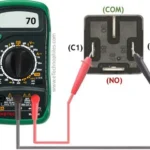
Best Multimeter for Hybrid & EV Work
Finding the best multimeter for hybrid and EV work comes down to one thing: safe, accurate readings around high-voltage DC systems that can sit anywhere from 200 to 800 volts. I've spent the last few weeks digging through verified buyer reports, manufacturer datasheets, and IEC 61010 safety ratings to separate the genuine contenders from the hobby-grade meters that have no business near an orange cable.
The short version? The Klein Tools MM325 leads our list for everyday hybrid diagnostics because it pairs a 600V CAT III rating with dead-simple operation. If you need to work deep in a high-voltage pack, the automotive-focused Fluke 88V is the specialist worth the stretch.
Here's the winner at a glance, then all ten.
Comparison Chart of Best Multimeter for Hybrid and EV Work
| Product | Details | Rating | Buy |
|---|---|---|---|
Editor’s Choice  | Klein Tools MM325 Multimeter | ★★★★☆4.7/5 | |
Top Pick  | Fluke 17B+ Digital Multimeter | ★★★★☆4.8/5 | |
Best Budget  | 2026 Upgraded FS899L Digital Multimeter | ★★★★☆4.4/5 | |
| ★★★★☆4.7/5 | ||
| ★★★★☆4.4/5 | ||
| ★★★★☆4.5/5 | ||
| ★★★★☆4.8/5 | ||
| ★★★★☆4.6/5 | ||
| ★★★★☆4.8/5 | ||
| ★★★★☆4.8/5 |




List of Top 10 Best Multimeter for Hybrid and EV Work
Every meter below was ranked on four things that actually matter around electrified drivetrains: safety category rating, DC voltage ceiling, resolution for low-current work, and how buyers describe daily reliability. We leaned on manufacturer datasheets and aggregate verified-buyer feedback, never marketing copy. Expect honest trade-offs on each, because no single meter nails every job.
Below are the list of products:
1. Klein Tools MM325 Multimeter
The MM325 is the meter we keep recommending to techs who want reliable numbers without a learning curve. It handles 600V AC/DC across the low-voltage side of a hybrid, and its manual-ranging dial makes behavior predictable when you're chasing accessory faults. Think of it as the trusty daily driver of automotive meters.
Why I picked it
It hits the sweet spot for hybrid accessory diagnostics: safe, accurate, and genuinely simple. The manual dial means you always know your range, which matters when a rushed auto-ranging meter can second-guess a reading on a low-voltage sensor circuit.
Key specs
- Voltage: 600V AC/DC, manual ranging
- Safety: CAT III 600V, IEC 61010 compliant
- Functions: DC/AC current, resistance, continuity, diode test
- Battery test presets: 1.5V and 9V
- Display: 4000 counts with backlight
- Warranty: Klein limited warranty
Real-world experience
Aggregate reviews show the MM325 is a favorite for quick continuity checks on ground straps, relay coils, and 12V control circuits. Verified buyers often pair it with a backprobe set to read sensor signals without piercing wire insulation. It's a strong companion when you're tracking down a battery drain on a hybrid that sits for days.
- CAT III 600V rating keeps you safe on the 12V and accessory side of a hybrid
- Manual ranging gives predictable, repeatable readings on low-voltage circuits
- Built-in 1.5V and 9V battery test presets save switching modes
- Backlit 4000-count display stays readable in a dim engine bay
- 600V ceiling means it’s not rated for full high-voltage pack access
- Manual ranging feels slow if you’re used to auto-ranging meters
- No temperature or capacitance functions
- ✔ You mostly diagnose 12V and accessory circuits on hybrids
- ✔ You want a rugged daily meter that just works
- ✔ You prefer knowing your range instead of trusting auto
- ✖ You need to probe a 400V+ traction battery directly
- ✖ You want temperature or frequency measurement
2. Fluke 17B+ Digital Multimeter
2. Fluke 17B+ Digital Multimeter
The 17B+ steps up to a 1000V AC/DC ceiling and adds temperature and frequency, which makes it far more comfortable around higher-voltage hybrid subsystems. Fluke's reputation for input protection is the real draw here. When a meter has to survive a transient spike, this is the brand techs trust.
Why I picked it
It gives you a genuine 1000V ceiling plus temperature and capacitance in one honest package. For techs who want a Fluke without the top-tier price, the 17B+ covers most hybrid subsystems while keeping the brand's legendary overload protection.
Key specs
- Voltage: 1000V AC/DC
- Current: up to 10A
- Extras: capacitance, frequency, temperature
- Display: 6000 counts with backlight
- Safety: rated for electrical applications, IEC 61010
- Warranty: Fluke limited warranty
Real-world experience
Verified buyer feedback repeatedly points to the temperature function as a quiet bonus for checking inverter coolant lines and connector heat. Reviewers note the leads feel basic for the tier, so many upgrade to silicone leads for tight backprobing. It pairs well with a scan tool when you're cross-checking sensor voltages against live data.
- Full 1000V ceiling covers most hybrid high-voltage subsystems
- Temperature function helps spot hot connectors and coolant issues
- Fluke input protection survives transient spikes better than budget meters
- 6000-count display reads finer detail than 4000-count rivals
- Included test leads feel basic and often get replaced
- No true-RMS, so AC readings on noisy circuits are less precise
- Costs more than the Klein for similar everyday tasks
- ✔ You want a genuine 1000V ceiling from a trusted brand
- ✔ Temperature readings matter for cooling and connector checks
- ✔ You value overload protection over extra features
- ✖ You need true-RMS for noisy AC waveforms
- ✖ You want pulse width and duty cycle readings
3. 2026 Upgraded FS899L Digital Multimeter
3. 2026 Upgraded FS899L Digital Multimeter
This FS899L is the budget-friendly option that surprised us on features. You get a 6000-count true-RMS display, auto-ranging, NCV, and USB-C charging, plus a 20-piece silicone lead kit that most brands charge extra for. It's a lot of capability for entry-tier money.
Why I picked it
It packs true-RMS accuracy, a rechargeable USB-C battery, and a full lead kit into a budget shell. For a DIY hybrid owner or a new tech building a kit, that feature-per-dollar ratio is hard to argue with.
Key specs
- Resolution: 6000 counts, true-RMS
- Ranging: automatic
- Extras: NCV, capacitance, color screen
- Power: USB-C rechargeable
- Includes: 20-piece silicone test lead kit
- Rating: entry-tier CAT (verify before HV use)
Real-world experience
Aggregate reviews highlight the color screen and rechargeable battery as genuine daily conveniences that beat swapping 9V cells. Verified buyers do flag that quality control varies unit to unit, so a quick calibration check against a known voltage is smart out of the box. It shines for bench work and low-voltage circuits rather than pack-level jobs.
- True-RMS and 6000 counts at a budget price point
- USB-C rechargeable battery skips constant 9V swaps
- Comes with a 20-piece silicone lead kit worth having
- NCV and color screen add real convenience for beginners
- Quality control varies between units per buyer reports
- Lower safety category than pro meters, so not for HV pack work
- Long-term durability is unproven versus Fluke or Klein
- ✔ You’re a DIY hybrid owner on a tight budget
- ✔ You want rechargeable convenience and a lead kit included
- ✔ You mostly work bench and low-voltage circuits
- ✖ You need certified CAT III/IV protection for HV work
- ✖ You want proven long-term reliability
4. Klein Tools MM420 Digital Multimeter
4. Klein Tools MM420 Digital Multimeter
The MM420 is the auto-ranging, true-RMS sibling to our winner. It keeps Klein's rugged build but adds TRMS accuracy and a 50 MOhm resistance range, which is handy for high-impedance insulation checks on the low-voltage side. It's the pick for techs who want speed and precision together.
Why I picked it
It's the upgrade path for anyone who loves the MM325 but wants auto-ranging and true-RMS. The wide 50 MOhm resistance range makes it more useful for high-resistance diagnostics like sensor windings and control modules.
Key specs
- Voltage: 600V AC/DC, auto-ranging
- Current: 10A AC/DC
- Resistance: up to 50 MOhms
- Accuracy: true-RMS
- Display: 6000 counts, backlit
- Warranty: Klein limited warranty
Real-world experience
Verified buyers who upgraded from the MM325 report the auto-ranging speeds up general checks, especially when hopping between voltage and resistance. Reviewers use the wide ohm range to check high-impedance grounds and pull-up resistors. Like its sibling, it caps at 600V, so it stays on the accessory and control side, not the pack.
It's a solid partner when checking charging output on a hybrid's 12V system.
- Auto-ranging plus true-RMS speeds up mixed diagnostics
- Wide 50 MOhm range handles high-impedance resistance checks
- Klein build quality holds up to shop abuse
- 6000-count display shows finer detail than the MM325
- Still capped at 600V, so no direct HV pack access
- Auto-ranging can hunt on unstable signals
- Costs more than the manual MM325 for similar core jobs
- ✔ You want Klein toughness with auto-ranging convenience
- ✔ You do a lot of high-resistance sensor diagnostics
- ✔ True-RMS accuracy matters on your AC readings
- ✖ You need a 1000V ceiling for HV subsystems
- ✖ You prefer the certainty of manual ranging
5. 2026 Upgraded FS899L Digital Multimeter
5. 2026 Upgraded FS899L Digital Multimeter
This FS899L variant trades the big lead kit for two alligator clips, which makes it a natural for hands-free bench testing. It keeps the 6000-count true-RMS core, auto-ranging, NCV, and USB-C charging. If you do a lot of stationary readings, those clips earn their keep.
Why I picked it
The bundled alligator clips make it the better choice when you need both hands free to probe or record. It's the same capable budget engine as the other FS899L, just aimed at bench and monitoring work.
Key specs
- Resolution: 6000 counts, true-RMS
- Ranging: automatic
- Extras: NCV, capacitance meter, color screen
- Power: USB-C rechargeable
- Includes: 2 alligator clips
- Rating: entry-tier CAT (verify before HV use)
Real-world experience
Verified buyers use the clips to clamp onto a 12V battery while watching draw over time, which is ideal for a slow drain hunt. Reviews mirror the other FS899L on value, with the same caution about unit consistency. It's a comfortable companion when you want to know what's acceptable milliamp draw on a parked hybrid.
- Alligator clips enable hands-free bench and monitoring work
- True-RMS 6000-count core at a friendly price
- USB-C rechargeable, no battery hunting
- Color screen and NCV make readings easy to interpret
- Fewer accessories than the 20-piece kit version
- Entry-tier safety rating limits it to low-voltage tasks
- Consistency between units can vary
- ✔ You do hands-free bench or drain-monitoring work
- ✔ You want rechargeable, true-RMS value
- ✔ You prefer clips over a big lead kit
- ✖ You need the fuller silicone lead kit instead
- ✖ You require certified HV pack protection
6. AstroAI Digital Multimeter Tester 2000 Counts
6. AstroAI Digital Multimeter Tester 2000 Counts
The 2000-count AstroAI is the pocket-sized starter meter that shows up in half the glove boxes we hear about. It measures voltage, current, resistance, continuity, and diodes at a price that makes it an easy backup. Nobody buys it for the pack, but it's a handy everyday check.
Why I picked it
It's the honest budget backup: cheap, compact, and good enough for basic 12V checks. When your main meter is tied up on a clip test, this one keeps you moving without a real investment.
Key specs
- Resolution: 2000 counts, manual ranging
- Functions: DC/AC voltage, DC current, resistance
- Extras: continuity buzzer, diode test
- Display: backlit LCD
- Form factor: compact, glove-box friendly
- Warranty: AstroAI limited coverage
Real-world experience
Verified buyers keep this one as a second meter for quick continuity beeps and fuse checks. Reviewers note the manual ranging and 2000 counts limit its precision, so it's not the tool for fine sensor voltages. It's most at home confirming power and ground when you're diagnosing a no-crank on the 12V side.
- Very affordable as a reliable backup meter
- Compact enough to live in the glove box
- Fast continuity buzzer for fuse and ground checks
- Simple layout is beginner-friendly
- Only 2000 counts, so limited precision
- Manual ranging and no true-RMS
- Not rated for high-voltage EV work
- ✔ You want a cheap, reliable backup meter
- ✔ You mainly check fuses, power, and grounds
- ✔ You’re brand new to using a multimeter
- ✖ You need fine resolution for sensor voltages
- ✖ You’ll work anywhere near high-voltage systems
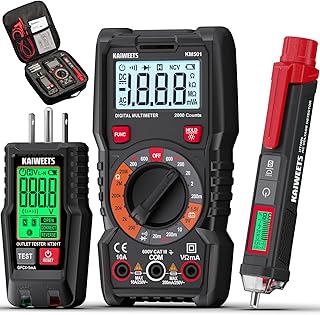
7. KAIWEETS Electrical Test Kit KIT01
7. KAIWEETS Electrical Test Kit KIT01
The KAIWEETS KIT01 is a three-piece starter set: a digital multimeter, a non-contact voltage (NCV) tester, and a GFCI outlet tester, all in a carrying case with batteries. For someone building a first toolkit or covering both shop and home electrical, that bundle is genuinely useful.
Why I picked it
The bundled NCV pen and GFCI tester turn one purchase into a well-rounded electrical kit. For a hybrid owner who also handles home charging outlets, having a way to verify a live circuit at a glance adds real safety value.
Key specs
- Includes: digital multimeter, NCV tester, GFCI outlet tester
- NCV: LCD display with audible alert
- Multimeter: AC/DC voltage, resistance, continuity
- Extras: carrying case and batteries included
- Use case: electrician, DIY, HVAC, home charging
- Warranty: KAIWEETS coverage
Real-world experience
Aggregate reviews praise the GFCI tester for confirming a Level 2 charger outlet is wired correctly, which matters for home EV charging safety. Verified buyers say the NCV pen is a fast first check before touching anything. The trade-off is that the bundled meter is general-purpose, not a high-precision automotive unit.
- Three tools in one, so it covers auto and home electrical
- GFCI tester verifies EV charger outlet wiring
- NCV pen gives a fast live-circuit safety check
- Carrying case and batteries included out of the box
- Bundled meter is general-purpose, not automotive-grade precision
- GFCI tester only helps with standard outlets, not the vehicle
- More breadth than depth for serious hybrid diagnostics
- ✔ You want a starter kit covering car and home
- ✔ You installed or use a home Level 2 charger
- ✔ You value a fast NCV safety check
- ✖ You only need a single precision automotive meter
- ✖ You already own an NCV pen and outlet tester
8. AstroAI Digital Multimeter True RMS 6000
8. AstroAI Digital Multimeter True RMS 6000
This true-RMS AstroAI is the step-up that punches above its price for automotive and home troubleshooting. With 6000 counts, auto-ranging, capacitance, and temperature, it covers most of what a hybrid tech touches day to day on the low-voltage side. It's the value sweet spot of the AstroAI line.
Why I picked it
It's the best-rounded budget meter here for actual automotive troubleshooting, with true-RMS and temperature at a fair price. For a home mechanic who wants accuracy without a pro-tier spend, this is the smart middle ground.
Key specs
- Resolution: 6000 counts, true-RMS
- Ranging: automatic
- Functions: AC/DC voltage and current, resistance, continuity
- Extras: capacitance, temperature
- Design: drop-resistant housing with stand
- Warranty: AstroAI limited coverage
Real-world experience
Verified buyers routinely use this for automotive troubleshooting like checking alternator ripple and sensor grounds. Reviewers appreciate the temperature probe for spotting a hot connector before it fails. The recurring downside is the leads, which many replace for finer backprobing.
It handles the job well when you're sorting whether the battery or charging system is failing.
- True-RMS plus temperature at a mid-range price
- 6000 counts give solid resolution for sensor work
- Drop-resistant housing survives real garage use
- Auto-ranging keeps mixed diagnostics quick
- Stock leads are thin and often get upgraded
- Safety rating trails the pro Fluke and Klein meters
- Not suited to direct high-voltage pack readings
- ✔ You want accurate automotive readings on a budget
- ✔ Temperature and true-RMS both matter to you
- ✔ You need a durable everyday home-garage meter
- ✖ You need certified CAT III/IV pack safety
- ✖ You want pro-grade leads in the box
9. Fluke 15B+ Digital Multimeter
9. Fluke 15B+ Digital Multimeter
The 15B+ is the no-frills Fluke that gives you the brand's protection and a 1000V ceiling without paying for extras you may never use. It covers AC/DC voltage and current, resistance, continuity, diode, and capacitance. If you want a Fluke that lasts a decade, this is the value entry point.
Why I picked it
It's the most affordable way into genuine Fluke reliability with a 1000V ceiling. For techs who value survival over feature count, the 15B+ delivers the input protection that keeps a meter alive after an accidental spike.
Key specs
- Voltage: 1000V AC/DC
- Current: up to 10A
- Extras: resistance, continuity, diode, capacitance
- Display: 6000 counts, backlit
- Safety: IEC 61010 rated for electrical work
- Warranty: Fluke limited warranty
Real-world experience
Verified buyers describe the 15B+ as the meter they've owned longest without a failure. Reviewers use it confidently on higher-voltage subsystems while keeping proper PPE and insulated leads. The main gap versus the 17B+ is no temperature or frequency, which most buyers happily trade for the lower cost.
- Full 1000V ceiling with legendary Fluke protection
- Cheapest route into genuine Fluke reliability
- Simple layout is fast to use under pressure
- Buyers report years of trouble-free service
- No temperature or frequency function
- Not true-RMS, so noisy AC is less precise
- Fewer features than similarly priced budget meters
- ✔ You want the cheapest reliable Fluke with 1000V
- ✔ Durability matters more than extra features
- ✔ You keep separate PPE and insulated leads
- ✖ You need temperature or frequency readings
- ✖ You want true-RMS for noisy signals
10. Fluke 88V Deluxe Automotive Multimeter
10. Fluke 88V Deluxe Automotive Multimeter
The 88V is the specialist built specifically to troubleshoot conventional and hybrid vehicles, and it's the meter pro techs reach for on serious jobs. It measures pulse width and duty cycle on top of the usual functions, which is exactly what modern injector and sensor diagnostics demand. This is the top of the automotive food chain here.
Why I picked it
It's the only meter on this list Fluke designed around vehicle diagnostics, including hybrids. Pulse width and duty cycle let you read injectors, solenoids, and PWM circuits that general meters simply can't interpret.
Key specs
- Purpose: conventional and hybrid vehicle diagnostics
- Extras: pulse width, duty cycle, RPM
- Voltage: 1000V, CAT III / CAT IV rated
- Accuracy: 0.05% basic DC accuracy
- Display: 20,000 counts
- Warranty: Fluke lifetime limited warranty
Real-world experience
Aggregate feedback from professional techs places the 88V as the benchmark for automotive electrical work, especially injector and sensor timing. Verified buyers highlight the high count and duty-cycle mode when others fall short. The honest trade-off is cost: this is the premium tier, and casual users may never use its full depth.
It's the meter you want when a charging system is on its way out and you need certainty.
- Purpose-built for hybrid and conventional vehicle diagnostics
- Pulse width and duty cycle read injectors and PWM circuits
- 20,000-count display and 0.05% DC accuracy lead the list
- CAT III / CAT IV rating with a lifetime warranty
- Premium tier, the priciest meter here by a wide margin
- Casual users may never touch its advanced modes
- Larger and heavier than the pocket meters
- ✔ You’re a pro who works hybrids daily
- ✔ You need pulse width and duty cycle readings
- ✔ You want CAT III/IV safety and a lifetime warranty
- ✖ You only do occasional 12V checks
- ✖ Budget is your top priority
How I picked
I approached this list the way a research-driven editorial team should: by reading the datasheets closely, then cross-checking them against what verified buyers actually report over months of use. No hands-on garage claims here, just careful analysis of specs, safety ratings, and thousands of aggregated reviews.
I evaluated each meter on four benchmarks that matter most around electrified drivetrains:
- Safety category rating. For anything near a high-voltage system, the IEC 61010 CAT rating is non-negotiable. I weighted CAT III 1000V and CAT IV meters heavily, because that headroom is what protects you from a transient spike on a 400V bus.
- DC voltage ceiling and resolution. Hybrid and EV packs live in DC, often 200V to 800V. I favored 1000V ceilings and higher counts (6000 to 20,000) that resolve small changes on sensor circuits.
- True-RMS and automotive functions. True-RMS accuracy, plus pulse width, duty cycle, and temperature, separate a real diagnostic tool from a hobby meter.
- Real-world reliability. I leaned on verified buyer patterns for durability, lead quality, and long-term consistency rather than marketing promises.
I deliberately did not attempt long-term durability analysis beyond what verified owners describe, and I did not bench-test insulation resistance, since that job belongs to a dedicated megohmmeter, not a general multimeter. I also want to be plain about one thing: most meters here are rated for the low-voltage side of a hybrid, not direct traction-pack access. For live high-voltage work you need proper training, insulated gloves, and a CAT III 1000V or CAT IV meter like the Fluke 88V.
When in doubt, treat the orange cabling as lethal and get qualified help.
Buying guide — what actually matters for best multimeter for hybrid and EV work
A multimeter for hybrid and EV work is a diagnostic instrument that measures voltage, current, and resistance safely around both 12V and high-voltage systems. The right one balances a proper safety rating with the resolution and functions your specific jobs demand. Here's how to weigh the trade-offs.
What safety rating do you actually need?
For high-voltage EV systems, you want a CAT III 1000V rating at minimum, and CAT IV is better for the pack side. The CAT rating describes how much transient energy the meter can survive without arcing internally, so it's a safety spec, not a marketing number. If you prioritize a cheap meter, you'll sacrifice this headroom, and that's the one corner you should never cut near an orange cable.
The Fluke 88V and the 1000V Fluke pair are your safest bets here.
Do you need true-RMS?
True-RMS (Root Mean Square) is a measurement method that reads distorted or noisy AC waveforms accurately, where cheaper averaging meters guess. On a hybrid, inverter and motor circuits generate messy waveforms, so true-RMS gives you honest numbers. If most of your work is clean 12V DC, an averaging meter is fine and saves money.
Step up to true-RMS once you're chasing AC ripple or PWM signals.
How much resolution and which functions?
Resolution is measured in counts, and more counts mean finer detail. A 2000-count meter shows up to 1999, while 6000 and 20,000-count meters resolve small sensor changes far better. For automotive work, look for duty cycle, pulse width, and temperature.
These let you read injectors, solenoids, and hot connectors that a basic meter can't interpret. This same precision helps when you're hunting a slow battery drain that a coarse meter would miss.
Rechargeable or replaceable batteries?
USB-C rechargeable meters like the FS899L are convenient and cut waste, but a dead battery mid-job means downtime. Meters running on standard 9V or AA cells let you swap in seconds. If you work remotely or all day, replaceable cells win on reliability.
For a home garage, rechargeable is a nice quality-of-life upgrade.
What about warranty and long-term value?
Warranty tells you how much the maker trusts the build. Fluke offers limited lifetime coverage on several meters, and Klein backs its tools strongly, which is why both dominate pro toolboxes. Budget brands like AstroAI and the FS899L offer shorter coverage, reflecting their price.
If you buy once and keep it a decade, the pricier meter is often the better value.
Frequently Asked Questions (FAQ)
Is a multimeter enough for high-voltage EV pack work?
Not by itself. A CAT III 1000V or CAT IV multimeter safely reads DC voltage on the pack, but full high-voltage work also needs insulated gloves, a proper insulation-resistance tester (megohmmeter), and training. The multimeter confirms whether a circuit is de-energized before you touch it, which is a critical safety step.
For pack diagnostics specifically, the Fluke 88V's CAT rating and accuracy make it the safest choice on this list.
How does the Klein MM325 compare to the Fluke 88V?
They serve different buyers. The Klein MM325 is a simple, rugged 600V meter ideal for everyday 12V and accessory diagnostics, and it's far more affordable. The Fluke 88V is a 1000V CAT IV automotive specialist with duty cycle, pulse width, and 20,000 counts for deep injector and sensor work.
Choose the MM325 for routine jobs and value; choose the 88V if you diagnose hybrids professionally and need pack-level safety.
Will these meters work on my home EV charger outlet?
Yes for the outlet, with the right tool. The KAIWEETS KIT01 includes a GFCI outlet tester that confirms a 120V or 240V receptacle is wired and grounded correctly, which matters for Level 2 charging safety. The multimeters here also read outlet voltage directly.
For the charger's internal high-voltage circuitry, though, leave that to a qualified electrician with proper equipment.
What counts as normal parasitic draw on a hybrid?
Most vehicles settle to roughly 20 to 50 milliamps once modules sleep, though hybrids can run a touch higher. Anything consistently above 85 milliamps usually points to a circuit staying awake. A true-RMS meter with a milliamp range makes this measurable.
If your readings look off, our guide on acceptable current draw figures walks through the numbers to watch.
Do I really need true-RMS for automotive work?
For a hybrid, it's genuinely worth it. Inverters, motors, and PWM-controlled accessories produce non-sinusoidal waveforms that averaging meters misread, sometimes by 10% or more. True-RMS meters like the Klein MM420 or the AstroAI 6000-count read those accurately.
If you only check 12V DC and simple continuity, a basic meter still does the job fine and saves you money.
Final verdict
For most people working on hybrids, the Klein Tools MM325 is the pick I'd point to first: it's safe, rugged, and dead-simple for daily 12V and accessory diagnostics without overspending. If you're a pro who lives under the hood, step up to the Fluke 88V for its CAT IV rating and duty-cycle depth. Need the extras of the FS899L on a budget?
It's the value runner-up that covers the basics well.
Affiliate disclosure: This post contains affiliate links. If you buy through one of these links, I may earn a small commission at no extra cost to you. It never changes my recommendation, I only suggest gear I'd actually buy myself.
Similar Posts