Does Synthetic Oil Really Last Longer Than Conventional?
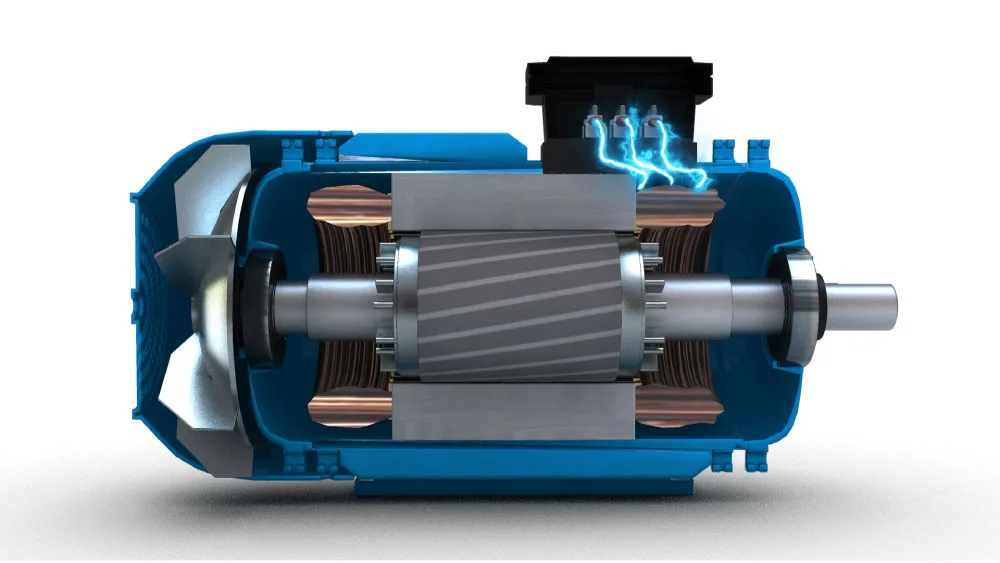
The short answer to "does synthetic oil last longer than conventional" is yes, and the gap isn't small. Synthetic oil typically runs 2 to 3 times longer between changes because its base stock is engineered to resist heat, oxidation, and breakdown. Conventional oil is refined from crude and carries impurities that shorten its useful life.
How long it actually lasts depends on your engine, your driving style, and what your owner's manual allows. As of 2026, most automakers spec drain intervals between 7,500 and 15,000 miles on full synthetic and 3,000 to 5,000 miles on conventional. The American Petroleum Institute (API) SP standard sets the minimum performance floor either oil must clear.
Here's what the extra life really buys you.
Quick Answer
Yes, synthetic oil lasts longer than conventional oil. Full synthetic typically runs 7,500 to 15,000 miles between changes. Conventional oil usually needs replacing every 3,000 to 5,000 miles.
Synthetic resists heat and oxidation better thanks to its uniform molecular structure. Always follow the drain interval in your owner's manual.
Does Synthetic Oil Actually Last Longer Than Conventional? The Straight Answer
Yes. Across manufacturer service data and API-licensed product specs, full synthetic outlasts conventional by a factor of 2 to 3. A conventional oil change hits its limit around 3,000 to 5,000 miles.
A full synthetic change routinely runs 7,500 to 15,000 miles under normal service.
The reason is chemistry, not marketing. Synthetics are built from pre-selected, uniform molecules. Conventional oils are refined from crude and carry paraffin, sulfur, and other trace compounds that oxidize faster.
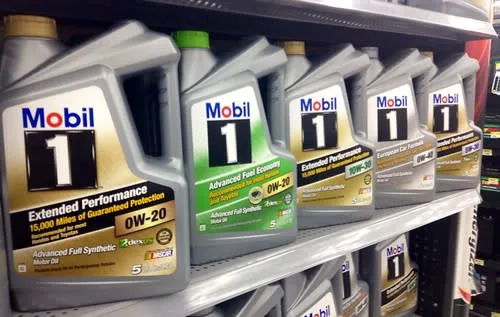
One big caveat. Your manufacturer's oil change interval trumps any bottle claim. If Toyota specs 10,000 miles for your engine, that's the number to follow, not the 20,000-mile figure printed on an extended-performance jug.
What Makes Synthetic Oil Different From Conventional at the Molecular Level
Both oils start with a base stock. The API sorts base oils into five groups. Group I and Group II are conventional mineral oils.
Group III is hydrocracked and marketed as synthetic in North America. Group IV is polyalphaolefin (PAO), the classic "true" synthetic. Group V covers esters and other specialty stocks.
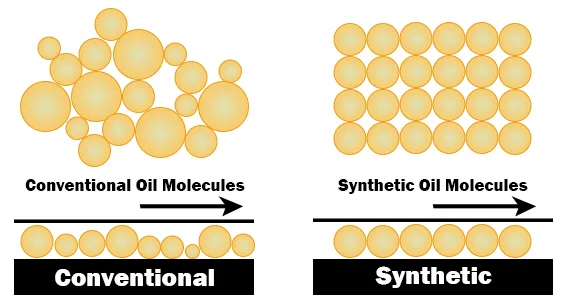
Conventional oil molecules vary in shape and size. Some are short, some long, some branched, some coiled. That inconsistency is why conventional shears down, evaporates faster, and forms deposits sooner.
Synthetic oil is engineered so every molecule looks nearly identical. Uniform chains resist heat, hold viscosity across a wider temperature range, and leave far less residue. That single design difference explains most of the longevity gap.
How Long Each Oil Type Really Lasts: Mileage Ranges by Category
Manufacturer specifications and API-licensed data sheets give us reliable ranges. The numbers below reflect normal service. Severe service (short trips, heavy towing, dusty roads, extreme cold or heat) cuts every interval roughly in half.
| Oil Type | Typical Drain Interval | Best For |
|---|---|---|
| Conventional | 3,000 to 5,000 miles | Older engines, mild driving |
| Synthetic blend | 5,000 to 7,500 miles | Mixed driving, budget-conscious owners |
| Full synthetic | 7,500 to 15,000 miles | Modern turbo and DI daily drivers |
| Extended-performance synthetic | Up to 20,000 miles (claimed) | Highway commuters using oil analysis |
Time also matters. Even if you don't hit the mileage, most automakers cap the interval at 12 months on synthetic and 6 months on conventional. Oil oxidizes inside your engine whether it's flowing or sitting.
If you handle oil changes yourself, track both odometer miles and calendar months.
Why Synthetic Resists Breakdown Better: Oxidation, Heat, and Volatility
Three lab metrics explain most of the longevity difference. NOACK volatility, oxidation stability, and total base number (TBN).
NOACK measures how much oil evaporates at 250°C. Lower is better. Quality full synthetics land around 6 to 10 percent.
Conventional oils often sit at 15 percent or higher. Less evaporation means fewer top-ups, less deposit formation, and more oil doing its job at 10,000 miles.
Oxidation stability tells you how long the oil resists chemical breakdown from heat and oxygen. Synthetics use antioxidant additive packages designed for long service. Conventional additive packs typically deplete by 5,000 miles.
TBN reflects the oil's ability to neutralize combustion acids. Fresh synthetic starts higher (often 8 to 12) and drops more slowly. When TBN falls below roughly 2.0, the oil is done regardless of how it looks on the dipstick.
Full Synthetic vs Synthetic Blend vs Conventional: Side-by-Side Comparison
Here's how the three main categories stack up on the factors that decide drain intervals. Use this to match the right oil to your engine and driving pattern.
| Factor | Conventional | Synthetic Blend | Full Synthetic |
|---|---|---|---|
| Base stock | API Group I/II | Group II + III mix | Group III, IV, or V |
| Typical OCI | 3k to 5k miles | 5k to 7.5k miles | 7.5k to 15k miles |
| Cold-start flow | Fair | Good | Excellent |
| High-temp stability | Fair | Good | Excellent |
| Cost per quart (2026) | $4 to $6 | $6 to $8 | $8 to $14 |
| Best for | Older, low-stress engines | Mixed driving | Modern turbo/DI engines |
Full synthetic wins on almost every technical measure. Blends are a middle ground for owners who drive under 10,000 miles a year and want longer life without the full price. Conventional still has a place in older engines with wide tolerances, especially those already using a bit of oil.
If you're weighing oil options while shopping for a vehicle, checking maintenance history is part of any thorough pre-purchase inspection.
What Actually Shortens Any Oil's Lifespan (Regardless of Type)
The bottle in your engine bay is only half the story. How you drive matters just as much.
Short trips are the biggest killer. When the engine never fully warms up, moisture and fuel condense in the crankcase and dilute the oil. Most automakers classify daily 5-mile commutes as severe service for exactly this reason.
Other conditions that cut oil life fast:
- Frequent cold starts below freezing
- Sustained high load (towing, mountain grades, roof-loaded travel)
- Stop-and-go traffic where operating temps swing widely
- Direct-injection or turbocharged engines, which run hotter and dilute faster
- Dusty environments that overload the air filter
- Track days or aggressive driving that pushes oil past 250°F
Even the best full synthetic gets punished under severe service. If any of the above describes your driving, cut the recommended interval by 30 to 50 percent.
Manufacturer Drain Intervals vs "Extended Performance" Marketing Claims
Bottle claims and manufacturer specs often disagree, and the manufacturer wins every time. Ford might spec 10,000 miles on 5W-30 in a 2.0L EcoBoost. The oil brand's extended-performance line might say "guaranteed for 20,000 miles." Following the bottle voids your safety margin.
Here's the honest read on extended-performance synthetics. They can genuinely run 15,000 to 20,000 miles in a highway-driven engine with a matching high-capacity filter. Push the same oil in stop-and-go city driving and it'll be spent by 10,000 miles.
The Magnuson-Moss Warranty Act protects you from being forced to buy a specific brand of oil during warranty coverage. It does not protect you from stretching intervals past what the manual allows. Skip a change and blow a turbo, and the claim gets denied.
When Synthetic's Longer Life Genuinely Pays Off
Full synthetic earns its keep in specific scenarios. These owners see the clearest return on the higher price per quart.
- Turbocharged or supercharged engines (turbos run at 900°F, and synthetic resists coking)
- Direct-injection engines prone to LSPI (low-speed pre-ignition)
- Anyone driving in temperatures below 0°F or above 100°F regularly
- Highway commuters logging 20,000+ miles a year
- Cars with 10,000-mile OEM oil life monitors (GM, Honda, Ford IOLM)
- Track-day and performance-driven cars
For a highway commuter doing 25,000 miles a year, one full-synthetic change every 12,500 miles beats five conventional changes on cost, time, and engine protection. That math is why almost every new vehicle sold since 2020 ships from the factory with full synthetic.
When Conventional Oil Still Makes Sense
Conventional isn't obsolete. It's the right call in a handful of situations where synthetic's extra performance goes to waste.
- Older engines (pre-2000) designed around Group I/II oils
- High-mileage engines already burning some oil
- Vehicles driven under 5,000 miles a year on strict 6-month changes
- Lawn mowers, generators, and small engines with short duty cycles
- Fleet vehicles on a strict 3,000-mile schedule anyway
There's also the "seal soak" myth. Switching an old engine to synthetic does not cause leaks. Synthetics clean deposits that were plugging a marginal seal, so a pre-existing leak becomes visible.
The seal was already failing. If your engine burns a quart every 1,000 miles on conventional, spending $50 a change on synthetic just accelerates the wallet damage.
The Role of the Oil Filter in Extended Drain Intervals
An oil is only as good as the filter cleaning it. Running a 3,000-mile budget filter for 15,000 miles is the single most common way owners cancel out synthetic's advantage.
Standard cellulose filters are rated for 3,000 to 5,000 miles of efficient filtration. Full-synthetic media filters (Mobil 1 Extended Performance, Fram Ultra, Wix XP, K&N Pro Series) are rated for 10,000 to 20,000 miles and use finer synthetic microglass media.
The rule is simple. Match your filter's rated interval to your oil's rated interval. Some owners split the difference and change the filter with a top-off at the halfway point.
That's cheap insurance on a long drain and keeps the oil analysis numbers cleaner.
Cost Breakdown: Price Per Quart vs Cost Per Mile
Sticker shock on synthetic goes away when you calculate cost per mile. A 5-quart jug of full synthetic runs $30 to $60 as of 2026. Conventional is $18 to $28 for the same volume.
Here's the math on a typical 5-quart change with a mid-range filter.
| Oil Type | Change Cost | Interval | Cost Per 1,000 Miles |
|---|---|---|---|
| Conventional | ~$35 | 4,000 miles | $8.75 |
| Synthetic blend | ~$50 | 6,000 miles | $8.33 |
| Full synthetic | ~$75 | 10,000 miles | $7.50 |
| Extended-performance | ~$90 | 15,000 miles | $6.00 |
Full synthetic wins on cost per mile once you clear about 7,500-mile intervals. Add fewer shop visits, less disposal waste, and less time under the car, and the gap widens. Conventional only wins the math when a car sits and you're changing on time, not miles.
API, ILSAC, and OEM Specs That Dictate Real Change Intervals
The specs printed on the bottle aren't marketing. They're pass/fail engineering certifications, and matching them is what protects your warranty and your engine.
Look for these three markings.
- API service category (currently API SP for gasoline engines) certifies wear, deposit, and LSPI protection.
- ILSAC GF-6A or GF-6B covers fuel economy and turbo protection for U.S. gas engines.
- OEM approvals like dexos1 Gen 3 (GM), Ford WSS-M2C961-A1, VW 502.00/504.00, MB 229.5, BMW LL-01, and Porsche A40 are stricter than API and often required by manual.
European specs (ACEA A3/B4, C3, C5) usually demand higher base-stock quality, which is why almost every European carmaker requires full synthetic. If your manual lists an OEM spec, matching API SP alone isn't enough. Buy the oil that carries the exact approval printed in your manual.
Signs Your Oil Is Done, No Matter What the Odometer Says
Color and smell tell you very little. Fresh oil turns dark within 500 miles, and that's normal for a working detergent package. Trust these signals instead.
- Level drops more than a quart between changes on a normally tight engine
- Oil life monitor reads 15 percent or lower
- Ticking or tapping at cold start that clears with warm-up
- Milky residue on the dipstick or oil cap (coolant intrusion)
- Strong fuel smell in the oil (fuel dilution, common in DI engines)
- Gritty texture when you rub a drop between your fingers
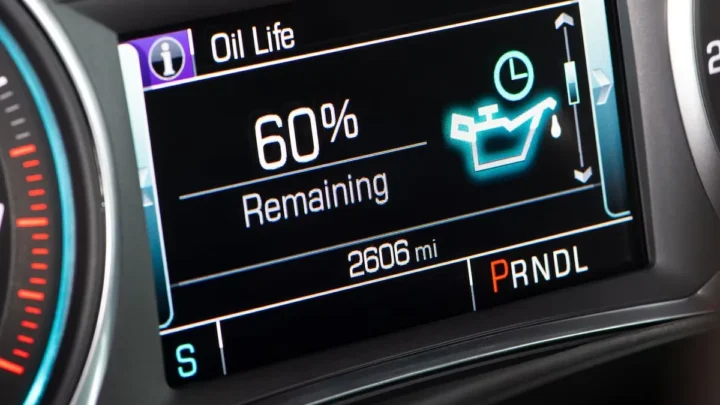
The oil life monitor in modern GM, Ford, and Honda vehicles isn't a mileage countdown. It tracks engine load, temperature, and rev cycles to estimate real oil condition. When it flashes, change the oil within 500 miles even if you're at 6,000 on a 10,000-mile interval.
Common Mistakes That Cancel Out Synthetic's Longevity Advantage
Paying for full synthetic and then wasting its performance is the most common mistake in oil maintenance. These are the top offenders.
- Reusing a cheap cellulose filter on a 12,000-mile interval
- Ignoring severe-service conditions and running "normal" intervals in city traffic
- Mixing viscosity grades to top off (5W-30 into a 0W-20 sump changes film strength)
- Skipping the annual time-based change on a low-mileage car
- Using the wrong OEM spec ("meets" is not "approved")
- Overfilling past the dipstick max, which aerates the oil and accelerates oxidation
- Ignoring turbo cooldown after hard runs, which cokes oil onto bearings
Follow the manual, match the spec, change the filter, and cut intervals in half for severe service. Miss any one of those and the extra $40 you spent on synthetic gets you nothing.
Using Oil Analysis to Prove How Long Your Oil Really Lasts
Oil analysis is the only way to know your actual safe drain interval. Labs like Blackstone Laboratories and Polaris Laboratories charge $30 to $40 per sample and return a full report in 5 to 10 business days.
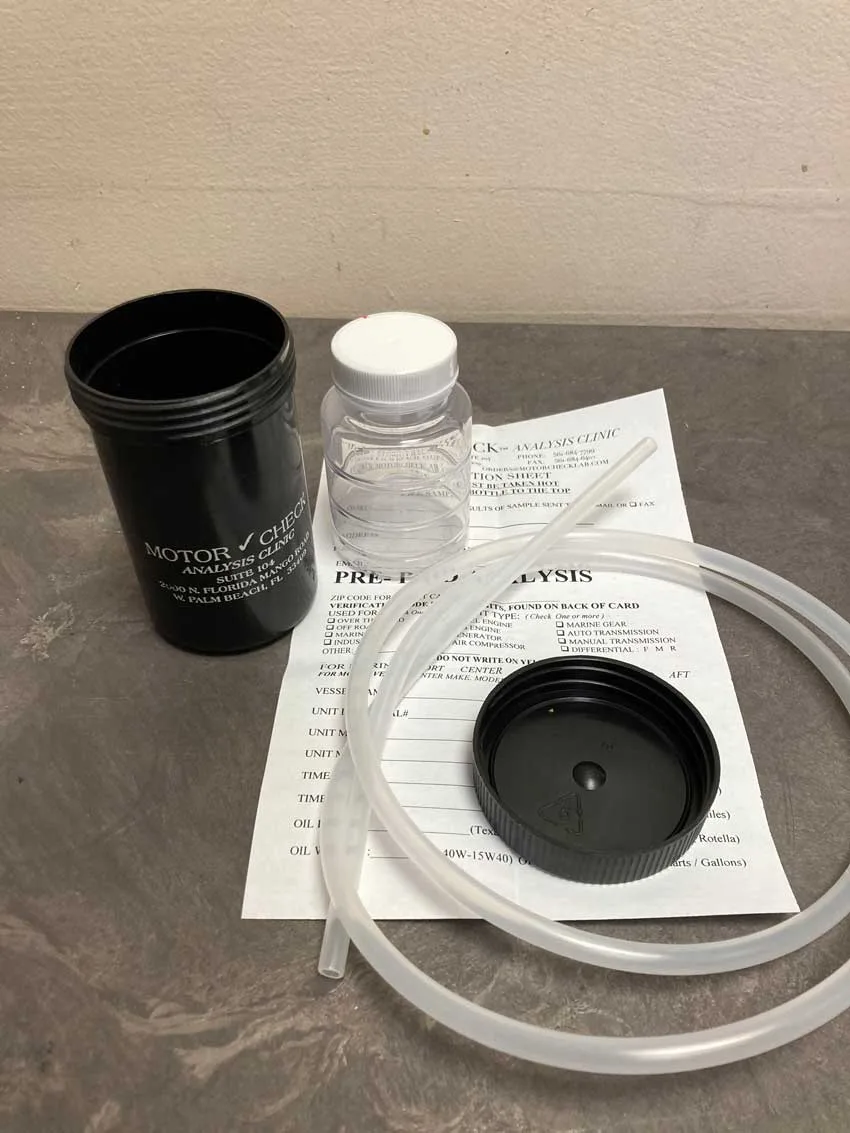
A sample tells you three critical things. Wear metals (iron, aluminum, copper) show whether the oil is still protecting internals. TBN shows how much acid-neutralizing life is left.
Viscosity, fuel dilution, and oxidation numbers reveal whether the oil is chemically shot.
Pull a sample at your manual's recommended interval first. If the numbers are clean and TBN is above 4.0, you can safely extend the next change by 20 to 30 percent. Repeat the test at the longer interval.
Extend only when the data supports it, never on brand claims.
FAQs on Synthetic vs Conventional Oil Longevity
Can I switch from conventional to synthetic in an older engine?
Yes. There's no risk in the switch itself. Older engines with existing seal leaks may show the leak more clearly because synthetic's detergents clean varnish that was masking it.
The seal was already failing. High-mileage synthetic blends contain seal conditioners that reduce this issue.
Is it safe to mix synthetic and conventional oil?
Yes, for emergency top-offs. Both oils share the same base chemistry and additive families, so mixing them won't damage your engine. You will lose synthetic's longevity advantage, though.
Treat the sump as blended oil and change it at conventional intervals until your next full drain.
Does synthetic oil expire on the shelf?
Sealed synthetic oil stays good for about 5 years in stable storage. Heat, sunlight, and open containers cut that fast. Once the seal breaks, use the jug within 12 months.
Additives settle and oxidize even in an unopened bottle past its shelf life, so check the manufacture date before pouring.
How often should I check the oil level between changes?
Check the dipstick once a month or every 1,000 miles, whichever comes first. Modern engines with tight tolerances still burn a small amount of oil, especially turbo and DI models. Extended drain intervals on synthetic make regular level checks more important, not less.
Do synthetic oils really work in old cars from the 1970s and 80s?
Yes, but match the viscosity your engine was designed around. Many pre-1990 engines call for 10W-40 or 20W-50, and running a modern 0W-20 in them causes oil consumption and low pressure. Full synthetic in the correct grade actually improves cold-start protection on classic engines.
The Verdict: Does Synthetic Oil Last Longer Than Conventional?
Yes, and by a wide margin. Full synthetic runs 2 to 3 times longer than conventional under the same conditions, thanks to uniform base stocks, better oxidation resistance, and lower volatility.
That said, longevity only shows up if the rest of the maintenance chain matches. Use a filter rated for the interval, follow your OEM spec, respect severe-service conditions, and pull an oil sample before pushing past the manual's number. Do those four things and full synthetic saves you money, time, and engine wear.
For most drivers as of 2026, full synthetic is the smart choice. Conventional still fits older engines and low-mileage garage queens. Synthetic blend is a fair middle ground for shorter budgets.
Whichever you pick, the manual on the passenger seat is the only extended-life guarantee that actually counts.

Similar Posts