Can You Mix Different Oil Viscosities? What to Know

Can you mix different oil viscosities? Short answer: yes, in most modern gasoline engines it's perfectly safe, and countless drivers do it every year without a hiccup. Motor oils sold today are designed to be miscible, meaning they blend cleanly instead of curdling or separating.
Safe and ideal aren't the same thing, though. There's a smart way to do it and a way that quietly costs you protection.
The SAE J300 standard defines every viscosity grade you see printed on a bottle, and as of 2026 that standard is what makes a 5W-30 in Ohio behave like a 5W-30 in Arizona. The difference between a 5W-30 and a 10W-30 is really about cold-start performance, not two completely different fluids. That single fact drives almost every decision below.
Quick Answer
Yes, you can mix different oil viscosities in most modern gasoline engines. Blending two SAE-rated oils won't damage the engine short-term. Keep the grades close to your manufacturer's spec.
Treat mixing as an emergency fix, not a habit. Change the oil at the next scheduled interval to reset the additive package.
What Oil Viscosity Actually Means (and Why the Numbers Matter)

Viscosity is just a fancy word for how thick a fluid is. Motor oil viscosity changes with temperature. Cold oil is thick and slow.
Hot oil is thin and fast. The SAE grading system on the bottle tells you how the oil behaves at both extremes.
Decoding the "W" and the Second Number
Take 5W-30 as the classic example. The 5W is the winter rating, and it describes how easily the oil pumps at cold-start temperatures. Lower is better in cold weather.
A 0W flows at around -35°C, a 5W at -30°C, and a 10W at -25°C.
The 30 after the dash is the high-temperature grade, measured at 100°C. That number tells the pump and bearings how thick a film they get once the engine is up to operating temperature. For a 30-grade oil, kinematic viscosity sits between 9.3 and 12.5 centistokes at 100°C, per the SAE J300 viscosity classification.
Same second number, same hot-running thickness.
Multigrade vs. Monograde Oils
A multigrade oil like 5W-30 meets two viscosity targets at once thanks to polymer additives called viscosity index improvers. A monograde like SAE 30 only meets one. You'll still see monograde in older engines, lawnmowers, and vintage motorcycles.
Mixing two multigrades is a routine, low-risk move. Mixing a multigrade with a monograde is trickier because the VI improvers get diluted. If you're servicing a mower or a classic engine, follow the manual instead of guessing.
When Mixing Different Viscosities Is Genuinely Fine
Most real-world mixing situations fall into the safe bucket. Here's when you can pour with confidence:
- Topping off with an adjacent grade, like adding 10W-30 to a sump of 5W-30
- Blending two multigrades that share the same API service category (SP with SP)
- Mixing the same brand across grades, since the additive chemistry is usually compatible
- Adding a quart or less to a 5-quart sump, so the ratio stays roughly 80/20
- Switching brands at your next full oil change (not a "mix" in the risky sense)
The engine doesn't care that the two bottles came from different aisles. It cares about total oil level and whether the resulting film thickness sits inside the tolerance window. Keep the grades close and the quantity limited, and you're fine.
One useful rule of thumb: if the oil you're adding differs from your normal fill by only one step in either number (5W vs 10W, or 30 vs 40), the blend will still land inside safe operating range. Two steps or more, and you're pushing your luck.
When Mixing Viscosities Becomes a Real Problem
Some blends do cause real headaches, and they're worth flagging before you pour. The common risky combinations:
- Mixing oils that meet different specs (a dexos1 Gen 3 with a non-dexos oil in a GM engine under warranty)
- Blending a low-SAPS European diesel oil (ACEA C3) with a full-SAPS oil in a DPF-equipped car
- Adding an automotive oil to a wet-clutch motorcycle that requires JASO MA/MA2 rating
- Mixing wildly different grades, like a 0W-16 with a 20W-50
- Topping off a fresh full synthetic with a bulk-conventional oil at every service, long-term
The failure modes here aren't dramatic. You won't hear a boom. What you'll see over months is diluted additive protection, sheared viscosity, and in emissions-controlled diesels, a clogged particulate filter.
Long-term mixing off-spec is a slow erosion, not an instant kill.
If your vehicle is under warranty, spec compliance matters more than viscosity. Many manufacturer approvals (MB 229.5, VW 508.00, BMW LL-01, Ford WSS-M2C) are strict. Using an off-spec oil, even one that "looks close", can void coverage on lubrication-related claims.
The Decision Tree: Should You Mix or Not?

Real life doesn't hand you the exact bottle you want at the exact right moment. Here's how to handle the four situations that come up most often. If you're due for a change anyway, our step-by-step guide to a DIY oil change walks through the full drain-and-refill process.
Scenario 1: Emergency Top-Off on the Road
You're 200 miles from home, the oil light flickers, and the gas station only stocks 10W-40. Your car takes 5W-30. Buy the 10W-40 and add just enough to bring the dipstick to the "add" line, not the full mark.
Running low is far worse than running mixed.
Change the oil within the next 1,000 miles to reset the sump. This is exactly what mixing was designed to survive.
Scenario 2: Leftover Oil in the Garage
You've got half a jug of 5W-30 from last year's change and a fresh jug of 0W-20 for the new car. Don't blend them into the new car if the manual specifies 0W-20 only. Modern engines with tight bearings and low-tension rings are sensitive to over-thick oil.
Save the 5W-30 for the older vehicle or an outdoor engine.
If both cars use similar grades, using up the leftover as a top-off is fine.
Scenario 3: Seasonal Switch (Summer to Winter)
Heading into a cold winter and considering a thinner winter grade? Don't mix. Drain and refill with the winter grade instead.
A partial swap leaves the sump at an unpredictable cold-crank rating, which defeats the whole point.
If you're stuck mid-season and can only do a partial change, use the closest available grade to what's already in there.
Scenario 4: Wrong Bottle Grabbed by Mistake
You just poured 5 quarts of 10W-40 into a car that takes 5W-20. Don't panic and don't drive it hard. Drain it, refill with the correct grade, and use a fresh filter.
The engine won't have suffered from a single cold start on the wrong oil, but the film thickness is well outside spec for daily use.
If you caught it after weeks of driving, change the oil now and monitor for any noise on cold starts.
Mixing Synthetic and Conventional Oil: The Truth
Full synthetic and conventional oils are fully miscible. Pouring one on top of the other won't cause the sludge, foaming, or seal shrinkage that old shop rumors love to warn about. Modern base oils across Groups I through V all play nicely together in the sump.
What you do lose is some of what you paid extra for. Full synthetic offers better cold-flow, higher oxidation resistance, and lower volatility at high temps. Blend it 50/50 with a conventional and you've essentially made a homemade synthetic blend, which is basically what "synthetic blend" oils are on the shelf.
If you're intentionally running synthetic for extended drain intervals (say 10,000 miles), diluting the sump with a quart of conventional dials that interval back down toward the conventional range. Change on the shorter schedule after a mix like this. Nothing catastrophic happens if you don't, but you're eating into the safety margin.
Mixing Different Brands and API Specs
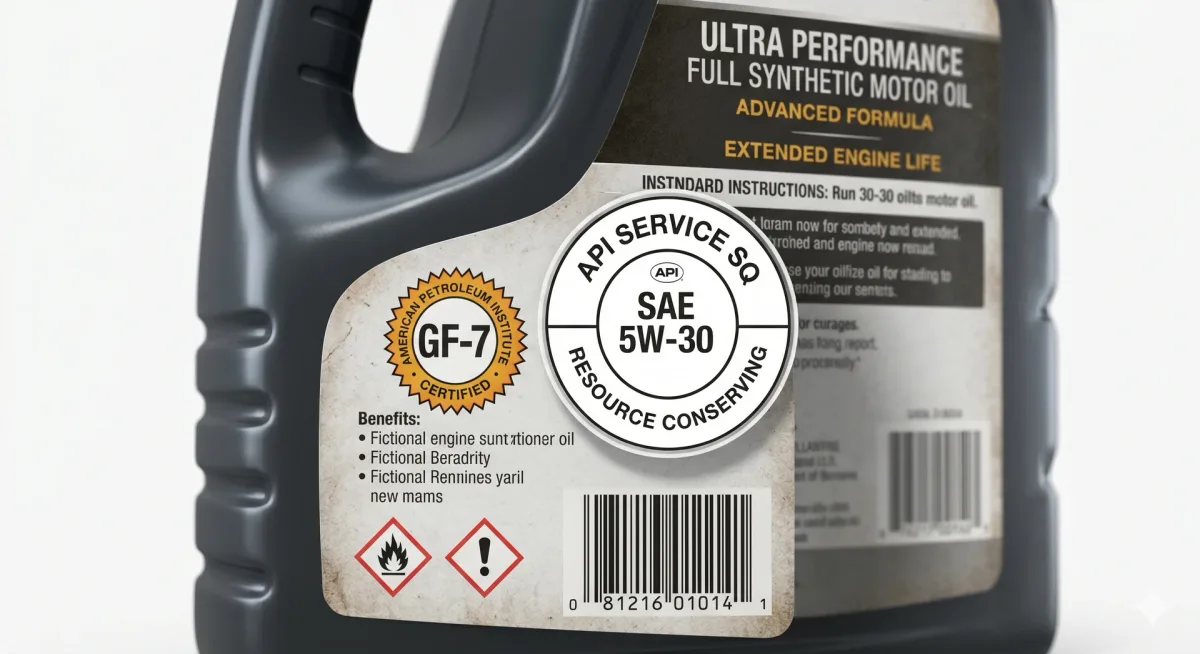
Mixing brands is almost always fine as long as the spec matches. If both bottles show the API SP donut and the ILSAC GF-6A starburst, they're formulated to hit the same benchmarks. The base oils and additive packages differ, but both meet the same performance floor.
Where things get messier is when the specs don't line up. Pouring an API SP oil into a sump of European ACEA C3 low-SAPS oil dilutes the low-ash chemistry that protects a diesel particulate filter. Same story with dexos1 Gen 3, MB 229.5, and BMW LL-01.
These aren't marketing labels, they're specific chemistries.
A quick rule for brand-mixing:
- Same API + same ILSAC + same viscosity range = safe blend
- Different friction modifier packages (moly-heavy vs moly-free) = short-term OK, avoid long-term
- Any OEM-specific approval requirement (dexos, MB, VW, BMW, Ford) = match the approval, not just the SAE grade
If your car spec calls out an OEM approval, treat it as non-negotiable and match it.
What Happens Inside the Engine When You Mix
Blending two oils isn't a chemistry experiment gone rogue. It's more like watering down a carefully balanced cocktail. The engine still runs, but the protective properties shift.
Viscosity Index Improvers and Shear
Viscosity index improvers are long polymer molecules that coil up when cold and stretch out when hot. That behavior is what lets a 5W-30 act like a 5-weight on cold start and a 30-weight at 100°C. Different oils use different VII chemistries at different concentrations.
Mix two oils and you get a blended VII profile. Under high shear (bearings, cam lobes, timing chains), some VII molecules chop apart faster than others. A long-term mixed sump can shear down toward the base-oil viscosity, which for a 5W-30 might mean it starts behaving like a 5W-20 by the end of the interval.
Additive Package Dilution
Every finished oil ships with a tightly engineered dose of anti-wear additives (ZDDP), detergents, dispersants, corrosion inhibitors, and friction modifiers. Blend two oils and every additive concentration lands somewhere between the two starting values.
For a one-time top-off, this dilution is trivial. For a sump that gets topped off with a random oil every 1,500 miles, the additive stack drifts away from what your engine needs. That's why the fix is always a fresh full change at the next interval, not endless top-offs.
Vehicles and Engines Where Mixing Is Riskier
Some engines tolerate a random top-off shrug-worthy. Others are fussy enough that you'll want to be more careful. The higher-risk categories:
- Turbocharged gasoline direct-injection engines, where low-speed pre-ignition (LSPI) protection depends on precise calcium and magnesium detergent balance
- Wet-clutch motorcycles requiring JASO MA or MA2, since automotive oils with friction modifiers can cause clutch slip
- DPF or GPF-equipped vehicles that need low-SAPS oils (ACEA C-series) to protect the filter
- High-mileage engines running high-mileage formulations with seal conditioners, where dilution weakens the leak-stopping chemistry
- Air-cooled small engines and vintage motors, which often want a straight-weight and no friction modifiers
For turbo GDI cars especially, mixing a non-API SP oil into a sump that started with API SP can dilute the LSPI protection. That's a real engine-damage risk, not a theoretical one.
Mistakes to Avoid When Blending Motor Oils
Most mixing horror stories trace back to the same handful of errors. Skip these and you'll be fine:
- Topping off with automatic transmission fluid, power steering fluid, or gear oil (yes, this happens)
- Using diesel-rated oil (API CK-4) in a modern gasoline engine that needs API SP, since the additive balance differs
- Ignoring an OEM approval and picking an oil purely by SAE grade
- Blending a 0W or 5W multigrade with an SAE 30 monograde in a car engine
- Adding oil to a sump that's already at the full mark, since overfilling causes aeration and foaming
- Assuming "synthetic blend" on the label means the mix in your sump is equivalent (formulations vary widely)
- Skipping the next scheduled oil change after a mix, because the sump chemistry is no longer at spec
The single biggest mistake is treating a mix as a permanent solution instead of a bridge to the next service. Fix that mindset, and everything else falls into place.
Manufacturer Warranty and Spec Compliance
Vehicle warranties don't automatically void because you added the wrong oil grade. A specific lubrication-related failure can absolutely be denied, though, if the dealer finds off-spec oil in the sump. The Magnuson-Moss Warranty Act protects you from being forced to buy only branded oil.
It does not protect you from using an oil that fails your engine's spec.
Keep receipts for every quart you pour, especially on a leased or under-warranty vehicle. Modern dealers routinely pull oil samples during warranty diagnostics on turbo GDI engines. If you're buying a used car, checking the service records is part of any solid pre-purchase vehicle inspection, and a missing oil history is a real red flag.
Match the OEM approval printed in your manual, not just the SAE grade. That's the version of "spec compliance" that actually protects you.
Pro Tips for Recovering From an Off-Spec Mix
If you already mixed something you shouldn't have, don't panic and don't drive it hard for extended periods. Get the sump back to spec at your earliest convenience.
- Change the oil and filter within 500 to 1,000 miles of the mix
- Use the exact grade and OEM approval your manual calls for
- Send a used oil sample to a lab if you're worried, since a small analysis fee will show wear metals and viscosity
- Listen for cold-start noise, tapping lifters, or a lit oil pressure light
- Skip flushing additives, since fresh oil does the job on its own
For a single off-spec top-off, one clean oil change fully resets the sump. There's no lingering damage from a short window on mixed oil.
Frequently Asked Questions
Can I mix 5W-30 and 10W-30?
Yes, mixing 5W-30 and 10W-30 is safe in any modern gasoline engine. Both share the same hot-viscosity grade (30). The only real difference is cold-start behavior, so the resulting blend will crank slightly slower than pure 5W-30 in freezing weather.
Change at the next scheduled interval to reset the sump.
Is it OK to mix synthetic and conventional oil?
Yes, full synthetic and conventional oils are fully miscible and safe to blend. You lose some of the synthetic's advantages in oxidation resistance and cold flow, which is fine for a top-off. Shorten your next drain interval slightly if you rely on extended-drain synthetic performance.
Will mixing oil brands damage my engine?
No, mixing brands won't damage the engine as long as both oils meet the same API service category and any OEM approval listed in your manual. Additive chemistry differs between brands, but modern oils are designed to remain compatible. Match the spec, not the label.
How much different-grade oil is safe to add?
Adding up to about 20 percent of your total sump capacity in a different but adjacent grade is safe short-term. For a 5-quart sump, that's roughly one quart. Larger ratios push the resulting viscosity outside your engine's design window, so schedule a full change soon after.
Can I mix different oil viscosities in a motorcycle?
Yes, but only automotive-friendly viscosities that also carry the JASO MA or MA2 rating your wet clutch needs. Using an oil with automotive friction modifiers can cause clutch slip. For dry-clutch bikes, standard automotive oil mixing rules apply.
The Bottom Line: Your Quick Decision Guide
Mixing motor oil viscosities is safe for almost every driver, almost every time. Stick with grades close to your manufacturer's spec, keep the ratio modest, and treat the mix as a bridge to your next oil change rather than a permanent state.
Where you have to be careful is spec compliance, not viscosity math. Turbo GDI engines, DPF diesels, wet-clutch bikes, and warranty-sensitive vehicles all want the approval printed in the manual, and no clever blend gets around that requirement. Match the spec first, then worry about the SAE grade.
If you took anything away from this guide, let it be this: a single mixed top-off will not hurt your engine. Repeated off-spec mixing quietly erodes the additive protection you paid for. Fix the mix at the next service and drive on.

Similar Posts