---
title: "What Is the API Starburst Symbol and What Does It Mean?"
canonical: "https://autoverseauthority.com/what-is-the-api-starburst-symbol/"
author: "Ryan Carter"
published: "2026-08-30T15:00:00+00:00"
modified: "2026-08-14T09:41:56+00:00"
language: "en-US"
site: "Autoverse Authority"
description: "If you've spotted a little fourpoint sparkle inside your API dashboard and wondered what it does, you're not alone. So what is the API starburst symbol?…"
categories: "Car Engine"
attribution: "Autoverse Authority (https://autoverseauthority.com/)"
---
# What Is the API Starburst Symbol and What Does It Mean?
If you've spotted a little four-point sparkle inside your API dashboard and wondered what it does, you're not alone. So what is the API starburst symbol? It's the tiny glyph that modern developer tools use to mark anything powered by AI.
You'll see it in Postman, the Gemini API console, OpenAI's Playground, Anthropic's Workbench, and dozens of similar places.
The icon started life as Google's Material Symbols glyph named "auto_awesome," and as of 2026 it has quietly become the near-universal sign for "AI lives here." Google's Material Symbols library now catalogs more than 3,500 open-source icons, and this one has spread far beyond Google's own products. Here's what the symbol actually means and where you'll spot it.
## Quick Answer
The API starburst symbol is a four-point sparkle icon. It marks features powered by AI or generative models. The glyph comes from Google's Material Symbols set, where it's named "auto_awesome." You'll find it in Postman, OpenAI, Anthropic, and Gemini tools.
Clicking it usually triggers an AI action like generate, summarize, or explain.
API Motor Oil Ratings Explained – Summit Tech Talk with Carl via Summit Racing
## What The API Starburst Symbol Actually Is
The starburst is a small four-point star with concave sides, giving it a shimmer or sparkle look. Most icon libraries call it a "sparkle," a "twinkle," or by its Google name, "auto_awesome." In Unicode it exists as the sparkle character U+2728 (✨).
In API tools, the icon acts as a visual affordance. It tells you that a specific button, field, or output is powered by AI. That includes generative text, code suggestions, auto-summaries, smart request builders, and explain-this-error features.
You'll usually find it rendered in one of three ways:
- A flat monochrome glyph inside a toolbar
- A filled gradient badge next to an "AI" or "Generate" label
- An animated shimmer that pulses while the model is thinking
The point of the icon is instant recognition. When you see the sparkle, you know AI is involved. When you don't, the feature is deterministic.
## Why You're Seeing This Icon Everywhere In API Tools
The sparkle has spread fast because there was no other icon for "AI." Before 2023, developer tools had no shared visual for a generative feature. A robot icon felt cartoonish. A brain icon felt clinical.
A magic wand felt too casual.
Google's "auto_awesome" sparkle threaded the needle. It's clean, positive, geometric, and instantly readable at 16 px. Once Google put it on Gemini and Vertex AI, other companies followed.
Today the sparkle appears across:
- Google AI Studio and the Gemini API console
- OpenAI Playground and ChatGPT admin panels
- Anthropic Console and the Workbench
- Postman AI features (Postbot)
- GitHub Copilot inside VS Code and JetBrains
- Cursor and Windsurf IDEs
- Figma AI, Notion AI, and Linear's AI actions
New API dashboards now adopt the sparkle by default. It has become an unofficial standard for generative UI.
## The Origin Story: Google's "auto_awesome" Glyph
The sparkle first shipped inside Google's Material Symbols icon set, the current successor to Material Icons. You can browse it directly on Google's [Material Symbols page](https://fonts.google.com/icons), where "auto_awesome" is one of the most-used glyphs in the library.
Google introduced "auto_awesome" long before generative AI took over the software world. It was originally used inside Google Photos to mark auto-enhanced images. The name gives it away.
It signaled, "we made this awesome automatically."
When Google needed a shorthand for Bard and later Gemini features, engineers reached for a glyph that already meant "the machine helped." The sparkle was ready to go. It jumped from Photos into Search, then Docs, then the Gemini API console.
By 2024, third-party design systems like Chakra, Radix, Lucide, and Phosphor had shipped their own sparkle variants. As of 2026, nearly every major open-source icon set includes at least one "sparkle" or "ai" glyph with the same silhouette.
## How To Recognize The Starburst At A Glance
The API sparkle has a distinct silhouette. Once you learn the shape, you'll spot it in seconds.
### Shape, Fill, And Color Cues
The core geometry is a four-point star with pinched, concave sides. That's what separates it from an asterisk (which has straight rays) or a snowflake (which has six or eight points with tiny branches).
Look for these visual cues:
- Exactly four points, top, bottom, left, right
- Curved or pinched edges between the points
- Sometimes a smaller second sparkle next to the main one
- Blue, purple, or gradient fill on branded surfaces
- Solid white or gray on neutral toolbars
Sizes commonly land at 16 px, 20 px, or 24 px. Google's Material Symbols ship in stroke weights from 100 to 700 with fill states 0 (outline) or 1 (filled).
### Where It Usually Sits In The UI
Placement is another giveaway. The sparkle almost always appears next to an interactive AI element.
| Location | What It Usually Means |
| --- | --- |
| Inside a button | Click to run an AI action |
| Beside an input field | AI suggestions available |
| Above a response block | Content is AI-generated |
| In a sidebar tab | Opens an AI assistant panel |
| Next to a menu item | Triggers an AI-powered feature |
If you're unsure, hover it. Almost every product ships a tooltip like "Ask AI," "Generate with AI," "Explain this," or "Improve with AI."
## What The Icon Means When You Click It
Clicking the sparkle usually kicks off a generative action. The specific behavior depends on the tool, but the pattern is consistent across the industry.
Common actions triggered by the icon include:
- Generating an API request body from a natural language prompt
- Summarizing a long JSON response
- Explaining a cryptic error message
- Writing tests for the current endpoint
- Drafting documentation from your schema
- Suggesting field values or query parameters
In some tools the sparkle opens a chat panel. In others it runs a one-shot generation right in place. A few products, like Postbot inside Postman, use it as both a trigger and a status marker.
The glyph animates while the model works and settles once the response arrives.
If the icon is grayed out, the AI feature usually requires a paid tier, an active API key, or an org-level opt-in. Hovering will normally tell you which.
## Where You'll Spot It Across Popular API Platforms
The sparkle shows up in almost every major API workspace on the market. The exact behavior varies, but the icon means the same thing: press here for AI.
### Google AI Studio And Gemini API Console
Google uses the sparkle as its house brand for AI. Inside Google AI Studio, you'll see it next to prompt suggestions, model swap options, and the "Get code" button that generates a starter request for the Gemini API.
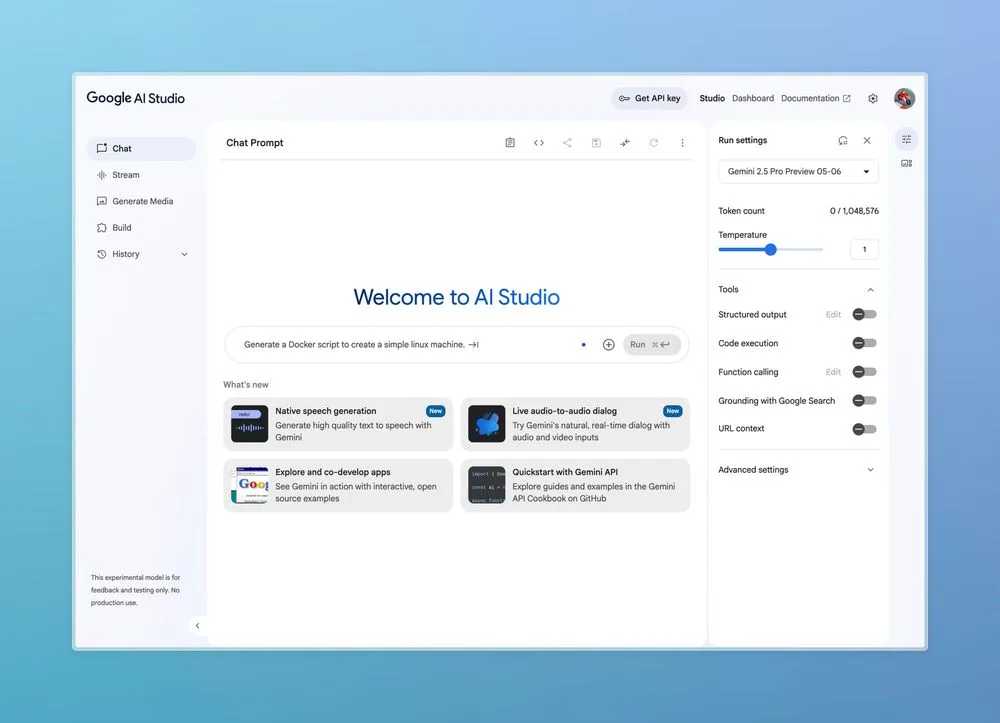
The Gemini API console also uses the sparkle to mark auto-generated examples in cURL, Python, JavaScript, and Go. If a snippet has the icon, a model helped build it. If it doesn't, it's a static template.
### OpenAI Playground
OpenAI's Playground uses a smaller, monochrome sparkle inside prompt editing tools. It shows up on the "Improve" and "Generate" chips near the system message.
Click it and the platform rewrites your prompt using a stronger model. The response streams back in place, replacing the previous version.
### Anthropic Console And Workbench
The Anthropic Console uses the sparkle in the Workbench, near the "Generate a prompt" and "Improve prompt" actions. It appears again in the evaluation flow when Claude produces suggested test cases.
The icon is deliberately subtle inside the Console, since most of the surface is already AI-driven. It's a marker of "assisted generation" rather than a launcher.
### Postman, Cursor, And GitHub Copilot
Postman uses the sparkle for Postbot, its built-in AI helper. You'll find it on the request builder, the response viewer, and the test-writing panel.
Cursor and Windsurf both use sparkle icons in their command palettes and inline edit menus. GitHub Copilot in VS Code uses one on the chat sidebar and near "Fix with Copilot" quick actions. Same silhouette, same intent, different vendors.
Starburst Galaxy walkthrough | Starburst Academy via Starburst
## Starburst Sparkle vs Other Icons People Confuse It With
The sparkle looks close enough to a handful of other glyphs that mix-ups are common. Knowing the difference speeds up scanning.

Here's how the sparkle differs from lookalikes:
| Icon | Silhouette | What It Means |
| --- | --- | --- |
| Sparkle (auto_awesome) | 4 points, concave sides | AI feature |
| Asterisk (*) | 5 or 6 straight rays | Required field, footnote |
| Snowflake | 6 or 8 points with branches | Freeze, cold, weather |
| Star (rating) | 5 points, convex sides | Favorite, rating |
| Magic wand | Diagonal stick with sparkles | Auto-fix, enhance |
| Lightbulb | Bulb outline | Tip, suggestion |
| Bolt | Zigzag arrow | Speed, action, energy |
| Starburst Data logo | Multi-ray sunburst | SQL query engine brand |
The Starburst Data confusion catches out a lot of readers. That's a separate company with a totally different logo, not the icon inside your API console.
## Common Mistakes When Interpreting The Symbol
The sparkle looks universal, but it isn't always safe to assume the same behavior across tools. A few mistakes come up repeatedly.
Assuming the icon is decorative. It isn't. Sparkles are interactive in nearly every modern developer product.
If you see one and don't hover it, you're missing a feature.
Assuming the icon is free. Many sparkle actions call a paid model in the background. Postman's Postbot, GitHub Copilot, and Cursor all meter usage or require an active subscription.
Check the tooltip before you click a hundred times.
Assuming the response is deterministic. Anything triggered by the sparkle is generative. That means output can change between runs, contain plausible-sounding errors, or hallucinate field names that don't exist in your schema.
Always verify AI-generated request bodies against the real API spec.
Assuming it means the same thing everywhere. In some products the icon flags "AI-generated content." In others it means "run an AI action." A few use it for both. Read the label or tooltip once per product to learn the local convention.
## Accessibility And Labeling Best Practices
Icon-only buttons are a common accessibility failure. If the sparkle sits alone with no label, screen readers announce nothing useful, and colorblind or low-vision users can miss it entirely.
The W3C's WCAG 2.2 guidance is clear on this. Every interactive icon needs a text alternative that a screen reader can announce. For the sparkle, that usually means an `aria-label` like "Generate with AI" or a visible text label next to the glyph.
Best practices for shipping the icon in your own API dashboard:
- Pair the sparkle with a visible text label whenever space allows
- Add an `aria-label` on icon-only buttons ("Ask AI," "Improve prompt")
- Keep contrast at 4.5:1 or better against the background
- Don't rely on color alone to signal AI, since some users can't distinguish blue-purple gradients
- Give the icon a focus ring for keyboard users
- Ensure the icon isn't the only cue for a state change
Google's Material Symbols ship with these properties baked in, but many custom implementations skip the ARIA attributes. Audit your build with a screen reader before shipping.
## How To Add The Sparkle Icon To Your Own API UI
If you're building an AI-powered API dashboard, adding the sparkle takes minutes. The most direct path is Google's Material Symbols.
Steps to add "auto_awesome" to a web project:
1. Load the Material Symbols font in your HTML head from `fonts.googleapis.com/icon?family=Material+Symbols+Outlined`.
2. Drop the icon in with a span: `auto_awesome`.
3. Style the size with `font-size` and the color with `color`. Use CSS `font-variation-settings` to adjust fill, weight, grade, and optical size.
4. Wrap it in a `